Trading Note: GBP/USD Make or Break
March 2nd, 2010WARNING: This is not a recommendation to buy, sell or hold any financial instrument.
I’m not seeing enough divergence to convince me that the British Pound is going to bounce off of that support. But, it’s a weekly support. I won’t try to call this. Too blurry.
It’s just to let you know that a potential financial emergency could be setting up in Britain over the next couple of days if that blue support line is breached to the downside.
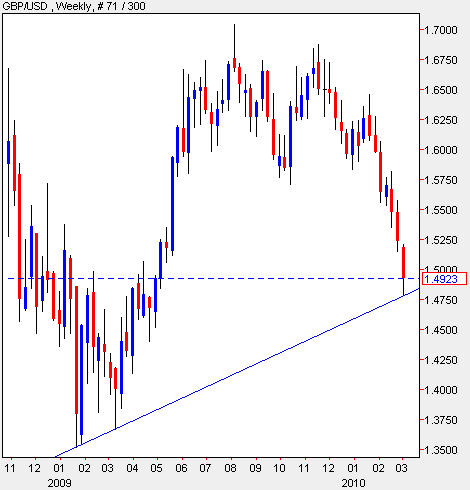
GBP/USD Weekly Interval
All of this chaos has caused the USDX to re-form an ascending triangle. However, the overhead resistance levels, previously mentioned, remain in place.
Via: Bloomberg:
The pound fell for a sixth day against the dollar amid concern that political uncertainties will hamper efforts to reduce the U.K.’s debt.
The U.K. currency weakened against all 16 of its most- active counterparts after polls showed Britain may have its first minority government since 1974 and ahead of a report forecast to show that a recovery in consumer confidence stalled in February. The Australian dollar traded near the strongest in a week versus the greenback after the Reserve Bank of Australia raised its benchmark interest rate to 4 percent.
“Concerns over politics and the debt situation in the U.K. are growing,” said Toshiya Yamauchi, manager of foreign- exchange margin trading at Ueda Harlow Ltd. in Tokyo. “If forthcoming data confirms the deterioration in sentiment, the pound may extend its decline.”
The pound declined to $1.4928 as of 12:32 p.m. in Tokyo from $1.4991 in New York yesterday when it dropped to $1.4784, the lowest level since May 1. It was at 90.64 pence per euro from 90.47 yesterday after reaching 91.50, the weakest since Dec. 1. Sterling traded at 60.26 pence against the Australian dollar from 60.12 yesterday, when it reached 60.46, the weakest since March 1985.
The U.K. currency yesterday had its biggest drop against the dollar since Feb. 2, 2009, as a poll showed the opposition Conservative Party has the smallest lead over the Labour Party in more than two years. Elections must be held by June. The pound has tumbled by 7.6 percent against the dollar and 2.3 percent versus the euro this year.
U.K. Sentiment
U.S. Prime Minister Gordon Brown is selling a record amount of debt to finance stimulus measures introduced to help the economy recover from its longest recession on record. In December, the government increased gilt sales planned for the fiscal year ending this month to 225.1 billion pounds ($337 billion), up from 220 billion pounds announced in April.
“A hung parliament in the U.K. is clearly bearish because the market would not expect them to press ahead with fiscal measures,” said Thomas Harr, a senior currency strategist at Standard Chartered Plc in Singapore, in a Bloomberg News interview. “If this continues and we end up in a hung parliament, the sterling could fall more.”
The Nationwide Building Society’s index of U.K. consumer sentiment stood at 73 in February, unchanged from the previous month, according to a Bloomberg News survey before the release of the survey from tomorrow.
Australia’s currency traded at 90.06 U.S. cents from 90.09 cents after reaching 90.16 cents, the most since Feb. 23.
The Reserve Bank of Australia increased its target rate to 4 percent from 3.75 percent, as predicted by economists in a Bloomberg survey.


Gold is making new highs in GBP, over £750 per ounce now. What will the new PIIGS acronym be to include the dis-UK?
GUPIIS? SUKPIGI? PIIGSUK?