Solar Cell Production Jumps 50 Percent in 2007
January 3rd, 2008“If this society doesn’t come down, if the genetic engineering, artificial intelligence, robotics and surveillance research all continue apace, your children are going to inherit a dystopia that is so incomprehensible that science fiction authors will be struck dumb by it. A total, systemic collapse would be extremely bad, and it’s the best of all possible outcomes at this point. Pray for it.”
People, didn’t get it then, they don’t get it now and they won’t get it when the terminators are running on clean, green energy. Oh yeah, the phrase, “your children,” above should be replaced with, “our children,” now. I wrote that piece long before Owen was born.
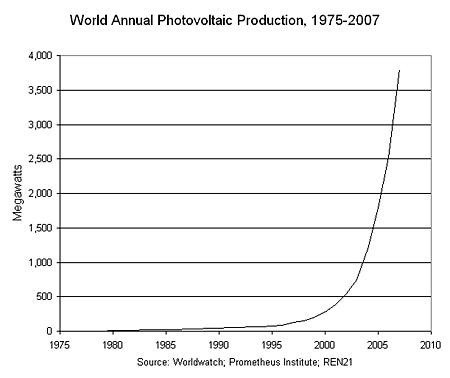
Saying, “I told you so,” feels pretty hollow, looking at the exponential roll out of PV systems below. That is a truly horrifying chart.
Via: The Energy Blog:
According to The Earth Policy Institute production of photovoltaics (PV) jumped to 3,800 megawatts worldwide in 2007, up an estimated 50 percent over 2006. At the end of the year, according to preliminary data, cumulative global production stood at 12,400 megawatts, enough to power 2.4 million U.S. homes. Growing by an impressive average of 48 percent each year since 2002, PV production has been doubling every two years, making it the world’s fastest-growing energy source.
A key force driving the advancement of thin-film technologies is a polysilicon shortage that began in April 2004. In 2006, for the first time, more than half of polysilicon production went into PVs instead of computer chips. While thin films are not as efficient at converting sunlight to electricity, they currently cost less and their physical flexibility makes them more versatile than traditional solar cells. Led by the United States, thin film grew from 4 percent of the market in 2003 to 7 percent in 2006. Polysilicon supply is expected to match demand by 2010, but not before thin film grabs 20 percent of the market.
Related: Clean Energy and Turning What’s Left Into Trash
Related: All Electric Vehicles and the Concept of Enough

