The Price of Wheat is More Than 80% Higher Than a Year Ago
March 4th, 2008A couple of points:
1. Those bulk grains we bought turned out to be our best investment yet.
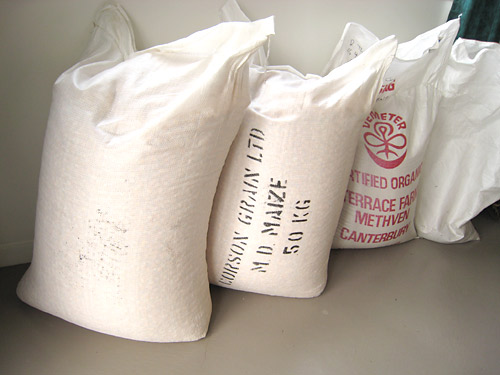
50KG sacks of maize (left), 25KG sacks of hard wheat berries (right)
2. The corn based ethanol strategy is working perfectly; if potential for kill off is the metric in question.
Via: New York Times:
According to the United Nations Food and Agriculture Organization, the price of wheat is more than 80 percent higher than a year ago, and corn prices are up by a quarter. Global cereal stocks have fallen to their lowest level since 1982.
As usual, the brunt is falling disproportionately on the poor. The F.A.O. estimates that the cereal import bill of the neediest countries will increase by a third for the second year in a row. Prices have gone so high that the World Food Program, which aims to feed 73 million people this year, said it might have to reduce rations or the number of people it will help.
The world has faced periodic bouts when it looked as if population growth would outstrip the food supply. Each time, food production has grown to meet demand. This time it might not be so easy.
Population growth and economic progress are part of the problem. Consumption of meat and other high-quality foods —mainly in China and India— has boosted demand for grain for animal feed. Poor harvests due to bad weather in this country and elsewhere have contributed. High energy prices are adding to the pressures.
Yet the most important reason for the price shock is the rich world’s subsidized appetite for biofuels. In the United States, 14 percent of the corn crop was used to produce ethanol in 2006 — a share expected to reach 30 percent by 2010. This is also cutting into production of staples like soybeans, as farmers take advantage of generous subsidies and switch crops to corn for fuel.
The benefits of this strategy are dubious. A study by the Organization for Economic Cooperation and Development suggested that — absent new technologies — the United States, Canada and the European Union would require between 30 percent and 70 percent of their current crop area if they were to replace 10 percent of their transport fuel consumption with biofuels. And two recent studies suggested that a large-scale effort across the world to grow crops for biofuels would add carbon dioxide to the atmosphere rather than reduce it.
The human costs of this diversion of food into energy are all too evident.


“Yet the most important reason for the price shock is the rich world’s subsidized appetite for biofuels.”
And yet, somehow, nobody but us paranoid conspiracy freaks could see that coming 2 and 3 years ago, when all you ever heard concerning ethanol was what a savior it was going to be. What a pile of horseshit. Ethanol is making Archer Daniels Midland a pile of money; end of analysis. And THAT is why this article is most appropriately listed under “Kill Off”.
This sort of information having been considered “underground” less than a year ago, seeing it in in NYT and other pravdas is alarming.
Yes. Any person with half a brain and a pocket calculator can prove in minutes that this biofuel project is utterly insane. It would only make sense to use byproducts that would otherwise go to waste to produce fuels – using food stuffs is just a nastu strategy.
We did these calculations for my home country once a few years back. This is a sparsely populated land with plenty of unused agricultural soil. The math tells that if wed use all the fields now in use to produce fuels – it would be enough for the needs of heavy traffic (transportation). Not a drop for private cars. People dont realize how MUCH fuels our societies use – replacing them is not an option. We need to cut the amount of vehicles to a fraction of what it is, and then alternative fuels would be perfectly doable.
Also with other energy, here all energy was produced with water power in the 60s. All of it. Today the amount of renewables is about 7%, most of it water power – that 7% was enough for the whole country just 50 years ago.
The media will start to make noises if prices rise high enough. Wonder what they’ll blame, though; perhaps not ethanol.
Cloud: Agreed.
We must preserve our way of life at any cost. Even if that means starvation!
(I’ll have to keep driving my car – too weak to ride my bike)
Glenn Beck, and perhaps other conservative hosts, talk about this all the time and are blaming democrats. The idea is that hippies supported waste oil biodiesel and perceive many sharing this association and believe that liberals pushed ethanol on us. I’m not a democrat, and I understand that there are democrats in the farm lobby.
The Economist marach 1 – 7 2008 vol 386 number 8569 has a good 1/2 page on ethanol production and water usage as well as stats food prices.
seeing it in in NYT and other pravdas is alarming.
Perhaps the elites less enthusisastic about the Kill-Off agenda are having a “Marge Simpson moment”: “I don’t this is a very good idea…”
using food stuffs is just a nastu strategy.
Indeed. If they were serious about developing a viable biofuel program, they would be using a crop such as hemp, not freaking corn!
More of the same:
“UN warns on food price inflation”
http://news.bbc.co.uk/2/hi/in_depth/7281686.stm
“Miss Sheeran said global food reserves were at their lowest level in 30 years – with enough to cover the need for emergency deliveries for 53 days, compared with 169 days in 2007.”