Police Secretly Track Cellphones to Solve Routine Crimes
August 24th, 2015Via: USA Today:
In one case after another, USA TODAY found police in Baltimore and other cities used the phone tracker, commonly known as a stingray, to locate the perpetrators of routine street crimes and frequently concealed that fact from the suspects, their lawyers and even judges. In the process, they quietly transformed a form of surveillance billed as a tool to hunt terrorists and kidnappers into a staple of everyday policing.
The suitcase-size tracking systems, which can cost as much as $400,000, allow the police to pinpoint a phone’s location within a few yards by posing as a cell tower. In the process, they can intercept information from the phones of nearly everyone else who happens to be nearby, including innocent bystanders. They do not intercept the content of any communications.
Not The Onion: Thync’s Mood-Altering Headset
August 24th, 2015You’ll love this.
Via: TechCrunch:
During the demo, Thync co-founder and CEO Isy Goldwasser explained that the module wasn’t directly stimulating neurons in my brain (that would be too damn weird for me to try, to be honest). Instead, it uses tiny pulses of electricity to stimulate the skin at your temple, which then activates the instinctual fight-or-flight response in your brain to indirectly affect emotional response.
In use, you get a wavy, tingly feeling on your upper forehead and the front of your scalp. It’s not unpleasant, but it would definitely take a few uses before it stops feeling weird.
While I was warned that Thync might not work the first time, a few minutes into my first session (using the Calm setting) I felt a wave of sluggishness pass over me. I had some difficulty putting words into a coherent question for Goldwasser, and felt a strong urge to take a nap that lasted until I got home. While I may have cranked the settings too high for my first go, the impression I got was that it would be great for falling asleep, not de-stressing at the office.
7 Million People Haven’t Made A Single Student Loan Payment In At Least A Year
August 24th, 2015Via: ZeroHedge:
Nearly seven million Americans have gone at least a year without making a payment on their federal student loans, a staggering level of default that highlights how student debt continues to burden households despite an improving labor market.
As of July, 6.9 million Americans with student loans hadn’t sent a payment to the government in at least 360 days, quarterly data from the Education Department showed this week. That was up 6%, or 400,000 borrowers, from a year earlier.
The figures translate into about 17% of all borrowers with federal loans being severely delinquent—and that share would be even higher if borrowers currently in school were excluded. Additionally, millions of other borrowers who haven’t hit the 360-day threshold that the government defines as a default are months behind on their payments.
Each new crop of students is experiencing the same problems” with repaying, said Mark Kantrowitz, a higher-education expert and publisher of the information website Edvisors.com. “The entire situation isn’t getting better.”
Katherine Albrecht: Windows 10 Is Full Blown Electronic Tyranny
August 24th, 2015Via: Pete Santilli:
No-Fly List Uses ‘Predictive Assessments’ Instead of Hard Evidence, U.S. Admits
August 24th, 2015Shocker.
Via: Guardian:
The Obama administration’s no-fly lists and broader watchlisting system is based on predicting crimes rather than relying on records of demonstrated offenses, the government has been forced to admit in court.
In a little-noticed filing before an Oregon federal judge, the US Justice Department and the FBI conceded that stopping US and other citizens from travelling on airplanes is a matter of “predictive assessments about potential threats”, the government asserted in May.
“By its very nature, identifying individuals who ‘may be a threat to civil aviation or national security’ is a predictive judgment intended to prevent future acts of terrorism in an uncertain context,” Justice Department officials Benjamin C Mizer and Anthony J Coppolino told the court on 28 May.
“Judgments concerning such potential threats to aviation and national security call upon the unique prerogatives of the Executive in assessing such threats.”
It is believed to be the government’s most direct acknowledgement to date that people are not allowed to fly because of what the government believes they might do and not what they have already done.
The Justice Department said it must meet a standard of “reasonable suspicion” that a blacklisted individual poses a threat, a step below probable cause.
Faked Peer Reviews Prompt 64 Retractions
August 24th, 2015Via: Nature:
A leading scientific publisher has retracted 64 articles in 10 journals, after an internal investigation discovered fabricated peer-review reports linked to the articles’ publication.
Berlin-based Springer announced the retractions in an 18 August statement. In May, Springer merged with parts of Macmillan Science and Education — which publishes Nature — to form the new company Springer Nature.
The cull comes after similar discoveries of ‘fake peer review’ by several other major publishers, including London-based BioMed Central, an arm of Springer, which began retracting 43 articles in March citing “reviews from fabricated reviewers”. The practice can occur when researchers submitting a paper for publication suggest reviewers, but supply contact details for them that actually route requests for review back to the researchers themselves.
Citigroup’s “Low Risk” Hedge Funds
August 24th, 2015Via: AFP:
US securities regulators ordered two Citigroup affiliates Monday to pay $180 million to settle charges that they defrauded investors by falsely claiming a pair of hedge funds were low-risk.
Citigroup collected nearly $3 billion from 4,000 investors by claiming the ASTA/MAT fund and the Falcon fund were low-risk investments akin to investing in government bonds, said the US Securities and Exchange Commission.
In 2008, both funds collapsed during the financial crisis.
“The funds were not bond substitutes, and an investment in the funds carried significantly greater risk than a bond investment,” the SEC said.
Both funds used “significant amounts of leverage” and were classified in an internal Citigroup rating system as having “significant risk to principal.”
“That rating, however, was not shared with the majority of investors and financial advisors,” the SEC said.
India Sues Nestle for Nearly $100 Million: Lead and MSG in Noodles
August 24th, 2015Via: Al Jazeera:
India’s government is seeking damages of nearly $100m from Nestle India for “unfair trade practices” after the food safety regulator banned its hugely popular Maggi noodles brand in June for containing unsafe levels of lead.
The government said on Wednesday that it has filed a suit with the country’s top consumer court, National Consumer Disputes Redressal Commission (NCDRC), for 6,400 million rupees ($98.6m) in damages from the Indian arm of the Swiss food giant.
“Our complaint is over their unfair trade practices and the court will now issue them notices to hear their response,” G Gurcharan, additional secretary at the Ministry of Consumer Affairs, told AFP news agency.
In April, laboratory tests ordered by some state governments found the noodles contained far higher levels of lead than legally allowed. The tests also detected the flavour enhancer chemical monosodium glutamate, or MSG, which is not mentioned in the product’s list of ingredients.
Physicists Unveil First Quantum Interconnect
August 24th, 2015Via: MIT Technology Review:
An international team of physicists has found a way to connect quantum devices in a way that transports entanglement between them.
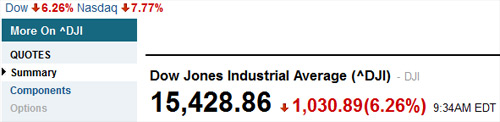
DJIA DOWN OVER A GRAND
August 24th, 2015And how about that NASDAQ!?
Plunge Protection Team: Activate!