New Zealand: Meridian Energy CEO – Solar Power Users Hurt Poor People
March 6th, 2015Disclosure: I sell solar power systems in New Zealand.
—
Although grid-tie solar power users pay daily site and network charges like everyone else, because we’re drawing less power from the grid, we should have to pay more, according to Meridian CEO Mark Binns, “For fairness.”
I don’t know if Mark Binns is an idiot or barking mad, but here’s the real problem with solar power in New Zealand. This is what’s at the core of all the preposterous rambling and hostility directed at solar. (Don’t worry. This is a very short lesson.)
This is a screengrab from my most recent Meridian bill:

Yep, $10.93.
Without solar power, we would have had to pay something like $235. So it’s not hard to see why guys like Binns will say and do anything to try to discourage people from getting solar power. Throw some bullshit at the wall, if it doesn’t stick, try it again in a few months.
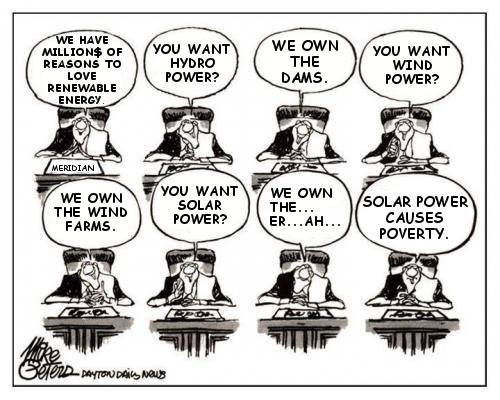
Today it’s the one about how solar power is bad for poor people. What’s it going to be next time?
Energy Company CEO Says Solar Power Users Kill Kittens
What?
Too much?
Anyway, while they’re thinking up their next ludicrous anti-solar PR campaign, maybe solar uptake will double again.
In closing, here’s my message to Meridian CEO Mark Binns: Pack this list into your pipe and smoke it you asshole: 42 Battery Storage Companies To Watch.
Via: 3News:
When it comes to solar power, Mr Binns says there’s a growing social divide.
“It tends to be the richer people who can afford solar,” he says. “The cost of maintaining the grids and networks will fall on the people who perhaps can’t afford it, so I think there’s a social equity issue coming up.”
For fairness, Mr Binns says solar customers may have to be charged more to draw from the national grid when they need to.
“Somebody has to pay for the maintenance of the lines and the maintenance of the grid,” he says.
The Electricity Authority says solar uptake more than doubled from 2013 to 4500 households last year. It agrees with Meridian that there could be pricing issues ahead, and is conducting a review of the situation.
But while drawing from the grid may cost more in the future, those on solar could have the last laugh. Battery technology is getting cheaper, and a new report by Deutsche Bank believes cheap storage will push solar into the mainstream.
When batteries are cheap, people will have less reason to draw from the grid, threatening the power companies.
Energy and Resources Minister Simon Bridges says the industry will just have to deal with the situation.
—
Update: Australia: Rooftop Solar Lowers Electricity Costs for Everyone
The reason this isn’t true in New Zealand is because the power retailers keep raising prices as demand falls. Use less, pay more.
Via: ABC:
While the cost savings for solar homeowners are clear, what is less widely known is how someone else making the choice to install solar panels reduces everyone’s power bill.
Here’s how it works. The price we pay for our electricity is figured out in the Australian energy market using the ‘merit order system’.
The system asks energy generators to bid to sell their energy on the market. The market operator then starts buying up energy starting at the lowest price and working up to more expensive bids until it has met everyone’s demands at a particular time.
Solar households, meanwhile, use the energy produced on their rooftop, reducing the demand at the point of consumption, especially during daylight hours on sunny days when demand for energy tends to peak.
This has the same effect of ‘cancelling out’ some of the more expensive bids in the energy system, making all energy prices cheaper even if your household doesn’t have solar panels installed.
—
Related: Why Hacking a Tesla Battery May Foreshadow an Energy Revolution
Solution for NZ Energy Company CEO Bullshit: Solar Plant Will Float on a Wastewater Treatment Facility
Newly Released Snowden Documents Related to New Zealand
March 4th, 2015We know more of the operational names and technical details than in past years, but Hager let the world know this was happening back in 1996: Secret Power.
Via: New Zealand Herald:
New Zealand is “selling out” its close relations with the Pacific nations to be close with the United States, author Nicky Hager has said.
Hager, in conjunction with the New Zealand Herald and the Intercept news site, revealed today how New Zealand’s spies are targeting the entire email, phone and social media communications of the country’s closest, friendliest and most vulnerable neighbours.
The revelations, based on documents supplied by United States fugitive and whistleblower Edward Snowden, expose a heavy focus on “full-take collection” from the Pacific with nearly two dozen countries around the world targeted by our Government Communications Security Bureau.
The Snowden documents show that information from across the Pacific is collected by New Zealand’s GCSB but sent on to the United States’ National Security Agency to plug holes in its global spying network.
“Lab Mishap” Infects Macaques with “Potential Bioterror Bacteria”
March 4th, 2015See: Dr. Mary’s Monkey by Edward T. Haslam
Via: USA Today:
Tests indicate a fifth monkey had been exposed to deadly bacteria that was somehow released from a high-security lab at the Tulane National Primate Research Center near New Orleans, according to an e-mail circulated among federal and state investigators. The monkey, like the others before it, was not part of an experiment. How the dangerous pathogen got out of its lab remains a mystery.
Preliminary tests on a sample taken from the monkey, a rhesus macaque known as IL88, indicates a possible infection with Burkholderia pseudomallei, the potential bioterror bacteria that was being used in vaccine development research elsewhere on the primate center’s 500-acre campus in Covington, La.
A confirmation test is being done by the Centers for Disease Control and Prevention. Results are expected later this week or early next week, Tulane spokesman Michael Strecker said Tuesday evening.
Strecker said this fifth macaque, like the others that were confirmed as testing positive in recent weeks, had been in the facility’s veterinary hospital around the same time late last year. The hospital is the leading suspect for where the primates were exposed to the bacteria — which was supposed to be securely contained inside a laboratory located in another building on the sprawling campus.
Federal and state officials from multiple health, environmental, agriculture and homeland security agencies have spent weeks trying to determine how the bacteria got out of that secure biosafety level 3 lab – but have not yet determined what happened. Research with the bacteria has been halted as the investigation continues. The CDC has said there is no evidence of a public health threat. The bacteria can cause a potentially fatal disease called melioidosis in humans and animals, with a wide range of non-specific symptoms such as fever, headache and joint pain.
.Mil’s Next Massive Boondoggle: Long Range Strike Bomber
March 4th, 2015Via: Washington Post:
With so little known about it, there is growing concern about the system’s cost. And given the Pentagon’s vast history of cost overruns on major weapons systems, experts worry that even though a contract has yet to be awarded, it is already facing the same troubling problems that have plagued other programs.
The Air Force has estimated each new bomber will cost $550 million apiece, but that figure was set in 2010 without counting for inflation and is already five years outdated. It’s also significantly less than the cost of its predecessor, the B-2 bomber, and not that much more than some high-end commercial jets. Coming in at such a low price will be difficult, if not impossible, analysts said.
Government Plan for Increasing Adult Vaccinations
March 4th, 2015Via: Jon Rappoport:
It’s happening under the leadership of the US Dept. of Health and Human Services (HHS): “The Adult Immunization Plan.”
(See National Adult Immunization Plan National Vaccine Program Office DRAFT: National Vaccine Program Office February 5, 2015 and also Solicitation of Written Comments on the Draft National Adult Immunization Plan (HHS, 02/06/2015))
The HHS is a cabinet agency under the President.
The goal of the Plan? To vastly increase the number of adults in the US who are vaccinated against diseases in accordance with the CDC schedule of vaccines.
Here are key quotes from the Plan:
“The HHS Action Plan to Reduce Racial and Ethnic Health Disparities includes a measure to increase the percentage of the minority population who receive the seasonal influenza vaccination.”
Translation: The government cares about minorities, and to prove it these persons will be injected with a variety of germs and toxic chemicals.
“Increase the use of electronic health records (EHRs) and immunization information systems (IIS) to collect and track adult immunization data.”
Translation: expose confidential patient medical records to many doctors and government agencies, in order to discover all adults who aren’t up to speed on their vaccinations—and therefore must get the shots. Goodbye, privacy. Goodbye, unencumbered free choice.
“Educate and encourage other groups (e.g., community-
and faith-based groups) to promote the importance of adult immunization…A variety of networks can be leveraged, including faith-based and community organizations and individual trusted leaders.”
Translation: Step up government-initiated propaganda at all levels of society, in order to convince adults to come forward and receive their injections.
“All healthcare professionals must ensure that adult patients are fully immunized.”
Translation: During every office visit, doctors must check the vaccination status of their adult patients and pressure them to take their injections.
Report of Shots Fired Near NSA Headquarters, Building Damaged
March 3rd, 2015Via: NBC:
U.S. Park Police are investigating a report of shots fired near the National Security Agency’s headquarters Tuesday evening.
A spokesperson for the police said the NSA is investigating damage to one of its buildings that appeared to be from gunshots.
‘FREAK’ Flaw Undermined Security for Apple and Google Users for Over a Decade
March 3rd, 2015Via: Washington Post:
Technology companies are scrambling to fix a major security flaw that for more than a decade left users of Apple and Google devices vulnerable to hacking when they visited millions of supposedly secure Web sites, including Whitehouse.gov, NSA.gov and FBI.gov.
The flaw resulted from a former U.S. government policy that forbade the export of strong encryption and required that weaker “export-grade” products be shipped to customers in other countries, say the researchers who discovered the problem. These restrictions were lifted in the late 1990s, but the weaker encryption got baked into widely used software that proliferated around the world and back into the United States, apparently unnoticed until this year.
Researchers discovered in recent weeks that they could force browsers to use the weaker encryption, then crack it over the course of just a few hours. Once cracked, hackers could steal passwords and other personal information and potentially launch a broader attack on the Web sites themselves by taking over elements on a page, such as a Facebook “Like” button.
The problem illuminates the danger of unintended security consequences at a time when top U.S. officials, frustrated by increasingly strong forms of encryption on smartphones, have called for technology companies to provide “doors” into systems to protect the ability of law enforcement and intelligence agencies to conduct surveillance.
Polio-Like Paralysis in Children Is Perplexing Parents — and Researchers
March 3rd, 2015Via: Washington Post:
For most of the children who fell ill last year during an outbreak of enterovirus, the symptoms were relatively mild — fever, runny nose, coughing and sneezing.
But then there was this mystery: More than 100 kids suffered an unexplained, polio-like paralysis that struck quickly but even now continues to stump researchers and upend the lives of the families across the country.
For Priya Duggal and her colleagues at the Johns Hopkins University, the biggest puzzle is why those children became paralyzed while their brothers and sisters, who also were exposed to the virus, escaped largely unscathed.
Enphase Promotes STEM Careers for Women
March 2nd, 2015Disclosure: I sell solar power systems that include Enphase products in New Zealand.
This is far off topic, but I thought I’d share this for people with young daughters, or for any young women who happen to be reading.
The media is saturated with stories about women leaving tech jobs because of entrenched nonsense.
Let’s look another possibility.
Companies that want to change the world for the better need women to help them do it.
Via: Enphase Energy:
Cryptogon Readers Send Donations in February
March 2nd, 2015Thank you.
AM $10
DS $25
KL $5
KH $15
TG $5
DE $10
Eileen $45
AD $5
JH $5




