Probiotic Helps People with Peanut Allergy
January 29th, 2015Via: Guardian:
Australian researchers have found a possible key to a cure for people with potentially fatal peanut allergies.
A Melbourne-based study has already transformed the lives of many of the children who took part in the clinical trial.
Researchers from the Murdoch Childrens Research Institute gave about 30 allergic children a daily dose of peanut protein together with a probiotic in an increasing amount over an 18-month period.
The probiotic used in the study was Lactobacillus rhamnosus and the dose was equivalent to eating about 20kg of yoghurt each day. At the end of the trial 80% of the children could eat peanuts without any reaction.
“Many of the children and families believe it has changed their lives, they’re very happy, they feel relieved,” said the lead researcher, Mimi Tang. “These findings provide the first vital step towards developing a cure for peanut allergy and possibly other food allergies.”
Almost three in every 100 Australian children have a peanut allergy.
“We focused on peanut allergy because it is usually lifelong and it is the most common cause of death from food anaphylaxis,” Tang said.
Beijing Smog Makes City Unliveable, Says Mayor
January 29th, 2015Via: Guardian:
Beijing’s mayor, Wang Anshun, has called the city “unliveable” because of its noxious smog, according to state media.
“To establish a first-tier, international, liveable and harmonious city, it is very important to establish a system of standards, and Beijing is currently doing this,” he said last Friday, according to the China Youth Daily newspaper.
“At the present time, however, Beijing is not a liveable city.”
AI Will Not Kill Us, Says Microsoft Research Chief
January 28th, 2015Via: BBC:
Microsoft Research’s chief has said he thinks artificial intelligence systems could achieve consciousness, but has played down the threat to human life.
Eric Horvitz’s position contrasts with that of several other leading thinkers.
Last December, Prof Stephen Hawking told the BBC that such machines could “spell the end of the human race”.
Mr Horvitz also revealed that “over a quarter of all attention and resources” at his research unit were now focused on AI-related activities.
“There have been concerns about the long-term prospect that we lose control of certain kinds of intelligences,” he said.
“I fundamentally don’t think that’s going to happen.
“I think that we will be very proactive in terms of how we field AI systems, and that in the end we’ll be able to get incredible benefits from machine intelligence in all realms of life, from science to education to economics to daily life.”
Mr Horvitz heads up a team of more than 1,000 scientists and engineers at Microsoft’s research wing.
The division’s work on AI has already helped give rise to Cortana – a voice-controlled virtual assistant that runs on the Windows Phone platform and will shortly come to desktop PCs when Windows 10 is released.
Mr Horvitz said that he believed Cortana and its rivals would spur on development of the field.
“The next if not last enduring competitive battlefield among major IT companies will be artificial intelligence,” he said.
Related: Microsoft’s Bill Gates Insists AI Is a Threat
Litvinenko Post-Mortem: “The Most Dangerous Ever Undertaken in the Western World”
January 28th, 2015Via: BBC:
The post-mortem examination of poisoned Russian dissident Alexander Litvinenko was probably “the most dangerous ever undertaken in the Western world”, a pathologist has said.
Dr Nathaniel Cary told the inquiry into Mr Litvinenko’s death that his body was “very hazardous” and had to be transferred to a secure site for tests.
Mr Litvinenko died from radiation poisoning in a London hospital in 2006.
His death came nearly three weeks after he drank tea laced with polonium.
The former KGB agent had fled to the UK where he became a vocal critic of the Kremlin and worked for the UK intelligence service MI6.
‘Super-Secure’ BlackPhone
January 28th, 2015Your what hurts?
Via: Register:
The maker of BlackPhone – a mobile marketed as offering unusually high levels of security – has patched a critical vulnerability that allows hackers to run malicious code on the handsets.
Attackers need little more than a phone number to send a message that can compromise the devices via the Silent Text application.
The impact of the flaw is troubling because BlackPhone attracts what hackers see as high-value victims: those willing to invest AU$765 (£415, $630) in a phone that claims to put security above form and features may well have valuable calls and texts to hide from eavesdroppers.
Mark Dowd (@mdowd), noted Sydney-based hacker and co-founder of security consultancy Azimuth Security, discovered the flaw during casual research in the latter months of 2014. He shared his findings with The Register while the fix – due to be disclosed today – was being developed.
“Successful exploitation can yield remote code execution with the privileges of the Silent Text application, which runs as a regular Android app, but with some additional system privileges required to perform its SMS-like functionality such as access to contacts, access to location information, the ability to write to external storage, and of course net access,” Dowd said, noting the bug took him about a week to find.
The flaw could also be coupled with a privilege-escalation exploit to gain full control of the vulnerable device, but this was not required to run arbitrary code as an unprivileged user.
1,000 Paratroopers from 82nd Airborne Headed to Iraq
January 28th, 2015Via: Fay Observer:
The 82nd Airborne, and more specifically its 3rd Brigade Combat Team, are no strangers to Iraq.
Since 2003, parts of the brigade have deployed in support of U.S. efforts there on at least three occasions.
Now, more than three years after the U.S. military presence in Iraq was thought over, about a quarter of the Panther Brigade will return with a new mission to help train Iraqi forces to fight the Islamic State.
About 1,000 paratroopers from the brigade will deploy this week as part of the Operation Inherent Resolve mission.
The deployment was officially announced in December and is expected to last nine months.
Experts Unmask ‘Regin’ Trojan as NSA Tool
January 27th, 2015Via: Spiegel:
Just weeks ago, SPIEGEL published the source code of an NSA malware program known internally as QWERTY. Now, experts have found that it is none other than the notorious trojan Regin, used in dozens of cyber attacks around the world.
NYSE: Rule 48 At Open
January 27th, 2015MSFT down 10% at the moment.
—
Futures took a dump on earnings numbers…
Via: ZeroHedge:
And what better excuse to stall the opening plunge implied by futures than the “blizzard” which never was… The last time this was invoked was June 2012 (amid a dramatic drop in pre-open futures) and Sept 2011 amid the chaotic 400-point swings in The Dow. Funny they do not use this “Rule” when futures indicate massive upside opens?
How the CIA Made Google
January 27th, 2015This is a really good one.
Via: Medium:
Google styles itself as a friendly, funky, user-friendly tech firm that rose to prominence through a combination of skill, luck, and genuine innovation. This is true. But it is a mere fragment of the story. In reality, Google is a smokescreen behind which lurks the US military-industrial complex.
The inside story of Google’s rise, revealed here for the first time, opens a can of worms that goes far beyond Google, unexpectedly shining a light on the existence of a parasitical network driving the evolution of the US national security apparatus, and profiting obscenely from its operation.
More: Part 2
Research Credit: almaverdad2
S&P Cuts Russia Credit Rating to ‘Junk’
January 27th, 2015“I’d seriously consider getting her and her money out of there ASAP. You wouldn’t want her to be in Putin-Land or holding Putin-Bucks if this thing gets any worse.”
Via: AFP:
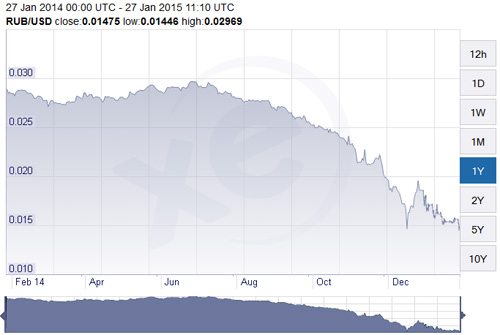
Standard and Poor’s stripped Russia of its investment-grade rating on Monday, cutting it to “junk” status with a warning of weak growth.
“The downgrade reflects our view that Russia’s monetary policy flexibility has become more limited and its economic growth prospects have weakened,” the ratings agency said in a statement announcing the one-notch cut to a ‘BB+’ rating.
The plunge in oil prices and Western sanctions over Moscow’s role in the Ukraine war have pummelled the Russian economy in recent months, with the ruble collapsing in value.
Russia’s finance minister on Monday criticised Standard & Poor’s rating agency for its decision to cut the country’s rating from investment-grade to “junk” status.




