Obama to Announce Easing in U.S.-Cuba Relations
December 17th, 2014Via: Bloomberg:
President Barack Obama will end the U.S. isolation of Cuba that has persisted for more than a half century, initiating talks to resume diplomatic relations, opening a U.S. embassy in Havana and loosening trade and travel restrictions on the nation.
The steps effectively end an embargo that has been one of the most durable elements of U.S. foreign policy. Travelers will be able to use credit cards in Cuba and Americans will be able to legally bring home up to $100 in previously illegal Cuban cigars treasured by aficionados.
Obama is scheduled to deliver remarks from the White House at 12:01 p.m. Washington time, about the same time that Raul Castro is set to speak in Cuba. The two spoke yesterday about the deal, an administration official said.
Most Politically Active Corporations Receive $760 from U.S. Government for Every Dollar Spent on Influencing Politics
December 17th, 2014Via: Sunlight Foundation:
Between 2007 and 2012, 200 of America’s most politically active corporations spent a combined $5.8 billion on federal lobbying and campaign contributions. A year-long analysis by the Sunlight Foundation suggests, however, that what they gave pales compared to what those same corporations got: $4.4 trillion in federal business and support.
That figure, more than the $4.3 trillion the federal government paid the nation’s 50 million Social Security recipients over the same period, is the result of an unprecedented effort to quantify the less-examined side of the campaign finance equation: Do political donors get something in return for what they give?
Four years ago, the U.S. Supreme Court suggested the answer to that question was no. Corporate spending to influence federal elections would not “give rise to corruption or the appearance of corruption,” the majority wrote in the landmark Citizens United v. Federal Election Commission decision.
Sunlight decided to test that premise by examining influence and its potential results on federal decision makers over six years, three before the 2010 Citizens United decision and three after.
We focused on the records of 200 for-profit corporations, all of which had active political action committees and lobbyists in the 2008, 2010 and 2012 election cycles — and were among the top donors to campaign committees registered with the Federal Election Commission. Their investment in politics was enormous. There were 20,500 paying lobbying clients over the six years we examined; the 200 companies we tracked accounted for a whopping 26 percent of the total spent. On average, their PACs, employees and their family members made campaign contributions to 144 sitting members of Congress each cycle.
After examining 14 million records, including data on campaign contributions, lobbying expenditures, federal budget allocations and spending, we found that, on average, for every dollar spent on influencing politics, the nation’s most politically active corporations received $760 from the government. The $4.4 trillion total represents two-thirds of the $6.5 trillion that individual taxpayers paid into the federal treasury.
Welcome to the world of “Fixed Fortunes,” a seemingly closed universe where the most persistent and savvy political players not so mysteriously have the ability to attract federal dollars regardless of who is running Washington.
Russia Tries Emergency Steps for Second Day to Stem Ruble Plunge
December 17th, 2014Via: Bloomberg:
Russia tried for a second straight day to reverse a rout in the ruble with emergency measures, narrowing President Vladimir Putin’s options in confronting the country’s deepest financial crisis since 1998.
The ruble rose after the Finance Ministry announced that it bought the currency. The rebound came after a plunge yesterday in the wake of the central bank’s increase in interest rates to 17 percent from 10.5 percent. The ruble’s down 52 percent this year.
“Certainly, there’s a panic in the markets,” Vitaly Isakov, a money manager at Otkritie Asset Management in Moscow, said by e-mail. “The Finance Ministry is sending a signal that it sees the ruble as seriously undervalued and that at current levels it makes sense to sell dollars.”
Verizon’s “End to End” Encryption Includes Backdoor for Law Enforcement and Intelligence Agencies
December 17th, 2014Via: Businessweek:
Verizon is the latest big company to enter the post-Snowden market for secure communication, and it’s doing so with an encryption standard that comes with a way for law enforcement to access ostensibly secure phone conversations.
Verizon Voice Cypher, the product introduced on Thursday with the encryption company Cellcrypt, offers business and government customers end-to-end encryption for voice calls on iOS, Android, or BlackBerry devices equipped with a special app. The encryption software provides secure communications for people speaking on devices with the app, regardless of their wireless carrier, and it can also connect to an organization’s secure phone system.
Cellcrypt and Verizon both say that law enforcement agencies will be able to access communications that take place over Voice Cypher, so long as they’re able to prove that there’s a legitimate law enforcement reason for doing so.
Helicopters Flying Over Dallas Part of Special Operations Training
December 17th, 2014Via: Dallas Morning News:
Curious about the helicopters flying over Dallas on Monday night?
Many people took to social media posting about the helicopters saying they were flying low to the ground and close together.
That was part of preparedness training for U.S. Special Operations Forces so they can get a feel for “realistic urban sites,” according to a Dec. 8 release from Dallas police.
Related: U.S. Military Plans for Combat in Mega-Urban Areas
What Is It?
December 17th, 2014Via: Daily Camera:
Officials from Lockheed Martin say this cylindrical object seen pointed toward Boulder this week off Colo. 128 was part of a sensor-technology test.
Oil Still Dropping
December 16th, 2014$53.80.
Via: Reuters:
U.S. stock index futures fell on Tuesday as a slide in the Russian rouble and crude oil prices sent traders fleeing risky assets.
The rouble (RUB=) lost more than 17 percent against the U.S. dollar even after Moscow’s central bank hiked its main interest rate to 17 percent from 10.5 percent.
Brent crude (LCOc1) lost nearly 4 percent after hitting a low of $58.50 and U.S. crude (CLc1) was down 3 percent at $54.21 after hitting $53.80.
Massacre: Taliban Storms Pakistan School, Killing 126, Mostly Children
December 16th, 2014Via: USA Today:
Taliban gunmen stormed a school in Pakistan on Tuesday, killing at least 126 people, mostly children, that country’s government said.
Hours after the attack, it was still not clear if hostages were being held or whether the militants were killed by Pakistan’s military.
The attack began in the early morning, with the gunmen entering the school — a military-run facility in the northwestern city of Peshawar with students in grades 1-10 — and shooting at random, said police officer Javed Khan. Army commandos quickly arrived at the scene and exchanged fire with the gunmen, he said.
Mushtaq Ghani, the province’s information minister, said most of the dead were students, children and teenagers.
Bahramand Khan, director of information for the regional Chief Minister’s Secretariat, said 122 people were wounded, Reuters reported.
Taliban spokesman Mohammed Khurasani claimed responsibility for the attack in a phone call to media, saying that six suicide bombers carried out the attack in revenge for the killings of Taliban members at the hands of Pakistani authorities. The army said five militants were killed, according to Reuters.
New Zealand: “Are Electricity Prices Rising Too Quickly?”
December 16th, 2014Disclosure: I sell solar power systems in New Zealand.
There are multiple retailers, so a functional market must exist!
Right?
Cartel. Cartel. Cartel. This is a word that crooks on both the left and right hope you’ll never understand.
In economics, a cartel is an agreement between competing firms to control prices or exclude entry of a new competitor in a market. It is a formal organization of sellers or buyers that agree to fix selling prices, purchase prices, or reduce production using a variety of tactics. Cartels usually arise in an oligopolistic industry, where the number of sellers is small or sales are highly concentrated and the products being traded are usually commodities. Cartel members may agree on such matters as setting minimum or target prices (price fixing), reducing total industry output, fixing market shares, allocating customers, allocating territories, bid rigging, establishment of common sales agencies, altering the conditions of sale, or combination of these. The aim of such collusion (also called the cartel agreement) is to increase individual members’ profits by reducing competition.
After our solar power system was installed, I spent several months struggling with our power retailer to get our import/export meter connected properly. They hooked it up incorrectly two different times. Long story short, we finally received an accurate bill. Here’s why New Zealand is the most solar hostile country in the developed world (see the green arrow on our most recent electricity bill):

We normally pay about NZ$250 at this time of year. I like NZ$10 a lot better.
F these bastards. And we don’t even have batteries yet.
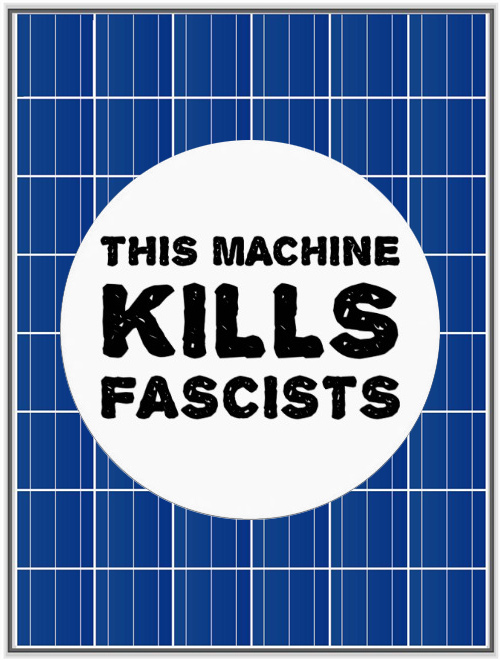
This machine kills fascists.
In case you don’t click through, here are some selected gems from the many satisfied customers who took the time to leave comments:
I clearly remember a certain bill birch saying that `we will all be better off and have cheaper power` back in the `90`s when the power companies were `freed` to compete. maybe all our power bills should be sent to him to pay
—martynA despicable industry, working on a cost plus mentality. It doesn’t matter how many companies are available if they are all driven by greed. The Minister conveys what he is told by officials and we should remeber that “Yes Minister” was a documentary, not a comedy. By the way, I’m a long term supporter of the Government but this industry is out of control.
—Gary HDoes not matter how many competitors you have if they all work together then there really is no competition. This is the case in NZ. Yeah yeah, we get the spiel about low margins, expenses blah blah blah yet all their profits have increased even with lower demand and their senior management are still getting huge salary increases and packages. We are to small for all this free market guano. It did not work when Douglas introduced it and it does not work now with a business friendly Government practicing corporate welfare on a grand scale.
—GrahamIt’s interesting to note that all the power company execs are all on a million plus. Says it all really. That money has to come from somewhere.
—IVAN TURKThey shouldn’t be rising at all in view of the current surplus of electricity. The more that power rises, the more you realise what a racket we are all caught up in. This isn’t an exercise about the real cost of electricity, it’s more about how to extract money from our wallets into the hands of power company shareholders. But conversely new technology is slowly evolving that will in time make current electricity providers near redundant to other than major users. This will be a sunset industry in the not too distant future.
—DJSTUGet alternative, off-the-grid energy! Use battery banks and screw the thieving power companies. Power prices will continue to wreck your budgets and winter will remain the nightmare of the poor, as they either stay cold so they can afford to eat, or pay the power bill. Utterly, utterly shameful for a supposedly 1st world democracy!
—The Orator
It goes on and on. I don’t see a single comment supporting the outlaw cartel that’s operating here.
Via: New Zealand Herald:
Residential electricity prices rose again on average in 2014, outstripping inflation and pushing up the cost of living.
Last month the Green Party released figures showing Kiwis are spending more of the pay packets on electricity, saying power bills make up 3.5 percent of expenditure this year.
Green Party energy spokesperson Gareth Hughes says power prices have gone up 25 per cent in six years, despite a 10 per cent drop in demand over the same time period.
The Government has rejected claims that the electricity market is failing, pointing out the large number of power supply companies available, giving people more chance to shop around.
Iraq War Veteran Suspected in 6 Fatal Pennsylvania Shootings Still at Large
December 15th, 2014Via: Los Angeles Times:
An Iraq war veteran suspected in a shooting rampage that left six of his estranged family members dead remained at large late Monday as the manhunt continued north of Philadelphia.
The victims included his ex-wife, her mother, her grandmother, her sister, her brother-in-law and a niece. A nephew was wounded.
Former Marine Sgt. Bradley William Stone, 35, also may have abducted his two daughters from his ex-wife’s home, a witness said, but dropped them off with a neighbor before he vanished. By late Monday night, the manhunt had spilled from Montgomery County into Bucks County, leading residents in Doylestown to shelter indoors.




