U.S. Doctors Choose a $2000 Drug Instead of a $50 Alternative to Treat Eye Condition
December 8th, 2013Via: Washington Post:
The two drugs have been declared equivalently miraculous. Tested side by side in six major trials, both prevent blindness in a common old-age affliction. Biologically, they are cousins. They’re even made by the same company.
But one holds a clear price advantage.
Avastin costs about $50 per injection.
Lucentis costs about $2,000 per injection.
Doctors choose the more expensive drug more than half a million times every year, a choice that costs the Medicare program, the largest single customer, an extra $1 billion or more annually.
Spending that much may make little sense for a country burdened by ever-rising health bills, but as is often the case in American health care, there is a certain economic logic: Doctors and drugmakers profit when more-costly treatments are adopted.
Genentech, a division of the Roche Group, makes both products but reaps far more profit when it sells the more expensive drug. Although Lucentis is about 40 times as expensive as Avastin to buy, the cost of producing the two drugs is similar, according to scientists familiar with the drugs and the industry.
Doctors, meanwhile, may benefit when they choose the more expensive drug. Under Medicare repayment rules for drugs given by physicians, they are reimbursed for the average price of the drug plus 6 percent. That means a drug with a higher price may be easier to sell to doctors than a cheaper one. In addition, Genentech offers rebates to doctors who use large volumes of the more expensive drug.
“Genentech continues to maintain that Lucentis is the most appropriate medicine,” the company said in a statement, adding that it costs “significantly” more to make and is tailored for use in the eye. The drug “has made an immense impact.”
Many ophthalmologists, however, are skeptical that it provides any added value over the cheaper alternative.
“Lucentis is Avastin — it’s the same damn molecule with a few cosmetic changes,” said J. Gregory Rosenthal, a Toledo ophthalmologist who, outraged by the price, co-founded a group called Physicians for Clinical Responsibility to protest its use. “Yet Americans are paying a billion dollars every year for no good reason — unless you count making Genentech rich.”
The Day Mandela Was Arrested, With A Little Help From the CIA
December 7th, 2013Via: Time:
One of the great things about the late great Nelson Mandela is that he didn’t hold grudges.
How else could he have accepted normal relations with the CIA, which tipped off the white-supremacy regime to his whereabouts in 1962?
According to a 1990 Johannesburg Sunday Times newspaper account, a CIA agent by the name of Millard Shirley fingered Mandela for the apartheid regime’s secret police, allowing them to throw up a roadblock and capture him.
Research Credit: ottilie
Birds Will Attack Amazon’s Delivery Drones
December 7th, 2013Amazon is just one potential operator. Once the rules are formalized in 2015, tens of thousands of organizations are going to be operating similar aircraft.
Via: Slate:
Birds already cause a lot of problems for other things in the airspace. The FAA has tracked more than 121,000 instances of bird-aircraft collisions since 1990. These are accidental; the birds—most frequently gulls or pigeons, or in the case of the plane that landed on the Hudson River, Canada geese—are spooked off a runway during takeoff or landing.
The difference for Amazon’s drones is that the birds will be chasing them. Unseen to us, the skies are checkered with fiercely defended bird territories. Open-country raptors—hawks, eagles, kites, harriers, etc.—don’t take kindly to interlopers on their hunting grounds, and frequently chase, dive-bomb, and take talons to intruders. The confrontations can be even more violent during nesting season when vulnerable chicks are potential prey.
Smaller birds also bravely shoo away potential threats, including raptors. Kingbirds are most famous for this behavior and can sometimes be seen riding the backs of much larger birds, escorting them out of the area. It’s impressive behavior when seen from below—an aerial David and Goliath—and it’s common among open-country species, either solo or in pairs, like the kingbirds, or in huge flocks.
Won’t birds know that Amazon’s drones aren’t really threats, though? Nope. To a bird, a big flying thing is a big flying potential threat. For proof, check out all the videos online of birds attacking and crashing remote-controlled planes and helicopters…
Reagan Administration, CIA Complicit in DEA Agent’s Murder, Say Former Insiders
December 7th, 2013Via: Tico Times:
Former DEA El Paso boss: Agent Camarena had discovered the arms-for-drugs operation run on behalf of the Contras, aided by U.S. officials in the National Security Council and the CIA, and threatened to blow the whistle on the covert operation.
Two former U.S. Drug Enforcement Administration agents and a former U.S. Central Intelligence Agency contract pilot are claiming that the Reagan Administration was complicit in the 1985 murder of DEA agent Enrique “Kiki” Camarena at the hands of Mexican drug lord Rafael Caro Quintero.
The administration’s alleged effort to cover up a U.S. government relationship with the Mexican drug lord to provide for the arming and the training of Nicaraguan Contra rebels, at a time when official assistance to the Contras was banned by the congressional Boland Amendment, led to Camarena’s kidnap, torture and murder, according to Phil Jordon, former head of the DEA’s El Paso office, Hector Berrellez, the DEA’s lead investigator into Camarena’s kidnapping, torture and murder, and CIA contract pilot Robert “Tosh” Plumlee.
…
Camarena had discovered the arms-for-drugs operation run on behalf of the Contras, aided by U.S. officials in the National Security Council and the CIA, and threatened to blow the whistle on the covert operation, Jordan alleged.
Berrellez said two witnesses identified, from a photo lineup, two or three Cuban CIA operatives who participated in Camarena’s interrogation.
Plumlee said he and three other pilots ran tons of cocaine into U.S. military bases on return trips from delivering weapons to Contra rebels in Central America, and was warned by Camarena that he would be busted.
Research Credit: Dr. David Sabow
Stanford: Method of recording Brain Activity Could Lead to ‘Mind-Reading’ Devices
December 7th, 2013Intracranial implant required.
Via: Stanford:
A brain region activated when people are asked to perform mathematical calculations in an experimental setting is similarly activated when they use numbers — or even imprecise quantitative terms, such as “more than”— in everyday conversation, according to a study by Stanford University School of Medicine scientists.
Using a novel method, the researchers collected the first solid evidence that the pattern of brain activity seen in someone performing a mathematical exercise under experimentally controlled conditions is very similar to that observed when the person engages in quantitative thought in the course of daily life.
“We’re now able to eavesdrop on the brain in real life,” said Josef Parvizi, MD, PhD, associate professor of neurology and neurological sciences and director of Stanford’s Human Intracranial Cognitive Electrophysiology Program. Parvizi is the senior author of the study, published Oct. 15 in Nature Communications. The study’s lead authors are postdoctoral scholar Mohammad Dastjerdi, MD, PhD, and graduate student Muge Ozker.
The finding could lead to “mind-reading” applications that, for example, would allow a patient who is rendered mute by a stroke to communicate via passive thinking. Conceivably, it could also lead to more dystopian outcomes: chip implants that spy on or even control people’s thoughts.
“This is exciting, and a little scary,” said Henry Greely, JD, the Deane F. and Kate Edelman Johnson Professor of Law and steering committee chair of the Stanford Center for Biomedical Ethics, who played no role in the study but is familiar with its contents and described himself as “very impressed” by the findings. “It demonstrates, first, that we can see when someone’s dealing with numbers and, second, that we may conceivably someday be able to manipulate the brain to affect how someone deals with numbers.”
The researchers monitored electrical activity in a region of the brain called the intraparietal sulcus, known to be important in attention and eye and hand motion. Previous studies have hinted that some nerve-cell clusters in this area are also involved in numerosity, the mathematical equivalent of literacy.
…
The procedure involves temporarily removing a portion of a patient’s skull and positioning packets of electrodes against the exposed brain surface. For up to a week, patients remain hooked up to the monitoring apparatus while the electrodes pick up electrical activity within the brain. This monitoring continues uninterrupted for patients’ entire hospital stay, capturing their inevitable repeated seizures and enabling neurologists to determine the exact spot in each patient’s brain where the seizures are originating.
Northrop Grumman RQ-180
December 7th, 2013Via: Aviation Week:
A large, classified unmanned aircraft developed by Northrop Grumman is now flying—and it demonstrates a major advance in combining stealth and aerodynamic efficiency. Defense and intelligence officials say the secret unmanned aerial system (UAS), designed for intelligence, surveillance and reconnaissance (ISR) missions, is scheduled to enter production for the U.S. Air Force and could be operational by 2015.
Funded through the Air Force’s classified budget, the program to build this new UAS, dubbed the RQ-180, was awarded to Northrop Grumman after a competition that included Boeing and Lockheed Martin. The aircraft will conduct the penetrating ISR mission that has been left unaddressed, and under wide debate, since retirement of the Lockheed SR-71 in 1998.
Neither the Air Force nor Northrop Grumman would speak about the classified airplane. When queried about the project, Air Force spokeswoman Jennifer Cassidy said, “The Air Force does not discuss this program.”
The RQ-180 carries radio-frequency sensors such as active, electronically scanned array (AESA) radar and passive electronic surveillance measures, according to one defense official. It could also be capable of electronic attack missions.
This aircraft’s design is key for the shift of Air Force ISR assets away from “permissive” environments—such as Iraq and Afghanistan, where Northrop Grumman’s non-stealthy Global Hawk and General Atomics’ Reaper operate—and toward operations in “contested” or “denied” airspace. The new UAS underpins the Air Force’s determination to retire a version of the RQ-4B Global Hawk after 2014, despite congressional resistance. The RQ-180 eclipses the smaller, less stealthy and shorter-range RQ-170 Sentinel.
If the previous patterns for secret ISR aircraft operations are followed, the new UAV will be jointly controlled by the Air Force and the CIA, with the program managed by the Air Force’s Rapid Capabilities Office and flight operations sustained by the Air Force. This arrangement has been used for the RQ-170, which is operated by the Air Force’s 30th Reconnaissance Sqdn., according to a fact sheet the Air Force released after one of the aircraft turned up in Iran (AW&ST Nov. 22, 2010, p. 28).
Northrop Grumman’s financial reports point to a possible award of a secret UAS contract in 2008, when the company disclosed a $2 billion increase in the backlog in its Integrated Systems division. This is the operating unit responsible for building the B-2 bomber, Global Hawk and Fire Scout UAS and X-47B unmanned combat air system (UCAS) demonstrator. This year, Northrop Grumman financial reports acknowledged that an unnamed aircraft program entered low-rate initial production, the Pentagon term for low-volume deliveries that begin as testing nears completion and before the program is approved for full production.
Beyond the financial disclosures, publicly available overhead imagery shows new shelters and hangars sized for an aircraft with a 130-ft.-plus wing span at Northrop’s Palmdale, Calif., plant and at Area 51, the Air Force’s secure flight-test center at Groom Lake, Nev.
The company also pushed for a substantial expansion of its Palmdale production facilities in 2010, perhaps to support work on the RQ-180.
Japan: Special State Secrets Law
December 6th, 2013Update: Japan Enacts Strict State Secrets Law Despite Protests
—
Via: Guardian:
Whistleblowers and journalists in Japan could soon find themselves facing long spells in prison for divulging and reporting state secrets, possibly including sensitive information about the Fukushima nuclear disaster and the country’s souring relations with China.
Under a special state secrets bill expected to pass on Friday, public officials and private citizens who leak “special state secrets” face prison terms of up to 10 years, while journalists who seek to obtain the classified information could get up to five years.
Critics of the new law say it marks a return to the days of prewar and wartime Japanese militarism, when the state used the Peace Preservation Act to arrest and imprison political opponents.
“It is a threat to democracy,” said Keiichi Kiriyama, an editorial writer for the Tokyo Shimbun newspaper, adding that the legislation would “have a chilling effect on public servants, who could become wary about giving the information” to journalists.
NROL-39: Nothing Is Beyond Our Reach
December 6th, 2013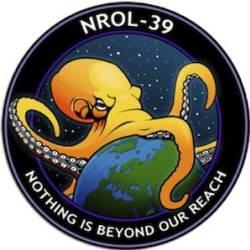
NROL-39
Via: Register:
The NRO are totally embracing their menacing Big Brother persona and putting it out there for world+dog to see, having launched a bunch of satellites and a mysterious payload on a spacecraft yesterday – complete with the logo of a creepy octopus sucking the life out of our world.
The Office of the Director of National Intelligence (DNI) tweeted pictures of an Atlas 5 rocket bearing the NROL-39 getting ready for launch yesterday, which it said was carrying a “classified NRO payload” along with some cubesats.
The NRO is the agency in charge of designing, building, launching and maintaining America’s spy satellites. The DNI said that its latest rocket would carry a dozen mini satellites co-funded by NASA as well as its unknown primary payload.
The DNI did not say just why the NRO thought that a good logo for its spy-craft would be a hugely evil-looking octopus with its tentacles wrapped around the Earth and the inscription “Nothing is beyond our reach”.
Research Credit: Douglas
Rise of the Machines – USA
December 6th, 2013Via: Journeyman Pictures:
Microsoft Mood Bra to Help Women with Emotional Pigouts [???]
December 6th, 2013Via: BBC:
Microsoft researchers have designed a smart bra that can detect stress.
The prototype contains removable sensors that monitor heart and skin activity to provide an indication of mood levels.
The aim was to find out if wearable technology could help prevent stress-related over-eating.
Mood data was provided to the wearer via a smartphone app in order to highlight when “emotional eating” was likely to occur.
A team from Microsoft’s visualisation and interaction research group embedded an electrocardiogram and electro-dermal activities sensors as well as a gyroscope and accelerometer in the bra.
In their paper, the researchers say using a bra “was ideal because it allowed us to collect EKG [electrocardiogram] near the heart”.
Efforts to create a similar piece of underwear for men worked less well, largely because the sensors were located too far away from the heart.