Stuxnet Infected Russian Nuclear Plant, International Space Station
November 11th, 2013Via: SC Magazine:
Stuxnet had ‘badly infected’ the internal network of a Russian nuclear plant after the sophisticated malware caused chaos in Iran’s uranium facilities in Natanz.
The malware, widely considered to have been developed by the US Government as a means to disrupt Iran’s uranium enrichment plans, had crossed a physically separated ‘air-gapped’ network in the Russian plant after it was carried across on a USB device.
Eugene Kaspersky, the charismatic boss of the Russian antivirus company bearing his name, said a staffer at the unnamed nuclear plant informed him of the infection.
“[The staffer said] their nuclear plant network which was disconnected from the internet … was badly infected by Stuxnet,” Kaspersky said.
“So unfortunately these people who were responsible for offensive technologies, they recognise cyber weapons as an opportunity.”
But USB devices were used to ferry malware cross a far greater air-gap: Russian astronauts had carried a virus on removable media to the International Space Station infecting machines there, Kaspersky said.
New DHS Funded WiFi Network and Probable Tracking System Installed Throughout Downtown Seattle
November 11th, 2013There are a variety of apps out there that use GPS as a proximity switch to turn your phone’s WiFi radio on and off. With the WiFi radio off, networks like the one described below can’t track your phone.*
* Of course, the mobile operating system and cellular radio are giving you up about a dozen different ways. So… *sigh*
Via: The Stranger:
If you’re walking around downtown Seattle, look up: You’ll see off-white boxes, each one about a foot tall with vertical antennae, attached to utility poles. If you’re walking around downtown while looking at a smartphone, you will probably see at least one—and more likely two or three—Wi-Fi networks named after intersections: “4th&Seneca,” “4th&Union,” “4th&University,” and so on. That is how you can see the Seattle Police Department’s new wireless mesh network, bought from a California-based company called Aruba Networks, whose clients include the Department of Defense, school districts in Canada, oil-mining interests in China, and telecommunications companies in Saudi Arabia.
The question is: How well can this mesh network see you?
How accurately can it geo-locate and track the movements of your phone, laptop, or any other wireless device by its MAC address (its “media access control address”—nothing to do with Macintosh—which is analogous to a device’s thumbprint)? Can the network send that information to a database, allowing the SPD to reconstruct who was where at any given time, on any given day, without a warrant? Can the network see you now?
The SPD declined to answer more than a dozen questions from The Stranger, including whether the network is operational, who has access to its data, what it might be used for, and whether the SPD has used it (or intends to use it) to geo-locate people’s devices via their MAC addresses or other identifiers.
Research Credit: bretwalda
Atheist ‘Mega-Churches’ Take Root Across U.S., World
November 11th, 2013Via: AP:
It looked like a typical Sunday morning at any mega-church. Several hundred people, including families with small children, packed in for more than an hour of rousing music, an inspirational talk and some quiet reflection. The only thing missing was God.
Nearly three dozen gatherings dubbed “atheist mega-churches” by supporters and detractors have sprung up around the U.S. and Australia — with more to come — after finding success in Great Britain earlier this year. The movement fueled by social media and spearheaded by two prominent British comedians is no joke.
On Sunday, the inaugural Sunday Assembly in Los Angeles attracted several hundred people bound by their belief in non-belief. Similar gatherings in San Diego, Nashville, New York and other U.S. cities have drawn hundreds of atheists seeking the camaraderie of a congregation without religion or ritual.
The founders, British duo Sanderson Jones and Pippa Evans, are currently on a tongue-in-cheek “40 Dates, 40 Nights” tour around the U.S. and Australia to drum up donations and help launch new Sunday Assemblies. They hope to raise more than $800,000 that will help atheists launch their pop-up congregations around the world. So far, they have raised about $50,000.
They don’t bash believers but want to find a new way to meet likeminded people, engage in the community and make their presence more visible in a landscape dominated by faith.
Jones got the first inkling for the idea while leaving a Christmas carol concert six years ago.
“There was so much about it that I loved, but it’s a shame because at the heart of it, it’s something I don’t believe in,” Jones said. “If you think about church, there’s very little that’s bad. It’s singing awesome songs, hearing interesting talks, thinking about improving yourself and helping other people — and doing that in a community with wonderful relationships. What part of that is not to like?”
The movement dovetails with new studies that show an increasing number of Americans are drifting from any religious affiliation.
The Pew Forum on Religion & Public Life released a study last year that found 20 percent of Americans say they have no religious affiliation, an increase from 15 percent in the last five years. Pew researchers stressed, however, that the category also encompassed majorities of people who said they believed in God but had no ties with organized religion and people who consider themselves “spiritual” but not “religious.”
Sunday Assembly — whose motto is Live Better, Help Often, Wonder More — taps into that universe of people who left their faith but now miss the community church provided, said Phil Zuckerman, a professor of secular studies at Pitzer College in Claremont.
NYC Food Bank Head: 40% of Veterans Need Food Assistance
November 11th, 2013Via: CBS:
“On this Veterans Day, when we’re waving our flags — I need every New Yorker to know — 40 percent of New York City veterans are relying on soup kitchens and pantries,” Purvis said.
That amounts to 95,000 people.
“That is not a guesstimate; that is a fact,” she said.
UK Spies Continue “Quantum Insert” Attack via LinkedIn, Slashdot Pages
November 11th, 2013Via: Ars Technica:
Der Spiegel suggests that the Government Communications Headquarters (GCHQ), the British sister agency to the NSA, used spoofed versions of LinkedIn and Slashdot pages to serve malware to targets. This type of attack was also used to target “nine salaried employees” of the Organization of Petroleum Exporting Countries (OPEC), the global oil cartel.
Amazon and U.S. Postal Service Beginning Sunday Deliveries in Los Angeles and New York City
November 10th, 2013Compare and contrast: Most people in NZ will only receive mail three days per week starting in 2015.
Via: Los Angeles Times:
The postal service will deliver Amazon packages on Sundays in the L.A. and New York metropolitan areas at no extra charge starting this week. The service will expand to other cities next year.
Giant online retailer Amazon.com Inc. is turning up the heat on rivals this holiday season and beyond under a new deal with the U.S. Postal Service for delivering packages on Sundays.
Starting this week, the postal service will bring Amazon packages on Sundays to shoppers’ doors in the Los Angeles and New York metropolitan areas at no extra charge. Next year, it plans to roll out year-round Sunday delivery to Dallas, New Orleans, Phoenix and other cities.
International Construction Firm Balfour Beatty Considering Drone Workers
November 10th, 2013Via: Technology Advice:
Most people associate drones with military and counter-terrorism programs, but Balfour Beatty CIO Danny Reeves wants to use them for a rather different purpose. Speaking at the Fujitsu Forum, he told Techworld that unmanned aerial vehicles could be used to build walls, and improve project efficiency.
Balfour Beatty is a international construction and engineering firm that specializes in large-scale projects and building management. Their revenue for 2012 was approximately $17 billion, with an operating income of just under $500 million, so presumably they have the resources to commission a fleet of construction drones. Reeves also spoke of the potential for drones to monitor sprawling project sites, hopefully reducing communication errors and wasted labor on large sites.
Related: Print a 2,500 Square Foot House in 20 Hours
Meet the American Nomads of Walmart’s Plentiful Parking Lots
November 9th, 2013This was my dad’s cunning plan: At 80-years-old, and in poor health, set off with his cat and a .357 magnum—for Arizona.
If he had gone through with it, he would probably be dead by now.
He held off, waiting for his arthritis pain to improve. It didn’t improve, but rather worsened until he couldn’t move at all. I happened to call and he happened to answer and he said something like, “This is it. I’m on my way out.” As in dying, not headed to Arizona.
Despite infuriating my sister to the point where she didn’t want to know him anymore, she took him to the emergency room, stayed with him through a couple of weeks in the hospital and then took him into her own home—where he is continuing to drive her nuts. (There’s a lot more. You don’t want to know and I don’t want to tell you, but those who have experienced eldercare nightmares will be nodding heads in grim understanding.)
My sister is a sort of dog rescue lady, and she has a no-dogs-on-the-furniture rule. To make a long story short, see the picture below:
Crusty and Friends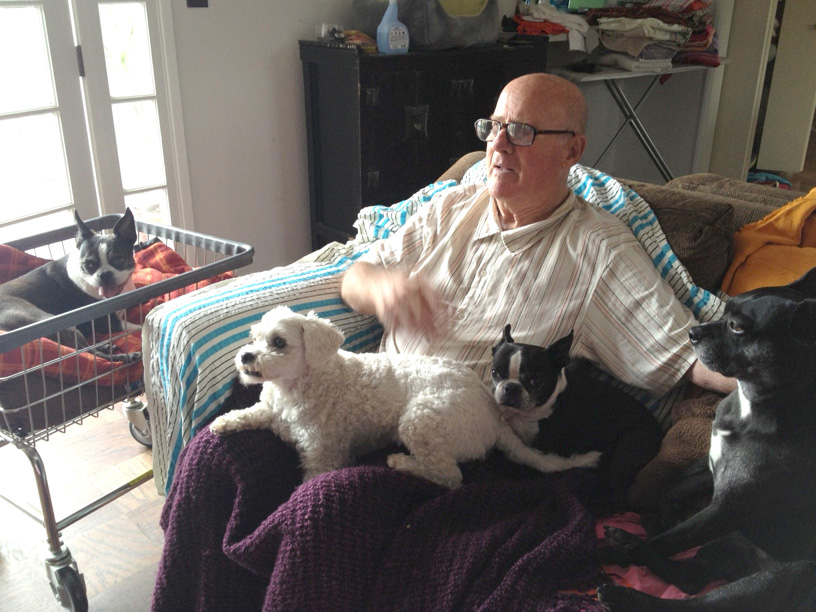
To all daughters who rescued your elderly fathers from certain death in a Walmart parking lot or other grim circumstances, I salute you. May your mental health recover, someday.
Via: Wired:
If you’ve ever tried to sleep in your car on a long trip without planning ahead, you may have run into the law at some point. Each U.S. city has a different policy and tolerance for car-sleeping and it’s hard to find a legit spot if you don’t know where exactly you’ll be stopping.
What you can count on is one of Walmart’s over 3,000 stores being nearby. The company’s policy of allowing overnight stays in their parking lots is intended to boost sales, but has the tangential effect of creating a subculture around its locations (though they’re still at the mercy of local laws).
The two separate Walmart parking lots in Flagstaff, Arizona are specifically known for their long-term residents, and this past summer photographer Nolan Conway spent several days making a series of portraits of both the overnighters and the people who call these asphalt grids a temporary home.
“Flagstaff is the one place in Arizona where it’s not too hot in the summer and a lot of people who live in their cars or RVs stay there,” he says.
Obamacare: Tens of Millions Forced Out of Health Insurance They Had
November 9th, 2013Via: McClatchy:
Even as President Barack Obama sold a new health care law in part by assuring Americans they would be able to keep their insurance plans, his administration knew that tens of millions of people actually could lose those their policies.
“If you like your private health insurance plan, you can keep your plan. Period,” Obama said as he pitched the plan, the unqualified promise he made repeatedly.
Yet advisers did say in 2010 that there were large caveats and that anyone whose insurance plan changed would lose the promised protection of being able to keep existing plans. And a report in 2010 said that as many as 69 percent of certain employer-based insurance plans would lose that protection, meaning as many as 41 million people could lose their plans even if they wanted to keep them and would be forced into other plans. Another 11 million who bought their own insurance also could lose their plans. Combined, as many as 52 million Americans could lose or have lost old insurance plans.
Solid Concepts Unveils First 3D-Printed Metal Gun
November 9th, 2013I don’t like 1911s on the best of days, and I was thinking, “No way that thing will cycle properly. Even once.”
Well, I’ll be damned.
Via: Guns:
Solid Concepts is taking 3D printing over a threshold with their just-announced 3D printed stainless steel handgun. A 1911, the Solid Concepts pistol is chambered for full-power centerfire .45 ACP cartridges.
The company is out to prove a point, that 3D printing has reached a level of maturity and precision that they can make a traditional firearm with the leading-edge technologies. Naturally, they are working with industrial-scale 3D printers, not the types of devices hobbyists have at home.
“Solid Concepts is a world leader of 3D printing services, and our ability to 3D print the world’s first metal gun solidifies our standing,” explained Alyssa Parkinson in the company announcement. “The gun is a classic 1911, a model that is at once timeless and public domain. It functions beautifully: Our resident gun expert has fired 50 successful rounds and hit a few bull’s eyes at over 30 yards. The gun is composed of 30-plus 3D printed components with 17-4 stainless steel and Inconel 625 materials. We completed it with a selective laser sintered (SLS) 3D-printed hand grip, because we’re kind of crazy about 3D printing.”
Apparently the only part of the gun that was not 3D-printed was the magazine. All of the other handgun’s components — including the rifled barrel — were 3D-printed.