Abu Ghraib Torture Victims Ordered To Pay U.S. Contractor’s Legal Fees
September 15th, 2013Via: Huntington Post:
A federal judge on Wednesday ordered four Iraqis who were imprisoned at the infamous Abu Ghraib prison to pay nearly $14,000 in legal fees to defense contractor CACI, an Arlington, Va.-based company that supplied interrogators to the U.S. government during the Iraq War.
The decision in favor of CACI stemmed from a lawsuit filed by the former prisoners in 2008, alleging that CACI employees directed the torture of prisoners at Abu Ghraib. The suit was dismissed in June, when U.S. District Judge Gerald Bruce Lee ruled that because the alleged acts took place on foreign soil, CACI was “immune from suit” in U.S. court.
More Details on Claims SAS Assassinated Diana
September 15th, 2013Via: 7News:
A former soldier told his wife Princess Diana was murdered by the SAS after they shone a light into her driver’s face, according to reports in the British media.
The ex-SAS sergeant, who is only referred to as Soldier N, is reported to have told his then-wife a former member of the elite squad was in charge of an assassination squad.
Princess Diana, Dodi Al Fayed and their driver Henri Paul were killed in the crash in 1997.
The extraordinary claim is reported to have happened after Soldier N had taken Prince William on an advanced driving course in 2008.
It is reported Soldier N’s ex-wife told Scotland Yard last month that her husband had revealed the secret after a conversation about the Prince’s driving course.
The couple are now separated but the conversation occurred while they were still together.
“We were talking about it and I was saying how lovely it was that Princes William and Harry were doing so well and that it was sad that their mum wasn’t here to see it,” the wife said according to a source, reports the Sunday Mirror.
“Then he said one of the guys was responsible for the accident, for the death of Diana. I was shocked. I believed what he said.
“He went on to tell me that it had to be done in a tunnel, that people had been monitoring them – a light was shone in the driver’s eyes.”
When pressed on details, her husband said that the SAS had been following Diana and Dodi Al Fayed on the night they were killed and a night was shone into the Paris tunnel before the car crashed.
He also intimated it was because the royal inner circle disapproved of Diana’s relationship with Fayed.
It is believed the revelations could have been the trigger for Scotland Yard’s reported decision to reopen the case 16 years after Diana’s death.
In separate reports, the Sunday Express claimed it has been revealed Princess Diana’s phone had been bugged and the investigation could unearth recordings of the crash.
Research Credit: GB
Recovery: More Americans Identify Themselves as ‘Lower Class’
September 15th, 2013Via: Los Angeles Times:
Roquemore is among the small but surging share of Americans who identify themselves as “lower class.” Last year, a record 8.4% of Americans put themselves in that category — more than at any other time in the four decades that the question has been asked on the General Social Survey, a project of the independent research organization Norc at the University of Chicago.
The rising numbers surprised some researchers and activists even in light of the bruising economy. For decades, the vast majority of Americans have seen themselves as “middle class” or “working class.” Even during earlier downturns, so few people called themselves lower class that scholars routinely lumped them with working class. Activists for the poor often avoid the term, deeming it an insult.
When people call themselves lower class, “we’ll say, ‘You’re not lower than someone else. You just have less money,'” said Michaelann Bewsee, co-founder of Arise for Social Justice, a Massachusetts low-income rights group. But many don’t consider it insulting today, Bewsee said.
“They’re just reflecting their economic reality,” she said.
Unemployment surged during the downturn. Millions of homes were repossessed in the years since, and millions more people slipped into poverty. And years after the recession ended, the U.S. Department of Agriculture reported record shares of households were still struggling, at times, to put adequate food on the table.
Global Credit Situation Worse than Pre-Lehman
September 15th, 2013Via: Telegraph:
Extreme forms of credit excess across the world have reached or surpassed levels seen shortly before the Lehman crisis five years ago, the Bank for International Settlements has warned.
Extreme forms of credit excess across the world have reached or surpassed levels seen shortly before the Lehman crisis five years ago, the Bank for International Settlements has warned.
The Swiss-based `bank of central banks’ said a hunt for yield was luring investors en masse into high-risk instruments, “a phenomenon reminiscent of exuberance prior to the global financial crisis”.
This is happening just as the US Federal Reserve prepares to wind down stimulus and starts to drain dollar liquidity from global markets, an inflexion point that is fraught with danger and could go badly wrong.
“This looks like to me like 2007 all over again, but even worse,” said William White, the BIS’s former chief economist, famous for flagging the wild behaviour in the debt markets before the global storm hit in 2008.
“All the previous imbalances are still there. Total public and private debt levels are 30pc higher as a share of GDP in the advanced economies than they were then, and we have added a whole new problem with bubbles in emerging markets that are ending in a boom-bust cycle,” said Mr White, now chairman of the OECD’s Economic Development and Review Committee.
‘Follow the Money’: NSA Spies on International Payments
September 15th, 2013Via: Spiegel:
The United States’ NSA intelligence agency is interested in international payments processed by companies including Visa, SPIEGEL has learned. It has even set up its own financial database to track money flows through a “tailored access operations” division.
The National Security Agency (NSA) widely monitors international payments, banking and credit card transactions, according to documents seen by SPIEGEL.
The information from the American foreign intelligence agency, acquired by former NSA contractor and whistleblower Edward Snowden, show that the spying is conducted by a branch called “Follow the Money” (FTM). The collected information then flows into the NSA’s own financial databank, called “Tracfin,” which in 2011 contained 180 million records. Some 84 percent of the data is from credit card transactions.
Further NSA documents from 2010 show that the NSA also targets the transactions of customers of large credit card companies like VISA for surveillance. NSA analysts at an internal conference that year described in detail how they had apparently successfully searched through the US company’s complex transaction network for tapping possibilities.
Their aim was to gain access to transactions by VISA customers in Europe, the Middle East and Africa, according to one presentation. The goal was to “collect, parse and ingest transactional data for priority credit card associations, focusing on priority geographic regions.” In response to a SPIEGEL inquiry, however, a VISA spokeswoman ruled out the possibility that data could be taken from company-run networks.
The NSA’s Tracfin data bank also contained data from the Brussels-based Society for Worldwide Interbank Financial Telecommunication (SWIFT), a network used by thousands of banks to send transaction information securely. SWIFT was named as a “target,” according to the documents, which also show that the NSA spied on the organization on several levels, involving, among others, the agency’s “tailored access operations” division. One of the ways the agency accessed the data included reading “SWIFT printer traffic from numerous banks,” the documents show.
Oxford Researchers Say 45 Percent of America’s Occupations Will be Automated Within the Next 20 Years
September 15th, 2013Via: MIT Technology Review:
Rapid advances in technology have long represented a serious potential threat to many jobs ordinarily performed by people.
A recent report (which is not online, but summarized here) from the Oxford Martin School’s Programme on the Impacts of Future Technology attempts to quantify the extent of that threat. It concludes that 45 percent of American jobs are at high risk of being taken by computers within the next two decades.
The authors believe this takeover will happen in two stages. First, computers will start replacing people in especially vulnerable fields like transportation/logistics, production labor, and administrative support. Jobs in services, sales, and construction may also be lost in this first stage. Then, the rate of replacement will slow down due to bottlenecks in harder-to-automate fields such engineering. This “technological plateau” will be followed by a second wave of computerization, dependent upon the development of good artificial intelligence. This could next put jobs in management, science and engineering, and the arts at risk.
FBI Admits It Controlled Tor Servers Behind Mass Malware Attack
September 14th, 2013Via: Wired:
It wasn’t ever seriously in doubt, but the FBI yesterday acknowledged that it secretly took control of Freedom Hosting last July, days before the servers of the largest provider of ultra-anonymous hosting were found to be serving custom malware designed to identify visitors.
Freedom Hosting’s operator, Eric Eoin Marques, had rented the servers from an unnamed commercial hosting provider in France, and paid for them from a bank account in Las Vegas. It’s not clear how the FBI took over the servers in late July, but the bureau was temporarily thwarted when Marques somehow regained access and changed the passwords, briefly locking out the FBI until it gained back control.
U.S., Russia Reach Agreement on Seizure of Syrian Chemical Weapons Arsenal
September 14th, 2013Via: Washington Post:
The United States and Russia agreed Saturday on an outline for the identification and seizure of Syrian chemical weapons and said Syria must turn over an accounting of its arsenal within a week.
The agreement will be backed by a U.N. Security Council resolution that could allow for sanctions or other consequences if Syria fails to comply, Secretary of State John F. Kerry said.
Kerry said that the first international inspection of Syrian chemical weapons will take place by November, with destruction to begin next year.
Related: Securing Syria’s Weapons May Require U.S. Troops
New Addition to Our Family: Baby Girl
September 14th, 2013Update: Niamh
Her name is Niamh Katherine Flaherty. Niamh is an Irish name and, depending on who you ask, it’s pronounced Neev or Ne-uv. We say Neev.
Niamh was our first choice all along, but we didn’t like the anglicised spellings of it, and we were wondering how difficult it would be for her to have a name like Niamh outside of Ireland.
We will be homeschooling her so she will be spared teachers calling out, “Ny-am” at roll call, etc.
If she winds up thinking Niamh is too weird of a name, I can console her by telling her that I thought Saoirse (sear-sha) and Arwen were pretty cool too. 😉
—
Our daughter was born yesterday afternoon (NZ time) at home. I helped to deliver her because Becky’s labor was very fast! Our midwife was only about a half hour away, but by the time she got here, our baby had been born.
Niamh Katherine Flaherty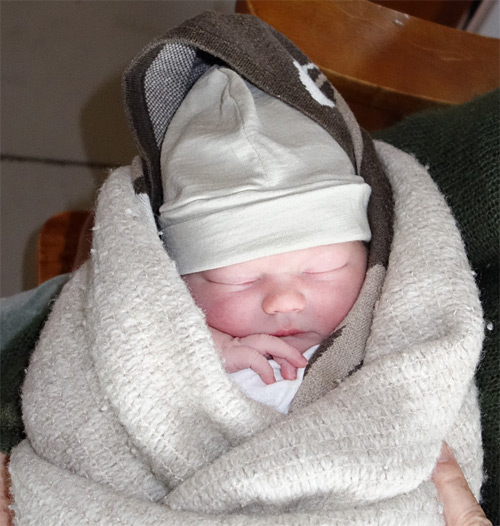
Mum and baby are doing great. *phew*
We would like to tell you her name, but we haven’t decided on one yet.
Google Probably Knows Nearly Every Wi-Fi Password in the World
September 13th, 2013Via: Computer World:
If an Android device (phone or tablet) has ever logged on to a particular Wi-Fi network, then Google probably knows the Wi-Fi password. Considering how many Android devices there are, it is likely that Google can access most Wi-Fi passwords worldwide.
Recently IDC reported that 187 million Android phones were shipped in the second quarter of this year. That multiplies out to 748 million phones in 2013, a figure that does not include Android tablets.
Many (probably most) of these Android phones and tablets are phoning home to Google, backing up Wi-Fi passwords along with other assorted settings. And, although they have never said so directly, it is obvious that Google can read the passwords.
Sounds like a James Bond movie.




