U.S. and Russia: Cyberwar Hotline
June 20th, 2013Via: Ars Technica:
As leaked details of ongoing network surveillance and espionage programs by the National Security Agency (NSA) continue to stir up international concern about how deep US intelligence is reaching into IT operations worldwide, Russia and the US have taken steps to cooperate on cybersecurity—or at least prevent an accidental cyberwar.
During talks at the G-8 Summit in Enniskillen, Northern Ireland, the US and Russia agreed to cooperate more fully on a number of security measures. In addition to agreeing to continue to work together in preventing nuclear proliferation, the two governments are taking steps to improve communications about the proliferation of information weaponry. “We recognize that threats to or in the use of ICT (information and computer technologies) include political, military, and criminal threats, as well as threats of a terrorist nature, and are some of the most serious national and international security challenges we face in the 21st century,” the governments said in a joint statement issued by Presidents Barack Obama and Vladimir Putin today.
India: Central Monitoring System
June 20th, 2013Via: Times of India:
India has launched a wide-ranging surveillance program that will give its security agencies and even income tax officials the ability to tap directly into e-mails and phone calls without oversight by courts or parliament, several sources said.
The expanded surveillance in the world’s most populous democracy, which the government says will help safeguard national security, has alarmed privacy advocates at a time when allegations of massive US digital snooping beyond American shores has set off a global furor.
“If India doesn’t want to look like an authoritarian regime, it needs to be transparent about who will be authorized to collect data, what data will be collected, how it will be used, and how the right to privacy will be protected,” said Cynthia Wong, an Internet researcher at New York-based Human Rights Watch.
The Central Monitoring System (CMS) was announced in 2011 but there has been no public debate and the government has said little about how it will work or how it will ensure that the system is not abused.
The government started to quietly roll the system out state by state in April this year, according to government officials. Eventually it will be able to target any of India’s 900 million landline and mobile phone subscribers and 120 million Internet users.
U.S. Scrapping Billions of Dollars Worth of Military Equipment in Afghanistan
June 20th, 2013The U.S. Government borrowed money of China and did what with it?
Via: Washington Post:
Facing a tight withdrawal deadline and tough terrain, the U.S. military has destroyed more than 170 million pounds worth of vehicles and other military equipment as it rushes to wind down its role in the Afghanistan war by the end of 2014.
The massive disposal effort, which U.S. military officials call unprecedented, has unfolded largely out of sight amid an ongoing debate inside the Pentagon about what to do with the heaps of equipment that won’t be returning home. Military planners have determined that they will not ship back more than $7 billion worth of equipment — about 20 percent of what the U.S. military has in Afghanistan — because it is no longer needed or would be too costly to ship back home.
That has left the Pentagon in a quandary about what to do with the items. Bequeathing a large share to the Afghan government would be challenging because of complicated rules governing equipment donations to other countries, and there is concern that Afghanistan’s fledgling forces would be unable to maintain it. Some gear may be sold or donated to allied nations, but few are likely to be able to retrieve it from the war zone.
Therefore, much of it will continue to be shredded, cut and crushed to be sold for pennies per pound on the Afghan scrap market — a process that reflects a presumptive end to an era of protracted ground wars. The destruction of tons of equipment is all but certain to raise sharp questions in Afghanistan and the United States about whether the Pentagon’s approach is fiscally responsible and whether it should find ways to leave a greater share to the Afghans.
“We’re making history doing what we’re doing here,” said Maj. Gen. Kurt J. Stein, head of the 1st Sustainment Command, who is overseeing the drawdown in Afghanistan. “This is the largest retrograde mission in history.”
The most contentious and closely watched part of the effort involves the disposal of Mine-Resistant Ambush Protected vehicles, the hulking beige personnel carriers that the Pentagon raced to build starting in 2007 to counter the threat of roadside bombs in Iraq and Afghanistan. The massive trucks, known as MRAPs, came to symbolize the bloody evolution of wars that were meant to be short conflicts but turned into quagmires.
The Pentagon has determined that it will no longer have use for about 12,300 of its 25,500 MRAPs scattered at bases worldwide, officials said. In Afghanistan, the military has labeled about 2,000 of its roughly 11,000 MRAPs “excess.” About 9,000 will be shipped to the United States and U.S. military bases in Kuwait and elsewhere, but the majority of the unwanted vehicles — which cost about $1 million each — will probably be shredded, officials said, because they are unlikely to find clients willing to come pick them up.
Related: War is a Racket by Smedley D. Butler
‘KKK Member, Accomplice Created Lethal X-ray System, FBI Says’
June 20th, 2013Via: CNN:
Two New York state men have been charged in a bizarre plan to develop a mobile X-ray system that would be used from afar to silently kill people that they deemed “undesirable,” federal officials said.
Glendon Scott Crawford, 49, and Eric J. Feight, 54, were arrested Tuesday after an undercover operation by the Albany FBI Joint Terrorism Task Force. They were charged with conspiracy to provide material support for use of a weapon of mass destruction, according to the criminal complaint.
Crawford and Feight were developing a device “intended to be mobile … designed to turn on remotely from some distance away” that would emit “some dangerous levels of X-ray radiation,” according to John Duncan, executive assistant U.S. attorney for the Northern District of New York.
Individuals who might have been “subject to this X-ray radiation, would not immediately know that they had been harmed until some days later when they would either be injured, or it could result in their death,” he said.
The suspects intended to use the device to harm and kill “enemies of Israel,” a Department of Justice news release said.
Undercover agents allegedly heard Crawford, a self-described member of the Ku Klux Klan, state that he “harbors animosity towards individuals and groups that he perceives as hostile to the interests of the United States” and refers to them as “medical waste.” He specifically identified Muslims as belonging to this group, according to the criminal complaint.
…
Though the device had extraordinary potential for harm, the public was not in danger because of the early involvement of authorities, Duncan said.
Andrew St. John, a friend of Feight’s for 30 years, called Feight a “pacifist” and a “smart guy.”
Crawford, a manufacturing employee at a GE plant in Schenectady, New York, worked with Feight, an employee at a nearby automotive company often contracted by GE, according to the investigation report. The automotive company did not comment.
…
According to the criminal complaint, Crawford repeatedly used another GE employee as a proxy “to covertly obtain the parts list for the remote initiation system” among other things, at times meeting in GE’s parking lot.
Wiggins told CNN on Wednesday that he could not speak to those allegations.
Crawford contacted two Jewish organizations in April 2012 for funding assistance of an “off the shelf” technology that could be used by Israel to defeat its enemies by killing them while the slept, according to the criminal complaint.
A lengthy federal investigation then began. Agents met with Crawford and Feight, posing as both potential middle men and customers for this “radiation emitting device,” according to the criminal complaint.
Crawford said the lethal machine would be capable of emitting 8 to 10 grays — a unit of radiation dose — toward the target Muslim community, according to the criminal complaint. The radiation-emitting device would be “Hiroshima on a light switch,” Crawford said, and that “everything with respiration would be dead by the morning.”
Feight was recruited by Crawford to develop a “remote initiation device” powered “by a plug-in cigarette lighter electrical source,” according to an affidavit by FBI Special Agent Geoffrey Kent. The system would have three parts — the X-ray, a power source and a remote initiation device — and it would fit into a truck, the complaint said.
In October, Crawford traveled to North Carolina to meet with a high-ranking KKK official and two businessmen affiliates, all working with the FBI, to discuss his scheme and raise money, according to the complaint.
Feight was introduced to undercover FBI agents in November and called the design of the lethal machine “incredibly smart” because it gives “a lot more isolation from the … issue,” according to a recorded dialogue in the criminal complaint.
Feight seemingly explains his rationale for involvement in the same meeting. “When I started seeing how things, the direction things were going … after the elections,” Feight said, “You know, the only thing necessary for evil to triumph is for good men to do nothing.”
70 Percent Of Americans On Prescription Drugs
June 20th, 2013Via: CBS:
Researchers find that nearly 70 percent of Americans are on at least one prescription drug, and more than half receive at least two prescriptions.
Mayo Clinic researchers report that antibiotics, antidepressants and painkiller opioids are the most common prescriptions given to Americans. Twenty percent of U.S. patients were also found to be on five or more prescription medications.
The study is uncovering valuable information to the researchers about U.S. prescription practices.
“Often when people talk about health conditions they’re talking about chronic conditions such as heart disease or diabetes,” Dr. St. Sauver stated in a Mayo Clinic press release. “However, the second most common prescription was for antidepressants — that suggests mental health is a huge issue and is something we should focus on. And the third most common drugs were opioids, which is a bit concerning considering their addicting nature.”
Nearly one in four women ages 50-64 were found to be on an antidepressant, with 13 percent of the overall population also on antidepressants. Seventeen percent of people in the study were being prescribed antibiotics, and 13 percent were on painkilling opioids.
Former TWA Flight 800 Investigators Claim Coverup
June 19th, 2013Via: ABC News:
In a new documentary, former investigators who looked into the mysterious crash of TWA Flight 800, which killed 230, are breaking their silence to claim that the explosion that brought down the plane in 1996 was likely no accident, and that the final report on the cause of the blast was falsified.
TWA Flight 800 exploded in mid-air on July 17, 1996 about 11 minutes after taking off from New York’s JFK airport on its way to Paris. Though theories abounded as to what happened to the plane — from a bomb on the aircraft to it being struck by a missile or even a meteorite — the National Transportation Safety Board concluded after a four-year investigation that the probable cause of the crash was an accidental fuel tank explosion. The NTSB said it could not be sure what exactly ignited the blast, but “of the sources evaluated by the investigation, the most likely was a short circuit outside of the [fuel tank] that allowed excessive voltage to enter it through electrical wiring…”
But according to the new documentary, named TWA Flight 800 and premiering on Epix next month, six former members of the official crash investigation have stepped forward to refute the NTSB’s findings, saying the crash report was purposefully falsified, and to claim the investigation was “systematically undermined” by federal authorities.
“We didn’t find any part of the airplane that indicated a mechanical failure,” one of the whistleblowers says in a trailer for the film. The former officials allege the explosion came from outside the plane, though they don’t speculate any further on the original source.
Another of the whistleblowers, former senior accident investigator with the NTSB Hank Hughes, said in a preview of the documentary that FBI agents were spotted on surveillance cameras going through the hanger where the crash evidence was kept “in the wee hours of the morning… for purposes unknown.”
Journalist Michael Hastings Dies In Car Crash
June 19th, 2013Update: Autopsy Shows Journalist Michael Hastings Had Meth, Pot In System At Time Of Fiery Auto Crash
Via: The Smoking Gun:
The family of journalist Michael Hastings was trying to get him into drug rehab at the time he died in a fiery Los Angeles car wreck, according to a coroner’s report released today.
Hastings, 33, was speeding when he “apparently lost control of his vehicle colliding with a tree head-on in a center grass median” around 4:30 AM on June 18. “Death was rapid, within seconds” due the “massive blunt force trauma” endured by the writer.
The L.A. coroner’s report notes that Hastings’s family told investigators that they were attempting to get Hastings into detox since they thought he “had started to use drugs again in the past month or so.” Hastings was believed to have been sober “for about the past 14 years.”
A brother told a coroner’s investigator that he believed Hastings was “currently using DMT,” a hallucinogenic, and medicinal marijuana, which “was believed as prescribed for PTSD, as decedent was a war journalist, having had assignments in Iraq, Afghanistan, and in Baghdad a few years ago.”
A toxicology screen revealed “a small amount of amphetamine” in Hastings’s blood, which was “consistent with possible intake of methamphetamine many hours before death.” However, the amount detected was “unlikely to have an intoxicative effect at the time of the accident.” Additionally, “marijuana was present in the blood…indicating intake hours earlier.”
—
Update: Hastings Sent Colleagues Email Hours Before Crash
Via: KTLA:
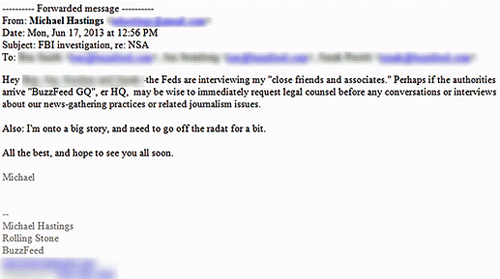
Staff Sgt. Joseph Biggs told KTLA that he received an email from Hastings on Monday.
Biggs had known Hastings since 2008, when the journalist was embedded in his unit in Afghanistan.
“On Monday morning, I woke up and I got an email, and it’s very panicked,” Biggs said.
He was blind-copied on the email, which was sent to Hastings’ colleagues.
In part, it said that the feds were interviewing his close friends and associates, and that he was onto a big story and needed to get off the radar.
The FBI has denied that Hastings was ever under investigation.
—End Update—
Update: Fire
conceptualdecay sent in this local TV news piece about the crash:
Remember Ashley Turton?
The wife of a key White House aide was found dead early Monday in a sport-utility vehicle that was heavily damaged by fire in the garage of the couple’s Capitol Hill home, sources familiar with the incident said.
—
Update: WikiLeaks Claims Contact from Hastings Just Before Death
Via: WikiLeaks / Twitter:
Michael Hastings contacted WikiLeaks lawyer Jennifer Robinson just a few hours before he died, saying that the FBI was investigating him.
Michael Hastings contacted WikiLeaks lawyer Jennifer Robinson just a few hours before he died, saying that the FBI was investigating him.
— WikiLeaks (@wikileaks) June 19, 2013
—
Via: NPR:
Michael Hastings, the journalist whose candid interviews of Gen. Stanley McChrystal led to the officer’s eventual removal from his post, has died in a car crash. The news was announced Tuesday by BuzzFeed, which employed Hastings, 33. He was reportedly killed in an accident this morning in Los Angeles.
FBI Has Started Using Surveillance Drones Inside U.S.
June 19th, 2013Via: Huffington Post:
FBI Director Robert Mueller revealed Wednesday that the bureau uses drones to conduct surveillance on U.S. soil.
Asked by Sen. Chuck Grassley (R-Iowa) if the FBI was following in the footsteps of the Drug Enforcement Agency and the Bureau of Alcohol, Tobacco and Firearms in pursuing the use of unmanned aerial vehicles, Mueller said yes. The vehicles are used in very narrow circumstances for surveillance, he said.
Asked if the bureau had developed a set of policies governing drone use and privacy protections, however, Mueller said that such a process was just starting.
“We are in the initial stages of doing that,” Mueller said, emphasizing that the FBI drone program was in the nascent stages. “I will tell you that our footprint is very small. We have very few of limited use, and we’re exploring not only the use, but the necessary guidelines for that use.”
He added that drones were used “in a very, very minimal way, and very seldom.”
Offensive Cyber Effect Operations
June 19th, 2013Via: CNN:
Today, the United States is conducting offensive cyberwar actions around the world.
More than passively eavesdropping, we’re penetrating and damaging foreign networks for both espionage and to ready them for attack. We’re creating custom-designed Internet weapons, pre-targeted and ready to be “fired” against some piece of another country’s electronic infrastructure on a moment’s notice.
This is much worse than what we’re accusing China of doing to us. We’re pursuing policies that are both expensive and destabilizing and aren’t making the Internet any safer. We’re reacting from fear, and causing other countries to counter-react from fear. We’re ignoring resilience in favor of offense.
Welcome to the cyberwar arms race, an arms race that will define the Internet in the 21st century.
Presidential Policy Directive 20, issued last October and released by Edward Snowden, outlines U.S. cyberwar policy. Most of it isn’t very interesting, but there are two paragraphs about “Offensive Cyber Effect Operations,” or OCEO, that are intriguing:
“OECO can offer unique and unconventional capabilities to advance U.S. national objectives around the world with little or no warning to the adversary or target and with potential effects ranging from subtle to severely damaging. The development and sustainment of OCEO capabilities, however, may require considerable time and effort if access and tools for a specific target do not already exist.
“The United States Government shall identify potential targets of national importance where OCEO can offer a favorable balance of effectiveness and risk as compared with other instruments of national power, establish and maintain OCEO capabilities integrated as appropriate with other U.S. offensive capabilities, and execute those capabilities in a manner consistent with the provisions of this directive.”
These two paragraphs, and another paragraph about OCEO, are the only parts of the document classified “top secret.” And that’s because what they’re saying is very dangerous.
Cyberattacks have the potential to be both immediate and devastating. They can disrupt communications systems, disable national infrastructure, or, as in the case of Stuxnet, destroy nuclear reactors; but only if they’ve been created and targeted beforehand. Before launching cyberattacks against another country, we have to go through several steps.
We have to study the details of the computer systems they’re running and determine the vulnerabilities of those systems. If we can’t find exploitable vulnerabilities, we need to create them: leaving “back doors” in hacker speak. Then we have to build new cyberweapons designed specifically to attack those systems.
Sometimes we have to embed the hostile code in those networks, these are called “logic bombs,” to be unleashed in the future. And we have to keep penetrating those foreign networks, because computer systems always change and we need to ensure that the cyberweapons are still effective.
Like our nuclear arsenal during the Cold War, our cyberweapons arsenal must be pretargeted and ready to launch.
NSA Implementing ‘Two-Person’ Rule To Stop The Next Edward Snowden
June 19th, 2013This is great. They can spend all day trying to comply with their increasingly cumbersome security directives.
Via: Forbes:
The next Edward Snowden may need a partner on the inside.
On Tuesday, National Security Agency Director Keith Alexander told a congressional hearing of the Intelligence Committee that the agency is implementing a “two-person” system to prevent future leaks of classified information like the one pulled off by 29-year-old Booz Allen contractor Edward Snowden, who exfiltrated “thousands” of files according to the Guardian, to whom he has given several of the secret documents.