Off-Duty Cops Collect DNA Samples at Alabama Roadblocks
June 11th, 2013You’ll love this one.
Via: Daily Caller:
Off-duty cops in two counties in Alabama spent the weekend collecting saliva and blood samples from drivers at roadblocks.
According to Lt. Freddie Turrentine with the St. Clair County Sheriff’s Department, drivers were asked to voluntarily offer samples of their saliva and blood for a study being conducted by the Pacific Institute for Research and Evaluation.
The drivers were compensated for their samples.
“They’ve got big signs up that says ‘paid volunteer survey’ and if they want to participate they pull over there and they ask them questions and if they are willing to give them a mouth swab they give them $10 and if they are willing to give them a blood sample they give them $50. And if they don’t do anything they drive off,” Turrentine explained to The Daily Caller.
Turrentine said that St. Clair County had five roadblocks from Friday afternoon through the early morning hours of Sunday. He added that Bibb County also had roadblocks of this kind.
Turrentine said that Alabama Department of Economic and Community Affairs asked the county to participate and that the funding for the study is coming from the National Highway Safety Administration.
“What they are trying to do is 60 sites across the country,” he said, explaining the study will be conducted from June to October and is meant to get a better understanding of inebriation patterns.
“We’re Looking Out For You”
June 11th, 2013Via: CBS:
The shorthanded Antioch Police Department is enlisting the help of local garbage collectors and letter carriers tospot crime on city streets.
Employees of the local trash collector, Republic Services Inc., as well as U.S. Postal Service employees have been given tips on how to act as effective witnesses to crimes. The program, dubbed “We’re Looking Out For You” aims to add some experience eyeballs looking out for the city’s 105,000 residents.
As part of the training, drivers received a list of questions designed to help them identity criminal activity, as well as a laminated copy of the police department’s non-emergency phone number.
“It’s a huge resource multiplier for us,” said Lt. T. Brooks of the Antioch Police Department. “These are people who are actively engaged in the community and are actively participating in making Antioch a safer place.”
Ava 500 Telepresence System
June 10th, 2013PHB-Bot?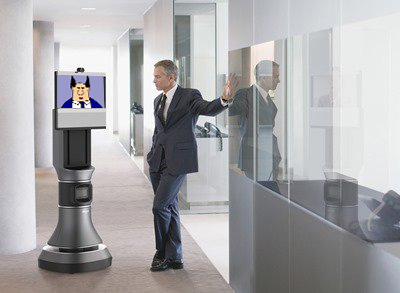
Via: TechWorld:
Ava 500 is essentially a Cisco TelePresence EX60 personal video endpoint mounted on top of an iRobot mobile robotics platform, which can self-navigate busy environments like offices, manufacturing floors and laboratories without bumping into people or objects.
The robot is controlled via an iPad interface. This means that the remote user can select his or her destination by tapping a location on a map or by choosing a room or employee name.
An available robot is then activated to “take” the user where they want to go. The user can choose whether to make the trip from the charging station to selected location in either “private” mode – where the screen appears blank – or in “public” mode – where the user’s face is displayed.
If public mode is chosen, the user can see and be seen, and even stop to have an ad-hoc hallway conversation with a colleague. When the session is complete, the Ava 500 automatically returns to its charging station. It can last for about six hours on one charge.
U.S. State Department Cover-Ups Range From Prostitution Charges To Drug Rings
June 10th, 2013Via: CBS:
CBS News has uncovered documents that show the State Department may have covered up allegations of illegal and inappropriate behavior within their ranks.
The Diplomatic Security Service, or the DSS, is the State Department’s security force, charged with protecting the secretary of state and U.S. ambassadors overseas and with investigating any cases of misconduct on the part of the 70,000 State Department employees worldwide.
CBS News’ John Miller reports that according to an internal State Department Inspector General’s memo, several recent investigations were influenced, manipulated, or simply called off. The memo obtained by CBS News cited eight specific examples. Among them: allegations that a State Department security official in Beirut “engaged in sexual assaults” on foreign nationals hired as embassy guards and the charge and that members of former Secretary of State Hillary Clinton’s security detail “engaged prostitutes while on official trips in foreign countries” — a problem the report says was “endemic.”
The memo also reveals details about an “underground drug ring” was operating near the U.S. Embassy in Baghdad and supplied State Department security contractors with drugs.
Aurelia Fedenisn, a former investigator with the State Department’s internal watchdog agency, the Inspector General, told Miller, “We also uncovered several allegations of criminal wrongdoing in cases, some of which never became cases.”
More: U.S. Ambassador to Belgium Howard Gutman Allegedly Solicited Prostitutes, Including Minors
Edward Snowden: The Whistleblower Behind the NSA Surveillance Revelations
June 10th, 2013Remember, The NSA Wiretapping Story Nobody Wanted?
Klein was essentially ignored at first, and people like me, who mentioned Klein’s story and the implications, were called conspiracy theorists…
Ok, so why are the same media apparently on-board now?
Curious.
Via: Guardian:
The individual responsible for one of the most significant leaks in US political history is Edward Snowden, a 29-year-old former technical assistant for the CIA and current employee of the defence contractor Booz Allen Hamilton. Snowden has been working at the National Security Agency for the last four years as an employee of various outside contractors, including Booz Allen and Dell.
The Guardian, after several days of interviews, is revealing his identity at his request. From the moment he decided to disclose numerous top-secret documents to the public, he was determined not to opt for the protection of anonymity. “I have no intention of hiding who I am because I know I have done nothing wrong,” he said.
Snowden will go down in history as one of America’s most consequential whistleblowers, alongside Daniel Ellsberg and Bradley Manning. He is responsible for handing over material from one of the world’s most secretive organisations – the NSA.
In a note accompanying the first set of documents he provided, he wrote: “I understand that I will be made to suffer for my actions,” but “I will be satisfied if the federation of secret law, unequal pardon and irresistible executive powers that rule the world that I love are revealed even for an instant.”
Despite his determination to be publicly unveiled, he repeatedly insisted that he wants to avoid the media spotlight. “I don’t want public attention because I don’t want the story to be about me. I want it to be about what the US government is doing.”
He does not fear the consequences of going public, he said, only that doing so will distract attention from the issues raised by his disclosures. “I know the media likes to personalise political debates, and I know the government will demonise me.”
Despite these fears, he remained hopeful his outing will not divert attention from the substance of his disclosures. “I really want the focus to be on these documents and the debate which I hope this will trigger among citizens around the globe about what kind of world we want to live in.” He added: “My sole motive is to inform the public as to that which is done in their name and that which is done against them.”
He has had “a very comfortable life” that included a salary of roughly $200,000, a girlfriend with whom he shared a home in Hawaii, a stable career, and a family he loves. “I’m willing to sacrifice all of that because I can’t in good conscience allow the US government to destroy privacy, internet freedom and basic liberties for people around the world with this massive surveillance machine they’re secretly building.”
‘I am not afraid, because this is the choice I’ve made’
Three weeks ago, Snowden made final preparations that resulted in last week’s series of blockbuster news stories. At the NSA office in Hawaii where he was working, he copied the last set of documents he intended to disclose.
He then advised his NSA supervisor that he needed to be away from work for “a couple of weeks” in order to receive treatment for epilepsy, a condition he learned he suffers from after a series of seizures last year.
As he packed his bags, he told his girlfriend that he had to be away for a few weeks, though he said he was vague about the reason. “That is not an uncommon occurrence for someone who has spent the last decade working in the intelligence world.”
On May 20, he boarded a flight to Hong Kong, where he has remained ever since. He chose the city because “they have a spirited commitment to free speech and the right of political dissent”, and because he believed that it was one of the few places in the world that both could and would resist the dictates of the US government.
In the three weeks since he arrived, he has been ensconced in a hotel room. “I’ve left the room maybe a total of three times during my entire stay,” he said. It is a plush hotel and, what with eating meals in his room too, he has run up big bills.
He is deeply worried about being spied on. He lines the door of his hotel room with pillows to prevent eavesdropping. He puts a large red hood over his head and laptop when entering his passwords to prevent any hidden cameras from detecting them.
Though that may sound like paranoia to some, Snowden has good reason for such fears. He worked in the US intelligence world for almost a decade. He knows that the biggest and most secretive surveillance organisation in America, the NSA, along with the most powerful government on the planet, is looking for him.
Since the disclosures began to emerge, he has watched television and monitored the internet, hearing all the threats and vows of prosecution emanating from Washington.
And he knows only too well the sophisticated technology available to them and how easy it will be for them to find him. The NSA police and other law enforcement officers have twice visited his home in Hawaii and already contacted his girlfriend, though he believes that may have been prompted by his absence from work, and not because of suspicions of any connection to the leaks.
“All my options are bad,” he said. The US could begin extradition proceedings against him, a potentially problematic, lengthy and unpredictable course for Washington. Or the Chinese government might whisk him away for questioning, viewing him as a useful source of information. Or he might end up being grabbed and bundled into a plane bound for US territory.
“Yes, I could be rendered by the CIA. I could have people come after me. Or any of the third-party partners. They work closely with a number of other nations. Or they could pay off the Triads. Any of their agents or assets,” he said.
“We have got a CIA station just up the road – the consulate here in Hong Kong – and I am sure they are going to be busy for the next week. And that is a concern I will live with for the rest of my life, however long that happens to be.”
Having watched the Obama administration prosecute whistleblowers at a historically unprecedented rate, he fully expects the US government to attempt to use all its weight to punish him. “I am not afraid,” he said calmly, “because this is the choice I’ve made.”
He predicts the government will launch an investigation and “say I have broken the Espionage Act and helped our enemies, but that can be used against anyone who points out how massive and invasive the system has become”.
The only time he became emotional during the many hours of interviews was when he pondered the impact his choices would have on his family, many of whom work for the US government. “The only thing I fear is the harmful effects on my family, who I won’t be able to help any more. That’s what keeps me up at night,” he said, his eyes welling up with tears.
‘You can’t wait around for someone else to act’
Snowden did not always believe the US government posed a threat to his political values. He was brought up originally in Elizabeth City, North Carolina. His family moved later to Maryland, near the NSA headquarters in Fort Meade.
By his own admission, he was not a stellar student. In order to get the credits necessary to obtain a high school diploma, he attended a community college in Maryland, studying computing, but never completed the coursework. (He later obtained his GED.)
In 2003, he enlisted in the US army and began a training program to join the Special Forces. Invoking the same principles that he now cites to justify his leaks, he said: “I wanted to fight in the Iraq war because I felt like I had an obligation as a human being to help free people from oppression”.
He recounted how his beliefs about the war’s purpose were quickly dispelled. “Most of the people training us seemed pumped up about killing Arabs, not helping anyone,” he said. After he broke both his legs in a training accident, he was discharged.
After that, he got his first job in an NSA facility, working as a security guard for one of the agency’s covert facilities at the University of Maryland. From there, he went to the CIA, where he worked on IT security. His understanding of the internet and his talent for computer programming enabled him to rise fairly quickly for someone who lacked even a high school diploma.
By 2007, the CIA stationed him with diplomatic cover in Geneva, Switzerland. His responsibility for maintaining computer network security meant he had clearance to access a wide array of classified documents.
That access, along with the almost three years he spent around CIA officers, led him to begin seriously questioning the rightness of what he saw.
He described as formative an incident in which he claimed CIA operatives were attempting to recruit a Swiss banker to obtain secret banking information. Snowden said they achieved this by purposely getting the banker drunk and encouraging him to drive home in his car. When the banker was arrested for drunk driving, the undercover agent seeking to befriend him offered to help, and a bond was formed that led to successful recruitment.
“Much of what I saw in Geneva really disillusioned me about how my government functions and what its impact is in the world,” he says. “I realised that I was part of something that was doing far more harm than good.”
He said it was during his CIA stint in Geneva that he thought for the first time about exposing government secrets. But, at the time, he chose not to for two reasons.
First, he said: “Most of the secrets the CIA has are about people, not machines and systems, so I didn’t feel comfortable with disclosures that I thought could endanger anyone”. Secondly, the election of Barack Obama in 2008 gave him hope that there would be real reforms, rendering disclosures unnecessary.
He left the CIA in 2009 in order to take his first job working for a private contractor that assigned him to a functioning NSA facility, stationed on a military base in Japan. It was then, he said, that he “watched as Obama advanced the very policies that I thought would be reined in”, and as a result, “I got hardened.”
The primary lesson from this experience was that “you can’t wait around for someone else to act. I had been looking for leaders, but I realised that leadership is about being the first to act.”
Over the next three years, he learned just how all-consuming the NSA’s surveillance activities were, claiming “they are intent on making every conversation and every form of behaviour in the world known to them”.
He described how he once viewed the internet as “the most important invention in all of human history”. As an adolescent, he spent days at a time “speaking to people with all sorts of views that I would never have encountered on my own”.
But he believed that the value of the internet, along with basic privacy, is being rapidly destroyed by ubiquitous surveillance. “I don’t see myself as a hero,” he said, “because what I’m doing is self-interested: I don’t want to live in a world where there’s no privacy and therefore no room for intellectual exploration and creativity.”
Once he reached the conclusion that the NSA’s surveillance net would soon be irrevocable, he said it was just a matter of time before he chose to act. “What they’re doing” poses “an existential threat to democracy”, he said.
A matter of principle
As strong as those beliefs are, there still remains the question: why did he do it? Giving up his freedom and a privileged lifestyle? “There are more important things than money. If I were motivated by money, I could have sold these documents to any number of countries and gotten very rich.”
For him, it is a matter of principle. “The government has granted itself power it is not entitled to. There is no public oversight. The result is people like myself have the latitude to go further than they are allowed to,” he said.
His allegiance to internet freedom is reflected in the stickers on his laptop: “I support Online Rights: Electronic Frontier Foundation,” reads one. Another hails the online organisation offering anonymity, the Tor Project.
Asked by reporters to establish his authenticity to ensure he is not some fantasist, he laid bare, without hesitation, his personal details, from his social security number to his CIA ID and his expired diplomatic passport. There is no shiftiness. Ask him about anything in his personal life and he will answer.
He is quiet, smart, easy-going and self-effacing. A master on computers, he seemed happiest when talking about the technical side of surveillance, at a level of detail comprehensible probably only to fellow communication specialists. But he showed intense passion when talking about the value of privacy and how he felt it was being steadily eroded by the behaviour of the intelligence services.
His manner was calm and relaxed but he has been understandably twitchy since he went into hiding, waiting for the knock on the hotel door. A fire alarm goes off. “That has not happened before,” he said, betraying anxiety wondering if was real, a test or a CIA ploy to get him out onto the street.
Strewn about the side of his bed are his suitcase, a plate with the remains of room-service breakfast, and a copy of Angler, the biography of former vice-president Dick Cheney.
Ever since last week’s news stories began to appear in the Guardian, Snowden has vigilantly watched TV and read the internet to see the effects of his choices. He seemed satisfied that the debate he longed to provoke was finally taking place.
He lay, propped up against pillows, watching CNN’s Wolf Blitzer ask a discussion panel about government intrusion if they had any idea who the leaker was. From 8,000 miles away, the leaker looked on impassively, not even indulging in a wry smile.
Snowden said that he admires both Ellsberg and Manning, but argues that there is one important distinction between himself and the army private, whose trial coincidentally began the week Snowden’s leaks began to make news.
“I carefully evaluated every single document I disclosed to ensure that each was legitimately in the public interest,” he said. “There are all sorts of documents that would have made a big impact that I didn’t turn over, because harming people isn’t my goal. Transparency is.”
He purposely chose, he said, to give the documents to journalists whose judgment he trusted about what should be public and what should remain concealed.
As for his future, he is vague. He hoped the publicity the leaks have generated will offer him some protection, making it “harder for them to get dirty”.
He views his best hope as the possibility of asylum, with Iceland – with its reputation of a champion of internet freedom – at the top of his list. He knows that may prove a wish unfulfilled.
But after the intense political controversy he has already created with just the first week’s haul of stories, “I feel satisfied that this was all worth it. I have no regrets.”
To Improve Today’s Concrete, Do As The Romans Did
June 9th, 2013Via: UC Berkeley:
In a quest to make concrete more durable and sustainable, an international team of geologists and engineers has found inspiration in the ancient Romans, whose massive concrete structures have withstood the elements for more than 2,000 years.
The researchers’ findings are described in two papers, one that was posted online May 28 in the Journal of the American Ceramic Society, and the other scheduled to appear in the October issue of the journal American Mineralogist.
“Roman concrete has remained coherent and well-consolidated for 2,000 years in aggressive maritime environments,” said Marie Jackson, lead author of both papers. “It is one of the most durable construction materials on the planet, and that was no accident. Shipping was the lifeline of political, economic and military stability for the Roman Empire, so constructing harbors that would last was critical.”
…
The recipe for Roman concrete was described around 30 B.C. by Marcus Vitruvius Pollio, an engineer for Octavian, who became Emperor Augustus. The not-so-secret ingredient is volcanic ash, which Romans combined with lime to form mortar. They packed this mortar and rock chunks into wooden molds immersed in seawater. Rather than battle the marine elements, Romans harnessed saltwater and made it an integral part of the concrete.
The researchers also described a very rare hydrothermal mineral called aluminum tobermorite (Al-tobermorite) that formed in the concrete. “Our study provided the first experimental determination of the mechanical properties of the mineral,” said Jackson.
So why did the use of Roman concrete decrease? “As the Roman Empire declined, and shipping declined, the need for the seawater concrete declined,” said Jackson. “You could also argue that the original structures were built so well that, once they were in place, they didn’t need to be replaced.”
Research Credit: alvinroasting
Greenwald Apparently Has Some Technical Details of NSA Intercept Operations but Won’t Publish Them
June 9th, 2013If Greenwald has this, others must as well.
It’ll have to be pretty good to top Klein’s revelations from 2007.
Via: Twitter:
@buffalopundit @green_footballs The highly detailed NSA technical materials on how they eavesdrop, that I have & am not publishing.
— Glenn Greenwald (@ggreenwald) June 8, 2013
Boundless Informant
June 9th, 2013Via: Guardian:
The National Security Agency has developed a powerful tool for recording and analysing where its intelligence comes from, raising questions about its repeated assurances to Congress that it cannot keep track of all the surveillance it performs on American communications.
The Guardian has acquired top-secret documents about the NSA datamining tool, called Boundless Informant, that details and even maps by country the voluminous amount of information it collects from computer and telephone networks.
The focus of the internal NSA tool is on counting and categorizing the records of communications, known as metadata, rather than the content of an email or instant message.
The Boundless Informant documents show the agency collecting almost 3 billion pieces of intelligence from US computer networks over a 30-day period ending in March 2013. One document says it is designed to give NSA officials answers to questions like, “What type of coverage do we have on country X” in “near real-time by asking the SIGINT [signals intelligence] infrastructure.”
An NSA factsheet about the program, acquired by the Guardian, says: “The tool allows users to select a country on a map and view the metadata volume and select details about the collections against that country.”
Under the heading “Sample use cases”, the factsheet also states the tool shows information including: “How many records (and what type) are collected against a particular country.”
A snapshot of the Boundless Informant data, contained in a top secret NSA “global heat map” seen by the Guardian, shows that in March 2013 the agency collected 97bn pieces of intelligence from computer networks worldwide.
Mass Shooting Half Hour After President Obama’s Motorcade Passed Through Area
June 8th, 2013Via: New York Daily News:
A berserk black-clad gunman carrying an AR-15 assault weapon went on bloody rampage in Santa Monica on Friday, shooting eight people — six fatally — before cops gunned him down near a college library.
The violence erupted about noon during an apparent domestic dispute at a modest, single-story home in the California beachfront community. Neighbors reported hearing multiple gunshots coming from the house and saw smoke pouring from the windows.
…
The midday shootings took place about half an hour after President Obama’s motorcade passed through the area. The Secret Service said the rampage did not affect the President’s fundraising visit to Los Angeles, but his limousine was re-routed as a precaution.
GCHQ Also Accesses PRISM
June 7th, 2013It’s probably not just the U.S. and Britain. See Five Eyes, which also includes Canada, Australia and New Zealand.
Via: Guardian:
The UK’s electronic eavesdropping and security agency, GCHQ, has been secretly gathering intelligence from the world’s biggest internet companies through a covertly run operation set up by America’s top spy agency, documents obtained by the Guardian reveal.
The documents show that GCHQ, based in Cheltenham, has had access to the system since at least June 2010, and generated 197 intelligence reports from it last year.
The US-run programme, called Prism, would appear to allow GCHQ to circumvent the formal legal process required to seek personal material such as emails, photos and videos from an internet company based outside the UK.
The use of Prism raises ethical and legal issues about such direct access to potentially millions of internet users, as well as questions about which British ministers knew of the programme.
In a statement to the Guardian, GCHQ, insisted it “takes its obligations under the law very seriously”.
The details of GCHQ’s use of Prism are set out in documents prepared for senior analysts working at America’s National Security Agency, the biggest eavesdropping organisation in the world.
Dated April this year, the papers describe the remarkable scope of a previously undisclosed “snooping” operation which gave the NSA and the FBI easy access to the systems of nine of the world’s biggest internet companies. The group includes Google, Facebook, Microsoft, Apple, Yahoo and Skype.