F-35 Joint Strike Fighter: Trillion Dollar Boondoggle
December 14th, 2011Via: Wired:
The most expensive weapons program in U.S. history is about to get a lot pricier.
The F-35 Joint Strike Fighter, meant to replace nearly every tactical warplane in the Air Force, Navy and Marine Corps, was already expected to cost $1 trillion dollars for development, production and maintenance over the next 50 years. Now that cost is expected to grow, owing to 13 different design flaws uncovered in the last two months by a hush-hush panel of five Pentagon experts. It could cost up to a billion dollars to fix the flaws on copies of the jet already in production, to say nothing of those yet to come.
In addition to costing more, the stealthy F-35 could take longer to complete testing. That could delay the stealthy jet’s combat debut to sometime after 2018 — seven years later than originally planned. And all this comes as the Pentagon braces for big cuts to its budget while trying to save cherished but costly programs like the Joint Strike Fighter.
Frank Kendall, the Pentagon’s top weapons-buyer, convened the so-called “Quick Look Review” panel in October. Its report — 55 pages of dense technical jargon and intricate charts — was leaked this weekend. Kendall and company found a laundry list of flaws with the F-35, including a poorly placed tail hook, lagging sensors, a buggy electrical system and structural cracks.
Some of the problems — the electrical bugs, for instance — were becoming clear before the Quick Look Review; others are brand-new. The panelists describe them all in detail and, for the first time, connect them to the program’s underlying management problems. Most ominously, the report mentions — but does not describe — a “classified” deficiency. “Dollars to doughnuts it has something to do with stealth,” aviation guru Bill Sweetman wrote. In other words, the F-35 might not be as invisible to radar as prime contractor Lockheed Martin said it would be.
Patent for Amazon Big Brother Tracking System That Tries to Guess Where You’re Going
December 14th, 2011We must assume that They are using the full spectrum of surveillance information to try to PREDICT HOW EACH OF US IS LIKELY TO BEHAVE ON A DAY TO DAY BASIS. Where we go. Which routes we take. What we buy. Etc.
—Synthetic Environments for Analysis and Simulation
Via: CBS:
Location tracking has become a hot privacy issue. Google, Apple, and Microsoft have all stepped into massive PR messes over the question. Now there’s a new entry: Amazon.
A patent, made public last week, covers a system to not only track, through mobile devices (Kindle, anyone?), where individuals or aggregated users have been, but determine where they’re likely to go next to better target ads, coupons, or other messages that could appear on a mobile phone or on displays that individuals are likely to see on their routes. The system could also use someone’s identity to further tailor the marketing according to demographic information.
…
According to the patent’s description, location could be specific spots inside a mall:
In some embodiments, mobile device users’ current and past travel patterns may be analyzed to determine a predicted next destination. For instance, by analyzing the recent movements of a mobile device user among stores in a shopping mall, it may be determined that a particular store is a predicted next destination for the mobile device user. Thus, advertising content for the predicted destination, such as coupons, may be sent to the mobile device user.
This is a bare-knuckled approach to tracking and analysis that other companies have yet to publicly admit (though it doesn’t mean they aren’t working on similar concepts). Consider what “analyzing” would mean. It’s unlikely to only be examining a pattern of movement, though that would obviously be part of it. Such a system goes beyond malls:
For example, a mobile device user may be tracked while attending a large entertainment venue or sporting event and coupons advertising a discount at a restaurant that the mobile device user is likely to visit based on the user’s traffic or travel patterns at the entertainment venue or sporting event. Similarly, mobile device users attending a large venue may be tracked and provided coupons for vendors the mobile device users are likely to pass based on their recent travel patterns in and around the venue.
Location ties to function. If you know what sort of establishment is at a spot, you can start to make more intelligent guesses of what a person is doing. The more stops, the more chances of putting together a picture of what a person is doing. And if you store this data over time, you might build a more complete picture.
Real Estate Market Worse Than Reported: Sales Figures Since 2007 Are Bogus Due to “Double Counting”
December 14th, 2011Via: Reuters:
Data on sales of previously owned homes from 2007 through October this year will be revised down next week because of double counting, indicating a much weaker housing market than previously thought.
The National Association of Realtors said a benchmarking exercise had revealed that some properties were listed more than once and in some instances new home sales were also captured.
“All the sales and inventory data that has been reported since January 2007 is being downwardly revised. Sales were weaker than people thought,” NAR spokesman Walter Malony told Reuters.
“We’re capturing some new home data that should have been filtered out and we also discovered that some properties were being listed in more than one list.”
Disclosure: Long DBA
December 14th, 2011Warning: This is not a recommendation to buy, sell or hold any financial instrument.
I’m long DBA.
U.S. Dollar Index: Breakout
December 14th, 2011Warning: This is not a recommendation to buy, sell or hold any financial instrument.
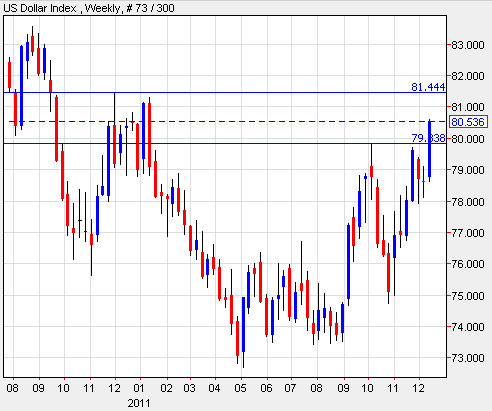
The dollar has clawed its way up and out of the recent range on the European chaos. Look for some resistance in the vicinity of 81.444.
U.S. Dollar Index, Weekly Interval
Update: Gold Breakdown
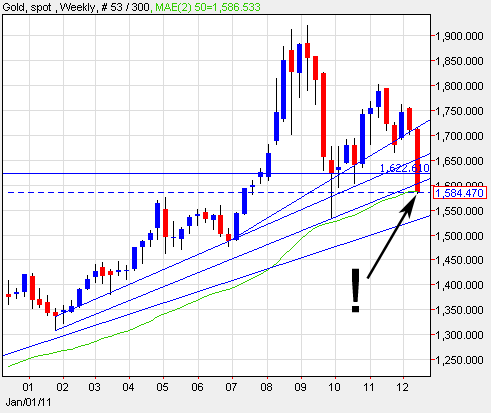
The spot gold weekly candle is down through the 50EMA just now. Make or break.
Spot Gold, Weekly Interval
Austrian Makes Formal Request for All Personal Information Facebook Keeps on Him
December 14th, 2011Via: ThreatPost:
Be careful of what you ask for. That’s a lesson that Max Schrems of Vienna, Austria, learned the hard way when he sent a formal request to Facebook citing European law and asking for a copy of every piece of personal information that the world’s largest social network had collected on him.
After a wait, the 24 year-old law student got what he was seeking: a CD with all his data stored on it – 1,222 files in all. The collection of PDF format documents was roughly the length Leo Tolstoy’s War and Peace but told a more mundane story: a record of Schrems’ years-long relationship with the world’s largest social network.
Collected together were records of when Schrems logged in and out of the social network, the times and content of sent and received messages and an accounting of every person and thing he’s ever liked, posted, poked, friended or recorded. The archive captured friend requests, former or alternative names and email addresses, employment and relationship statuses and photos, in some cases with their GPS locations included, to name a few. To Schrems’ dismay, much of the data he received from the network was information he thought he had deleted. Facebook, it seems, doesn’t think much of the Delete key and continued to hold copies of the data on its servers.
Russia Will Use Nuclear Reactors Beyond Their Engineered Life Spans
December 14th, 2011Via: The Bulletin of Atomic Scientists:
In response to the accident at the Fukushima Daiichi Nuclear Power Station, countries such as Germany and Switzerland are preparing to phase out aging nuclear power plants. The Russian State Atomic Energy Corporation (Rosatom), however, is taking a very different approach. In 2001, Rosatom began extending the operation of nuclear power plants that had surpassed their projected life spans. More recently, Sergey Kiryenko, the chief executive of Rosatom, confirmed that Rosatom intends to give all of its aging reactors a new lease on life, including water-cooled, graphite moderated RBMK reactors like the one that exploded at Chernobyl in 1986. Under Rosatom’s plan, the youngest of these reactors would continue operating until 2035.
Many of the country’s experts and non-governmental organizations maintain that this decision is economically unjustifiable and environmentally dangerous — to say nothing of illegal. The Russian nuclear industry, however, argues that lifetime extensions are justified because the original estimate of a 30-year life span was conservative; the plants have been significantly upgraded; and extensions cost significantly less than constructing new reactors.
The Neil Keenan / “Dragon Family” Trillion-Dollar Lawsuit Is Real
December 14th, 2011The full text of the lawsuit (Case 1:11-cv-08500-JFK, Filed 11/23/11, downloaded from pacer.gov) has been posted at the Divine Cosmos website:
This is a civil claim arising out of the concerted, knowing, malicious scheme and international conspiracy engaged in by the Defendants for the designed purpose of defrauding plaintiff KEENAN, the designated Agent of his Principal, the “Dragon Family,” for the express purpose of expropriating, stealing and converting certain negotiable financial instruments lawfully owned by the Dragon Family and entrusted to KEENAN in early 2009. These assets (hereinafter referred to as the “Dragon Family Financial Instruments” or the “DFFI”) had been intended for participation in select, registered and authorized Private Placement Investment Programs (or “PPPs”) for the benefit of a wide range of global humanitarian purposes. At the time of the criminal and deceitful acts of the Defendants, the approximate face value of the stolen DFFI was One Hundred Forty-Five and One Half Billion ($145,500,000,000.00) United States Dollars with an approximate accrued interest value of One Trillion ($1,000,000,000,000.00) United States Dollars.
Related:
Courthouse News Service: Bizarre Claim for $1 Trillion
Blackwater, Xe, ACADEMI
December 13th, 2011Via: AFP:
The US security firm formerly known as Blackwater, which was barred from Iraq over a deadly 2007 shooting, has renamed itself a second time.
USTC Holdings, the investor consortium that acquired ex-Blackwater firm Xe Services in December 2010, announced ACADEMI as the new name and brand for Xe Services.
The rebranding came as President Barack Obama met with Iraqi Prime Minister Nuri al-Maliki on Monday, marking America’s exit from a war launched to oust Saddam Hussein.
Advertisement: Story continues below
“We have had a year of extraordinary changes that have resulted in a new, better company,” ACADEMI president and chief executive Ted Wright said in a statement.
“I know that everyone at ACADEMI shares in this commitment to promote the highest standards of ethical conduct, compliance and integrity in all of our activities.
“We are already the best operationally. We are going to become the best at governance,” Wright said, adding “we still have much work to do.”
South Korea: Seoul Skyscraper Resembling Twin Towers Collapse
December 13th, 2011Pic at link.
Via: Bloomberg:
The design of twin skyscrapers planned for Seoul may be modified in the wake of criticism that a cloud-shaped bridge joining the buildings resembles the explosions that felled the World Trade Center towers.
MVRDV, the Dutch architecture firm that drew the plans for the towers joined at the 27th floor by a billowing cloud-shaped bridge, apologized for any affront caused by the resemblance to the fireball that sprung from the New York buildings in the Sept. 11 attacks that destroyed the twin towers.
The building designs “have been widely published in Asia and Europe without anyone noticing a resemblance,” Jan Knikker, a spokesman for the Rotterdam-based firm, said in an e-mail today. “Once the plan was published in the U.S., the controversy started.”
The design represents a cloud wrapping around the center of the skyscrapers, according to the firm’s website. The bridge connecting the towers, which are 57 and 60 stories high, would house a conference center, restaurants, swimming pools and a lounge, MVRDV said.