Britain: Sign Into the Dole Website with Facebook
June 13th, 2011Via: Register:
Facebook and other social networks could be used by British citizens to sign into public services online, The Register has learned.
A Cabinet Office spokeswoman confirmed to us this morning that the department was speaking to “a range of industry” about its ID assurance scheme, a prototype for which is expected in October this year.
Cabinet Office minister Francis Maude said in the House of Commons last month that “people will be able to use the service of their choice to prove identity when accessing any public services [via the internet].”
Companies such as banks that already hold personal customer information in their databases will be among private sector organisations involved in the new system.
But social networks are also in the mix, too.
The Cabinet Office spokeswoman didn’t want to offer specific details about individual companies such as Facebook and Google, instead preferring to say that “social networks could possibly be involved with the system.”
She was keen to stress that “no data would be held by the government through the ID assurance scheme” because, in effect, the identity authentication process would be farmed out to a variety of players in the private sector.
Cryptogon Readers Send Contributions
June 13th, 2011Pookie sent $75 and an anonymous reader sent 5 bitcoins. Thank you.
Update: Another 2 bitcoins arrived. Thank you.
May Earnings
June 13th, 2011Earnings in May totaled $1001.95. Thank you to everyone who helped keep Cryptogon going in May.
Deepbit Bitcoin Mining Pool to Support Cryptogon
June 13th, 2011Update: 22 ‘Yes’ Votes, But Only One Person Actually Offering to Help
Maybe this is somehow confusing.
If you want to help, you need to install the GUIMiner app (assuming you have a machine running Windows), or set up a mining app manually, and then email me for the Deepbit pool worker ID.
Voting ‘Yes’ in the poll thingy below doesn’t do anything except let me know how many people are interested—or just like playing with radio buttons on poll widgets.
—End Update—
Update: Getting Started ASAP
For people who want to get started now, and don’t need technical support, email me with the number of worker IDs you require. If you want to mine using one machine, you need one ID. Two machines, two IDs, etc. I’ll get them to you ASAP. Hint: On Windows machines, the easiest way to go for pooled mining is the GUIMiner (download). If you have a high end graphics card, definitely use GPU mining, but if you don’t, that’s fine, use the Ufasoft CPU miner.
The Deepbit profile is ready to go. All you’ll need from me are your worker IDs (which go in the ‘Email’ field) and the passwords.
If you want to help, but don’t know what any of this means, let me know and I’ll try to help you as soon as I can.
—End Update—
Are you interested in helping support Cryptogon by mining bitcoins with Deepbit? I could establish a pool account and give you worker IDs for each machine on the job.
You would be in complete control of how much mining you do as you run the client on your system.
Investigation Into IMF Cyber Attack
June 12th, 2011In other news: Hacker Groups Thoroughly Infiltrated by Government
Via: RTE:
The FBI is helping the International Monetary Fund investigate a cyber attack on its computer systems.
It is understood the breach was designed to install software which would create a ‘digital insider presence’.
The IMF, which holds sensitive economic data about many countries, said its operations were fully functional.
A cybersecurity expert who has worked for both the IMF and the World Bank said the intruders’ goal had been to install software that would give a nation state a ‘digital insider presence’ on the IMF network.
Such a presence could yield a trove of non-public economic data used by the Fund to promote exchange rate stability, support balanced international trade and provide resources to remedy members’ balance-of-payments crises.
‘It was a targeted attack,’ said Tom Kellerman, who has worked for both international financial institutions and who serves on the board of a group known as the International Cyber Security Protection Alliance.
The code used in the IMF incident was developed specifically for the attack on the institution, said Mr Kellerman.
Italian Politician ‘Bloodied’ Sneaking Into Bilderberg Hotel
June 12th, 2011Via: TheLocal:
Italian MEP Mario Borghezio was reportedly given a bloody nose on Thursday as he attempted to sneak into the secretive Bilderberg conference in St. Moritz.
Borghezio, of right-wing Italian party Lega Nord, was reportedly with another Italian as he attempted to infiltrate the luxury Suvretta House hotel where the conference is taking place.
Borghezio was blocked by guards from the security firm Securitas, who then called in the Swiss police. After having their identities checked, the two Italians were told they could not enter the building.
But according to the Italian news agency ANSA, Borghezio’s nose was bloodied during the altercation with the security guards. He told the agency he intends to press charges.
Swiss police spokesman Thomas Hobi said, “We don’t comment on the work of private security firms,” before adding that the police was not at liberty to even confirm the identities of the two men, because of data protection laws.
In a separate incident, two Swiss men were detained near the conference because “several suspicious items” were found in their car.
Hobi said that “for tactical reasons,” the police did not want to give any more information on the objects, but it is understood they initially suspected explosives. A security cordon was set up around the car while forensic specialists investigated the objects.
The items in the car were eventually judged to be harmless, though both men have been turned over to state police.
The annual Bilderberg meeting, which gathers over 100 of the world’s political and economic leaders, are usually secured by a tight police presence.
Bitcoin: Spectacular Slaughter
June 12th, 2011Warning: This is not a recommendation to buy, sell or hold any financial instrument.
Update: 20.20
—End Update—
Update: Bounce Off MtgoxUSD 10.25
It hit a low of 10.25 and is currently trading at 16.08 x 16.32.
—End Update—
The public participation phase of bitcoin was the most spectacular I’ve ever seen—with the typical, disastrous results for latecomers.
What we see here is a standard BARF frenzy.
Now, there is some support around mtgoxUSD 10. Supporting factors include the trend line connecting earlier pivot lows and the 50-day EMA. This would be the first opportunity to try to catch the falling knife.
If 10 breaks down, and that trend line, however, it will be a matter of watching volumes for signs of seller exhaustion.
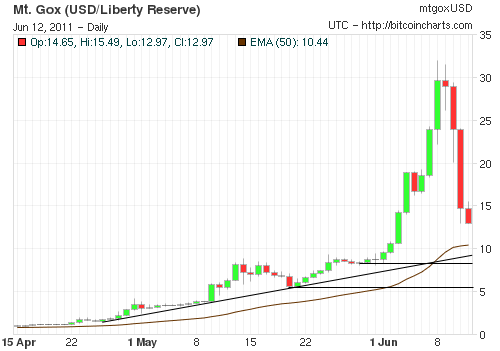
Bitcoin Daily Interval
Cedar Falls Demands Keys to All Commercial Properties (Including Rental Homes and Apartments) to Be Placed in Lock Boxes That City Employees Can Access
June 12th, 2011Research Credit: EB
U.S. Special Ops Troops Deployed in Mexico, Leaked Briefing Confirms
June 11th, 2011Via: Narcosphere:
A Pentagon document has come to light that confirms the U.S. has put special operations troops on the ground in Mexico as the drug war there continues to escalate, notching some 40,000 murders since late 2006.
The document is a Department of Defense briefing presented in mid-May 2009 in Washington, D.C., to a group of business and political leaders from northwest Florida. The “Unclassified/For Official Use Only” briefing reveals the 18 Latin American nations where 7th Special Forces Group soldiers [Airborne Green Berets] were deployed as of fiscal year 2009, which ended Sept. 30, 2009.
Among those nations, according to the briefing document, was Mexico.
The document also indicates a 7th Special Forces unit was deployed in Mexico in 1996 as well, as part of a “counter-narcotics” mission.
The revelations in the briefing material are important because, to date, neither the Pentagon nor the State Department has confirmed that U.S. special forces have been deployed inside Mexico — a politically volatile subject in that Latin American nation given the rising drug-war death toll there and the “Yankee” history of U.S. Gunboat Diplomacy in the region.
Research Credit: ottilie
School Surveillance: How Big Brother Spies On Pupils
June 11th, 2011Lockdown High: When the Schoolhouse Becomes a Jailhouse by Annette Fuentes
Via: Guardian:
‘Every day in communities across the United States, children and adolescents spend the majority of their waking hours in schools that increasingly have come to resemble places of detention more than places of learning. From metal detectors to drug tests, from increased policing to all-seeing electronic surveillance, the schools of the 21st century reflect a society that has become fixated on crime, security and violence.”
So reads a passage from the opening pages of Lockdown High, a new book by the San Francisco-based journalist Annette Fuentes. Subtitled “When the schoolhouse becomes the jailhouse”, it tells a story that decisively began with the Columbine shootings of 1999, and from across the US, the text cites cases that are mind-boggling: a high-flying student from Arizona strip-searched because ibuprofen was not allowed under her school rules; the school in Texas where teachers can carry concealed handguns; and, most amazingly of all, the Philadelphia school that gave its pupils laptops equipped with a secret feature allowing them to be spied on outside classroom hours.
Just about all the schools Fuentes writes about are united by a belief in that most pernicious of principles, “zero tolerance”. Their scanners, cameras and computer applications are supplied by a US security industry that seems to grow bigger and more insatiable every year. And as she sees it, their neurotic emphasis on security has plenty of negative results: it renders the atmosphere in schools tense and fragile, and in coming down hard on young people for the smallest of transgressions, threatens to define their life chances at an early age – because, as she puts it, “suspensions and academic failure are strong predictors of entry into the criminal justice system”. There is also, of course, the small matter of personal privacy.