Fed’s Secret Loans to Big Banks
May 26th, 2011Via: Bloomberg:
Credit Suisse Group AG (CS), Goldman Sachs Group Inc. (GS) and Royal Bank of Scotland Group Plc (RBS) each borrowed at least $30 billion in 2008 from a Federal Reserve emergency lending program whose details weren’t revealed to shareholders, members of Congress or the public.
The $80 billion initiative, called single-tranche open- market operations, or ST OMO, made 28-day loans from March through December 2008, a period in which confidence in global credit markets collapsed after the Sept. 15 bankruptcy of Lehman Brothers Holdings Inc.
Units of 20 banks were required to bid at auctions for the cash. They paid interest rates as low as 0.01 percent that December, when the Fed’s main lending facility charged 0.5 percent.
“This was a pure subsidy,” said Robert A. Eisenbeis, former head of research at the Federal Reserve Bank of Atlanta and now chief monetary economist at Sarasota, Florida-based Cumberland Advisors Inc. “The Fed hasn’t been forthcoming with disclosures overall. Why should this be any different?”
Why Are Spy Researchers Building a ‘Metaphor Program’?
May 26th, 2011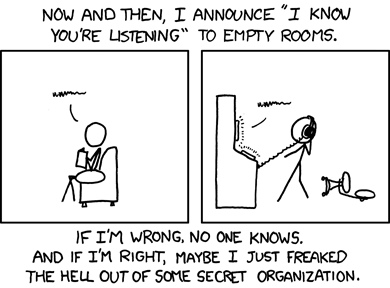
Via: The Atlantic:
A small research arm of the U.S. government’s intelligence establishment wants to understand how speakers of Farsi, Russian, English, and Spanish see the world by building software that automatically evaluates their use of metaphors.
That’s right, metaphors, like Shakespeare’s famous line, “All the world’s a stage,” or more subtly, “The darkness pressed in on all sides.” Every speaker in every language in the world uses them effortlessly, and the Intelligence Advanced Research Projects Activity wants know how what we say reflects our worldviews. They call it The Metaphor Program, and it is a unique effort within the government to probe how a people’s language reveals their mindset.
“The Metaphor Program will exploit the fact that metaphors are pervasive in everyday talk and reveal the underlying beliefs and worldviews of members of a culture,” declared an open solicitation for researchers released last week. A spokesperson for IARPA declined to comment at the time.
Three Chinese Government Buildings Bombed
May 26th, 2011Via: Telegraph:
Three Chinese government buildings have been bombed in the southern city of Fuzhou, in Jiangxi province, killing two and injuring six.
The first blast went off in the car park of the Fuzhou public prosecutor’s office just after nine o’clock this morning, as workers were arriving for the day.
Two other bombs went off in the following 30 minutes, one at the Linchuan district government building and another at the local pharmaceutical drug administration bureau.
The three buildings were within walking distance of each other and two of the bombs were left inside cars parked outside.
According to Xinhua, the state news agency, three of the six injured are critical. The bombings were initially blamed on a local farmer who was said to be upset at the progress of a court case, but Xinhua later said the cause of the attacks was still under investigation.
Groups Sue FDA to Stop Addition of Antibiotics in Livestock Feed
May 26th, 2011Via: Washington Post:
Several environmental and public health groups filed suit against the Food and Drug Administration on Wednesday to try to force the government to stop farmers from routinely adding antibiotics to livestock feed to help animals grow faster.
The groups say widespread agricultural antibiotic use and the FDA’s allowance of the practice are compounding a public health crisis: the increasing prevalence of “superbugs” that infect people and do not respond to antibiotics.
U.S. Runs Surveillance Operations Based on Secret Interpretations of Patriot Act
May 26th, 2011Via: Wired:
You may think you understand how the Patriot Act allows the government to spy on its citizens. Sen. Ron Wyden (D-Oregon) says it’s worse than you’ve heard.
Congress is set to reauthorize three controversial provisions of the surveillance law as early as Thursday. But Wyden says that what Congress will renew is a mere fig leaf for a far broader legal interpretation of the Patriot Act that the government keeps to itself — entirely in secret. Worse, there are hints that the government uses this secret interpretation to gather what one Patriot-watcher calls a “dragnet” for massive amounts of information on private citizens; the government portrays its data-collection efforts much differently.
“We’re getting to a gap between what the public thinks the law says and what the American government secretly thinks the law says,” Wyden tells Danger Room in an interview in his Senate office. “When you’ve got that kind of a gap, you’re going to have a problem on your hands.”
What exactly does Wyden mean by that? As a member of the intelligence committee, he laments that he can’t precisely explain without disclosing classified information. But one component of the Patriot Act in particular gives him immense pause: the so-called “business-records provision,” which empowers the FBI to get businesses, medical offices, banks and other organizations to turn over any “tangible things” it deems relevant to a security investigation.
“It is fair to say that the business-records provision is a part of the Patriot Act that I am extremely interested in reforming,” Wyden says. “I know a fair amount about how it’s interpreted, and I am going to keep pushing, as I have, to get more information about how the Patriot Act is being interpreted declassified. I think the public has a right to public debate about it.”
…
“I’m talking about instances where the government is relying on secret interpretations of what the law says without telling the public what those interpretations are,” Wyden says, “and the reliance on secret interpretations of the law is growing.”
Serbia Arrests Ratko Mladic
May 26th, 2011Via: CBS News:
The Serbian government confirmed Thursday that Ratko Mladic, Europe’s most wanted war crimes fugitive, had been arrested.
A man who identified himself as Milorad Komadic when he was arrested Thursday is the wartime Bosnian Serb army commander.
The director of communications for the government of President Boris Tadic confirmed to CBS News’ Natasha Popovic in Belgrade that the man arrested was Mladic.
About an hour later, Tadic appeared on national television to confirm the arrest to the wider world.
“On behalf of the Republic of Serbia we announce that Ratko Mladic has been arrested,” Tadic told reporters. He said the arrest was made by the Serbian Security Intelligence Agency.
Mladic will be extradited to the U.N. war crimes tribunal in The Hague, Netherlands, he said. He did not specify when, but said “an extradition process is under way.”
Angry Parents in Japan Confront Government Over Radiation Levels
May 26th, 2011Via: New York Times:
The accusations flew on Wednesday at the local school board meeting, packed with parents worried and angry about radiation levels in this city at the heart of Japan’s nuclear crisis.
“Do you really care about our children’s health?” one parent shouted. “Why have you acted so late?” said another. Among other concerns: isn’t radiation still raining down on Fukushima? Shouldn’t the entire school building be decontaminated? The entire city? Can we trust you?
“We are doing all we can,” pleaded Tomio Watanabe, a senior official of Fukushima’s education board.
A huge outcry is erupting in Fukushima over what parents say is a blatant government failure to protect their children from dangerous levels of radiation. The issue has prompted unusually direct confrontations in this conflict-averse society, and has quickly become a focal point for anger over Japan’s handling of the accident at the nearby Fukushima Daiichi nuclear power plant, ravaged in the March 11 earthquake and tsunami.
At issue are updated government guidelines that allow schoolchildren to be exposed to radiation doses that are more than 20 times the previously permissible levels. That dose is equal to the international standard for adult nuclear power plant workers.
China: Yangtze River Drought Crisis Forces Government to Release Five Billion Cubic Meters of Water from Three Gorges Reservoir
May 26th, 2011Via: Guardian:
The Yangtze – Asia’s biggest river – is experiencing its worst drought in 50 years, forcing an unprecedented release of water from the Three Gorges reservoir. The drought is damaging crops, threatening wildlife and raising doubts about the viability of China’s massive water diversion ambitions.
Between now and 10 June the dam will release 5bn cubic metres of water – equivalent to the volume of Lake Windermere in Britain every day – as engineers sacrifice hydroelectric generation for irrigation, drinking supplies and ecosystem support.
The drastic measure comes amid warnings of power shortages and highlights the severity of the dry spell in the Yangtze delta, which supports 400 million people and 40% of China’s economic activity.
From January to April, the worst hit province of Hubei has had 40% less rainfall than the average over the same period since 1961. Shanghai, Jiangsu and Hunan are also severely affected.
Cryptogon Readers Send Contributions
May 26th, 2011Thank you.
MW $20
DS $20
LAPD Chevy Caprice PPV
May 26th, 2011Via: AOL Autos:
Taking a ride in a police squad car is typically an unenviable experience, but not today. Bradley teams up with our friends at the LAPD to check the tech on the all new Chevrolet Caprice PPV (Police Patrol Vehicle). From an infrared night vision camera to an automated license plate scanner, this Caprice cop car puts Robocop’s ’86 Taurus LX to shame.
Research Credit: getdusted




