Natural Gas Futures Surge Most in Eight Months on Storage Drop
March 17th, 2011WARNING: This is not a recommendation to buy, sell, or hold any financial instrument.
😉
Via: Bloomberg:
Natural gas futures rose the most in eight months after a government report showed a bigger-than- forecast U.S. stockpiles decline.
Gas posted its biggest percentage gain since July 15 after the Energy Department said inventories fell 56 billion cubic feet in the week ended March 11 to 1.618 trillion cubic feet. Analyst estimates compiled by Bloomberg showed an expected decline of 42 billion. A separate survey of Bloomberg users showed a decrease of 43 billion.
Related: Long Natural Gas
U.S. Checks Passengers, Cargo from Japan for Radiation
March 17th, 2011Update: Low Levels of Radiation Detected on Passengers from Tokyo:
Radiation detectors at Dallas-Fort Worth and Chicago O’Hare airports were triggered when passengers from flights that started in Tokyo passed through customs, the New York Post reported.
Tests at Dallas-Fort Worth indicated low radiation levels in travelers’ luggage and in the aircraft’s cabin filtration system; no passengers were quarantined, the newspaper said.
—End Update—
Several countries are doing this now.
Via: Reuters:
Homeland Security Secretary Janet Napolitano said on Thursday that passengers and cargo arriving in the United States from Japan are being checked for radiation from the damaged Japanese nuclear power plants.
Napolitano told reporters at an unrelated event that the radiation checks were being done out of an abundance of caution and that no radiation has been detected.
China Suspends ‘Approval’ of Nuclear Power Plants
March 17th, 2011Via: BBC:
China has suspended approval for new nuclear power stations following the accident at Japan’s Fukushima Daiichi plant.
It will also carry out checks at existing reactors and those under construction.
China is currently building 27 new reactors – about 40% of the total number being built around the world.
The news comes as China grows increasingly worried about the nuclear accident in Japan.
…
The decision to temporarily halt approval for nuclear plants came at a meeting of China’s State Council, or Cabinet, chaired by Premier Wen Jiabao.
“We will temporarily suspend approval for nuclear power projects, including those that have already begun preliminary work, before nuclear safety regulations are approved,” read a statement from the State Council.
Feds Deploy More Radiation Monitors in Western U.S.
March 17th, 2011Yeah, well, I’d say: Get your own Geiger counter and ignore the feds on this.
Via: AP:
More radiation monitors are being deployed in the western United States and Pacific territories, as officials seek to mollify public concern over exposure from damaged nuclear plants in Japan, federal environmental regulators said.
The U.S. Environmental Protection Agency already monitors radiation throughout the area as part of its RadNet system, which measures levels in air, drinking water, milk and rain.
The additional monitors are being deployed in response to the ongoing nuclear crisis in Japan, where emergency workers are attempting to cool overheated reactors damaged by last week’s magnitude-9.0 earthquake and tsunami.
Officials with the U.S. Nuclear Regulatory Commission said they do not expect harmful radiation levels to reach the U.S. from Japan.
“The agency decided out of an abundance of caution to send these deployable monitors in order to get some monitors on the ground closer to Japan,” said Jonathan Edwards, director of EPA’s radiation protection division.
EMERGENCY: U.S. STATE DEPARTMENT CHARTERING FLIGHTS TO HELP AMERICANS EXIT JAPAN
March 17th, 2011Update / Confirmation: U.S. Starts Evacuating Some Americans Out of Japan
Via: AP:
The Obama administration has authorized the first evacuations of Americans out of Japan, and said it will charter aircraft to help U.S. citizens wishing to escape elevated radiation levels in the country.
The State Department late Wednesday issued a warning to Americans to avoid travel to Japan and said U.S. citizens in the country should consider leaving. Its authorized departure offers a voluntary evacuation to family members and dependents of U.S. personnel in Tokyo and Yokohama and affects some 600 people.
Senior State Department official Patrick Kennedy said the chartered planes would help private American citizens wishing to leave.
He said people faced less risk in southern Japan, but warned that changing weather and wind conditions could raise radiation levels elsewhere in the coming days.
—End Update—
Standing by for confirmation. This is all Reuters right now. No confirmation yet.
Via: Reuters:
U.S. State Department says bringing in chartered aircraft to Tokyo to help Americans exit Japan
by Reuters_UrvashiSibal at 4:54 PM
Nikkei 225 Midmorning Trade Down 2%
March 17th, 2011Monitoring…
Australia Again Urges Citizens to Consider Leaving Japan; More Over Infrastructure Concerns than Radiation
March 17th, 2011Via: Reuters:
Australia’s government on Thursday urged citizens in Tokyo and eight other affected prefectures to consider getting out of Japan, including the families of embassy staff.
But it said its warning was because of infrastructure problems, not the fear of radiation.
“We have a real problem in terms of the infrastructure in Japan. We have uncertainty of power supply, we have problems with train services, we have problems with public transport services, many schools have closed and there is this repeated series of aftershocks,” Foreign Minister Kevin Rudd said.
“Unless it’s essential you be there, then we are saying you should consider going, departing,” he said.
YEN RECORD HIGH; MAJOR TECHNICAL LEVEL TAKEN OUT VS. DOLLAR
March 17th, 2011WARNING: This is not a recommendation to buy, sell or hold any financial instrument.
Update: USD/JPY Breaking Down Again
US$ could be about to retest the low vs. yen. I’m watching the weak support level at 78.61 USD/JPY. Currently trading around 78.71. It looks like it’s going to break down again.
—End Update—
80.43 was the number.
Here’s a monthly chart to fit it all in. This is going back to 1995.
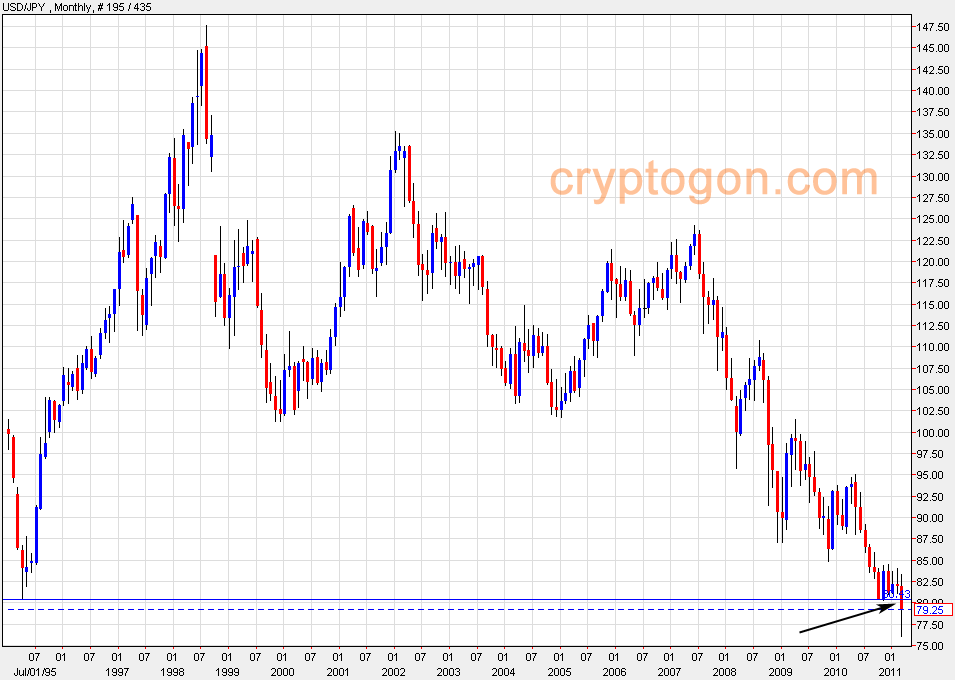
USD/JPY Monthly Candles
The intervention/manipulation that occurred to bring this back is probably unimaginable. Even so, that 80.43 level is busted.
Here’s the five minute resolution that shows the wheels coming off the cart:
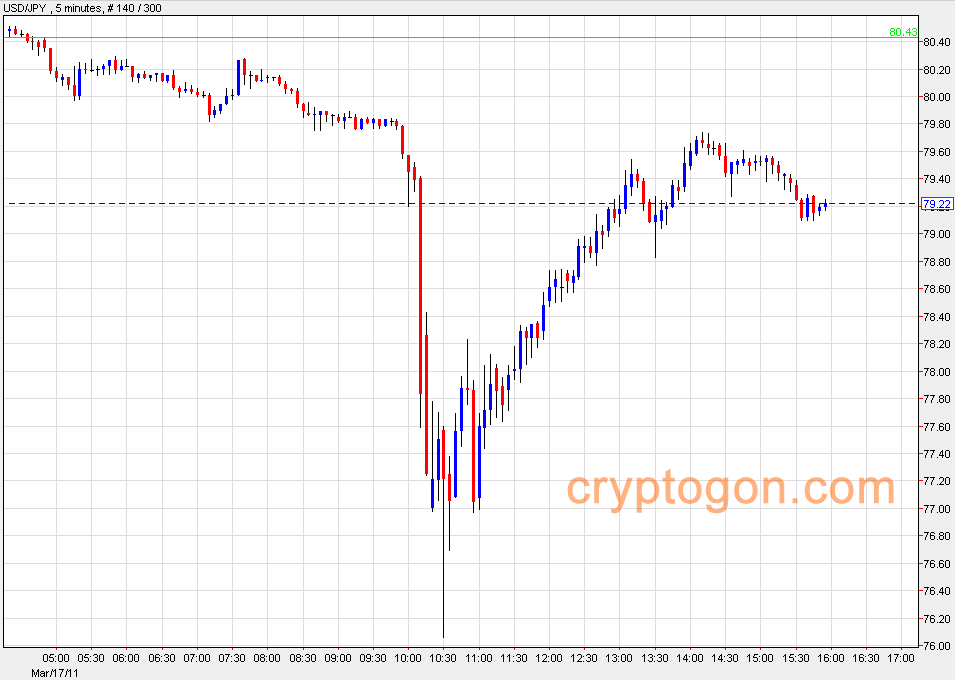
USD/JPY 5 Minute Candles
What’s the significance of this?
Everything from Japan is going to get much more expensive.
Head of U.S. Nuclear Regulatory Commission: “There is no water in the spent fuel pool and we believe that radiation levels are extremely high”
March 17th, 2011Via: AP:
The chief of the U.S. Nuclear Regulatory Commission said Wednesday that all the water is gone from one of the spent fuel pools at Japan’s most troubled nuclear plant, raising the possibility of widespread nuclear fallout. But Japanese officials denied the pool was dry.
“There is no water in the spent fuel pool and we believe that radiation levels are extremely high, which could possibly impact the ability to take corrective measures,” NRC Chairman Gregory Jaczko said at a House Energy and Commerce subcommittee hearing.
If Jaczko was correct, this would mean there was nothing to stop the fuel rods from heating and ultimately melting down. The outer shell of the rods could also ignite with enough force to propel the radioactive fuel inside over a wide area.
That country’s nuclear safety agency and Tokyo Electric Power Co., which operates the six-unit Fukushima Dai-ichi complex, denied Jaczko’s statements that the water is gone from the pool.
Utility spokesman Hajime Motojuku said the “condition is stable” at Unit 4, which was shut when the earthquake and tsunami hit last week.
After the hearing, Jaczko left some wiggle room. If he is wrong, it would represent a very embarrassing moment for the U.S. government.
“My understanding is there is no water in the spent fuel pool,” he said. “I hope my information is wrong. It’s a terrible tragedy for Japan.”
Jaczko said the information came from NRC staff and experts in Tokyo who are working with the utility in Japan. He said NRC staffers continue to believe the spent fuel pool is dry. “They believe the information they have is reliable,” he said.
Physicist and Uranium-Industry Analyst at MIT: ‘This Is a Slow-Moving Nightmare’
March 16th, 2011Via: Reuters:
Japan’s nuclear crisis appeared to be spinning out of control on Wednesday after workers withdrew briefly from a stricken power plant because of surging radiation levels and a helicopter failed to drop water on the most troubled reactor.
In a sign of desperation, police will try to cool spent nuclear fuel at one of the facility’s reactors with water cannon, normally used to quell riots.