Courts Helping Banks Screw Over Homeowners
November 12th, 2010Via: Rolling Stone:
The foreclosure lawyers down in Jacksonville had warned me, but I was skeptical. They told me the state of Florida had created a special super-high-speed housing court with a specific mandate to rubber-stamp the legally dicey foreclosures by corporate mortgage pushers like Deutsche Bank and JP Morgan Chase. This “rocket docket,” as it is called in town, is presided over by retired judges who seem to have no clue about the insanely complex financial instruments they are ruling on — securitized mortgages and labyrinthine derivative deals of a type that didn’t even exist when most of them were active members of the bench. Their stated mission isn’t to decide right and wrong, but to clear cases and blast human beings out of their homes with ultimate velocity.
Related: MERS to Be Legitimized by Act of Congress?
Research Credit: BW
Pentagon Readies New Ship-Killers for Showdown with China
November 12th, 2010Via: Wired:
Pentagon planners were wary of China’s double-digit military-budget growth rates even before the global economic crisis put the squeeze on America’s own defense investment. Now the Chinese army’s growth continues while America’s flat-lines. That’s got the U.S. military, especially the Navy, scrambling for new ideas.
The most hopeful is an emerging concept for mixing U.S. Navy ships and subs with Air Force planes to form a tightly-knit, super-lethal, ship-killing force meant to counter an increasingly powerful Chinese fleet. The Pentagon calls it “AirSea Battle,” an homage to NATO’s Cold War “AirLand Battle” concept that pioneered tactics for taking out thousands of Soviet tanks with smart weapons. U.S. Secretary of Defense Bob Gates called the classified AirSea Battle concept “encouraging.”
It seems AirSea Battle mostly involves better communications and command procedures for integrating ships and planes into the same task forces. But there’s at least one new piece of hardware: a new, more deadly anti-ship missile. On Wednesday, the Defense Advanced Research Projects Agency awarded Lockheed Martin a 3-year, $160 million contract to develop the Long-Range Anti-Ship Missile. The goal is for LRASM to give Navy ships “the ability to attack important enemy ships outside the ranges of the enemy’s ability to respond with anti-ship missiles of their own.”
Genetically Altered Mosquitoes Released into the Wild
November 12th, 2010What happens to the bats, dragonflies, bird and other creatures that eat the GM mosquitoes?
Via: New Scientist:
An outdoor trial of mosquitoes genetically engineered to sabotage Aedes aegypti mosquitoes, which spread dengue fever, has been declared a success by scientists in the field.
…
Oxitec breeds millions of males carrying an altered gene called tTA which they pass down when they mate with females. The lethal gene overcommits the gene-reading machinery of larva and pupae, preventing them from growing properly and causing them to die before adulthood, breaking the insects’ life cycle.
In the six months of the trial, the researchers released males in batches of 50,000. A total of 3.3 million were released.
Related: Bill Gates Funds Research Into ‘Flying Syringe’ Mosquitos to Deliver Vaccines
Research Credit: anothernut
Dollar Soars on Ireland Wreckage; Might Be Hammer Time
November 11th, 2010WARNING: This is not a recommendation to buy, sell or hold any financial instrument.
There’s still another trading day to go, but the dollar will likely print a weekly hammer-like candle off the support:
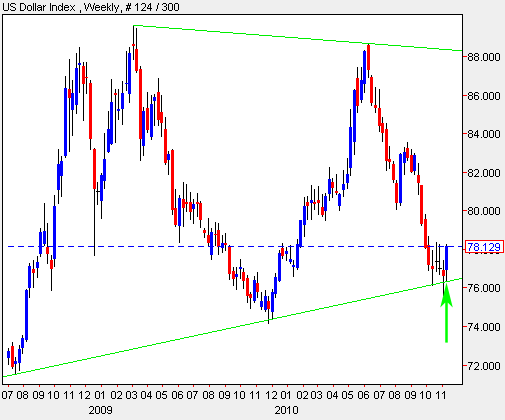
U.S. Dollar Index, Weekly Interval
Is this really a hammer? Not really. But the proximity to the support is causing me to squint really hard at it.
This is getting ahead a bit, but check out how the monthly candle is forming up:
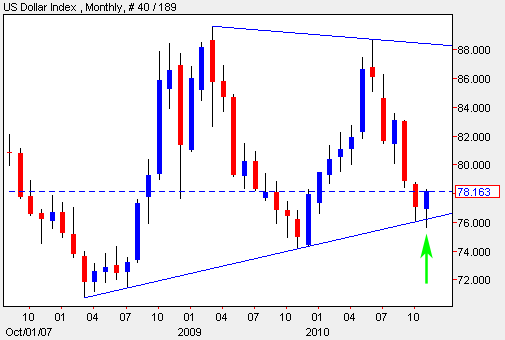
U.S. Dollar Index, Monthly Interval
That’s looking much more like a real hammer.
There are weeks to go on this candle, though. I thought I’d give you a heads up, just in case.
Via: Reuters:
Doubt about Ireland’s ability to repay its debts spread further on Thursday, driving the euro lower and overshadowing G20 attempts to ease currency tensions and secure commitment to more balanced global growth.
Yields on 10-year Irish bonds rose to a record high over comparable German debt as some investors worried that Ireland wouldn’t be able to cut spending as planned and may require a bailout, with bond holders forced to absorb losses.
The euro was down 0.5 percent at $1.3717 EUR=, not far from a five-week low of $1.3670 hit a day ago, and was also lower against the yen, Swiss franc and sterling.
Russia Hunts Double Agent Who Betrayed U.S. Cell
November 11th, 2010Via: MSNBC:
The head of Moscow’s deep cover spying operations in the United States was a double agent who had betrayed at least 10 compatriots in a major blow to Russian intelligence, a Russian newspaper said on Thursday.
Kommersant reported that Colonel Shcherbakov, head of the Foreign Intelligence Service’s department for “illegal” spying operations in the United States, had been working for Washington.
The article listed red flags that the newspaper’s sources said should have been investigated, including that he had a daughter living in the United States and a son who left his government anti-narcotics job shortly before the spy scandal broke. Additionally, Shcherbakov turned down a promotion, which might have involved taking a lie detector test, about a year before the spy ring’s discovery.
The newspaper said Shcherbakov — it did not give his first name — had been spirited out of Moscow to the United States days before the FBI announced in June that it had arrested the members of a Russian spy ring.
California Missile Story – Heavily Updated
November 11th, 2010Just in case you’re following this one: Mystery Missile Launch Seen Off California Coast.
HP Mini 5102 Review
November 11th, 2010Becky doesn’t drive. Since she was a teenager, and until we got married, she had lived in some form of student housing and always got by without owning a car. She’s now heavily involved with Playcentre and needs to go to a lot of classes and meetings. Sometimes she and the boys catch rides with a friend or her mum. Usually, I drive.
This is a roundabout way of saying that I needed a netbook to take advantage of several quiet hours per week to get some work done when I’m away from home. I’ve been wanting a netbook for a while, but I considered the build quality of that class of machine to be somewhat of a joke across the board. For many years, high quality ultraportables (the Dell Latitude E4200 being a current example) have been available, but I wasn’t prepared to spend anything near what those machines cost.
I recently learned about Hewlett Packard’s Mini 510x series of netbooks. Currently, the Mini 5102 machines are being cleared out and the 5103s are the new models.
The build quality is very high on these. No, really. If you think that all netbooks belong in the same aisle as the plastic pumpkins and whoopie cushions at WalMart, think again. The 5102 case and chassis are made out of aluminum and magnesium alloy.
The chicklet keyboard is great. It’s absolutely rigid. There is no flex at all. It’s 95% of full size and I have no trouble typing on it at essentially full speed.
For mobile broadband, if you buy a model with the Gobi mobile broadband interface, just pop your SIM card into the back of the machine and you’re good to go; no USB modem sticks out the side. The reception is great; equal too or better than the USB modems I use. HP’s mobile broadband software is slick and robust.
I came across a 5102 with the Atom N450, 2GB RAM, 7200rpm 320MB drive, Windows 7 Pro, and the hi-res (1366 x 768) display at what is—for NZ—a deep discount. Ascent.co.nz is selling them new for less than bozos on Trademe (our version of Ebay) are trying to get for their used ones. The current model equivalent in the 5103 costs double what I paid for my 5102. The meager performance boost was definitely not worth the extra money in my opinion.
The battery life (6-cell) is ridiculously good. Ten hours is possible.
It’s plenty fast for what I need it to do (web browser, email, word processing, listening to mp3s).
In summary: I’m very happy with this machine.
(Here’s a full review.)
Caveats?
There are two, in my opinion:
First, the machine ships with a profoundly broken piece of software called the HP Wireless Assistant. The version on the machine runs the CPU at 100%, which causes the fan to spin constantly at maximum RPM. I thought my 5102 had a hardware problem at first. Nope. It was the old/buggy HP Wireless Assistant. Installing the latest version (4.0.10.0, 21 Jul 2010 as of this writing) fixed the problem.
Why not just kill it/stop it from loading? You could, but this app controls all of your radios (Bluetooth, Wi-Fi, mobile broadband) in a convenient way, so it’s nice to have. Shutting these interfaces off when not in use extends the battery life.
Using msconfig to stop a few other apps from loading during startup and using a basic desktop theme, I found, helps keep the fan quiet. Flash is pretty much guaranteed to get the fan to announce itself. Flashblock does the trick.
The other issue has to do with readability. The display is stunning, but 1366 x 768 packed into the 10.1 incher is definitely not easy on the eyes with default settings. Here are two quick tips to improve readability:
1) Bump the OS font size to 125% or 150%.
2) Use the fantastic NoSquint addon with Firefox. NoSquint allows you to force text on websites to display at whatever size you like, on both a global and a per site basis. On the HP Mini 5202, I set the global zoom to 125% and then I tweak it up or down as necessary. NoSquint remembers these settings. (I tried to pay Jason Tackaberry some money for his work on this addon, but he requests that any contributions should go to EFF instead. I was happy to do that.)
Ok, that’s it. After all of that you might expect me to try to sell you one of these machines by having an affiliate link up to Amazon. The reason I’m not doing that is because there are so many options that, chances are, I won’t link to the one you want. So, if you find the one you’re after on Amazon, as always, I’d appreciate it if you get there via Cryptogon, but you’ll want to check around to make sure that you get a good deal on one that’s configured with the options you want.
World’s Largest Pilot Union Shuns Full-Body Scanners; Radiation Risks
November 10th, 2010Via: Register:
The world’s largest independent airline pilot association is warning its members to avoid security screening by full-body scanners out of concern the machines emit dangerous levels of radiation.
The American Pilots Association, which represents about 12,000 pilots, is recommending members instead submit to new pat-down searches, even though critics have described them as “horribly invasive” and likened them to foreplay. The recommendation is based on concerns that, contrary to claims by the US Transportation Security Administration, the types of X-rays emitted by the machines could pose serious risks that still aren’t well understood.
“We are already subjected to larger amounts of radiation by flying long distances at high altitudes,” Captain Sam Mayer, who is the APA’s communications committee chairman, told The Register. “While the TSA is telling us it’s completely safe, that may be true for the occasional user, but we haven’t seen any data yet talking about the long term cumulative effects of this over time.”
The pilots are by no means alone in voicing concern over the safety of the backscatter X-ray scanners, which are also known as advanced imaging technology. In April, radiation experts from the University of California, San Francisco, warned President Obama’s science assistant that the machines pose potentially serious health risks.
Multiple Independent Lab Tests Confirm Oil in Gulf Shrimp
November 10th, 2010Via: Raw Story:
The federal government is going out of its way to assure the public that seafood pulled from recently reopened Gulf of Mexico waters is safe to consume, in spite of the largest accidental release of crude oil in America’s history.
However, testing methodologies used by the government to deem areas of water safe for commercial fishing are woefully inadequate and permit high levels of toxic compounds to slip into the human food chain, according to a series of scientific and medical professionals interviewed by Raw Story.
In two separate cases, a toxicologist and a chemist independently confirmed their seafood samples contained unusually high volumes of crude oil and harmful hydrocarbons — and some of this food was allegedly being sent to market.
Judges Dismissing Foreclosure Cases Due to Banks’ Fraudulent or Sloppy Paperwork
November 10th, 2010Via: Washington Post:
A year ago, Long Island Judge Jeffrey Spinner concluded that a mortgage company’s paperwork in a foreclosure case was so flawed and its behavior in negotiations with the borrower so “repugnant” that he erased the family’s $292,500 debt and gave the house back for free.
The judgment in favor of the homeowner, Diane Yano-Horoski, which is being appealed, has alarmed the nation’s biggest lenders, who say it could establish a dramatic new legal precedent and roil the nation’s foreclosure system.
It is not the only case that has big banks worried. Spinner and some of colleagues in the New York City area estimate they are dismissing 20 to 50 percent of foreclosure cases on the basis of sloppy or fraudulent paperwork filed by lenders.
Related: Video Depositions of Nationwide Title Clearing Employees




