Department of Homeland Security’s “Social Networking Monitoring Center”
October 14th, 2010Via: EFF:
Narcissistic tendencies in many people fuels a need to have a large group of “friends” link to their pages and many of these people accept cyber-friends that they don’t even know. This provides an excellent vantage point for FDNS to observe the daily life of beneficiaries and petitioners who are suspected of fraudulent activities.
This social networking gives FDNS an opportunity to reveal fraud by browsing these sites to see if petitioners and beneficiaries are in a valid relationship or are attempting to deceive [United States Citizen and Immigration Services] about their relationship. Once a user posts online, they create a public record and timeline of their activities. In essence, using MySpace and other like sites is akin to doing an unannounced cyber “site-visit” on a [sic] petitioners and beneficiaries.
Related: The CIA and NSA Want You to Be Their Friend on Facebook
Canada: Secret Cold War Plan Included Mass Detentions
October 14th, 2010Via: CBC:
At the height of the Cold War, the Canadian government crafted a top-secret plan to detain thousands of citizens with Communist links in the event of a national security threat, according to a joint CBC/Radio-Canada investigation.
The secret contingency plan, called PROFUNC, allowed police to round up and indefinitely detain Canadians believed to be Communist sympathizers.
The CBC’s The Fifth Estate and Radio-Canada’s Enquête investigative programs have unearthed troubling details about PROFUNC, which stands for PROminent FUNCtionaries of the Communist Party.
Related: MAIN CORE
Gold: New Record High, $1388
October 14th, 2010Warning: This is not a recommendation to buy, sell or hold any financial instrument.
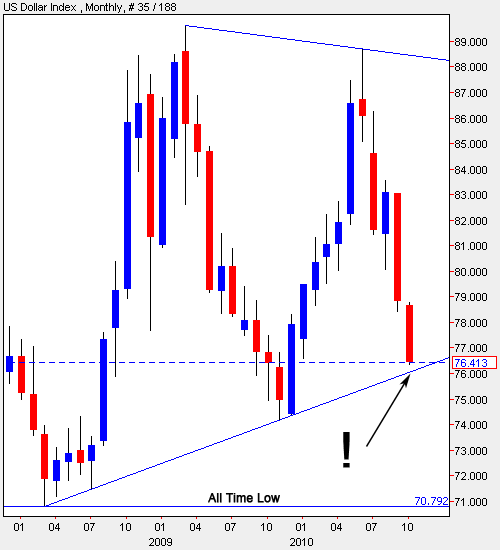
Continuing its sharp decline, the U.S. Dollar Index is nearing an important “make or break” level as indicated on the monthly interval chart below. This pattern is a massive bearish pennant, but as you can see, there are significant rallies as it forms. Even if the dollar manages to rally for weeks or months, the strategic picture remains bearish.
The question is: Will that pennant break down now, or are we in for another bounce?
My guess is that it will bounce around here because of the way some other assets are behaving. (I don’t want to get too into it because it’s just a bunch of snake oil, but the volume on UDN appears to show a lack of faith in breaking much higher and the Dow30 rally has some issues.) The very near term bullish hypothesis for the dollar is interesting, though, because, as far as I can tell, everyone and their brother is out in the media talking about selling the dollar.
Whether that support is taken out near term, or longer term, once it happens, that will signal a return to the-wheels-coming-off-the-cart chaos we saw back in 2008.
Related: Dollar Hits Fresh 15-Year-Low Against Yen
Cryptogon Readers Send Contributions
October 14th, 2010Thanks to MercOut.com for sending NZ$100. Thanks also go to CS, who sent a second contribution this month of £10 (£25 total for the month).
50 State Attorneys General Announce Foreclosure Probe
October 13th, 2010Via: Washington Post:
The attorneys general of all 50 U.S. states announced Wednesday that they are joining to probe mortgage loan servicers who are accused of submitting false affidavits, but they stopped short of calling for a national moratorium.
The multistate investigation will initially focus on whether Bank of America, J.P. Morgan Chase, Ally Financial and other large mortgage companies made misleading or fraudulent statements to evict struggling borrowers from their homes.
Indiana Attorney General Greg Zoellersaid investigators initially will focus on whether industry employees – so-called “robo-signers” – signed off on thousands of foreclosures every month without reviewing the files as legally required. Homeowner attorneys also allege that lenders forged signatures and improperly notarized documents.
Such actions might have violated laws against unfair and deceptive trade practices, which could result in civil penalties. Typically the laws have been used to protect consumers from false advertising, but state officials say they could also be applied to foreclosure.
Super Soaker Inventor May Hold the Key to Affordable Solar Power
October 13th, 2010Take this graph into consideration as you read the piece below.

Solar energy research vs. the cost of the war in Iraq (2007)
Via: The Atlantic:
From his childhood in segregated Mobile, Alabama, to his run-ins with a nay-saying scientific establishment, the engineer Lonnie Johnson has never paid much heed to those who told him what he could and couldn’t accomplish. Best known for creating the state-of-the-art Super Soaker squirt gun, Johnson believes he now holds the key to affordable solar power.
DARPA Wants Automated Counterintelligence Magic 8 Ball
October 13th, 2010Via: DARPA Solicitation: Anomaly Detection at Multiple Scales (ADAMS):
Each time we see an incident like a soldier in good mental health becoming homicidal or suicidal or an innocent insider becoming malicious we wonder why we didn’t see it coming. When we look through the evidence after the fact, we often find a trail – sometimes even an “obvious” one. The question is can we pick up the trail before the fact giving us time to intervene and prevent an incident? Why is that so hard? Because we generally need to look through an enormous amount of data and don’t know where to look or what to look for. In particular, we generally don’t have a good understanding of normal versus anomalous behaviors and how these manifest themselves in the data.
The general goal of the ADAMS program is to create, adapt and apply technology to the problem of anomaly characterization and detection in massive data sets. The importance of anomaly detection is due to the fact that anomalies in data translate to significant, and often critical, actionable information in a wide variety of application domains.
While technology developed for ADAMS will have applicability in many domains, we will use the problem of insider threat detection as a focal point in order to make sure that the work is well grounded. We define insider threat as malevolent (or possibly inadvertent) actions by an already trusted person in a secure environment with access to sensitive information and information systems and sources. The focus is on malevolent insiders that started out as “good guys.” The specific goal of ADAMS is to detect anomalous behaviors before or shortly after they turn. Operators in the counterintelligence community are the target end-users for ADAMS insider threat detection technology.
The Crisis of the Humanities Officially Arrives
October 13th, 2010I personally know someone who recently got a tenure track position in a French department. Yes! It’s true. (I exhale deeply and lean back in my chair with sense of awe and wonderment at his achievement.) Of course, he might simply be fired after four to eight years—increasingly, this is how alleged tenure track jobs wind up—but let’s just bask in the golden light of miracles for now.
Via: New York Times:
In a response to last week’s column on “Howl,” the movie about Allen Ginsberg’s famous poem, Charlie from Binghamton asked, “What happened to public investment in the humanities and the belief that the humanities enhanced our culture, our society, our humanity?” And he speculated that it “will be a sad, sad day if and when we allow the humanities to collapse.”
What he didn’t know at the time is that it had already happened, on Oct. 1, when George M. Philip, president of SUNY Albany, announced that the French, Italian, classics, Russian and theater programs were getting the axe.
For someone of my vintage the elimination of French was the shocker. In the 1960s and ’70s, French departments were the location of much of the intellectual energy. Faculty and students in other disciplines looked to French philosophers and critics for inspiration; the latest thing from Paris was instantly devoured and made the subject of conferences. Spanish was then the outlier, a discipline considered stodgy and uninteresting.
Now Spanish is the only safe department to be in. Russian’s stock has gone down, one presumes, because in recent years the focus of our political (and to some extent cultural) attention has shifted from Russia to China, India, Pakistan, Iran, Iraq. Classics has been on the endangered species list for decades. As for theater, the first thing to go in a regime of bottom-line efficiency are the plays.
And indeed, if your criteria are productivity, efficiency and consumer satisfaction, it makes perfect sense to withdraw funds and material support from the humanities — which do not earn their keep and often draw the ire of a public suspicious of what humanities teachers do in the classroom — and leave standing programs that have a more obvious relationship to a state’s economic prosperity and produce results the man or woman in the street can recognize and appreciate. (What can you say to the tax-payer who asks, “What good does a program in Byzantine art do me?” Nothing.)
Google to Invest in Offshore Wind Power Project
October 12th, 2010Via: AP:
Google is investing in an extensive network of deepwater transmission lines worth billions for future wind farms off the East Coast, the company said Tuesday.
The transmission lines, which could cost up to $5 billion over the next 10 years, would run as far as 20 miles offshore from Virginia to New Jersey. The initial phase of the project would be capable of delivering 2,000 megawatts of wind energy — enough to power about 500,000 homes.
Google, which will own more than a third of the project, has teamed up with other technology companies and investment firms.
China Stakes Claim to South Texas Oil, Gas
October 12th, 2010Via: Houston Chronicle:
State-owned Chinese energy giant CNOOC is buying a multibillion-dollar stake in 600,000 acres of South Texas oil and gas fields, potentially testing the political waters for further expansion into U.S. energy reserves.
With the announcement Monday that it would pay up to $2.2 billion for a one-third stake in Chesapeake Energy assets, CNOOC lays claim to a share of properties that eventually could produce up to half a million barrels a day of oil equivalent.
It also might pick up some American know-how about tapping the hard-to-get deposits trapped in dense shale rock formations, analysts said.
As part of the deal, the largest purchase of an interest in U.S. energy assets by a Chinese company, CNOOC has agreed to pay about $1.1 billion for a chunk of Chesapeake’s assets in the Eagle Ford, a broad oil and gas formation that runs largely from southwest of San Antonio to the Mexican border.
CNOOC also will provide up to $1.1 billion more to cover drilling costs.
The deal represents China’s second try at making a big move into the U.S. oil and gas market, following a failed bid five years ago to buy California-based Unocal Corp.




