Privacy Tool for Iranian Activists Disabled After Security Holes Exposed
September 15th, 2010Via: Wired:
A highly lauded privacy tool designed to help Iranian activists circumvent state spying and censorship has been disabled after an independent researcher discovered security vulnerabilities in the system that could potentially expose the identities of anonymous users.
Users have been instructed to destroy all copies of the software, known as Haystack, and the developers have now vowed to obtain a third-party audit of the code and release most of it as open source before distributing anything to activists again.
Haystack is designed to encrypt a user’s traffic and also obfuscate it by using steganography-like techniques to hide it within innocuous or state-approved traffic, making it harder to filter and block the traffic. Despite its nascent status, Haystack got widespread media attention, including from Newsweek recently.
The tool is still in development, but an initial diagnostic version was being used by “a few dozen” activists in Iran when security researcher Jacob Appelbaum, a U.S. volunteer with WikiLeaks, discovered vulnerabilities in the source code and implementation of the system that could potentially place the lives of activists at risk.
Austin Heap, one of the tool’s developers, has faced sharp criticism from Appelbaum and others for failing to vet the tool with security professionals before distributing it for use. The media have also been criticized for failing to properly examine the system before praising it as an option for activists.
“The more I have learned about the system, the worse it has gotten,” Appelbaum said. “Even if they turn Haystack off, if people try to use it, it still presents a risk…. It would be possible for an adversary to specifically pinpoint individual users of Haystack.”
Heap told Threat Level that distribution of the test program had been highly controlled among a small group of select users, and that all of the participants, except one, had been informed beforehand that there were potential risks in using software that was still in development.
“They are all people who are aware of the risks who use other anti-censor tools and had expressed a direct interest to me or others that they would like to be part of the test program,” Heap said.
Nonetheless, he and colleagues decided to halt human testing of the program this week and use only machine testing going forward, in light of the criticism from Appelbaum and others. He said the group would open-source 90 percent of the code before releasing a version to users.
“All of the encryption routines, all the parts that are tantamount to protecting a user’s privacy will be publicly released,” he promised.
Appelbaum, a developer for the Tor Project, which developed and maintains the Tor anonymity and anti-censorship tool, disputed that distribution of Haystack was controlled. He said the tool was available for download from multiple sites on the internet, including Heap’s own web site, which Threat Level confirmed.
Although Heap assured Appelbaum that the program had been disabled by Saturday, Appelbaum found he could still use it without problems as of Sunday evening. He decided to go public with his criticism out of concern that some users might still be unaware of the risks of using it.
Protesters Put on State Terror Watch List
September 15th, 2010Via: Pittsburgh Tribune Review:
An activist who believes he was improperly included on a state terror threat list said this morning he is preparing a federal lawsuit.
“When people’s civil rights are trampled it’s a federal issue,” said Gene Stilp of Harrisburg, who holds a Virginia law license but does not practice as an attorney.
Gov. Ed Rendell, speaking Downtown this morning, said he does not believe activists’ Constitutional rights were violated.
The statement was a reversal from what he said yesterday. Asked in Harrisburg on Tuesday whether monitoring activists was “tantamount to trampling” on their Constitutional rights, he said: “I would say so.”
Rendell said he is “deeply embarrassed” by the disclosure that state Homeland Security officials included information about protesters on what was supposed to be a list of possible terrorist threats.
“Being embarrassed doesn’t cut it,” Stilp said.
The list, which included information on public hearings that opponents of Marcellus gas drilling might attend, was sent to drilling companies.
Stilp said he believes he was among those monitored, based on Rendell’s comment that a 25-foot inflatable “pink pig” Stilp takes to rallies was included in the monitoring.
“The pig! They were after the pig,” Rendell said Tuesday. “That pig is what makes Harrisburg a very special place.”
Stilp owns the pig and frequently displays it at the Capitol at protests over what he sees as government excesses.
Stilp said an outside investigation is warranted, by the attorney general or federal authorities.
The state paid a Philadelphia-based nonprofit $125,000 to compile the list as part of the state Homeland Security’s federally mandated mission to protect public infrastructure.
The list included a Washington County meeting that Rendell attended to discuss Marcellus shale gas drilling, a screening of a documentary on the industry, a rally supporting Rendell’s education budget and anti-tax protesters who took an inflatable pig to Harrisburg.
Homeland Security officials distributed the list in a security bulletin to government and law enforcement officials — including Pittsburgh City Council members — as well as universities and gas drilling companies.
New Name for High Fructose Corn Syrup: Corn Sugar
September 15th, 2010Via: Food Consumer:
On September 14, the Corn Refiner’s Association said in a press release posted on its website that it has asked the Food and Drug Administration to allow manufacturers of high fructose corn syrup, or HFCS, to use the name “corn sugar” instead of high fructose corn syrup.
‘About 90% of Americans are walking around with a portable tracking device all the time, and they have no idea’
September 15th, 2010Via: Time:
As long as you don’t leave home without your phone, that handy gadget keeps a record of everywhere you go — a record the government can then get from your telephone company.
…
It is not hard to imagine that the government could also one day use cell-phone data to stifle dissent. Cell-phone records could tell them who attended an antigovernment rally. It could also tell them who is going into the opposition party’s headquarters or into the home of someone they have questions about. Cell-phone data may be the most efficient way ever invented for a government to spy on its people — since people are planting the devices on themselves and even paying the monthly bills. The KGB never had anything like it.
And, indeed, the U.S. government already appears to be sweeping up a lot of data from completely innocent people. The ACLU recently told Congress of a case in which, while looking for data on a suspect, the FBI apparently used a dragnet approach and took data on another 180 people. The FBI has said that if it does happen to gather data on innocent people in the course of conducting an investigation, it keeps that information for as long as 20 years.
Britain: Under New Plan, Government Would Deduct Taxes Directly from Workers’ Gross Pay and Issue Pay Checks
September 15th, 2010Wow!
Do you think it will stop at just the income tax? Just wait. Property taxes. Unpaid speeding tickets. Fart taxes. Oh, baby. The sky’s the limit on this terrifying nonsense. That’s the beauty of a “centralised deductions system.” Her Majesty can authoritatively and effortlessly lift your wallet and send you on your way.
Via: Telegraph:
HM Revenue and Customs could take direct control of every worker’s monthly pay cheque under plans to overhaul the error-prone income tax system.
Instead of employers deducting income tax then paying gross salaries to employees, the gross monthly payment would go to an HMRC-run tax “calculator”, which would then pass the net salary to the worker.
The reform would mean the end of traditional monthly payslips, because employers would no longer be able to tell workers how much tax they had paid each month.
The tax authorities are consulting accountants, lawyers and businesses on the plans to reform the pay-as-you-earn (PAYE) system.
The potential shake-up has emerged after HMRC confirmed that inaccurate data means millions of people will be made to pay back underpaid tax, and millions more will get rebates.
PAYE is based on tax codes that estimate each taxpayer’s annual income, but accountants say the system is increasingly failing to reflect the reality of modern work, where people frequently change jobs and benefits.
In the two years from 2008-10, almost six million people paid the wrong amount of income tax, leaving some facing demands for repayment and others qualifying for rebates.
HMRC also has more than 18 million open cases relating to wrongly paid tax predating 2008.
Under the current PAYE system, employers calculate a worker’s tax liability and deduct the appropriate share before paying the rest to the employee.
Employees then give HMRC an annual summary of each worker’s pay and tax, which the tax authorities then assess to see if more or less tax is owed.
To make PAYE more accurate, Treasury ministers have suggested that employers should provide HMRC with monthly updates on workers’ salary payments and other financial details.
Such “real time information” could then be used as the basis of a new “centralised deductions” system that would give HMRC an unprecedented role in workers’ monthly salary payments.
Under the centralised deductions system, employers would pay workers’ monthly salary into a central calculator run by HMRC.
There, income tax deductions would be made automatically and the net salary then passed on to the worker by HMRC.
Instead of a payslip detailing pay and deductions, workers would only find out how much income tax they had paid by asking HMRC.
Research Credit: JF
The Technological Disobedience Of Ernesto Oroza
September 15th, 2010Via: VBS TV:
In 1991, Cuba’s economy began to implode. “The Special Period in the Time of Peace” was the government’s euphemism for what was a culmination of 30 years worth of isolation. It began in the 60s, with engineers leaving Cuba for the Unites States. Ernesto Oroza, designer and artist, studied the innovations created during this period. He found that the general population had created homespun, Frankenstein-like machines for their survival, made from day to day objects. Oroza began to collect these machines, and would later contextualize it as “art” in a movement he dubbed “Technological Disobedience.”
Cryptogon Readers Send Contributions
September 15th, 2010Thank you.
kitwatkins.com $55.55
DF $25
Cryptogon Readers Sign Up for Hosting with BlueHost
September 15th, 2010Thanks to the Cryptogon readers who signed up for hosting with BlueHost.
Anonymous
zygomagic.com
ivanacroatia.net
Cryptogon received $270.
Real IRA Says it Will Target UK Bankers
September 15th, 2010As I’ve stated before, a way to assess if a terrorist organization is real, or a false flag, state sponsored scam, is to look at the targets of the attacks.
If the attacks target civilians, make work for janitors or provide a lot of footage of chaos for the state’s media to play in an endless loop on the telescreens, it’s likely false flag.
If the attacks target the critical infrastructure that facilitates the operation of capital markets, it’s the real deal.
The “assassinating bankers” meme is a dream come true for the elite. Certain banking minions know too much, and how convenient would it be if the “IRA” happened to start assassinating people in that category? When the know-too-much bankers simply “commit suicide”, the fascist state misses out on opportunities to call for more surveillance and harassment, etc. to deal with the “terrorist threat”. Better to kill two birds with one stone.
Are there a handful of poor, Irish republicans who call themselves various flavors of IRA and essentially act like a street gang? Yes.
Has British Intelligence been involved with high level IRA operations for decades? There is absolutely no doubt at all that the answer is yes.
British Military Intelligence Operative Inside IRA Murdered Dozens
British Gave Bomb Technology to the IRA Which Is Now Being Used by Iraqi Insurgents
As usual, ask yourself: Who benefits from this?
Via: Guardian:
Banks and bankers are now potential targets for the Real IRA, leaders of the dissident republican terror group have warned in an exclusive interview with the Guardian. Despite having only 100 activists they also said that targets in England remained a high priority.
In an attempt to tap into the intense hostility towards the banks on both sides of the Irish border they branded bankers as “criminals” and said: “We have a track record of attacking high-profile economic targets and financial institutions such as the City of London. The role of bankers and the institutions they serve in financing Britain’s colonial and capitalist system has not gone unnoticed.
“Let’s not forget that the bankers are the next-door neighbours of the politicians. Most people can see the picture: the bankers grease the politicians’ palms, the politicians bail out the bankers with public funds, the bankers pay themselves fat bonuses and loan the money back to the public with interest. It’s essentially a crime spree that benefits a social elite at the expense of many millions of victims.”
But security sources in Northern Ireland point out say the Real IRA lacks the logistical resources of the Provisional IRA to prosecute a bombing campaign similar to the ones that devastated the City of London in the early 1990s or the Canary Wharf bomb in 1996. Although the Real IRA has access to explosives it has yet to carry out large-scale bombings.
The terror group stressed in a series of written answers to the Guardian’s questions that future attacks would alternate between the “military, political and economic targets”. It is the first time the Real IRA has engaged in such open anti-capitalist rhetoric or focused on the role of the banking system.
The leaders also threatened to intensify the group’s terror campaign on all fronts.
“Realistically, it is important to acknowledge that we have regrouped and reorganised and emerged from a turbulent period in republican history.
“We have already shown our capacity to launch attacks on the British military, judicial, and policing infrastructure. As we rebuild, we are confident that we will increase the volume and effectiveness of attacks,” the organisation said.
One element in the Real IRA’s recent activity has been a wave of so-called “punishment” shootings and beatings of those they deem “antisocial elements” in nationalist working class areas. In Derry alone the Real IRA and other aligned groups have shot around two dozen men over the last 18 months.
The Real IRA’s leadership was unapologetic over what its critics have described as “rough justice”. The group believes such attacks are popular and can garner support in areas where the communities were previously alienated from the police.
“These actions are taken as a last resort to protect the community. We are an integral part of the community and the people in them are our eyes and ears. The fact is that the British police force is rejected by republican communities and people naturally turn to us for help.
“The vast majority of issues are resolved by negotiation, a small percentage require more direct forms of intervention including punishment shootings and expulsions,” they said.
On the political front they dismissed Sinn Féin’s claims that its electoral strategy would ultimately yield a united Ireland despite the majority of nationalists in Northern Ireland still voting for Sinn Féin and an overwhelming majority backing the peace process.
The Real IRA insisted, however, that support for them was building and they had turned away hundreds of young disaffected nationalists because they didn’t have the capacity to absorb so many members.
“From the point of view of republican communities, there is still a heavily armed British police force that casually uses plastic baton rounds, CS gas and Tasers, carry out house raids, stop and search operations and general harassment.
“There’s still a 5,000-strong British army garrison, a new MI5 HQ in Belfast, and a British secretary of state. Republican communities are still subjected to sectarian parades and the right to protest is being met with intimidation and violence.”
On the subject of recent reports of talks between dissident republicans and the Dublin and London governments the Real IRA said: “There are no talks with either the British government or the Free State Administration.
“The IRA is not unwilling to talk, in fact there needs to be talks … however, talks need to deal with the root cause of the conflict, namely the illegal British occupation of Ireland. We are mindful, though, that the history of such approaches from the British has been characterised by a lack of integrity, a lack of willingness to address the causes of conflict, and has been motivated by a self-serving agenda.” Northern Ireland’s deputy first minister and Sinn Féin MP, Martin McGuinness, also came in for strong criticism. The former chief-of-staff of the IRA and key Sinn Féin negotiator recently claimed that he had knowledge that dissidents were holding secret discussions with the two governments.
“Martin McGuinness is a British Crown minister who has a vested interest in causing mischief among republicans. His job is to administer the Queen of England’s writ in Ireland … However, if he has any evidence to back up his claims, he should make it public,” the Real IRA said.
IMF Fears ‘Social Explosion’ from World Jobs Crisis
September 15th, 2010Look at the U.S. Duration of Unemployment chart featured in the piece below:
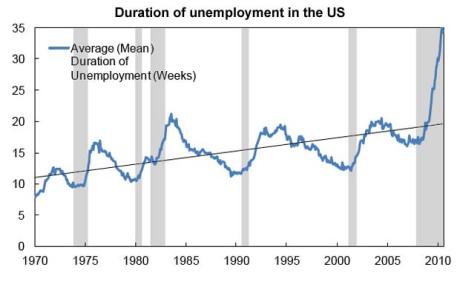
U.S. Duration of Unemployment (Weeks)
Via: Telegraph:
America and Europe face the worst jobs crisis since the 1930s and risk “an explosion of social unrest” unless they tread carefully, the International Monetary Fund has warned.
“The labour market is in dire straits. The Great Recession has left behind a waste land of unemployment,” said Dominique Strauss-Kahn, the IMF’s chief, at an Oslo jobs summit with the International Labour Federation (ILO).
He said a double-dip recession remains unlikely but stressed that the world has not yet escaped a deeper social crisis. He called it a grave error to think the West was safe again after teetering so close to the abyss last year. “We are not safe,” he said.
A joint IMF-ILO report said 30m jobs had been lost since the crisis, three quarters in richer economies. Global unemployment has reached 210m. “The Great Recession has left gaping wounds. High and long-lasting unemployment represents a risk to the stability of existing democracies,” it said.
The study cited evidence that victims of recession in their early twenties suffer lifetime damage and lose faith in public institutions. A new twist is an apparent decline in the “employment intensity of growth” as rebounding output requires fewer extra workers. As such, it may be hard to re-absorb those laid off even if recovery gathers pace. The world must create 45m jobs a year for the next decade just to tread water.
Olivier Blanchard, the IMF’s chief economist, said the percentage of workers laid off for long stints has been rising with each downturn for decades but the figures have surged this time.
“Long-term unemployment is alarmingly high: in the US, half the unemployed have been out of work for over six months, something we have not seen since the Great Depression,” he said.