Australia: 90% of Web Surveillance Document Censored to Stop ‘Premature Unnecessary Debate’
July 23rd, 2010Via: Sydney Morning Herald:
The federal government has censored approximately 90 per cent of a secret document outlining its controversial plans to snoop on Australians’ web surfing, obtained under freedom of information (FoI) laws, out of fear the document could cause “premature unnecessary debate”.
The government has been consulting with the internet industry over the proposal, which would require ISPs to store certain internet activities of all Australians – regardless of whether they have been suspected of wrongdoing – for law-enforcement agencies to access.
All parties to the consultations have been sworn to secrecy.
Industry sources have claimed that the controversial regime could go as far as collecting the individual web browsing history of every Australian internet user, a claim denied by the spokesman for Attorney-General Robert McClelland.
The exact details of the web browsing data the government wants ISPs to collect are contained in the document released to this website under FoI.
The document was handed out to the industry during a secret briefing it held with ISPs in March.
But from the censored document released, it is impossible to know how far the government is planning to take the policy.
The government is hiding the plans from the public and it appears to want to move quickly on industry consultation, asking for participants to respond within only one month after it had held the briefings.
European Banks “Stress Test” Nonsense
July 23rd, 2010Seven of 91 banks failed (breaking on CNBC), but note the part in bold below.
Via: Bloomberg:
The 91 banks undergoing stress tests were examined on European sovereign debt losses only for the bonds they trade, rather than those they hold to maturity, which may make the tests easier to pass.
Portfolios of sovereign five-year bonds were tested on trading books with banks needing to keep a Tier 1 capital ratio of 6 percent to pass, according to the Committee of European Banking Regulators, which is overseeing the exams. The stress tests assume a loss of 23.1 percent on Greek debt, 12.3 percent on Spanish bonds, 14 percent on Portuguese bonds and 4.7 percent on German state debt.
“The haircuts are applied to the trading book portfolios only, as no default assumption was considered,” according to a confidential European Central Bank document obtained by Bloomberg News dated July 22 and titled “EU Stress Test Exercise: Key Messages on Methodological Issues.”
European Union regulators are examining the strength of banks to determine if they can survive potential losses on sovereign-bond holdings. They are counting on the tests to reassure investors about the health of financial institutions from Germany’s WestLB AG and Bayerische Landesbank to Spanish savings banks as the debt crisis pummels the bonds of Greece, Spain and Portugal.
‘Lenient Treatment’
The “lenient treatment of bank book exposures” is part of a “sugarcoating” of the stress test results, Sony Kapoor, managing director of policy group Re-Define Europe, said before the criteria was released.
Information About DHS FOIA Requesters Reported to Political Staff
July 23rd, 2010Via: AP:
For at least a year, the Homeland Security Department detoured hundreds of requests for federal records to senior political advisers for highly unusual scrutiny, probing for information about the requesters and delaying disclosures deemed too politically sensitive, according to nearly 1,000 pages of internal e-mails obtained by The Associated Press.
The department abandoned the practice after AP investigated. Inspectors from the department’s Office of Inspector General quietly conducted interviews with employees last week to determine whether political advisers acted improperly.
The Freedom of Information Act, the main tool forcing the government to be more open, is designed to be insulated from political considerations. But in July 2009, Homeland Security introduced a directive requiring a wide range of information to be vetted by political appointees for “awareness purposes,” no matter who requested it.
The government on Wednesday estimated fewer than 500 requests underwent such political scrutiny; the Homeland Security Department received about 103,000 total requests for information last fiscal year.
These special reviews at times delayed the release of information to Congress, watchdog groups and the news media for weeks beyond the usual wait, even though the directive specified the reviews should take no more than three days.
This, despite President Barack Obama’s statement that federal workers should “act promptly” under the information law and Attorney General Eric Holder’s assertion: “Unnecessary bureaucratic hurdles have no place in the new era of open government.”
The foot-dragging reached a point that officials worried the department would get sued, one e-mail shows.
“We need to make sure that we flip these ASAP so we can eliminate any lag in getting the responses to the requesters,” the agency’s director of disclosure, Catherine Papoi, wrote to two of Secretary Janet Napolitano’s staffers. “Under the statute, the requester now has the right to allege constructive denial and take us to court. Please advise soonest.”
Under the directive, career employees were ordered to provide Napolitano’s political staff with information about people who asked for records, such as where they lived and whether they were reporters, and details about their organizations.
If a member of Congress sought such documents, employees were told to specify Democrat or Republican.
A department spokesman, Sean Smith, said the mandatory reviews by political appointees never blocked records that otherwise would have been released.
One Economic Chart That You Should Permanently Burn Into Your Memory
July 23rd, 2010Via: Economic Collapse Blog:
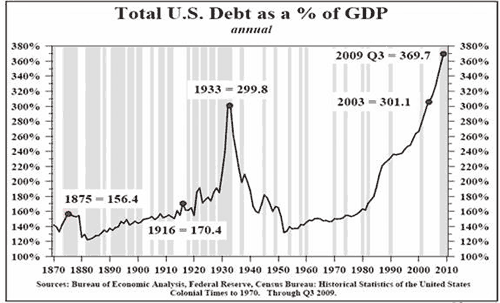
Total U.S. Debt as Percent of GDP
Congress Ranks Last in Confidence in Institutions
July 23rd, 2010In other Scum and Villainy news: Panel Hits Rangel with Ethics Violations.
Via: Gallup:
Gallup’s 2010 Confidence in Institutions poll finds Congress ranking dead last out of the 16 institutions rated this year. Eleven percent of Americans say they have “a great deal” or “quite a lot” of confidence in Congress, down from 17% in 2009 and a percentage point lower than the previous low for Congress, recorded in 2008.
Underscoring Congress’ image problem, half of Americans now say they have “very little” or “no” confidence in Congress, up from 38% in 2009 — and the highest for any institution since Gallup first asked this question in 1973.
Marine at Heart of Camp Pendleton Stolen Files Case Dies
July 22nd, 2010Via: AP:
A Marine Corps colonel accused of leaking classified information to an anti-terrorism unit of the Los Angeles County Sheriff’s Department has died.
The San Bernardino County Sheriff’s Department says Larry J. Richards was suffering brain, kidney and liver problems when he died Saturday at his home in Lake Arrowhead. He was 52.
Richards was a Marine reservist and sheriff’s detective in 2003 and 2004 when he allegedly helped leak Marine intelligence information from Camp Pendleton to an anti-terrorism task force he helped organize. He was later recalled to active Marine duty and was awaiting a military hearing.
Four other Marines have been convicted in the case.
The military has not released the nature of the leaked information.
More Car Buyers Paying With Cash Rather Than Borrowing
July 22nd, 2010This is exactly what Becky and I have been doing for years:
“It seems people are re-assessing their financial situations and deciding to spend less, buy used and pay more often with cash…”
Via: Car Connection:
It appears the recent economic downturn and spate of fuel price rises has not only changed the types of cars we buy, but also the way we pay for them. The latest study by independent vehicle pricing and information authority Kelley Blue Book has revealed that new car buyers are almost twice as likely to pay for their new purchase with cash as they were just three years ago.
The results are based on the findings of 338 in-market car shoppers surveyed last month on Kelley Blue Book’s website (kbb.com) and show that 74 percent of respondents plan to buy a car within the next six months; 67 percent of them opting for a used car and the remaining 33 percent planning to buy new.
Of these, 42 percent of used car shoppers and 20 percent of new car shoppers said they plan to pay cash for their next vehicle instead of going with a loan. Just three years ago, only 11 percent of new car buyers wanted to pay cash (there is no data for used car buyers).
“In-market car shoppers are taking a decidedly conservative approach to car buying right now, which we think can be directly attributed to low consumer confidence in the current economy,” explained Kelley Blue Book market analyst James Bell. “It seems people are re-assessing their financial situations and deciding to spend less, buy used and pay more often with cash…”
Canada: Woman Humiliated During Airport Strip Search
July 22nd, 2010Via: Toronto Sun:
Shileen Flynn, 29, had already missed one flight and lost her luggage when she says she found herself in a room at the Vancouver airport, naked and squatting, while two crude border agents strip-searched her.
…
Flynn — a frequent traveller who has been strip-searched twice before — said this time was different. She said the women made her bend over a table, open her legs, and squat and cough. They asked her personal questions, like when she last had sex, Flynn said.
She fought back tears throughout the ordeal.
“I thought, if I start crying, they’re gonna think I’m guilty,” she said.
“As soon as they finished the strip search, I started bawling.”
One guard told her if she didn’t stop crying, she’d be detained, Flynn said. When she explained why she was crying, Flynn said a guard piped up: “How do you think I feel? I just had lunch. You make me feel sick.”
“It’s the most embarrassing thing that’s ever happened to me in my life,” said Flynn, who cried the whole way to Frankfurt. “It was totally demeaning and degrading. … I’ve done nothing wrong. Absolutely nothing wrong.”
As soon as she got to Spain, she called her father, Charlie Flynn, who reported what happened to CBSA.
CBSA launched an internal investigation, interviewing Shileen and the officers involved.
After months of back and forth, Charlie received a letter from CBSA that read: “We have fully investigated the incident and concluded that the BSOs involved in examination of your daughter followed established guidelines and conducted themselves in a professional manner.”
Emotiv Systems Neural Interface
July 22nd, 2010Via: TED:
Tan Le’s astonishing new computer interface reads its user’s brainwaves, making it possible to control virtual objects, and even physical electronics, with mere thoughts (and a little concentration). She demos the headset, and talks about its far-reaching applications.
Big Picture Gallery: Oil Spill in Dalian, China
July 22nd, 2010Via: Big Picture:
Five days ago, in the northeastern port city of Dalian, China, two oil pipelines exploded, sending flames hundreds of feet into the air and burning for over 15 hours, destroying several structures – the cause of the explosion is under investigation. The damaged pipes released thousands of gallons of oil, which flowed into the nearby harbor and the Yellow Sea. The total amount of oil spilled is still not clear, though China Central Television earlier reported an estimate of 1,500 tons (400,000 gallons), as compared to the estimated 94 – 184 million gallons in the BP oil spill off the Louisiana coast. The oil slick has now grown to at least 430 square kilometers (165 sq mi), forcing beaches and port facilities to close while government workers and local fishermen work to contain and clean up the spill.