Japan’s Prime Minister Announces Resignation
June 2nd, 2010Change we can believe in, Japanese style.
Via: CNN:
Japanese Prime Minister Yukio Hatoyama announced Wednesday he will resign after eight months in power.
“I’m going to step down,” Hatoyama declared in a live broadcast on Japanese television NHK, while addressing party members of both the upper and lower houses of the Diet, Japan’s parliament.
“I have had many shortcomings, I have been allowed to lead all of you for the past eight months to today. I am extremely grateful for having been given this opportunity,” he said.
Eight months ago, Hatoyama’s Democratic Party of Japan won a sweeping victory, an outcome hailed by many as a revolution in Japanese politics.
With promises of a cleaner government, Hatoyama worked to shift the political dynamics in Japan by taking away power from the bureaucrats and granting more power to politicians and local governments.
In his first speech as Japan’s 92nd prime minister, Hatoyama made promises that he would conduct a clean and transparent government, launching a task force to monitor government spending.
But soon afterwards, allegations of illegal campaign financing tarnished his administration’s image. Some of his cabinet members were investigated for corruption.
His approval rating took further hits over his failed promise to move a major U.S. Marine base off Okinawa to ease the burden of the island, which hosts the majority of the United States military presence in Japan. Earlier this month, calling his decision “heartbreaking,” he announced that the base would remain on Okinawa, although relocated to a different part of the island.
Hatoyama’s critics claimed he gave in to U.S. pressure, and his government coalition broke up.
Hatoyama said that while he did lose public trust, he hopes future generations will remember his legacy.
“Ladies and gentlemen, I have often been dubbed as an alien and how I understand this is that I see not current Japan but always try to see future Japan,” he said.
“Local government, local communities should be the main actors,” said Hatoyama.
“In five or ten years people of Japan will understand what I am talking about.”
Parliamentary elections are scheduled to take place in July.
The DPJ will now elect a new leader of the party — most likely on Friday — who will be in line to be the next prime minister of Japan.
Some time early next week, Hatoyama will dissolve his cabinet in the morning and the new party leader will stand for election as new prime minister by both upper and lower houses of parliament.
Next Up for BP Oil Disaster: Hurricane Season
June 1st, 2010Via: Miami Herald:
If the growing oil disaster in the Gulf of Mexico isn’t contained soon – and the latest efforts suggest that’s unlikely – then the damage to the fragile region will intensify over the coming summer months as changing currents and the potential for hurricanes complicate the containment and cleanup efforts.
“It’s all lose, lose, lose here,” said Rick Steiner, a retired University of Alaska marine scientist who’s familiar with both the current Gulf oil spill and the Exxon Valdez disaster two decades ago.
“The failure of the top kill really magnified this disaster exponentially,” he said. “I think there’s a realistic probability that this enormous amount of oil will keep coming out for a couple months. This disaster just got enormously worse.”
As the federal government and BP try yet another strategy to curb the flow of oil from the blown well a mile below the surface of the Gulf – one that could increase the flow of oil by as much as 20 percent – scientists anticipate a range of disastrous effects, only some of which are well understood.
The damage to the shorelines of Gulf states such as Louisiana, Mississippi, Alabama and Florida is literally only the surface of the problem: The damage to the sea floor could be extensive, and oil could also devastate marine life between the Gulf floor and its surface, as well as in coastal areas far from the leaking wellhead.
If none of the short-term solutions plugs the well, the only long-term fix – drilling two relief wells to stem the flow of oil – likely won’t be completed until late July or August. President Barack Obama on Saturday called the news about the latest failed attempt “as enraging as it is heartbreaking.”
“As I said yesterday, every day that this leak continues is an assault on the people of the Gulf Coast region, their livelihoods, and the natural bounty that belongs to all of us,” he said in a White House statement.
Larry Crowder, a professor of marine biology at Duke University, said if the spill continues for a couple more months, then oil almost certainly would get into the Loop Current that flows clockwise around the Gulf. It then would be a week to 10 days before it got to the Florida Keys, and a couple of weeks more before the Gulf Stream carried it to North Carolina.
If the leak had been stopped this weekend, the oil might have been diluted, but if there’s two to three times the current amount by August, he said: “It could go anywhere.”
“If you have enough oil, it can go a big distance,” and some 100 million gallons could be spilled by this summer. “There’s almost no place that’s off-limits,” Crowder said.
With summer approaching, hurricanes are the most obvious complication. The National Oceanic and Atmospheric Administration predicts an above-average hurricane season, and a hurricane getting into the Gulf and moving toward the Louisiana coast could force BP to halt its effort to drill the relief wells until the storm passed.
Hurricanes also could disperse the oil farther and wider – or roil the waters so oil at the surface plunges to great depths and poisons the deepwater ecosystem.
Any hurricane and its accompanying storm surge also could drive oil onto land, even into the rice and sugarcane fields that aren’t far from the coast in Louisiana, said James H. Cowan Jr., a biological oceanographer at Louisiana State University.
“It will probably get stranded if it gets to the upper estuary, and it’s very difficult to clean there,” he said.
Japan Plans to Build Robot Moon Base by 2020
June 1st, 2010Via: PhysOrg:
Believing that a moon base is essential for exploration of the solar system, Japan has recently announced plans to send humanoid robots to the moon to construct a robot lunar base. As part of the $2.2 billion project, the robots will begin surveying the moon around 2015, and then build the unmanned base near the moon’s South Pole by 2020.
A Japanese government panel chaired by Katsuhiko Shirai, President of Waseda University, has developed a rough outline of the project. First, the robots, weighing about 660 pounds each, will begin by surveying the moon, taking images of the surface, collecting rocks, and returning the rocks to Earth via rocket for seismographic research. Later, robots will be sent to the moon to construct the lunar base for themselves.
According to the government panel, the robots and the unmanned moon base will be powered by solar panels. The robots will be controlled from Earth, but will also have a high degree of autonomy that enables them to operate on their own to perform certain tasks. Ultimately, the base could serve as a starting point for future robot colonizers, and even human colonizers.
Navy’s Drone Death Ray Takes Out Targets at Sea
June 1st, 2010Via: Wired:
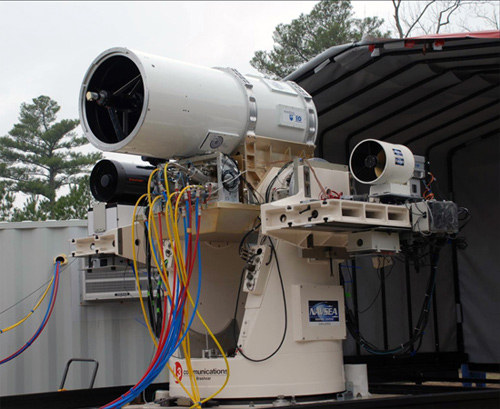
LaWS
For years, the U.S. Navy has been pursuing a workable ray gun that could provide a leap ahead in ship self-defenses. Now, with a series of tests of a system called the Laser Weapon System, or LaWS), it may be one step closer to that goal.
Naval Sea Systems Command (NAVSEA), the service’s technology development arm, announced today that LaWS had “successfully tracked, engaged, and destroyed” a drone in flight, during an over-the-water engagement at San Nicholas Island, Calif.
It’s certainly not the first time lasers have shot down an unmanned aerial vehicle — last year, the Air Force zapped several drones with beam weapons in a series of tests at China Lake, Calif. — but this test brings an additional bit of realism — and an extra technical challenge. Laser beams can lose strength as they move through the moist, salty sea atmosphere above the sea, so the Navy needs directed-energy weapons that can work effectively on ships.
The LaWS is essentially a laser upgrade to the MK 15 Close In Weapon System (CIWS), a.k.a. the Phalanx gun, a radar-guided autocannon that is already installed on Navy surface combatants. According to NAVSEA, the system tested (shown here) fired a laser through a beam director installed on a tracking mount, which in turn was controlled by a Mk 15 CIWS. That’s the basically same system that controls the Phalanx.
Cries From the Past: Torture’s Ugly Echoes
June 1st, 2010This is too long for general interest Cryptogonner reading, but well worth it for those who are interested in the mind control subject matter.
Via: Truthout:
A central Artichoke objective, according to one CIA document, centered on: “The problem exists of ascertaining whether effective and practical techniques exist, or could be developed, which could be utilized to render an individual subservient to an imposed will or control, thereby posing a potential threat to National Security.” [Italics added]
The same document explained that the Agency also wanted to put the same techniques to their own effective uses in the field offensively. Reads the document: “We need to also explore the ‘subtle’ means of making an individual say or do things he would normally not consider through the use of covertly administered drugs, ‘Black Psychiatry’*, hypnosis, and brain damaging processes. Dr. Chadwell feels these processes may be tried but they are ‘elaborate, impractical and unnecessary.'”[Italics added. Dr. Chadwell was H. Marshall Chadwell, the CIA’s director of Scientific Intelligence.]
A subsequent April 1954 Artichoke Conference meeting, attended by Frank Olson’s Fort Detrick superior, Col. Vincent Ruwet, explored the real nitty-gritty of Artichoke experimentation. Noted a CIA report on the meeting, “It was also recognized [by conference participants] that if Morse Allen and his group could produce bodies and if certain very rough, primitive, and ultimate tests could be carried out then a more accurate prediction could be made in connection with the ultimate goal of the group which is the running of selected foreign nationals back into Europe for specific work for this Agency.”
CIA Security Research chief Paul Gaynor, attending the same Artichoke Conference meeting, reminded the gathered Agency and Fort Detrick officials, “All individuals can be broken under mental and physical assaults and by such techniques as denying sleep, exhaustion, persuasion, starvation, pain, humiliation, and sickness.”
Giant Sinkhole in Guatemala
June 1st, 2010Must see.
Via: National Post:
A huge sinkhole caused by a landslide due to tropical storm Agatha, in Guatemala City, on May 30, 2010.
Research Credit: T
At Least 10 Dead as Israel Attacks Gaza Aid Flotilla
May 31st, 2010Via: Los Angeles Times:
Israeli naval ships seized control of a protest flotilla carrying humanitarian aid to the Gaza Strip on Monday, killing at least 10 people and injuring several dozen, the Israeli military said.
“Israel expresses sorrow for those killed in the takeover,” the Israeli Cabinet said in a statement, according to one Hebrew-language website.
Israeli television, citing foreign media reports, said the death toll could be as high as 16.
“The images are certainly not pleasant. I can only voice regret at all the fatalities,” Trade and Industry Minister Binyamin Ben-Eliezer told Israel’s Army Radio.
The Israeli military said its soldiers were attacked with knives, clubs and other objects when they boarded one of the vessels. A military spokesman said protesters grabbed a commando’s weapon and soldiers came under fire. But protest organizers insisted they were unarmed.
Protest organizers described a chaotic early-morning takeover in international waters.
A flotilla spokeswoman, Greta Berlin, told Israel Radio that the confrontation was broadcast live from a Turkish boat participating in the flotilla. The footage, she said, clearly showed Israeli soldiers landing on the deck and opening fire on civilians.
“The minute their feet hit the deck, they started to shoot,” Berlin said.
She added, “Something happened to your country to make it think it is all right” to shoot civilians.
Israel Defense Force sources told Ynet, a popular Hebrew-language website, that the “organizers were not innocent — they demonstrated violence against the soldiers. They were prepared for their arrival.”
Israeli radio military analyst Yoav Limor blamed the military for underestimating the resistance it would encounter. “There was serious violence” that forced the soldiers to open fire, he said.
Video images released by the protesters appeared to show passengers beating commandos with clubs as the soldiers rappelled onto the vessel’s deck. A live video feed, which showed bloodstains and injured people, was abruptly cut.
The Turkish government issued a statement that “strongly protested” Israel’s military action, according to Associated Press. The interception on the convoy is “unacceptable…. Israel will have to endure the consequences of this behavior,” the statement read.
Turkish media reported angry protesters shouting “Damn Israel!” outside the Israeli Consulate in Istanbul.
Israel put its security forces on alert in case of demonstrations by the nation’s Arab minority.
Flotilla organizers say they were carrying first-aid supplies and medical professionals in the event of casualties, but Adam Shapiro, the husband of one flotilla leader, said that “we thought that the possibility that Israeli soldiers would shoot” was remote.
Flotilla organizers said they carried no weapons.
The six-vessel flotilla, packed with hundreds of international activists, food and other humanitarian supplies, had left Cyprus on Sunday night in an attempt to break Israel’s longstanding blockade of the Gaza Strip.
Cryptogon Readers Send Contributions
May 31st, 2010Eileen sent $100. DB sent $10. JA sent $20.
Thank you.
Detonating Nuclear Bomb at BP Oil Spill Site… Might Produce a Bad Result
May 31st, 2010See: Obama Sends Bomb, Mars Experts to Fix BP Oil Spill:
U.S. Energy Secretary Steven Chu signaled his lack of confidence in the industry experts trying to control BP Plc’s leaking oil well by hand-picking a team of scientists with reputations for creative problem solving.
Dispatched to Houston by President Barack Obama to deal with the crisis, Chu said Wednesday that five “extraordinarily intelligent” scientists from around the country will help BP and industry experts think of back-up plans to cut off oil from the well, leaking 5,000 feet (1,500 meters) below sea-level.
Members of the Chu team are credited with accomplishments including designing the first hydrogen bomb, inventing techniques for mining on Mars and finding a way to precisely position biomedical needles.
“I don’t think there is a lot of confidence in BP in Washington right now,” David Pursell, a managing director at Tudor Pickering Holt & Co. LLC in Houston, said by phone. Chu’s decision to bring in additional scientists may reflect that concern, he said.
…
Their exact activities are cloaked in secrecy. “We saw some confidential and proprietary information,” said one scientist on the team, Jonathan I. Katz, a physics professor at Washington University in St. Louis.
Katz’s early work focused on astrophysics, but now he consults on a wide variety of physics puzzles, he said. He is a member of the JASON group, a think tank dedicated to researching complex problems for the U.S. Government, including the Defense Department.
Via: Technofascism Blog:
Lately, I’ve heard many talking heads in the news media suggesting that the only way to stop the BP oil leak might be to detonate a nuclear bomb under the leak site.
Before they consider that option, they might want to watch this video of Dr. Gregory Ryskin, Professor of Chemical Engineering at Northwestern University. In the video, Dr. Ryskin explains how a prehistoric methane gas explosion could explain the Permian-Triassic Extinction Event, a mysterious period in Earth history where 95% of all species went extinct.
Given that the amount of methane gas that is leaking from the BP spill site is at least equal to the amount of oil, it would lead one to believe that there is a huge underground pocket of methane gas buried there. Now, if Dr. Ryskin’s theory is correct, not only would detonating a nuclear bomb near that underground methane pocket end the oil spill, it might end all life on Earth as well.
Toolkit: A Look at the Gear That Experts Use to Spy on Spies
May 31st, 2010Via: Wired:
When companies like Archer Daniels Midland and Liberty Mutual Insurance are worried that someone is bugging their boardrooms or tapping their phone lines, they call Kevin Murray. He heads one of the most sophisticated surveillance-detection firms this side of the FBI. Wired asked Murray about the bevy of gizmos he and his staff use to sniff out corporate espionage.