Deepwater Horizon Survivors Kept in Seclusion After Rig Explosion, Coerced Into Signing Legal Waivers
May 25th, 2010Via: Yahoo News:
According to two surviving crew members of the Deepwater Horizon, oil workers from the rig were held in seclusion on the open water for up to two days after the April 20 explosion, while attorneys attempted to convince them to sign legal documents stating that they were unharmed by the incident. The men claim that they were forbidden from having any contact with concerned loved ones during that time, and were told they would not be able to go home until they signed the documents they were presented with.
Stephen Davis, a seven-year veteran of drilling-rig work from San Antonio, told The Guardian’s Suzanne Goldenberg today that he was held on a boat for 36 to 40 hours after diving into the Gulf from the burning rig and swimming to safety. Once on a crew boat, Davis said, he and the others were denied access to satellite phones or radio to get in touch with their families, many of whom were frantic to find out whether or not they were OK.
Davis’ attorney told Goldenberg that while on the boat, his client and the others were told to sign the statements presented to them by attorneys for Transocean — the firm that owned the Deepwater Horizon — or they wouldn’t be allowed to go home. After being awake for 50 harrowing hours, Davis caved and signed the papers. He said most of the others did as well.
Davis’ story seems to be backed up by a similar account given to NPR by another Deepwater Horizon crewmember earlier in the month. Christopher Choy, a roustabout on the rig, said that the lawyers gathered the survivors in the galley of a boat and said, “‘You need to sign these. Nobody’s getting off here until we get one from everybody.’ … At the bottom, it said something about, like, you know, this can be used as evidence in court and all that. I told them, ‘I’m not signing it.’ ”
Choy said that once he was finally allowed to get off the boat, he was shuttled to a hotel, where he met up with his wife. At the hotel, representatives from Transocean confronted him again and badgered him to sign the statement. Exhausted, traumatized and desperate to go home, Choy said that he finally relented and signed.
Choy’s lawyer, Steve Gordon, is incensed over what transpired in the hours after the explosion. He, along with other attorneys for Deepwater Horizon workers, is trying to get the documents voided by the courts.
“It’s absurd. It’s unacceptable, and it’s irresponsible,” Gordon told NPR.
Oil Reaches Louisiana Shores
May 25th, 2010Via: Boston Globe Big Picture Gallery:
Over one month after the initial explosion and sinking of the Deepwater Horizon oil rig, crude oil continues to flow into the Gulf of Mexico, and oil slicks have slowly reached as far as 12 miles into Louisiana’s marshes. According to Louisiana Governor Bobby Jindal, more than 65 miles of Louisiana’s shoreline has now been oiled. BP said it will be at least Wednesday before they will try using heavy mud and cement to plug the leak, a maneuver called a “top kill” that represents their best hope of stopping the oil after several failed attempts. Based on low estimates, at least 6 million gallons of crude have spewed into the Gulf so far – though some scientists have said they believe the spill already surpasses the 11 million-gallon 1989 Exxon Valdez oil spill off Alaska as the worst in U.S. history.
The Coca-Cola Case
May 25th, 2010Via: National Film Board of Canada:
Cryptogon Reader Sent Contribution
May 25th, 2010JR sent $20. Thank you.
Increase in Covert Operations Across Middle East
May 25th, 2010Via: Reuters:
A senior U.S. military commander issued a secret order last year that laid the ground for an escalation of covert operations across the Middle East and the Horn of Africa, officials said on Monday.
Issued last September by General David Petraeus, the order authorized an escalation that included boosting military and intelligence assistance to help Yemeni forces strike al Qaeda targets, as well as deployment of more unmanned aerial drones to collect information and track high-value targets.
The order also authorized U.S. Special Operations units to work with local security forces to counter al Qaeda and other threats, a goal Pentagon officials have made no secret of.
As the head of the U.S. military’s Central Command, Petraeus oversees U.S. wars in Iraq and Afghanistan and plays a major role in planning for any possible military action against Iran over its nuclear program.
The order was first reported by the New York Times, which quoted a document it obtained as saying the goal was to build networks that could “penetrate, disrupt, defeat or destroy” al Qaeda and other militant groups as well as “prepare the environment” for future attacks by U.S. or local military forces.
The newspaper said the directive also appeared to authorize specific operations in Iran, most likely to gather intelligence about its nuclear program or identify dissident groups that might be useful for any future military offensive.
Some of the covert military operations that followed the secret order have been reported. These include a September 2009 attack by helicopter-borne Special Operations Forces on a car carrying one of east Africa’s most wanted al Qaeda militants, Kenyan-born Saleh Ali Saleh Nabhan.
Central Command has been positioning Reaper drones at a base in the Horn of Africa. Officials said the drones can be used against militants in Yemen and Somalia, and even against pirates who attack ships traversing the Gulf of Aden and the Indian Ocean.
“They (the drones) are part of it but it is much broader than that,” one U.S. official said of the order.
In February, Defense Secretary Robert Gates authorized $150 million in security assistance for Yemen for fiscal 2010, up from $67 million last year.
Officials told Reuters the money would be used in part to bolster Yemen’s special operations forces to lead an offensive targeting al Qaeda in the Arabian Peninsula, which claimed responsibility for a failed plot to blow up a U.S. passenger plane on Christmas Day.
The group has emerged as one of al Qaeda’s most active affiliates, and the Obama administration recently took the extraordinary step of authorizing the CIA to kill a leading figure linked to the group — American-born Muslim cleric Anwar al-Awlaki.
Open Thread: Various BP Oil Spill Theories
May 25th, 2010Want to discuss BP oil spill theories that are percolating though the rumor sphere? Go for it here.
I’ve seen all of the ones that you guys have submitted (and then some!), but I can’t find any sources that I feel are worth mentioning here.
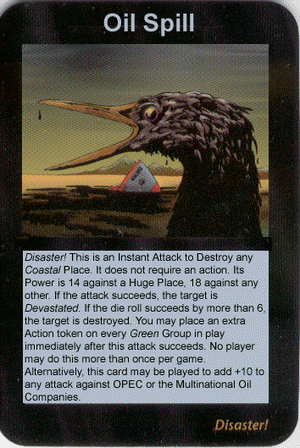
Oil Spill Card from Illuminati Role Playing Game
This is not to say that I think we’re getting the full picture from the corporate media on this cataclysm. As per routine, it’s probably not that bad, it’s worse. But, from long experience, I avoid posting stuff from sites that generate in excess of 95% noise and rat poison, consider Sucha Fool to be an authoritative source of information and have roll playing/social engineering games running as factual threads (complete with teams of trolls egging on the peanut gallery).
However, there is that other 5% of information that might represent legitimate signal… Think you have a grip on that 5%, well, shine on you wild diamond. This is the place.
If you want to mention something about the sea floor, the alleged looped video, space based beam weapons, etc. go for it.
Goldman Sachs Linked to Toxic Oil Dispersal Chemical Used by BP in Gulf of Mexico
May 24th, 2010Many tentacles.
Via: Picasso Dreams:
2003
…
The Blackstone Group, Apollo Management L. P. and Goldman Sachs Capital Partners buy Ondeo Nalco.
A Billionaire Goes All-In on Gold
May 24th, 2010Via: Wall Street Journal:
Gold is setting records again, boosting the holdings of central banks, Armageddon worrywarts, and ordinary people who own gold bars, coins and jewelry.
But few individuals stand to benefit as much as low-profile billionaire Thomas Kaplan. A New York-born commodities magnate who earned a doctorate in British colonial history at Oxford, Mr. Kaplan oversees an empire devoted largely to gold.
Many fund managers and high-rollers have allocated small percentages of their portfolios to gold as a hedge against inflation. But Mr. Kaplan is the bull of bullion. He has gone further than perhaps any other major investor, betting the majority of his wealth on gold and other precious metals. And it reflects his deeply held conviction that global economic instability could bring rising demand for gold.
Through his firm, Tigris Financial Group, and affiliates, Mr. Kaplan has loaded up on bullion and bought up properties in 17 countries on five continents, where geologists are exploring for more. Tigris subsidiaries have taken stakes in mining companies, including tiny firms that have yet to produce an ounce.
Though he won’t disclose how much physical gold he owns, Mr. Kaplan, who is 47 years old, controls up to 30% of the shares in some so-called junior miners. Together, his holdings amount to a nearly $2 billion bet on gold, more than the Brazilian central bank’s bullion is currently worth.
Flashback 2002: Australian Scientist Urged Government to Use Biological Weapons Against “Overpopulated” Countries
May 24th, 2010Via: The Age:
World-famous microbiologist Sir Macfarlane Burnet, the Nobel prize winner revered as Australia’s greatest medical research scientist, secretly urged the government to develop biological weapons for use against Indonesia and other “overpopulated” countries of South-East Asia.
The revelation is contained in top-secret files declassified by the National Archives of Australia, despite resistance from the Department of Foreign Affairs and Trade.
Sir Macfarlane recommended in a secret report in 1947 that biological and chemical weapons should be developed to target food crops and spread infectious diseases.
His key advisory role on biological warfare was uncovered by Canberra historian Philip Dorling in the National Archives in 1998.
The department initially blocked release of the material on the basis it would damage Australia’s international relations. Dr Dorling sought a review and the material was finally released to him late last year.
The files include a comprehensive memo Sir Macfarlane wrote for the Defence Department in 1947 in which he said Australia should develop biological weapons that would work in tropical Asia without spreading to Australia’s more temperate population centres.
“Specifically to the Australian situation, the most effective counter-offensive to threatened invasion by overpopulated Asiatic countries would be directed towards the destruction by biological or chemical means of tropical food crops and the dissemination of infectious disease capable of spreading in tropical but not under Australian conditions,” Sir Macfarlane said.
The Victorian-born immunologist, who headed the Walter and Eliza Hall Institute of Medical Research, won the Nobel prize for medicine in 1960. He died in 1985 but his theories on immunity and “clonal selection” provided the basis for modern biotechnology and genetic engineering.
On December 24, 1946, the secretary of the Department of Defence, F.G. Shedden, wrote to Macfarlane Burnet saying Australia could not ignore the fact that many countries were conducting intense research on biological warfare and inviting him to a meeting of top military officers to discuss the question.
The minutes of a meeting in January, 1947, reveal that Sir Macfarlane argued that Australia’s temperate climate could give it a significant military advantage.
“The main contribution of local research so far as Australia is concerned might be to study intensively the possibilities of biological warfare in the tropics against troops and civil populations at a relatively low level of hygiene and with correspondingly high resistance to the common infectious diseases,” he told the meeting.
In September, 1947, Sir Macfarlane was invited to join a chemical and biological warfare subcommittee of the New Weapons and Equipment Development Committee.
He prepared a secret report titled Note on War from a Biological Angle suggesting that biological warfare could be a powerful weapon to help defend a thinly populated Australia.
Sir Macfarlane also urged the government to encourage universities to research those branches of biological science that had a special bearing on biological warfare.
A clinically scientific approach is evident in a note he wrote in June, 1948.
He said a successful attack with a microbiological agent on a large population would have such a devastating impact that its use was extremely unlikely while both sides were capable of retaliation.
“The main strategic use of biological warfare may well be to administer the coup de grace to a virtually defeated enemy and compel surrender in the same way that the atomic bomb served in 1945.
“Its use has the tremendous advantage of not destroying the enemy’s industrial potential which can then be taken over intact.
“Overt biological warfare might be used to enforce surrender by psychological rather than direct destructive measures.”
The minutes of a meeting at Melbourne’s Victoria Barracks in 1948 noted that Sir Macfarlane “was of the opinion that if Australia undertakes work in this field it should be on the tropical offensive side rather than the defensive. There was very little known about biological attack on tropical crops.”
After visiting the UK in 1950 and examining the British chemical and biological warfare research effort, Sir Macfarlane told the committee that the initiation of epidemics among enemy populations had usually been discarded as a means of waging war because it was likely to rebound on the user.
“In a country of low sanitation the introduction of an exotic intestinal pathogen, e.g. by water contamination, might initiate widespread dissemination,” he said.
“Introduction of yellow fever into a country with appropriate mosquito vectors might build up into a disabling epidemic before control measures were established.”
The subcommittee recommended that “the possibilities of an attack on the food supplies of S-E Asia and Indonesia using B.W. agents should be considered by a small study group”.
It 1951 it recommended that “a panel reporting to the chemical and biological warfare subcommittee should be authorised to report on the offensive potentiality of biological agents likely to be effective against the local food supplies of South-East Asia and Indonesia”.
Dr Dorling said that while Sir Macfarlane was a great Australian he was also a product of times when many Australians held deep fears about more populous Asian countries.
He said the Menzies government was more interested in trying to acquire nuclear weapons. “Fortunately this also proved impracticable and Australia never acquired a weapon of mass destruction.”
The secretary of the Federation of Australian Scientific and Technological Societies, Peter French, said he had not yet seen the files but the whole notion of biological warfare was something that Australian scientists would not be comfortable with today. “Viewed through today’s eyes it is clearly an abhorrent suggestion,” Dr French said.