Swiss Artist Catalogs Mutant Insects Around Nuke Plants
May 12th, 2010Via: Wired:
Conventional wisdom holds that nuclear power stations don’t leak enough radiation to create malformed organisms. But in some locations, Hesse-Honegger discovered mutations — curtailed feelers, misshapen legs, asymmetrical wings — in as many as 30 percent of the bugs she gathered. That’s 10 times the overall rate of about 3 percent for insects found in the wild.
Senate Votes 96-0 to Audit Federal Reserve
May 12th, 2010Senate Passes Watered Down Sanders Amendment to Audit the Fed 96-0
Via: Los Angeles Times:
The Senate voted 96 to 0 on Tuesday to authorize a congressional audit of the secretive Federal Reserve Board’s emergency aid program and full disclosure of who got the money, a plan that could reveal more details about government help for embattled investment firm Goldman Sachs.
Under the plan, Congress’ Government Accountability Office would conduct a top-to-bottom audit of all the Federal Reserve’s emergency activities since the economic crisis began in December 2007. The Fed also would have to post on its website all recipients of money from the more than $2 trillion in emergency aid that’s been disbursed since then.
The GAO also would look into whether the financial deals involved conflicts of interest. It’s common for members of the board of directors of the powerful Federal Reserve Bank of New York, for example, also to be executives or directors of banks that got government bailout money.
The Fed also is locked in a court fight over a Freedom of Information Act suit to force it to identify all institutions that secretly got rescue money.
The White House and Fed Chairman Ben S. Bernanke had opposed the Fed audit but relented after two concessions were made: It will be done only once and the list of funding recipients won’t appear on the Internet until Dec. 1, rather than 30 days after enactment.
The vote Tuesday was on an amendment to a financial overhaul package making its way through the Senate.
Gold Hits New Record High
May 12th, 2010Warning: This is not a recommendation to buy, sell or hold any financial instrument.
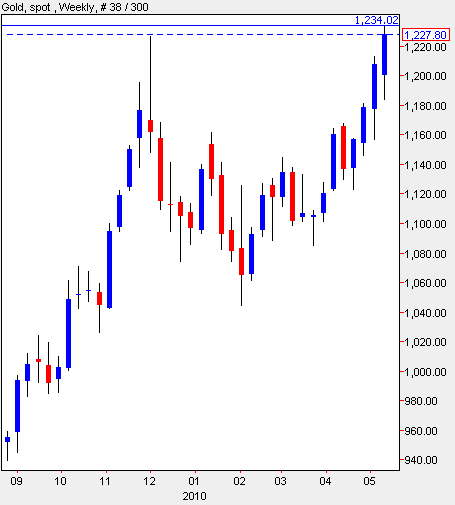
Spot Gold, Weekly Interval
Internet Approaches Addressing Limit
May 12th, 2010I wouldn’t be too concerned about this one.
IPv6 has been in roll out phase for several years. Modern operating systems support IPv6. Windows XP, by far the most popular operating system, has supported IPv6 since Service Pack 1. While XP is the most popular OS, it is dropping slowly every month now, mostly because of uptake of Windows 7, which includes native support for IPv6.
There are latency issues with running both addressing schemes at once, but, believe me, once push comes to shove, the move will be made and new network operators will say things like, “IPv6 only,” etc.
IT organizations are notorious for foot dragging when it comes to making major changes, but when there’s no choice (the PHBs usually have to get bloody as a result of ignoring the warnings from the IT department) the changes will be implemented.
So, why bother mentioning this?
September 9, 2011 is the date that the IPv4 addresses are expected to run out.
Have a nice day!
Via: BBC:
In less than 18 months there will be no more big blocks of net addresses to give out, estimates suggest.
Predictions name 9 September 2011 as the date on which the last of those tranches is released for net firms and others to use.
Everything connected to the net needs an “IP address” to ensure data reaches the right person or device.
Experts say that the net’s entire existing address space will be exhausted about a year after that date.
A newer scheme is being rolled out but many firms and countries are being slow to switch, experts warn.
Small pool
The net is built around version four of the Internet Protocol addressing scheme (IPv4) which has space for about four billion addresses. Its successor – IPv6 – has trillions available.
Research Credit: PH
18 Missiles, 14 Dead in Latest Drone Attack
May 11th, 2010Via: Wired:
There was a massive drone attack in Pakistan today — one involving multiple unmanned aircraft and “up to 18 American missiles,” according to the Associated Press. 14 people are dead.
This second robotic strike in three days is the latest sign that the American drone war in Pakistan has reached a new peak. There have been 34 reported attacks in Pakistan in the first 19 weeks on 2010. That’s almost as many as the 36 strikes carried out in all of 2009. And these strikes are no longer against specific, named terrorists. Signs of militant activity are enough to bring in the drones.
The latest target, according to AFP: a training camp “run by militants attached to Taliban-linked Afghan warlord Hafiz Gul Bahadur, who is reputed to control up to 2,000 fighters who attack U.S.-led forces over the border in Afghanistan.” CNN’s national security desk wonders whether the strike is in “retaliation” for the attempted Times Square bombing — which was allegedly inspired, at least in part, by the drone attacks in Pakistan.
American Reaper drones typically fly with four weapons stations. Each of those stations can carry two, 100-pound Hellfire missiles. Last month, however, the Washington Post reported that the CIA had begun outfitting their unmanned attackers with smaller, 35-pound glide bombs. So it’s tough to tell exactly how many drones were involved in the latest strike.
Eric Holder: Miranda Rights Should Be Modified For Terrorism Suspects
May 11th, 2010Via: Huffington Post:
Attorney General Eric Holder said for the first time today on ABC’s “This Week” that the Obama administration is open to modifying Miranda protections to deal with the “threats that we now face.”
“The [Miranda] system we have in place has proven to be effective,” Holder told host Jake Tapper. “I think we also want to look and determine whether we have the necessary flexibility — whether we have a system that deals with situations that agents now confront. … We’re now dealing with international terrorism. … I think we have to give serious consideration to at least modifying that public-safety exception [to the Miranda protections]. And that’s one of the things that I think we’re going to be reaching out to Congress, to come up with a proposal that is both constitutional, but that is also relevant to our times and the threats that we now face.”
America’s system of Miranda rights developed out of a 1966 Supreme Court ruling which found that the Fifth Amendment and Sixth Amendment rights of an alleged rapist and kidnapper, Ernesto Arturo Miranda, had been violated during his arrest and trial (Miranda was later retried and convicted).
The Court ruled that before being interrogated, a person in custody must (among other things) “be clearly informed that he or she has the right to remain silent, and that anything the person says will be used against that person in court,” and that they “must be clearly informed that he or she has the right to consult with an attorney and to have that attorney present during questioning.”
Food-Stamp Tally Nears 40 Million, Sets Record
May 11th, 2010Via: Reuters:
Nearly 40 million Americans received food stamps — the latest in an ever-higher string of record enrollment that dates from December 2008 and the U.S. recession, according to a government update.
Food stamps are the primary federal anti-hunger program, helping poor people buy food. Enrollment is highest during times of economic distress. The jobless rate was 9.9 percent, the government said on Friday.
The Agriculture Department said 39.68 million people, or 1 in 8 Americans, were enrolled for food stamps during February, an increase of 260,000 from January. USDA updated its figures on Wednesday.
‘Starving Yogi’ Astounds Indian Scientists
May 11th, 2010Via: AFP:
An 83-year-old Indian holy man who says he has spent seven decades without food or water has astounded a team of military doctors who studied him during a two-week observation period.
Prahlad Jani spent a fortnight in a hospital in the western India state of Gujarat under constant surveillance from a team of 30 medics equipped with cameras and closed circuit television.
During the period, he neither ate nor drank and did not go to the toilet.
“We still do not know how he survives,” neurologist Sudhir Shah told reporters after the end of the experiment. “It is still a mystery what kind of phenomenon this is.”
The long-haired and bearded yogi was sealed in a hospital in the city of Ahmedabad in a study initiated by India’s Defence Research and Development Organisation (DRDO), the state defence and military research institute.
The DRDO hopes that the findings, set to be released in greater detail in several months, could help soldiers survive without food and drink, assist astronauts or even save the lives of people trapped in natural disasters.
“(Jani’s) only contact with any kind of fluid was during gargling and bathing periodically during the period,” G. Ilavazahagan, director of India’s Defence Institute of Physiology and Allied Sciences (DIPAS), said in a statement.
Jani has since returned to his village near Ambaji in northern Gujarat where he will resume his routine of yoga and meditation. He says that he was blessed by a goddess at a young age, which gave him special powers.
During the 15-day observation, which ended on Thursday, the doctors took scans of Jani’s organs, brain, and blood vessels, as well as doing tests on his heart, lungs and memory capacity.
“The reports were all in the pre-determined safety range through the observation period,” Shah told reporters at a press conference last week.
Other results from DNA analysis, molecular biological studies and tests on his hormones, enzymes, energy metabolism and genes will take months to come through.
“If Jani does not derive energy from food and water, he must be doing that from energy sources around him, sunlight being one,” said Shah.
“As medical practitioners we cannot shut our eyes to possibilities, to a source of energy other than calories.”
Feds Probing JPMorgan Silver Trades
May 10th, 2010Via: New York Post:
Federal agents have launched parallel criminal and civil probes of JPMorgan Chase and its trading activity in the precious metals market, The Post has learned.
The probes are centering on whether or not JPMorgan, a top derivatives holder in precious metals, acted improperly to depress the price of silver, sources said.
The Commodities Futures Trade Commission is looking into civil charges, and the Department of Justice’s Antitrust Division is handling the criminal probe, according to sources, who did not wish to be identified due to the sensitive nature of the information.
The probes are far-ranging, with federal officials looking into JPMorgan’s precious metals trades on the London Bullion Market Association’s (LBMA) exchange, which is a physical delivery market, and the New York Mercantile Exchange (Nymex) for future paper derivative trades.
JPMorgan increased its silver derivative holdings by $6.76 billion, or about 220 million ounces, during the last three months of 2009, according to the Office of Comptroller of the Currency.
Regulators are pulling trading tickets on JPMorgan’s precious metals moves on all the exchanges as part of the probe, sources tell The Post.
JPMorgan has not been charged with any wrongdoing.
The DOJ and CFTC each declined to comment, as did JPMorgan.
The investigations stem from a story in The Post, which reported on a whistleblower questioning JPMorgan’s involvement in suppressing the price of silver by “shorting” the precious metal around the release of news announcements that should have sent the price upwards.
It is alleged that in shorting silver, JPMorgan sells large blocks of silver option contracts or physical metal — actions that would bring down the price of the metal — closely following news that would otherwise move the metals higher.
Research Credit: dagobaz
The NYPD Tapes: Inside Bed-Stuy’s 81st Precinct
May 10th, 2010Via: Village Voice:
Two years ago, a police officer in a Brooklyn precinct became gravely concerned about how the public was being served. To document his concerns, he began carrying around a digital sound recorder, secretly recording his colleagues and superiors.
He recorded precinct roll calls. He recorded his precinct commander and other supervisors. He recorded street encounters. He recorded small talk and stationhouse banter. In all, he surreptitiously collected hundreds of hours of cops talking about their jobs.
Made without the knowledge or approval of the NYPD, the tapes—made between June 1, 2008, and October 31, 2009, in the 81st Precinct in Bedford-Stuyvesant and obtained exclusively by the Voice—provide an unprecedented portrait of what it’s like to work as a cop in this city.
They reveal that precinct bosses threaten street cops if they don’t make their quotas of arrests and stop-and-frisks, but also tell them not to take certain robbery reports in order to manipulate crime statistics. The tapes also refer to command officers calling crime victims directly to intimidate them about their complaints.
As a result, the tapes show, the rank-and-file NYPD street cop experiences enormous pressure in a strange catch-22: He or she is expected to maintain high “activity”—including stop-and-frisks—but, paradoxically, to record fewer actual crimes.
Research Credit: ltcolonelnemo