Huge National Debts Could Push Euro Zone Into Bankruptcy
May 7th, 2010Via: Der Spiegel:
Greece is only the beginning. The world’s leading economies have long lived beyond their means, and the financial crisis caused government debt to swell dramatically. Now the bill is coming due, but not all countries will be able to pay it.
…
Robolis versus Thomsen. For the moment, this is the last skirmish between the old ideas and ideals of prosperity paid for on credit and a generous state, against the new realization that the time has come to foot the bill. The only question is: Who’s paying?
The euro zone is pinning its hopes on Thomsen and his team. His goal is to achieve what Europe’s politicians are not confident they can do on their own, namely to bring discipline to a country that, through manipulation and financial inefficiency, has plunged the European single currency into its worst-ever crisis.
If the emergency surgery isn’t successful, there will be much more at stake than the fate of the euro. Indeed, Europe could begin to erode politically as a result. The historic project of a united continent, promoted by an entire generation of politicians, could suffer irreparable damage, and European integration would suffer a serious setback — perhaps even permanently.
And the global financial world would be faced with a new Lehman Brothers, the American investment bank that collapsed in September 2008, taking the global economy to the brink of the abyss. It was only through massive government bailout packages that a collapse of the entire financial system was averted at the time.
A similar scenario could unfold once again, except that this time it would be happening at a higher level, on the meta-level of exorbitant government debt. This fear has had Europe’s politicians worried for weeks, but their crisis management efforts have failed. For months, they have been unable to contain the Greek crisis.
Whistleblower: BP Risks More Massive Catastrophes in Gulf
May 7th, 2010Via: Truthout:
A former contractor who worked for BP claims the oil conglomerate broke federal laws and violated its own internal procedures by failing to maintain crucial safety and engineering documents related to one of the firms other deepwater production projects in the Gulf of Mexico, according to internal emails and other documents obtained by Truthout.
The whistleblower, whose name has been withheld at the person’s request because the whistleblower still works in the oil industry and fears retaliation, first raised concerns about safety issues related to BP Atlantis, the world’s largest and deepest semi-submersible oil and natural gas platform, located about 200 miles south of New Orleans, in November 2008. Atlantis, which began production in October 2007, has the capacity to produce about 8.4 million gallons of oil and 180 million cubic feet of natural gas per day.
It was then that the whistleblower, who was hired to oversee the company’s databases that housed documents related to its Atlantis project, discovered that the drilling platform had been operating without a majority of the engineer-approved documents it needed to run safely, leaving the platform vulnerable to a catastrophic disaster that would far surpass the massive oil spill that began last week following a deadly explosion on a BP-operated drilling rig.
BP’s own internal communications show that company officials were made aware of the issue and feared that the document shortfalls related to Atlantis “could lead to catastrophic operator error” and must be addressed.
Indeed, according to an August 15, 2008, email sent to BP officials by Barry Duff, a member of BP’s Deepwater Gulf of Mexico Atlantis Subsea Team, the Piping and Instrument Diagrams (P&IDs) for the Atlantis subsea components “are not complete” and “there are hundreds if not thousands of subsea documents that have never been finalized, yet the facilities have been” up and running. P&IDs documents form the foundation of a hazards analysis BP is required to undertake as part of its Safety and Environmental Management Program related to its offshore drilling operations. P&IDs drawings provide the schematic details of the project’s piping and process flows, valves and safety critical instrumentation.
“The risk in turning over drawings that are not complete are: 1) The Operator will assume the drawings are accurate and up to date,” the email said. “This could lead to catastrophic Operator errors due to their assuming the drawing is correct,” said Duff’s email to BP officials Bill Naseman and William Broman. “Turning over incomplete drawings to the Operator for their use is a fundamental violation of basic Document control, [internal standards] and Process Safety Regulations.”
BP did not respond to repeated requests for comment for this story. Despite the claims that BP did not maintain proper documentation related to Atlantis, federal regulators authorized an expansion of the drilling project.
Britain: Thousands Are Turned Back at Polling Station Door
May 7th, 2010Via: Times:
Thousands of people were deprived of the right to vote last night as polling stations were unable to cope with demand.
Election chiefs told The Times that the widespread failures to deal with high voter turnout may lead to re-runs in the next few weeks, which could be critical to the overall outcome.
The Electoral Commission said it would be conducting a “thorough review” to determine what went wrong.
An estimated 500 people were turned away in Nick Clegg’s constituency of Sheffield Hallam as a large number of students and other voters descended on the polling station at St John’s Church in the Ranmoor district of the city. Police had to remove about 100 people who refused to leave.
A further 200 people in Woodseats, a suburb five miles away, were told that they could not cast their vote. Police were called to deal with 100 angry people who refused to leave the library being used as a polling station.
About 600 people were turned away in Chester, a key marginal where Labour was defending a majority of 915.
Police dispersed 300 people who were prevented from voting in Brockley in the Lewisham-Deptford constituency, southeast London. A sit-in was also broken up in Triangle Road in Hackney, East London.
Other polling stations in Newcastle East and Sutton Coldfield stayed open after 10pm to cope with demand. Electoral Commission rules state that votes can only be counted if ballot papers have been issued by the 10pm deadline. In Liverpool some polling stations were reported to have run out of ballot papers.
John Mothersole, returning officer for Sheffield, acknowledged the shortcomings there. “We got this wrong and I would like to apologise,” he said. “We were faced with a difficult situation with the numbers of people, and a large amount of students turning up to vote without polling cards.”
Students said that part of the problem was that more than 5,000 students had been registered at a single polling station. Elizabeth Eele, 19, a physics and philosophy undergraduate at Sheffield University, said that students may have been unfairly treated because they were moved into a separate, longer queue. “[The presiding officer] said that people with children and older people should go first, but that means that students who queued for longer were not allowed to vote.”
Alice Meakin, 18, a pupil at Sheffield High School, was turned away despite turning up more than an hour before the polls closed. “At school we’ve had talks saying how it is really important that we should vote and now we can’t.”
Some voters travelled to Mr Clegg’s house in Sheffield to voice their complaints. Robin Dallman, 25, a postman from Eccleshall, in the Sheffield Hallam constituency, said: “People were angry that there were only three people in the polling station when there should have been six or seven. It was a bit of a nightmare. We went round to Nick Clegg’s house. We wanted to post our polling cards through the door, but the policeman said, ‘You can’t knock on the door.’ ”
A protester at Woodseats said he queued for two hours in the rain to be told that he could not vote. “It was utter chaos and no one seemed to know what they were doing. Everybody was understandably upset at missing out.”
More than 300 people were turned away from a polling station in a student area of Manchester. Dr Lawrence Green, 49, a senior research fellow at Manchester Metropolitan University, said that what happened was “absolutely disgraceful”. He queued for 45 minutes but was turned away ten yards from the door of the Ladybarn community centre in Manchester Withington, where the Lib Dems had a notional majority of just over 500. “There were about 300 people behind me,” he said.
More: Electoral Commission Accused Over ‘Third World’ Ballot
Market Emergency
May 6th, 2010Update: NASDAQ to Cancel U.S. Trades That Moved More Than 60%
Via: Bloomberg:
Nasdaq OMX Group Inc. said it will cancel trades of 286 securities that fell or rose more than 60 percent from their prices at 2:40 p.m. New York time, just before U.S. equities plummeted.
The Dow Jones Industrial Average plunged almost 1,000 points before trimming its drop and ended down 347.80 points, or 3.2 percent, at 10,520.32. About $700 billion of U.S. stock- market value was wiped out in less than 10 minutes, according to data compiled by Bloomberg.
Nasdaq, which investigated trades between 2:40 p.m. and 3 p.m., said it didn’t find any technology or system issues that caused declines of as much as 99.9 percent in some shares. Citigroup Inc. may have been the firm that made an erroneous trade, CNBC said, citing “multiple sources.” New York-based Citigroup said it found “no evidence” of erroneous trades, and CME Group Inc. said the bank’s activity in CME stock index futures didn’t appear to be “irregular or unusual.”
“Somebody hits the wrong button and everybody heads through the same door at the same time,” said David Goerz, who oversees $17 billion as chief investment officer at Highmark Capital Management in San Francisco. “It clearly was a factor. When you have a lot of skepticism and nervousness in the market place, that just exacerbates the problem.”
90 Percent
Accenture Plc and Exelon Corp. were on Nasdaq’s list of companies and dropped more than 60 percent as U.S. equities tumbled, before recovering by the close. The list also included some bearish exchange-traded funds that surged as stocks fell.
The decision means that trades in Cincinnati-based Procter & Gamble Co., which slid as much as 37 percent for the biggest intraday drop in the Dow industrials, would stand. The world’s largest consumer products company said stock trades that pushed its shares down were probably an error.
Philip Morris International Inc. of New York, which sank as much as 96 percent to $2, also wasn’t included on the list of companies whose trades would be canceled.
Accenture, the second-biggest technology consulting company, fell more than 99 percent to a penny. All trades executed below $17.74 have been canceled, Bloomberg data showed. The stock closed down 2.6 percent at $41.09.
Exelon, the Chicago-based utility company, plummeted to a hundredth of a penny before closing down 4.2 percent at $41.86.
—End Update—
Update: 16 Billion S&P500 E-Mini Futures in Two Minutes, Bids Went to a Penny or to Zero on Several Stocks
Again, I don’t know what happened here. How many stocks had all the bids disappear? I’m throwing ticks in Infrastructure and War at this point, just in case.
Via: Business and Media:
While everyone is scratching their heads and trying to figure out how the Dow Jones Industrial Average (DJIA) lost nearly 1,000 points before rallying back to lose only 347 points – it appears not to be limited to just one stock.
On CNBC’s May 6 “Closing Bell,” correspondent Matt Nesto explained that investigators for both the stock exchanges and for Citigroup, the firm that some are pointing fingers at for a so-called trader error, have narrowed it down to a futures index called the E-mini S&P 500.
“A person familiar with the Citi investigation said one focus of the trading probes were the futures contracts tied to the S&P 500 stock index known as the E-mini S&P 500 futures and in particular that two-minute window in which 16 billion of the futures were sold,” Nesto said. “Again, those sources are telling us that Citigroup’s total E-mini volume for the entire day was only 9 billion, suggesting that the origin of the trades was elsewhere.”
Nesto named eight stocks that were hit with the supposed computer error/bad trade, if that’s indeed what happened, that went all the way down to zero or one cent, including Exelon (NYSE:EXC), Accenture (NYSE:ACN), CenterPoint Energy (NYSE:CNP), Eagle Material (NYSE:EXP), Genpact Ltd (G), ITC Holdings (NYSE:ITC), Brown & Brown (NYSE:BRO), Casey’s General (NASDAQ:CASY) and Boston Beer (NYSE:SAM)
“Now according to someone else close to Citigroup’s own probe of the situation, the E-Minis trade on the CME,” Nesto continued. “Now Maria, I want to add something else just in terms of these erroneous trades that Duncan Niederauer, the NYSE CEO was just talking about. I mean, we’ve talked a lot about Accenture, ACN. This is a Dublin-based company. It’s not in any of the indexes. If you look in the S&P 500, for example, I show at least two stocks that traded to zero or one cent – Exelon and CenterPoint. If you look in the Russell 1,000, I show Eagle Materials, Genpact, ITC and Brown & Brown, also trading to zero or a penny, and also Casey’s General Stores, as well as Boston Beer trading today, intraday, to zero or a penny. So those have at least eight names that they’re going to have to track down on top of the Accenture trade, where we have the stock price intraday showing us at least, we’ll assume, a bogus trade of zero.”
Nesto calling these trades “bogus” drew backlash from the host and CNBC veteran Maria Bartiromo, who said those trades sounded like “market manipulation” to her.
“ That is ridiculous,” Bartiromo replied. “I mean this really sounds like market manipulation to me. This is outrageous.”
According to Nesto, these are frequent occurrences, at least at the NASDAQ exchange and if you make a trade a lose money, there’s no recourse.
“It happens a lot, Maria. It really does. I mean, we could probably ask the NASDAQ, they may not want to say how often it happens, but it happens frequently. And they go back and they correct. And the thing that stinks is if you in good faith put in a trade and made money and then lost it, you lose it. And there’s no recourse and there’s no way to appeal.”
—End Update—
Update: Gold Gaps Sharply Higher
Via: Kitco:
Gold futures got another boost of buying power after the official close of Comex trading Thursday, pushing to a fresh five-month high of $1,209.20 an ounce, basis June futures. Bulls got another technical boost as gold prices shot past what was psychological resistance at $1,200.00 an ounce. A plunge in the U.S. stock market as traders watched on television rioting in the streets of Atens prompted the heavy buying interest in gold, on a safe-haven move amid the keen uncertainty in the markets at present. Gold prices are now within striking distance of the all-time high of $1,227.50, basis nearby Comex gold futures.
—End Update—
Update: I Have No Idea What Happened
All I can tell you is that I don’t buy any of the alleged explanations I’m reading at this time.
—End Update—
Monitoring…
Dow Jones Industrial Average, One Minute Interval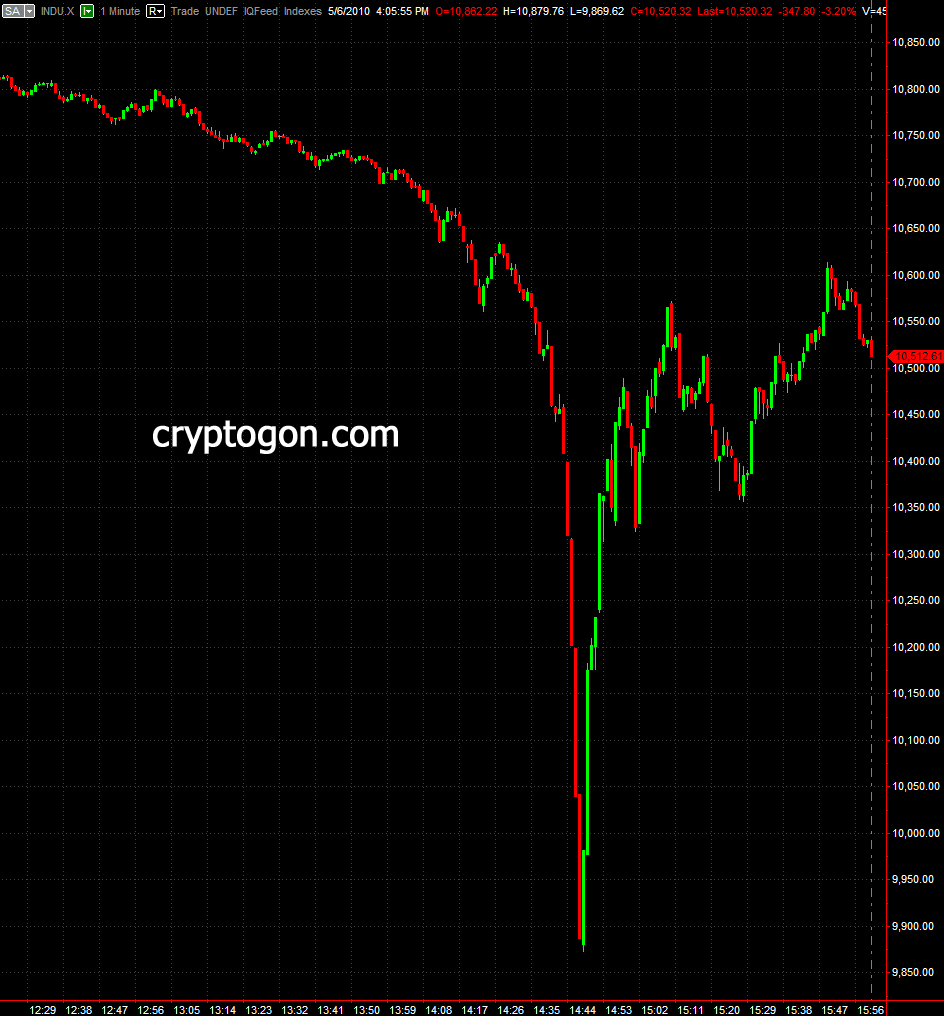
National Security Agency and U.S. Army Fund Yale Research Into Amplifier That Pushes the Boundary of Quantum Physics
May 6th, 2010Yes, the obvious application is with quantum computers.
This will also, no doubt, be going into military satellites, and probably countless other surveillance systems at some point. The requirement for cryogenic temperatures might delay many applications, but, this is Uncle $ugar that we’re dealing with here.
I like the analogy used in the article:
The typical signal power that must be measured is on the order of one billionth of one billionth of a watt, equivalent to the power of a cell phone call signal received on the moon from someone on earth.
*grin*
So, what would it be able to do if it was on-board a satellite in a low earth orbit, for example?
The gadget requires cryogenic temperatures, which means temperatures below 150 °C, ?238 °F or 123 K. Here’s an interesting trivia question for any of the many physicists/space nerds/spooks who read Cryptogon:
What temperatures are achievable on-board satellites in various Earth orbits? Assume that the satellite is always in the shade, even on passes when the sun is hitting it. Maybe a large mirror, curtain or solar panel, etc is configured to shade the bird when its exposed to the sun. How cold might that thing get? (Bonus points for rendering the bird invisible to the blessed freaks who track classified satellites because they can’t help themselves.)
Via: Yale University:
If powerful new quantum computers are to reach their enormous potential, they will need amplifiers capable of transmitting signals so weak they consist of a single photon. In the May 6 edition of the journal Nature, a team of Yale scientists report creating an amplifier almost as efficient as the laws of quantum physics allow.
Quantum computers, like cell phones, depend upon sophisticated microwave amplifiers to ensure that information is accurately retrieved. However, all amplifiers contain inherent flaws – most notably flaws which produce random noise that can obscure the signal. In quantum mechanics, the Heisenberg uncertainty principle dictates that a small amount of noise is inevitable, no matter how good the amplifier.
“If you want take information out of the computer, you will have to amplify very weak signals,” said Michel Devoret, Frederick William Beinecke Professor of Physics and Applied Physics at Yale’s School of Engineering & Applied Science and senior author of the paper. “The aim of our research is to devise an amplifier for signals so tiny they have only one photon in them.”
“Michel and his team have developed a new design for a practical amplifier using superconducting electrical circuits at cryogenic temperatures that comes very close to the ideal limit of this minimum amount of added noise,” said Steven M. Girvin, deputy provost for science and technology, the Eugene Higgins Professor of Physics & Applied Physics at Yale’s School of Engineering & Applied Science and a co-author of the work.
The Yale effort to build a quantum computer based on superconducting electrical circuits relies on incredibly weak microwave signals to both control and measure the quantum state of the computer. The typical signal power that must be measured is on the order of one billionth of one billionth of a watt, equivalent to the power of a cell phone call signal received on the moon from someone on earth.
Other Yale authors on the paper are: Nicola Bergeal, Flavius Schackert, Michael Metcalfe, R. Vijay, Vladimir Manucharyan, Luigi Frunzio, Daniel Prober, and Robert Schoelkopf.
Researchers at the University of Maryland and the University California, Berkeley also contributed to the paper.
The work was funded by the National Science Foundation, the National Security Agency and the Army Research Office.
Why Did CBS Scrub A Story About Army Spy Planes Capturing the Times Square Bomber?
May 6th, 2010UPDATE: So I Asked Someone…
I asked someone about this situation. Why not use the cell network?
Don’t ask me who this person is, but he responded. He calls his response a SWAG (Scientific Wild Ass Guess), but let’s just say that this person’s wild ass guess would be much more informed on these matters than your or my wild ass guesses would be:
Weird but my guess may be that it may be too much hassle(or time) to get a carrier involved. This is the usual problem where systems and agencies cannot be instantly connected on demand. It might also be difficult to triangulate on a person in a city with fixed ground stations. In an urban environment you get a ton of reflections and it could be difficult to pinpoint a particular emission. In any event I was not aware of the type of s i g i n t they have on planes nowadays. Interesting.
—End Update—
If they had his mobile device identified, why not use the triangulation data from the cell sites? It wouldn’t surprise me that military aircraft were used in the manner described below, but I don’t understand why that would have been required, given what we know about how easily mobile phones may be used for geolocation.
Maybe the .mil eye in the sky would be able to pinpoint the target on the ground more accurately than the triangulation data from the mobile network. Just a guess.
This is very interesting, in any event.
Via: Gawker:
Yesterday, we reported on the curious disappearance of a WCBS report that military spy planes had been used to capture the Times Square bomber. Why was this story scrubbed? We have the answer. Sort of.
The original WCBStv.com article, “Army Intelligence Planes Led to Suspect’s Arrest,” by Marcia Kramer, read:
In the end, it was secret Army intelligence planes that did him in. Armed with his cell phone number, they circled the skies over the New York area, intercepting a call to Emirates Airlines reservations, before scrambling to catch him at John F. Kennedy International Airport.
Then, a few minutes after we wrote about it, the article was rewritten with no mention of spy planes, and no indication it had been updated. Spooky! We asked WCBS what happened, and a spokesman responded:
The story that was broadcast by WCBS-TV did not include any mention of a military plane, although the station did have unconfirmed information about the use of a plane that we looked into but were unable to confirm. A line about the use of military aircraft was inadvertently included in the story that appeared on the station’s Web site but was removed.
According to WCBS, they simply got caught up in the frenzy of breaking news and “inadvertently” put in an unconfirmed detail. There is a problem with this account: The detail about the Army intelligence planes was featured prominently in the title of the originally article. Clearly, the line wasn’t “inadvertently included”—it was put in and deliberately promoted. After all, it was the most eye-catching detail of the story.
U.S. Not Accepting Foreign Help On Oil Spill
May 6th, 2010Any ideas as to why not?
Via: Foreign Policy:
When State Department spokesman P.J. Crowley refused to tell reporters which countries have offered assistance to help respond to the BP oil spill, the State Department press corps was flabbergasted.
“As a policy matter, we’re not going to identify those offers of assistance until we are able to see, you know, what we need, assess the ongoing situation. And as we accept those offers of assistance, we will inform you,” Crowley said.
Reporters pointed out that the Bush administration identified assistance offers after the Katrina disaster, so what is this, a new policy? They pressed Crowley, but he refused to budge.
Then they mentioned Iran’s offer of assistance, through its National Iranian Drilling Company. Crowley said there was no Iranian offer of assistance, at least in any official capacity. The reporters kept on it, asking why it was taking so long to figure out what was needed in the first place? That’s the Coast Guard’s decision, Crowley explained.
Late Wednesday evening, the State Department emailed reporters identifying the 13 entities that had offered the U.S. oil spill assistance. They were the governments of Canada, Croatia, France, Germany, Ireland, Mexico, the Netherlands, Norway, Romania, Republic of Korea, Spain, Sweden, the United Kingdom, and the United Nations.
“These offers include experts in various aspects of oil spill impacts, research and technical expertise, booms, chemical oil dispersants, oil pumps, skimmers, and wildlife treatment,” the email read.
“While there is no need right now that the U.S. cannot meet, the U.S. Coast Guard is assessing these offers of assistance to see if there will be something which we will need in the near future.”
The Obama administration has been relentless in its messaging that it is doing everything possible to aggressively respond to the oil spill. But for the record, the current message to foreign governments is: Thanks but no thanks, we’ve got it covered.
National Virtual Translation Center
May 6th, 2010I had never heard about the National Virtual Translation Center before today. (It came up in one of my feeds on NSA.)
Via: Monterey Herald:
The new National Virtual Translation Center at Fort Ord will be formally opened at 1 p.m. Friday.
The center will serve as the hub for national security translation needs for groups ranging from the Central Intelligence Agency to the FBI to the National Security Agency.
Rep. Sam Farr, D-Carmel, will attend a ribbon-cutting ceremony in the main lobby of the Defense Manpower Data Center, 400 Gigling Road.
U.S. to Expand Pakistan Drone Strikes
May 6th, 2010Via: Al Jazeera:
The Central Intelligence Agency (CIA) has been granted approval by the US government to expand drone strikes in Pakistan’s tribal regions in a move to step up military operations against Taliban and al-Qaeda fighters, officials have said.
Federal lawyers backed the measures on grounds of self-defence to counter threats the fighters pose to US troops in neighbouring Afghanistan and the United States as a whole, according to authorities.
The US announced on Wednesday that targets will now include low-level combatants, even if their identities are not known.
Barack Obama, the US president, had previously said drone strikes were necessary to “take out high-level terrorist targets”.
Dodd’s ‘Financial Reform’ Bill Is a Black Hole
May 6th, 2010Via: Josh Fulton:
Chris Dodd, everybody’s favorite hairdo, has introduced a “tough” financial “reform” bill that he claims will “limit the risk [financial institutions] can assume.” Of course, most people with a pulse realize that a 1565 page bill introduced by one of the top recipients of financial industry lobbyist money in Congress probably will do little to ‘reform’ the financial industry in the best interests of the American people. That, however, doesn’t fully capture the perniciousness of this bill. When we look at it closely, we can see it is one of the most dangerous bills introduced in Congress in years.
One of the worst parts of Dodd’s bill is that it institutionalizes “too big to fail.” Bank holding companies with assets greater than $50 billion and nonbank financial companies supervised by the Board of Governors of the Federal Reserve are required to pay into a $50 billion “orderly liquidation fund.” (Dodd gave verbal assurance on May 4th that this provision would be eliminated, but Dodd’s bill still needs to be reconciled with the House bill, which contains a $150 billion fund.) Why should a fund be necessary to liquidate a business? Well, to pay off creditors, that’s why. That’s the premise of “too big to fail”: if a large, interconnected firm fails, it could cause the collapse of its creditors, which could in turn cause the collapse of the entire economy. (If you believe that one, I’ve got some land in Florida to sell you.)