London Stock Exchange Halted
November 26th, 2009Mmm hmm.
Via: CNBC / AP:
LONDON – The London Stock Exchange PLC has halted electronic trading because of technical issues.
The LSE says the break to trading on Thursday is due to connectivity issues, but it hasn’t yet determined the root cause of the problem.
The exchange has placed all order-driven securities in to an auction call period — which allows customers to continue to place orders into the exchange’s order book. The exchange says it will give customers 30 minutes notice before ending the auction period, once it sorts out the technical issue.
Trading went offline at 10.33 GMT, freezing the FTSE 100 at 5,264.97.
The auction call period is usually used to set prices at the start and end of the daily trading session.
EMERGENCY: USDJPY
November 26th, 2009WARNING: This is not a recommendation to buy, sell or hold any financial instrument.
Update: Dollar Hits 14-Year Low in 86 Yen Zone in Tokyo
Via: Kyodo:
The U.S. dollar hit a 14-year low in the upper 86 yen level early Thursday afternoon in Tokyo as it remained weak across the board on persistent speculation about the low U.S. interest rate policy.
—End Update—
Update: BOJ Will Try to Stop Yen Rise
These comments came out before the last several minutes of trading shown below:
Via: Bloomberg:
Fujii Says Need to Take Action on Abnormal Yen Moves
By Kyoko Shimodoi
Nov. 26 (Bloomberg) — Japanese Finance Minister Hirohisa Fujii said the government needs to take action on abnormal currency movements after the yen traded close to a 14-year high against the dollar.
“I am watching these movements, right now it’s time to watch them closely,” he told reporters in Tokyo today. “We need to take appropriate action against abnormal movements.”
The yen traded at 87.24 per dollar at 12:10 p.m. in Tokyo. It earlier strengthened to 87.19, the highest since Jan. 21, when it touched 87.13.
—End Update—
And then…
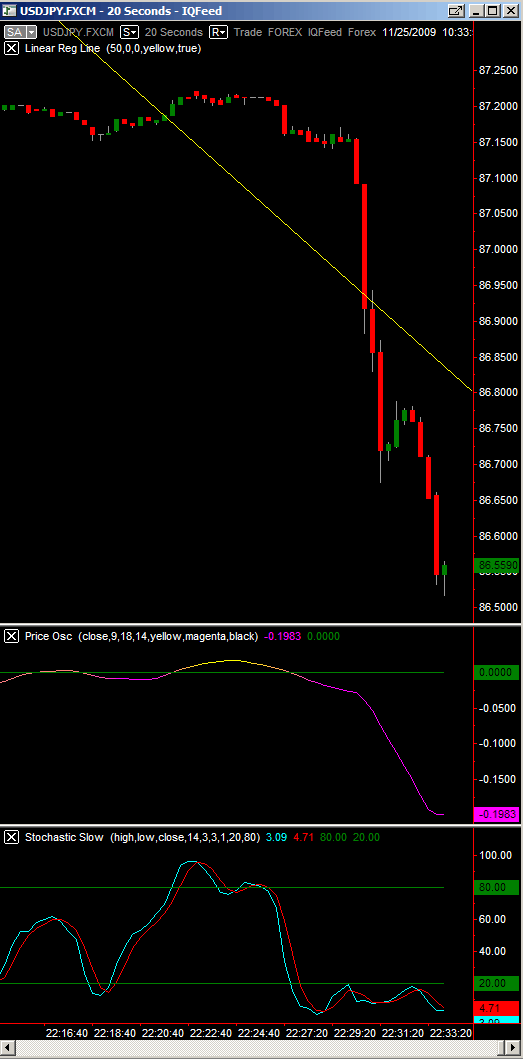
USDJPY 20 Second Interval
IMF Sold 10 Tons of Gold to Sri Lanka
November 26th, 2009Via: AFP:
The International Monetary Fund said Wednesday it had sold 10 tonnes of gold to Sri Lanka’s central bank for 375 million dollars, as part of a restructuring of IMF financial resources.
It was the third IMF sale of gold in a month as the Washington-based institution seeks to reduce its dependence on lending revenue and bolster its finances amid the global economic crisis.
“The sale was conducted on the basis of market prices prevailing on” Monday, the IMF said in a statement.
Gold prices had hit a record high that day, topping 1,170 dollars an ounce. Since then, the price of the precious metal has soared higher to new all-time peaks as investors seek a safe haven amid economic uncertainty.
The sale brought the total IMF gold sold to central banks to 212 tonnes. India bought 200 tonnes between October 19 and 30 for 6.7 billion dollars and Mauritius bought two tonnes on November 11 for 71.7 million dollars.
Sri Lanka has a 20-month IMF loan of 2.7 billion dollars that was awarded in July after the island nation’s reserves slumped to just over one billion dollars as the government made a final offensive to crush separatist Tamil Tiger rebels.
Sri Lanka’s central bank in early November said it has been buying gold to diversify its reserves amid volatile currency markets but refused to reveal from which sources the bank was buying the gold or at what prices.
The IMF executive board approved the sale of 403.3 tonnes of gold in September. The fund, which currently holds roughly 3,000 tonnes of gold, is the world’s third-largest official holder of the precious metal after the United States and Germany.
Gold and other commodity prices have surged in recent months amid a move away from a sliding dollar. The metal is also winning support over fears about a spike in inflation, as gold is widely regarded as a safe store of value.
The IMF said it would sell gold directly to central banks and other official holders for an initial period before selling the remaining amount on the open markets “in a phased manner over time,” in line with an approach used by central banks to avoid market disruptions.
Dollar Wreckage
November 26th, 2009WARNING: This is not a recommendation to buy, sell or hold any financial instrument.
UPDATE: USDJPY
Just now…
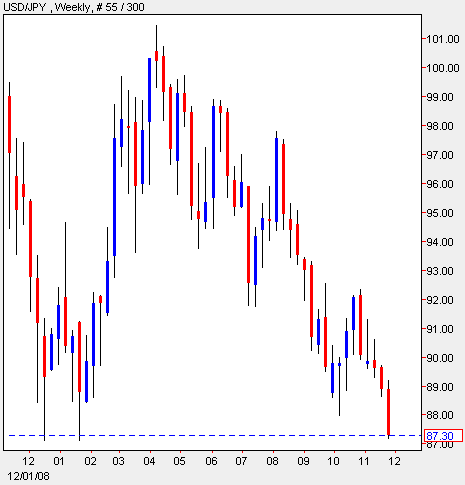
USDJPY Weekly Interval
BOJ will try to release the ninjas here…
—End Update—
The dollar has finally broken down solidly into the 74s. A retest of the all time lows looks likely now. If there’s going to be a bounce on the dollar (sucker, dead cat, short squeeze, or otherwise) this would be a good place for it to happen. Good luck with that…
Gold is flying higher and higher. Spot gold hit $1194.50 before pulling back just a bit.
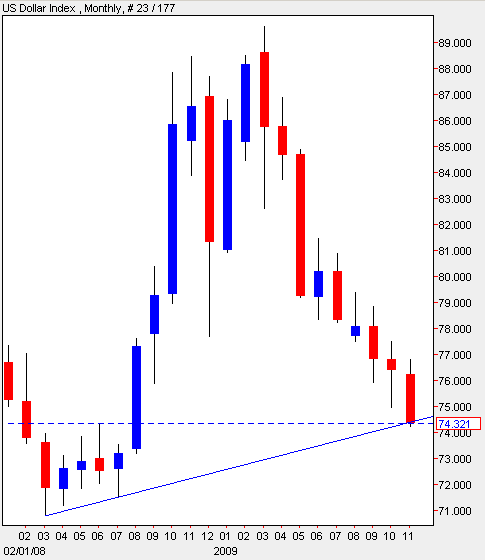
U.S. Dollar Index Monthly Interval
Cryptogon Reader Signs Up for Hosting with BlueHost
November 25th, 2009Thanks to The Broom Brothers for signing up for hosting with BlueHost. (WOW! Look at those brooms!)
Cryptogon received $90.
1983: Tungsten Filled Gold Bars in Wake of London Bullion Theft
November 25th, 2009In response to The Rumor About London Good Delivery Gold Bars That Are Allegedly Filled with Tungsten, JS sent this Reuters article from 1983.
The tungsten trick has been tried before.
Via: New York Times:
Austrians Seize False Gold Tied to London Bullion Theft
REUTERS
Published: December 22, 1983
The Austrian police announced the arrest today of 5 men and the discovery of 10 counterfeit gold bars stamped with numbers and refiner’s name to match 6,000 real bars stolen in Britain last month.
The police said the five arrested in Vienna on Tuesday night apparently planned to sell the counterfeit gold, passing it off as part of the haul of three tons of bullion stolen by masked gunmen from a warehouse near London’s Heathrow Airport on Nov. 26.
A police spokesman said the police did not know how the men had discovered the numbers stamped on the stolen bars.
The police at first suspected the counterfeit bars were part of the Heathrow booty, but the spokesman said tests showed the bars were made of tungsten and only coated with gold.
The fake bars were seized in a police raid on a hotel where the five men – four Italians and an Austrian – were meeting.
CBS Reporter Digging Into Swine Flu Scam
November 25th, 2009Via: Mercola:
The point is, of the vast majority of the presumed swine flu cases recognized by trained physicians, the vast majority were not flu at all. They weren’t swine flu or regular flu; they were some other sort of upper respiratory infection.
Scientist Repeats Swine Flu Lab-Escape Claim in Published Study
November 25th, 2009From where did the 2009 ‘swine-origin’ influenza A virus (H1N1) emerge?
Virology Journal 2009, 6:207 doi:10.1186/1743-422X-6-207
Adrian J Gibbs, John S Armstrong, Jean C Downie
Via: Bloomberg:
Adrian Gibbs, the virologist who said in May that swine flu may have escaped from a laboratory, published his findings today, renewing discussion about the origins of the pandemic virus.
The new H1N1 strain, which was discovered in Mexico and the U.S. in April, may be the product of three strains from three continents that swapped genes in a lab or a vaccine-making plant, Gibbs, and fellow Australian scientists wrote in Virology Journal. The authors analyzed the genetic makeup of the virus and found its origin could be more simply explained by human involvement than a coincidence of nature.
Their study, published in a free, online journal reviewed by other scientists, follows debate among researchers six months ago, when Gibbs asked the World Health Organization to consider the hypothesis. After reviewing Gibbs’ initial three-page paper, WHO and other organizations concluded the pandemic strain was a naturally occurring virus and not laboratory-derived.
“It is important that the source of the new virus be found if we wish to avoid future pandemics rather than just trying to minimize the consequences after they have emerged,” Gibbs and colleagues John Armstrong and Jean Downie said in today’s eight- page study.
Gibbs and Armstrong are on the emeritus faculty at the Australian National University in Canberra and Downie is affiliated with the Centre for Infectious Diseases and Microbiology Laboratory Services at Sydney’s Westmead Hospital, according to the study.
While the exact source of the new H1N1 strain is a mystery, their research has “raised many new questions,” they said. The authors compared the genetic blueprints of flu strains stored in the free database Genbank and found the pandemic virus’s nearest ancestors circulate in pigs.
‘Simplest Explanation’
While migratory birds may have acted as conduit for their convergence, human involvement in bringing them together is “by far the simplest explanation,” Gibbs said in a telephone interview today.
Research Credit: Zenc
The Secret Political Reach Of ‘The Family’
November 25th, 2009Via: NPR:
You may recognize these names from recent headlines: Sen. John Ensign, Rep. Bart Stupak and Rep. Joe Pitts. Stupak and Pitts have become familiar names through the media’s health care overhaul coverage; their abortion funding amendment introduced an 11th-hour twist as the House of Representatives approached a vote on a landmark health care bill.
Ensign was the focus of media attention over his affair with a campaign staffer. Just last night, a Nevada man disclosed that he found out about his wife’s affair with the state’s junior senator — his best friend — via a text message.
The common factor among these political players is their involvement with the Family, a secretive fellowship of powerful Christian politicians that centers on a Washington, D.C., townhouse. Investigative journalist Jeff Sharlet has written extensively about the influential group in his book The Family: The Secret Fundamentalism at the Heart of American Power.
Sharlet returns to Fresh Air to talk to host Terry Gross about Ensign, Stupak and Pitts, and about new developments concerning the Family.
Death Toll in Philippines Massacre Rises to 57
November 25th, 2009Via: Guardian:
The death toll from a massacre in the southern Philippines rose to 57 today after police found another 11 bodies in the country’s most horrific incident of election violence.
Not all the bodies have been identified, but 22 of the victims are believed to be journalists, making Monday’s attack the deadliest ever on the media anywhere in the world. Thirty-three of the victims were men and 24 were women, police said.




