Several Cryptogon Readers Sign Up for Hosting with BlueHost
November 23rd, 2009Thanks to the owners of the following domains for signing up for hosting with BlueHost:
Cryptogon received $450.
Air Force Zaps Drones in Laser Test
November 23rd, 2009Via: Wired:
In a recent series of tests at the Naval Air Warfare Center, China Lake, Calif., a trailer-mounted laser was able to knock five unmanned aircraft out of the sky.
The demo, sponsored by the Air Force Research Laboratory, was a test of the Mobile Active Targeting Resource for Integrated eXperiments (MATRIX), an experimental system developed by Boeing Directed Energy Systems. According to a company news release, the test showed the ability to take down a hostile unmanned aircraft with a “relatively low laser power” weapon. According to AFRL, MATRIX uses a two and a half kilowatt-class high energy laser.
While ballistic missile defense may get all of the press, some homeland-security experts worry about a more low-tech threat: drone technology. Bill Baker, chief scientist of the Air Force Research Laboratory’s Directed Energy Directorate, said in a statement that the shootdowns “validate the use of directed energy to negate potential hostile threats against the homeland.”
It’s not clear, exactly, how the lasers shot down the drones: Whether they disrupted the aircraft controls, or burned a big hole in them. (An AFRL news release said the drones were “acquired, tracked and negated at significant ranges” but offered few additional details.)
As part of the counter-drone tests, Boeing also shot down an unmanned aircraft with its Laser Avenger system, a Humvee-mounted directed-energy air defense system the company is developing. They also test-fired a lightweight 25mm machine gun integrated on the Laser Avenger platform (the machine gun fired at a static target board, not a drone). The idea behind this is to use good ol’ kinetic energy — i.e., a stream of hot lead — as a backup if the directed energy system fails to down the target.
Boeing has been developing a range of directed-energy weapons for the military, including the Airborne Laser (a Boeing 747 reconfigured as a ballistic-missile shooter), the Advanced Tactical Laser (a laser gunship), and the High Energy Laser Technology Demonstrator (a mobile laser cannon that can shoot down rockets and mortars).
Marines Use Brain Scans to Spot PTSD Triggers Before and During War
November 23rd, 2009In other words, the military is using the war as a giant MK screening lab.
Via: Wired:
Two days before shipping off to war, Marine Pfc. Jesse Sheets sat inside a trailer in the Mojave Desert, his gaze fixed on a computer that flashed a rhythmic pulse of contrasting images.
Smiling kids embracing a soldier. A dog sniffing blood oozing from a corpse. Movie star Cameron Diaz posing sideways in a midriff top. Troops cowering for safety during an ambush. (See pictures of movie costumes.)
A doctor tracked his stress levels and counted the number of times he blinked. Electrode wires dangled from his left eye and right pinky finger.
Sheets is part of a military experiment to try to predict who’s most at risk for post-traumatic stress disorder. Understanding underlying triggers might help reduce the burden of those who return psychologically wounded — if they can get early help.
Transsexual Linked to Italy’s Sex Scandal ‘Found Dead’
November 23rd, 2009Via: Guardian:
A Brazilian transsexual named in a sex scandal involving a former Italian politician is believed to have been killed in a fire in her Rome flat.
The media said a bottle of whisky was found near the body of the woman, known as Brenda. There is no confirmation.
She was linked to the case of Lazio Governor Piero Marrazzo, who quit last month after a video emerged apparently showing him with a transsexual.
Brenda had denied having any relationship with the former governor.
On Friday, police said that forensic tests were expected to formally identify the remains found in Brenda’s basement flat.
Depressed
It was not immediately known if there were any signs of foul play.
Earlier this month, Brenda called police to report that she had been attacked and robbed in the street.
Brenda’s friends have also said that she recently told them she felt depressed and suicidal.
Brenda and another Brazilian transsexual, known as Natalie, were involved in the scandal that led to Mr Marrazzo’s resignation.
He was allegedly blackmailed by four Italian policemen, who had reportedly shot the compromising video. All four have since been arrested.
Mr Marrazzo has admitted having encounters with transsexual prostitutes.
His lawyer, Luca Petrucci, said the “affair is taking a tragic and worrying turn”, Italy’s Ansa news agency reports.
The lawyer also called for police protection for Natalie.
Forced Labor and Rape, the New Face of Slavery in America
November 23rd, 2009I don’t know about the “new” part, but so it goes.
Via: Guardian:
In the Midwestern heartland, police are encountering a new social evil: trafficking, often involving women and children who are forced to work as prostitutes or unpaid labour; and the outcomes can be brutal.
Human trafficking has become a major issue in the Midwest heartland of America, causing some campaigners to dub it a modern form of slavery.
Figures from the State Department reveal that 17,500 people are trafficked into the US every year against their will or under false pretences, mainly to be used for sex or forced labour. Experts believe that, when cases of internal trafficking are added, the total number of victims could be up to five times larger. And increasing numbers of trafficked individuals are being transported thousands of miles from America’s coasts and into heartland states such as Ohio and Michigan.
“It is not only a crime. It is an abomination,” said Professor Mark Ensalaco, a political scientist at the University of Dayton, Ohio, who organised a recent conference on the issue. In Ohio a human trafficking commission has just been set up to study the problem, while in the northern Ohio city of Toledo a special FBI task force is tackling the issue. For many local law enforcement officials, it is a bewildering new world.
Research Credit: ltcolonelnemo
Historic Photographs Found Dumped Under Fort Worth Bridge
November 23rd, 2009Interesting date for such a find…
Via: WFAA:
Posted on November 22, 2009
A treasure trove of priceless photographs were recently found dumped under a bridge in South Fort Worth.
Among the found photographs were images of President John F. Kennedy’s motorcade just moments before his assassination, a young President George H. W. Bush and Gwendolyn Brooks, the first African American to win a Pulitzer Prize.
The photographs were found underneath Interstate 20 and Oak Grove in South Fort Worth by the Code Compliance iIllegal dumping team. The location is a well-known dumping ground monitored by the department.
Whoever tossed the pictures away apparently had no idea they were throwing away history.
“Here’s a picture of a much younger President George Bush presenting a football trophy,” said Brandon Bennett, director of Fort Worth Code Compliance, while browsing through the images.
The photographs were found in City Council District 8, which is represented by Kathleen Hicks.
“This isn’t just Fort Worth history, this is American history,” she said.
The Kennedy motorcade photograph was taken 46 years ago. The original photograph of Dealey Plaza on November 22nd, 1963 captured onlookers turning in an attempt to get a glimpse of the motorcade.
There were also photographs of former Texas Gov. John Connally and founder of the Fort Worth NAACP Chapter Dr. George Flemming.
Then there were the images of Gwendolyn Brooks, who won the Pulitzer in 1950, and Jesse Owens, who won four gold medals in the 1936 Olympics.
“I’ve got goose bumps,” said Sarah Walker, President of the Tarrant County Black Historical and Genealogical Society. “When Mr. Brandon Bennett, our code enforcement director called me and said we need to look at these photographs, I almost didn’t eat lunch today.”
Surprisingly, the pictures aren’t weathered at all. They were found in file folders, cataloged with typed labels on the front or back.
“I truly believe that they belong to the Genealogical Society because they’re so well kept,” Walker said. “They’ve just recently been dumped and I really believe that they would probably be the ones that were stolen from the building before we started the organization.”
That was almost five years ago. Where those photographs have been during that time is the mystery behind the treasure.
The photographs are now being stored in a secure location by the city of Fort Worth. Code Compliance will hold onto them until it can complete the legal process of finding out who may have dumped the pictures before possibly turning them over to a museum.
What’s in Your H1N1 Flu Vaccine?
November 23rd, 2009Via: Straight:
Chris Shaw wasn’t always skeptical about vaccines. The neuroscientist at the University of British Columbia had his teenage son vaccinated with most of the recommended shots. But then he started studying some of the ingredients commonly found in vaccines.
What he discovered caused him to go cold turkey on all shots for his six-year-old daughter. And that includes the vaccine for the H1N1 flu.
“I am not convinced H1N1 is sufficiently hazardous to most people to risk the potential downside of the vaccine,” Shaw said over the phone from his office in the research pavilion at the Vancouver Coastal Health Authority.
Shaw isn’t an easily dismissed vaccine conspiracy theorist. He is a leading expert on amyotrophic lateral sclerosis (ALS, or Lou Gehrig’s disease) and Parkinson’s disease. While investigating unusually high rates of ALS and other neurological disorders among veterans who have Gulf War syndrome, he found evidence that the cause may have been aluminum salt, an ingredient in the cocktail of vaccines given to soldiers before deployment.
Although aluminum salt isn’t present in the H1N1 vaccine, Shaw’s discovery made him concerned about other vaccines, including the swine-flu shot. He isn’t alone in his thoughts.
Despite a full frontal assault of news about the dangers of the flu and the importance of vaccination, a survey in late October revealed that only 36 percent of Canadians said they would get the shot. Lack of trust in the vaccine was cited as the main reason for vaccine opposition. Another poll in November found that 65 percent of Canadians believe the media has overreacted to the threat of swine flu.
Even many health workers aren’t convinced. In two separate surveys, in the U.K. (Pulse) and Hong Kong (British Medical Journal), published in August, half of health-care professionals said they didn’t intend to get the vaccine.
Canadian health officials and some newspaper columnists have reacted by accusing vaccine opponents of being conspiracy mongers or just plain irresponsible.
…
What about the vaccine? Is it safe? Despite the onslaught of confident pronouncements from health officials and doctors, Shaw says he hasn’t seen enough information on the safety of the vaccine. “If the science were there, we could make a rational decision. But it’s a coin toss.”
Looking for answers, Shaw turned to the 24-page product-information leaflet on the vaccine released by drug giant GlaxoSmithKline. Health Canada used this document in approving the shot.
The leaflet leaves Shaw cold. “You couldn’t turn this in as a master’s thesis anywhere I know of and get a passing grade,” he said, calling the leaflet a “shocking document”.
Shaw said the material lacks basic information. For example, there is no safety data at all for several groups of people—pregnant women, people aged over 60, kids aged 10 to 17, and children under three. For kids three to nine years old, there is only “very limited” data.
“Where is the safety data that the government used to license the vaccine?” Shaw asked.
Health Canada would not talk to the Straight, and the Public Health Agency of Canada did not respond to a request for an interview.
The H1N1 vaccine includes a component called an adjuvant—which is used to boost the drug’s effectiveness—that has raised a lot of questions.
GlaxoSmithKline says the adjuvant has been tested on 45,000 people worldwide and that clinical trials are now being done on children. In an e-mail, spokesperson Melanie Spoore said the company is planning 25 trials of its various H1N1 vaccines before November 2010.
She also said a different but closely related vaccine made by the company, for the H5N1 flu, includes the same adjuvant and “is generally well-tolerated and has an acceptable safety profile” in both kids and adults.
But Shaw has concerns about the company’s trial results for the H5N1 vaccine. The product leaflet mentions a study in which the company injected the vaccine into pregnant rats. It found “an increased incidence of fetal malformations” and “delayed neurobehavioural maturation”. Another study did not produce the same outcome.
But Shaw says the rat results deserve more study. “Anytime you observe such outcomes, it is a concern,” he said.
The leaflet also mentions a study on ferrets. The animals were given adjuvanted and nonadjuvanted H5N1 vaccines and then exposed to the flu. The ferrets that got the adjuvanted vaccine were protected by the vaccine. But those that got the nonadjuvanted vaccine all died.
This result could be a concern, Shaw said, because Canadian authorities are telling pregnant women to get the nonadjuvanted H1N1 vaccine since the adjuvanted version hasn’t ever been tested on pregnant women. Shaw also said the animal-study information in the leaflet lacks many important details and would be “unpublishable” as presented. “Any [medical-journal] referee would kick this out the window.”
The company’s leaflet also paints a picture of the vaccine’s side effects in humans somewhat different than the usual line from health authorities. The Public Health Agency of Canada says on its Web site that the adjuvanted vaccine is as safe as the nonadjuvanted shot. It also says the rate of “serious adverse events” from vaccination is extremely low—typically “about one for every 100,000 doses of vaccine”.
What we don’t often hear is that the adjuvanted vaccine caused dramatically more side effects than the nonadjuvanted version. Ninety percent of 62 subjects reported pain (versus 37 percent of 62 people for the nonadjuvanted vaccine), 34 percent had muscle soreness (compared to 8 percent with the nonadjuvanted shot), and 14 percent experienced a headache (as opposed to 8 percent for the nonadjuvanted shot), according to the product-information sheet.
Although these reactions are minor, the leaflet also says four of 253 people studied experienced “severe adverse reactions”. Three of the four were deemed to be unrelated to the vaccine, but one case of hypersensitivity (which can mean anything from an allergic reaction to autoimmune disease) was determined “to be related to vaccination”.
That one serious reaction might not sound like a lot, but it actually translates into a rate of 395 cases per 100,000 people. That’s more than 50 times the rate of hospitalization due to H1N1 itself: 7.3 per 100,000 Canadians.
Sucharit Bhakdi is concerned some serious vaccine reactions could go unnoticed. He is a professor of medical microbiology at the Johannes Gutenberg University of Mainz in Germany. In October—in a coauthored paper in the journal Medical Microbiology—he warned of a possible increase in the risk in heart problems due to mass H1N1 vaccination.
Speaking by phone from his office, Bhakdi cited the higher rate of heart problems when 1.4 million U.S. soldiers were vaccinated for smallpox before the 2003 Iraq war.
Soldiers who received the vaccine had almost 7.5 times the rate of heart inflammation of nonvaccinated personnel, according to a study by U.S. military medical researchers in 2004 in the American Journal of Epidemiology.
“Unexpected serious adverse effects thus may follow in the wake of a general vaccination program,” Bhakdi’s paper said.
Yet health authorities and doctors are urging people with heart problems to get the H1N1 vaccine on a priority basis and do not appear to be monitoring them for possibly elevated risks, he said.
Shaw is also concerned about Canada’s monitoring of the side effects of vaccinations, calling the system “flimsy”.
What especially worries Shaw is the possibility of longer-term side effects from the vaccine. Most vaccine safety studies monitor patients for a few days or, at most, several months.
That isn’t enough, Shaw says. With some vaccines, the most serious reactions have taken years to surface. “Neurological problems don’t happen overnight,” he said. “It took five to 10 years to see the bulk of the Gulf War–syndrome outcomes.”
One of the best examples involves a controversial ingredient present in the H1N1 vaccine: thimerosal. Thimerosal is a form of mercury used in some vaccines as a preservative. Drug makers agreed to phase it out of most vaccines after the U.S. Food and Drug Administration found in 1999 that mercury levels in children who had gotten multiple shots often exceeded safety levels set by the Environmental Protection Agency (EPA). Nonetheless, thimerosal still remains in many flu vaccines.
Controversy has raged for years about whether or not thimerosal is behind soaring childhood autism rates. While that debate continues, a 2008 study in the U.K. journal Toxicological and Environmental Chemistry found that boys who were given a vaccine containing thimerosal were nine times more likely to have developmental problems than unvaccinated boys.
The Public Health Agency of Canada says on its Web site that thimerosal is safe and that the amount in the H1N1 vaccine is below Health Canada’s daily safety limit set for mercury. “There’s significantly less mercury in the vaccine than you would find in a can of tuna fish,” the site states.
In fact, the amount of mercury in the nonadjuvanted H1N1 vaccine does actually exceed the daily safety level for pregnant women. Health Canada has established the safe dietary level of mercury for pregnant women at 0.2 micrograms (millionths of a gram) per kilo of body weight. The nonadjuvanted H1N1 vaccine contains 25 micrograms of mercury.
Simple math tells us an average Canadian pregnant woman—weighing 80 kilograms at term—gets about 56 percent more than the daily safe level of mercury when given a dose of the nonadjuvanted vaccine. By the EPA’s stricter standards, that same dose is actually triple its daily safe level.
What’s more, Shaw notes, those daily safety levels were set for consumption of mercury in food, not for injection directly into the body. Injecting a neurotoxin like mercury has much more impact than eating it, he said.
Squalene is another controversial component of the swine-flu vaccine. It’s an oil found in animal livers and is used as an adjuvant in vaccines and also as a moisturizer in cosmetic products. It is primarily gotten from shark livers—a fact that has upset conservation groups worried about endangered shark populations. Some companies, like Unilever and L’Oréal, have agreed to stop using squalene in cosmetic products.
Debate has raged for years about whether or not squalene is responsible for Gulf War syndrome. Most research suggests that’s not the case, but in recent years much more solid evidence has found squalene can cause autoimmune diseases like lupus and rheumatoid arthritis in animals.
Still other questions have been raised about polysorbate 80, another component of the H1N1 vaccine adjuvant. Studies have found it can cause severe allergic reactions and hypersensitivity.
In the end, we might only get a good picture of the vaccine’s side effects long after swine flu has run its course. Then again, with Canada’s lax monitoring system for side effects, we may never know which was worse.
Research Credit: mcantelon
Iowa: “What we’re seeing is very heavy, wet hemorrhagic lungs, lungs with a lot of blood in them”
November 23rd, 2009Via: KCCI:
Iowa has officially recorded 21 H1N1 deaths, including seven in Polk County alone. But the county’s medical examiner said he has performed autopsies on some residents who were never diagnosed with H1N1, but actually had it.
“In the autopsy, what we’re seeing is very heavy, wet hemorrhagic lungs, lungs with a lot of blood in them,” said Dr. Gregory Schmunk.
He said the official count of seven H1N1 deaths is inaccurate, but patient rights laws prohibit him from giving specific numbers.
He said there are two reasons for the discrepancy. First, not all sick patients get tests and second, the virus is difficult to detect. Some patients may be too sick to receive the most accurate H1N1 test.
“They’re not always done and it can be hazardous to the patient if they’re in a respiratory critical situation,” Schmunk said.
He also said that some tests reveal a false negative.
“Because of our limitations on testing, sometimes the tests aren’t positive,” he said. “They do appear to fit clinically the course of a H1N1 viral-type pneumonia.”
He said the cases he’s seen in Polk County were all middle-aged adults with a few underlying health conditions.
“These may be the patients that are obese,” Schmunk said. “Obesity restricts your ability to breathe and clear the virus from your upper respiratory.”
He also said that some of the patients had diabetes.
Gold: Fresh Record High
November 23rd, 2009WARNING: This is not a recommendation to buy, sell or hold any financial instrument.
$1164.
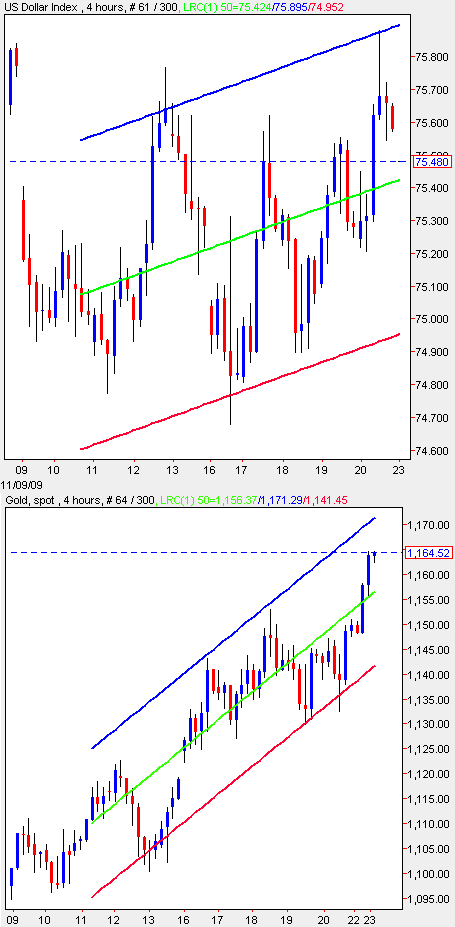
Gold and the U.S. Dollar Index typically describe an inverse relationship. When one goes up the other usually goes down. The charts below show the U.S. Dollar Index and gold as four hour candles. I have applied a 50 period linear regression channel to each chart. If you don’t know about linear regression lines, all this does is a draw a line right through the middle of the price action over a given period of time. The upper and lower lines are one standard deviation off the middle line. Traders often use this in an attempt to determine trends.
What do you notice about the linear regression channels since mid November on both the U.S. Dollar and gold?
USDX vs Gold, Four Hour
Not only are the slopes on the linear regression lines for both charts positive, the positive slope on gold is steeper than the positive slope on the dollar. I’m not really sure what’s happening here, but this isn’t going to continue for long. One of these moves is bogus.
In a sane world, the obvious answer would be that the dollar move is bogus, but, as I’ve said before, I never trade based on what I think I know about fundamentals.
The dollar has support below and gold is up in uncharted territory. My guess is that gold is going to come down in the short to medium term, but, then again, there’s nothing more delicious for the black box people than squeezing an asset higher as shorts think a top is in. I’m content to have pared down during this (possibly blow off top) phase. I’m still long about 40% of my original position—but I never thought the dollars I received as I closed out some of that gold would continue increasing in value along with the gold. This remaining gold is the “never sell” / pass-on-to-kids gold.
One final anecdote about taking profit and then watching an asset skyrocket higher: I used to hang out in a day trading chat room with other full time traders. Paring down profitable positions is a standard practice for professional traders. Anyway, one day, several traders had profit on a trade and some had dumped it all, while others were holding out for more. The thing gapped higher again.
Someone said they were thinking about getting back in.
Another guy wrote something like:
“You’re not going to see anything more from me for a while because I’ve just asked my wife to duct tape my hands to my desk so I can’t trade again.”
If you’re looking at that gold chart going vertical and hearing those Satanic voices in your head saying things like, “I’m missing out! It’s just going to keep headed higher! If I had just held on I would have made ____ more,” keep the image of the trader with his hands duct taped to his desk in mind.
That thought has kept me from getting decapitated many times.
Via: Reuters:
Gold rose more than 1 percent to a record high on Monday as concerns about accelerating inflation and weak economic growth prompted investors to seek relatively safer assets, while supply concerns boosted oil and copper.
VeriChip Buys Steel Vault, Creating Micro-Implant Health Record/Credit Score Empire
November 22nd, 2009Via: Bnet:
VeriChip (CHIP), the company that markets a microchip implant that links to your online health records, has acquired Steel Vault (SVUL), a credit monitoring and anti-identity theft company. The combined company will operate under a new name: PositiveID.
The all-stock transaction will leave PositiveID in charge of a burgeoning empire of identity, health and microchip implant businesses that will only encourage its critics. BNET previously noted that some regard the company as part of a prophecy in the Book of Revelation (because the HealthLink chip carries an RFID number that can be used as both money and proof of ID) or as part of President Obama’s secret Nazi plan to enslave America.
The most obvious criticism to be made of the deal is that it potentially allows PositiveID to link or cross-check patient health records (from the HealthLink chip) to people’s credit scores. One assumes that the company will put up firewalls to prevent that. PositiveID CEO Scott Silverman said:
“PositiveID will be the first company of its kind to combine a successful identity security business with one of the world’s first personal health records through our Health Link business. PositiveID will address some of the most important issues affecting our society today with our identification tools and technologies for consumers and businesses.”
Unless, of course, consumers don’t actually want to be implanted with chips, have their health records available over the internet, or have their medical records linked to their credit scores.
Research Credit: C