Shadow Market, Defiant Homeowners
October 26th, 2009Via: Miller McCune:
It’s been almost a year since Horatio Bernard effectively lost his Baltimore row house to foreclosure and roughly 15 months since he last made a payment on his primary mortgage.
And yet to his amazement and those following his story, Bernard continues living in the home with his ailing mother without any sign of an eviction notice or word from his lender, in this case JP Morgan Chase and then US Bank.
“I haven’t paid a dime,” Bernard told me, sounding gleeful over the phone.
…
There’s even a chance Bernard could get to stay in his home a lot longer. That’s because like hundreds of thousands of other homeowners in America these days, Bernard falls into what real estate experts call a shadow market, the growing backlog of foreclosures and bank-owned properties yet to reach real estate markets.
For various reasons, banks have slowed down the foreclosure process causing a reprieve for homeowners like Bernard while at the same time building a swell of foreclosed homes delayed from hitting the market. If they were to flood real estate markets at once, banks would suffer under a glut of inventory drawing down overall prices. So the banks have held back, in effect drawing out the nation’s recovery.
The shadow market today – those in distress or in some stage of foreclosure — represents roughly 14 percent of existing mortgages, says Rick Sharga, senior vice president of RealtyTrac, which compiles nationwide data on foreclosures.
“Right now what we’re seeing is delays in the entire process,” Sharga said. “It started in the fourth quarter of last year where we saw a spike in delinquencies that didn’t match a corresponding spike in foreclosures. What that suggested to us is it was taking the banks longer, for whatever reason, to execute on the foreclosure process. So we’re getting a buildup of properties that normally would have been in foreclosure but weren’t. That has continued to escalate. We’re now at record levels of delinquencies. Probably 10 percent of active mortgages are delinquent, and another 4 percent are in foreclosure.”
Trading Note: Took Profit on DBA This Morning
October 26th, 2009WARNING: This is not a recommendation to buy, sell or hold any financial instrument.
Out at @ $26.91. +1.46 / share. * shrug shoulders * I was expecting to pull more than cigarette butts and bottle caps on that one.
I’m overweight stuff that goes up when the dollar goes down. Time to flatten out a bit for a while. That was my main reason for selling DBA today, although, from a technical perspective, it wasn’t looking so hot. Extreme stochastic on the daily as the faster intervals fell apart…
Which got me thinking about my recent analysis on the dollar again.
Either I’m right about a rally setting up soon on the dollar, or I’m wrong. If I’m right, I’d probably be looking at having to ditch DBA at a loss, or waiting it out. Taking profit here seemed like a much more pleasant option.
FDA Fails to Pull Worthless Drugs from Marketplace
October 26th, 2009Via: AP:
The Food and Drug Administration has allowed drugs for cancer and other diseases to stay on the market even when follow-up studies showed they didn’t extend patients’ lives, say congressional investigators.
A report due out Monday from the Government Accountability Office also shows that the FDA has never pulled a drug off the market due to a lack of required follow-up about its actual benefits — even when such information is more than a decade overdue.
When pressed about that policy, agency officials said they have no plans to get more aggressive.
The GAO says the FDA should do more to track whether drugs approved based on preliminary results actually have lived up to their promise.
The FDA responded that the report paints an overly negative picture of its so-called “accelerated approval” program, which is only used to approve drugs for the most serious diseases.
“Millions of patients with serious or life-threatening illnesses have had earlier access to new safe and effective treatments,” thanks to the program, the FDA said in its response to the report.
In 1992, the FDA began speeding up the approval of novel drugs based on so-called surrogate endpoints, or laboratory measures that suggest the drug will make real improvements in patient health. HIV drugs, for example, are cleared based on their virus-lowering power, a predictor of increased survival.
Drugmakers favor the program because it helps them get products to market sooner, without conducting long-term patient studies that can take years and cost hundreds of millions of dollars. A condition of quicker approvals is that drugmakers conduct follow-up studies to show the drug’s benefits actually panned out.
But the GAO report, a copy of which was obtained by The Associated Press, identified several drugs still on the market that never lived up to their initial promise. And in the 16 years that the FDA has used accelerated approval, it has never once pulled a drug off the market due to missing or unimpressive follow-up data.
“FDA has fallen far short of where it should be for patient safety,” said Sen. Charles Grassley, R-Iowa, who requested the investigation.
Of the 144 studies the FDA has required under the program since 1992, 64 percent have been completed and more than one-third are still pending, according to the GAO. Investigators said the FDA does not rigorously track whether companies are making progress on their required studies, although the agency is improving.
FDA officials say they have overhauled their tracking system since the GAO completed its report.
Britain: Spotter Cards: What They Look Like and How They Work
October 26th, 2009Via: Guardian:
This kind of highly confidential document – pictured above – is rarely seen by the public.
These so-called “spotter cards” are issued by police to identify individuals they consider to be potential troublemakers because they have appeared at a number of demonstrations.
The photographs are drawn from police intelligence files. This card was apparently dropped at a demonstration against Britain’s largest arms fair in 2005.
H is Mark Thomas, the comedian and political activist. Asked why it was justifiable to put Thomas, who has no criminal record, on this card, the Metropolitan police replied: “We do not discuss intelligence we may hold in relation to individuals.”
Thomas had been acquitted of criminal damage after attaching himself to a bus containing arms traders at a previous fair.
The Met said: “This is an appropriate tactic used by police to help them identify people at specific events … who may instigate offences or disorder.”
The arms fair “is a biannual event that is specifically targeted by known protest groups, who in the past have stated their intention was to shut down or disrupt the event.” As the cards are “strictly controlled”, the officers who lost it were “dealt with”.
On Comment is Free today Thomas writes: “Protesters – or, as the police call them, ‘domestic extremists’ – are the new ‘reds under the bed’.”
Roubini Doesn’t Like Gold, Unless We’re Headed for “Armageddon”
October 26th, 2009Via: Yahoo Finance:
Nouriel Roubini believes that a “wall of liquidity” is chasing all kinds of assets, yet once the economy disappoints expectations, it will all come crashing down.
Yet for Dr. Doom, gold isn’t the answer.
According to him, despite the temporarily asset bubbles right now, we’re still in a deflationary world and we’ll realize it soon enough once growth stagnates and all kinds of inflated asset categories come falling down.
IndexUniverse: Roubini: I don’t believe in gold. Gold can go up for only two reasons. [One is] inflation, and we are in a world where there are massive amounts of deflation because of a glut of capacity, and demand is weak, and there’s slack in the labor markets with unemployment peeking above 10 percent in all the advanced economies. So there’s no inflation, and there’s not going to be for the time being.
The only other case in which gold can go higher with deflation is if you have Armageddon, if you have another depression. But we’ve avoided that tail risk as well. So all the gold bugs who say gold is going to go to $1,500, $2,000, they’re just speaking nonsense. Without inflation, or without a depression, there’s nowhere for gold to go. Yeah, it can go above $1,000, but it can’t move up 20-30 percent unless we end up in a world of inflation or another depression. I don’t see either of those being likely for the time being. Maybe three or four years from now, yes. But not anytime soon.
Detroit Attempts to Auction 9,000 Properties for as Little as $500; 80% Had No Bids
October 26th, 2009Via: Reuters:
In a crowded ballroom next to a bankrupt casino, what remains of the Detroit property market was being picked over by speculators and mostly discarded.
After five hours of calling out a drumbeat of “no bid” for properties listed in an auction book as thick as a city phone directory, the energy of the county auctioneer began to flag.
“OK,” he said. “We only have 300 more pages to go.”
There was tired laughter from investors ready to roll the dice on a city that has become a symbol of the collapse of the U.S. auto industry, pressures on the industrial middle-class and intractable problems for the urban poor.
On the auction block in Detroit: almost 9,000 homes and lots in various states of abandonment and decay from the tidy owner-occupied to the burned-out shell claimed by squatters.
Taken together, the properties seized by tax collectors for arrears and put up for sale last week represented an area the size of New York’s Central Park. Total vacant land in Detroit now occupies an area almost the size of Boston, according to a Detroit Free Press estimate.
The tax foreclosure auction by Wayne County authorities also stood as one of the most ambitious one-stop attempts to sell off urban property since the real-estate market collapse.
Despite a minimum bid of $500, less than a fifth of the Detroit land was sold after four days.
The county had no estimate of how much was raised by the auction, a second attempt to sell property that had failed to find buyers for the full amount of back taxes in September.
The unsold parcels add to an expanding ghost town within the once-vibrant town known worldwide as the Motor City.
Capmark Files for Bankruptcy With $21 Billion in Debt
October 26th, 2009Via: Bloomberg:
Capmark Financial Group Inc., the lender owned by companies including Goldman Sachs Group Inc. and KKR & Co., filed for bankruptcy protection after posting a second-quarter loss of about $1.6 billion.
The company listed consolidated debt of $21 billion and consolidated assets of $20.1 billion as of June 30, according to Chapter 11 documents filed yesterday in U.S. Bankruptcy Court in Wilmington, Delaware. Forty-three affiliates also sought protection.
Capmark, based in Horsham, Pennsylvania, is one of the largest U.S. commercial real estate finance companies, with more than $10 billion in originations, according to Moody’s Investors Service. The company, formerly known as GMAC Commercial Holding Corp., services more than $360 billion of debt. It has struggled as the default rate on commercial mortgages held by U.S. banks more than doubled to the highest since 1994.
“All the businesses will be saved and continue with Capmark or will be sold as going concerns for full value,” attorney Martin Bienenstock, a partner at Dewey & LeBoeuf LLC in New York, which is handling the bankruptcy case, said in an e- mail.
Capmark asked a bankruptcy judge to approve the sale of its loan-servicing and mortgage business to Warren Buffett’s Berkshire Hathaway Inc. and Leucadia National Corp. for as much as $490 million. Higher bids would be sought at an auction. The deal was announced Sept. 2, the same day Capmark said it might filed for bankruptcy.
$7.1 Billion
Capmark and its units owe $7.1 billion to the 30 largest creditors without collateral backing their claims, according to the filed court documents.
The three biggest are Citibank NA, as administrative agent under the $5.5 billion credit agreement, with a claim of $4.6 billion; Deutsche Bank Trust Co. Americas, as trustee for the 5.875 percent senior notes and the floating senior notes due 2010, with claims of $1.2 billion and $637.5 million, respectively; and Wilmington Trust FSB, as successor trustee for the 6.3 percent senior notes due 2017, with a claim of $500 million, according to court papers.
Commercial property values in the U.S. have plunged since 2007 as employers cut jobs and the recession reduced demand for offices, retail space and rental apartments. The Moody’s/REAL Commercial Property Price Indices fell 3 percent in August from July, bringing the decline to almost 41 percent since October 2007, Moody’s Investors Service said Oct. 19.
Unleased Space
U.S. office vacancies are at a five-year high, apartment vacancies are at a 23-year record, and retail centers are showing the greatest share of empty store-fronts since 1992, according to real estate research firm Reis Inc. All that unleased space makes it harder for landlords to pay their mortgages to lenders such as Capmark.
Property investors including New York developer Harry Macklowe, whose trophies included Manhattan’s General Motors Building, and Tishman Speyer Properties LP, which controls the Chrysler Building and Rockefeller Center, are being affected by plunging values and a dearth of credit.
Losses from commercial real-estate lending pose the biggest threat to U.S. banks as the loans deteriorate, leaders of Federal Deposit Insurance Corp., the Office of the Comptroller of the Currency and Office of Thrift Supervision told the Senate Banking Committee earlier this month.
Capmark had its senior unsecured ratings lowered to C from Caa1 by Moody’s Investors Service Inc. after the announcement of the potential sale, release of the operating results and restructuring efforts, according to a Sept. 9 credit opinion published by Moody’s.
‘Substantial Losses’
“Unsecured lenders and bondholders, either in a default or restructuring scenario, would experience substantial losses,” Moody’s said.
KKR, the New York-based private-equity company run by Henry Kravis and George Roberts, wrote the investment in Capmark down to zero as of March 31 of this year, according to data provided by KKR’s publicly traded investment vehicle.
The case is In re Capmark Financial Group Inc., 09-13684, U.S. Bankruptcy Court, District of Delaware (Wilmington).
Bearish Divergence on Gold
October 26th, 2009WARNING: This is not a recommendation to buy, sell or hold any financial instrument.
Please see Dollar Rally Setting Up for more context and Gold Pullback; Short Term Fibonacci Retracement Levels for initial downside targets.
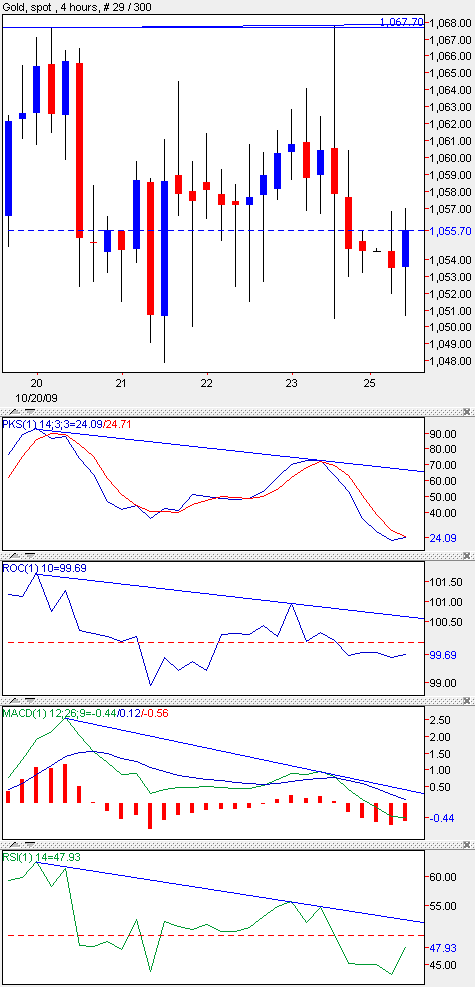
Spot Gold, Four Hour Interval
Jeffry Picower, Madoff Investor, Found Dead at Home
October 26th, 2009For the first time, I’m preemptively adding a story, this story, to the Assassination category.
—The Desperate Final Hours of the World’s Biggest Ever Financial Fraud
Six readers submitted this one. Thanks.
Via: Bloomberg:
Jeffry Picower, the philanthropist alleged to have withdrawn more than $7.2 billion from Bernard Madoff’s investment company, was found dead today at his home in Palm Beach, Florida, according to police. He was 67.
Picower’s wife Barbara told dispatchers at 12:09 local time that she had “just found her husband at the bottom of their swimming pool” at their oceanfront estate, police said. He was taken to Good Samaritan Hospital, where he was pronounced dead about 80 minutes later, the police said.
“As standard operating procedure in any drowning, the Palm Beach Police Department is conducting an investigation into Mr. Picower’s death,” police said in a statement.
Picower benefited more from Madoff’s $65 billion Ponzi scheme than any other investor, according to Irving Picard, the lawyer liquidating Madoff’s investment business. Picard sued Picower, his foundation and related entities, claiming they withdrew more than $7.2 billion over 20 years, including more than $5 billion in fake profits.
Picower’s attorney, William Zabel, didn’t immediately respond to a call and e-mail seeking comment.
Huge Returns
Zabel, in a court filing, said Picower was a victim of Madoff’s fraud rather than a beneficiary, as Picard claimed in his civil complaint in bankruptcy court in New York.
“Rather than recognizing Mr. Picower and the other defendants as victims of Madoff’s fraud, the trustee instead casts them as villains in history’s largest Ponzi scheme,” Zabel said in the July 31 filing seeking dismissal of Picard’s so-called clawback complaint.
The complaint claims Picower, his Palm Beach-based foundation, and related defendants should have known that the annual returns they were getting from Madoff — including some allegedly as high as 950 percent — were the result of fraud. Picower had said those figures are wrong.
Picard said that Picower received more than $2.4 billion from the fraud during the past six years alone, and that his accounts “were riddled with blatant and obvious fraud.”
Madoff, 71, pleaded guilty in March and is serving a 150- year prison term for using money from new clients to pay earlier investors. Picard is suing Madoff’s biggest investors and beneficiaries, including offshore hedge funds.
‘Highly Successful’
The Picower Foundation, run by Barbara Picower, gave away $163.9 million from 2002 to 2008, according to the July 31 filing in response to the Picard lawsuit.
Among the institutions that benefited from Picower’s giving were the Massachusetts Institute of Technology, which used a $50 million donation from Picower in 2002 to fund a brain-research center under Nobel prize-winner Susumu Tonegawa.
The Zabel filing described Picower as a “highly successful businessman and private investor who also is an inactive certified public accountant and retired attorney.”
Picower and related entities netted nearly $1 billion in 2004 on the sale of Alaris Medical Systems Inc., where he had been chairman, according to the filing.
He also was chairman of Decisions Inc., the principal entity through which he transacted his investment business and a defendant in the Picard complaint, according to the filing.
Over 30 years, Picower invested “huge sums of money” with Bernard L. Madoff Investment Securities LLC on behalf of himself, his business, his family and his charitable foundation, according to the filing.
‘Ugly Truth’
“Mr. Picower invested with BLMIS because he trusted Bernie Madoff, who he — and the world — believed to be a brilliant trader, a successful businessman, an industry leader, and a pillar of the financial community,” according to the filing.
Picower only learned the “ugly truth” upon Madoff’s arrest on Dec. 11, 2008, according to the filing.
“The consequences of Madoff’s betrayal to all BLMIS investors, including Mr. Picower and the other defendants, was devastating,” according to the filing.
“For Mr. Picower’s wife, Barbara, the consequences of Madoff’s fraud were immeasurable, as it caused the closure of the Picower Foundation, which Mrs. Picower had nurtured and to which she had devoted herself over many years,” it said.
Indiana: 500 Applicants for One $13 Per Hour Job Before Company Pulled Ad
October 25th, 2009Via: New York Times:
As soon as the job opening was posted on the afternoon of Friday, July 10, the deluge began.
C.R. England, a nationwide trucking company, needed an administrative assistant for its bustling driver training school here. Responsibilities included data entry, assembling paperwork and making copies.
It was a bona-fide opening at a decent wage, making it the rarest of commodities here in northwest Indiana, where steel industry layoffs have helped drive unemployment to about 10 percent.
When Stacey Ross, C. R. England’s head of corporate recruiting, arrived at her desk at the company’s Salt Lake City headquarters the next Monday, she found about 300 applications in the company’s e-mail inbox. And the fax machine had spit out an inch-and-a-half thick stack of résumés before running out of paper. By the time she pulled the posting off Careerbuilder.com later in the day, she guessed nearly 500 people had applied for the $13-an-hour job. “It was just shocking,” she said. “I had never seen anything so big.”
…
The 34-year-old recruiter decided the fairest approach was simply to start at the beginning, reviewing résumés in the order in which they came in. When she found a desirable candidate, she called to ask a few preliminary questions, before forwarding the name along to Chris Kelsey, the school’s director. When he had a big enough pool to evaluate, she would stop. Anyone she did not get to was simply out of luck.
She dropped significantly overqualified candidates right away, reasoning that they would leave when the economy improved. Among them was a former I.B.M. business analyst with 18 years experience; a former director of human resources; and someone with a master’s degree and 12 years at Deloitte & Touche, the accounting firm.
Over the course of four days, Ms. Ross forwarded 61 résumés to Mr. Kelsey, while rejecting 210 others. The remainder never even got a look. Many were, in fact, never uploaded to the company’s internal system because there were too many.




