The Man Who Paid the Men Who Stare at Goats
October 17th, 2009Via: Madcowprod:
The man who owned the flight school that taught Mohamed Atta to fly got rich selling his insurance company, we have learned, to the man who PAID “The Men Who Stare at Goats.”
Wally Hilliard’s links to American intelligence go back (at least) to November of 1981, when his insurance company, Wisconsin Employer’s Group, was bought out by Myron Du Bain, a World War II OSS/CIA operative and the Chairman of Fireman’s Fund of San Francisco.
We discovered the connection in a trip to Green Bay several years ago.
But only recently did we learn that Myron Du Bain’s life-long ties to the CIA included two stints at the helm of the Stanford Research Institute (SRI), famous for its classified research into psychic viewing, the results of which are currently on display in “The Men Who Stare at Goats.”
Change We Can Believe In: Obama Honors George H.W. Bush for Public Service
October 17th, 2009And all the crises and reforms (real reforms, too) so occupied the people that they did not see the slow motion underneath, of the whole process of government growing remoter and remoter…
The dictatorship, and the whole process of its coming into being, was above all diverting. It provided an excuse not to think for people who did not want to think anyway.
—Milton Mayer, They Thought They Were Free
The argument that the two parties should represent opposed ideals and policies, one, perhaps, of the Right and the other of the Left, is a foolish idea acceptable only to doctrinaire and academic thinkers. Instead, the two parties should be almost identical, so that the American people can ‘throw the rascals out’ at any election without leading to any profound or extensive shifts in policy.
—Carroll Quigley, Tragedy and Hope: A History of the World in our Time
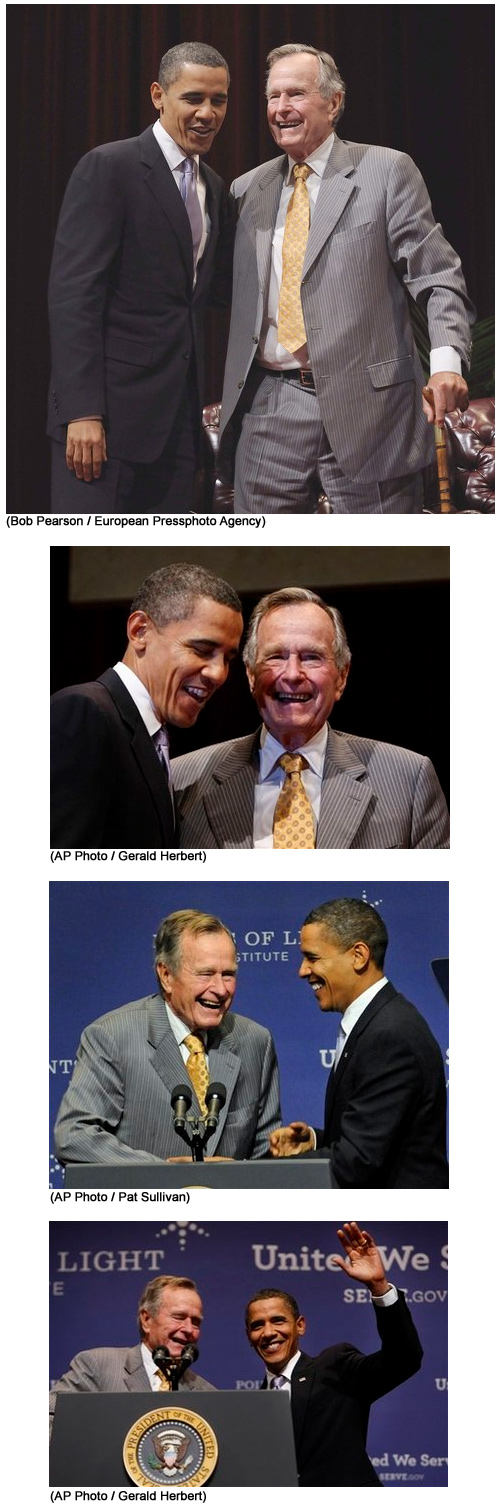
Obama Senior
Via: Los Angeles Times:
Reporting from College Station, Texas – In a glowing tribute to a Republican predecessor, President Obama on Friday praised President George H.W. Bush as an example of someone who eschewed “a life of comfort and privilege” and instead devoted himself to public service — inside government and out.
During an evening speech to honor the public service institute that Bush founded two decades ago, Obama called for cooperation between Republicans and Democrats. The former president, he said, proved that “the R or D next to your name is irrelevant” in challenging times.
“You might not always know it from watching the cable news shows or listening to folks on the radio,” Obama said, but “I think we’re standing in one of those moments.”
For his part, Bush reflected on Obama — the man who succeeded his son, President George W. Bush — as someone who at their initial meeting showed greater concern for Hurricane Katrina evacuees than for the television cameras.
“He came without fanfare,” Bush said of Obama’s 2005 visit to the region. “He was someone I could quickly see was genuinely concerned about helping others.”
They were joined onstage Friday in the Texas A&M University auditorium by Defense Secretary Robert M. Gates, who also served in the previous administration and was CIA director under the elder Bush.
The event presented a slightly odd situation, given that Obama’s administration has at times broadcast a rejection of policies and ideas under George W. Bush.
On Thursday, Obama had fielded tough questions in New Orleans about the federal response in the four years since Katrina. And he was not subtle in pointing to the failings of the younger Bush’s administration.
Friends of George H.W. Bush said that he has a genuine regard for Obama and that he came up with the idea six months ago of inviting the president to come to this college town to celebrate the 20th anniversary of the Points of Light Institute.
The former president is said to be unhappy with the Bush-bashing in Washington, but one former advisor said George H.W. Bush doesn’t hold it against Obama.
“Politics is politics,” said Ron Kaufman, a former White House political director. “But some things are bigger than that. He, like other Americans, would like to see the president be successful.”
Nevertheless, in the heart of Republican country, Obama inspired some protests and criticism.
Outside the auditorium Friday, a crowd of more than 100 chanted and waved signs, including one about the Obama administration’s spending and one about the national debt.
Inside, Bush had put together a polite and enthusiastic crowd.
The former president, who celebrated his 85th birthday in June with a parachute jump, walked gingerly with a cane. But he spoke in an unwavering voice of his admiration for Obama.
The evening was devoted to lauding the work of the Points of Light Institute, the name of which comes from a speech Bush gave envisioning the combined effect of individuals in public service.
Obama called on the audience of mostly college students to find time in their lives for service, even when it isn’t convenient or easy.
If the senior Bush could serve in combat missions overseas, Obama said, then “you can keep going when your service project gets tough.”
“He didn’t call for one blinding light shining from Washington,” Obama said. “He didn’t just call for a few bright lights from the biggest nonprofits. . . . He called for a vast galaxy of people and institutions working to solve problems in their own backyard.”
2009 Federal Deficit Surges to $1.42 Trillion
October 17th, 2009Via: AP:
What is $1.42 trillion? It’s more than the total national debt for the first 200 years of the Republic, more than the entire economy of India, almost as much as Canada’s, and more than $4,700 for every man, woman and child in the United States.
It’s the federal budget deficit for 2009, more than three times the most red ink ever amassed in a single year.
And, some economists warn, unless the government makes hard decisions to cut spending or raise taxes, it could be the seeds of another economic crisis.
Treasury figures released Friday showed that the government spent $46.6 billion more in September than it took in, a month that normally records a surplus. That boosted the shortfall for the full fiscal year ending Sept. 30 to $1.42 trillion. The previous year’s deficit was $459 billion.
As a percentage of U.S. economic output, it’s the biggest deficit since World War II.
“The rudderless U.S. fiscal policy is the biggest long-term risk to the U.S. economy,” says Kenneth Rogoff, a Harvard professor and former chief economist for the International Monetary Fund. “As we accumulate more and more debt, we leave ourselves very vulnerable.”
Forecasts of more red ink mean the federal government is heading toward spending 15 percent of its money by 2019 just to pay interest on the debt, up from 5 percent this fiscal year.
President Barack Obama has pledged to reduce the deficit once the Great Recession ends and the unemployment rate starts falling, but economists worry that the government lacks the will to make the hard political choices to get control of the imbalances.
Friday’s report showed that the government paid $190 billion in interest over the last 12 months on Treasury securities sold to finance the federal debt. Experts say this tab could quadruple in a decade as the size of the government’s total debt rises to $17.1 trillion by 2019.
Without significant budget cuts, that would crowd out government spending in such areas as transportation, law enforcement and education. Already, interest on the debt is the third-largest category of government spending, after the government’s popular entitlement programs, including Social Security and Medicare, and the military.
As the biggest borrower in the world, the government has been the prime beneficiary of today’s record low interest rates. The new budget report showed that interest payments fell by $62 billion this year even as the debt was soaring. Yields on three-month Treasury bills, sold every week by the Treasury to raise fresh cash to pay for maturing government debt, are now at 0.065 percent while six-month bills have fallen to 0.150 percent, the lowest ever in a half-century of selling these bills on a weekly basis.
The risk is that any significant increase in the rates at Treasury auctions could send the government’s interest expenses soaring. That could happen several ways — higher inflation could push the Federal Reserve to increase the short-term interest rates it controls, or the dollar could slump in value, or a combination of both.
Power Out Again
October 17th, 2009The storm took out the power. I’m on battery backup now. Anyway, you know the story. No updates probably means that the power is out.
Goldman Exec Named First COO of SEC Enforcement
October 17th, 2009The money is so dirty now, the gains so ill-gotten, that the most diabolical of ALL Wall Street firms needs to create a PRIVATE exchange because the existing bogus securities laws (WorldCom, Enron, blah blah) are too cumbersome and time consuming!?
Watch this space; if you dare.
I was mid sip of coffee as I was skimming headlines in the feed reader. I’m still sputtering.
Appropriately, there’s a thunder storm passing over us right now. The thunderclaps are long, low and ominous.
Via: AP:
A Goldman Sachs executive has been named the first chief operating officer of the Securities and Exchange Commission’s enforcement division.
The market watchdog agency said Friday that Adam Storch, vice president in Goldman Sachs’ Business Intelligence Group, is assuming the new position of managing executive of the SEC division.
The move came as the SEC has been revamping its enforcement efforts following the agency’s failure to uncover Bernard Madoff’s massive fraud scheme for nearly two decades despite numerous red flags.
Storch, who will be responsible for project management and operations, will report to SEC Enforcement Director Robert Khuzami.
Along with the enforcement division’s deputy director, Storch also will supervise the SEC’s Office of Market Intelligence, with an eye to improving the monitoring, collection and analysis of the hundreds of thousands of tips and complaints the agency receives annually.
Before joining Goldman Sachs, Storch was a senior consultant at accounting firm Deloitte & Touche. He is a certified public accountant and certified fraud examiner, and has an MBA from New York University and bachelors of science in business administration from the State University of New York in Buffalo.
Storch has a strong background in technology systems and project management, Khuzami said in a statement. “He will help to make us more efficient and nimble, and permit us to put more of our investigators on the front lines to detect and stop fraud,” Khuzami said.
Khuzami, a former federal prosecutor who came to the SEC in March from Wall Street investment firm Deutsche Bank, says he has undertaken the most extensive restructuring of the enforcement division in at least 30 years.
One in Eight Girls Pregnant at Chicago High School
October 16th, 2009Via: CBS2Chicago:
It is a Chicago public school full of energy and spirit. It has about 800 girls, and 115 of them have something in common…
All those young ladies are moms or moms-to-be at Paul Robeson High School. It’s not a school for young mothers, it’s a neighborhood school. And all of the pregnancies have happened, despite prevention talk.
If you want to know why, the people closest to the situation say there’s no simple explanation.
Chicago Public Schools says it does not track the overall number of teen moms in the district. But Robeson Principal Gerald Morrow knows the count at his school in Englewood: 115 young ladies who are expecting.
Britain: Supranational Banking Organization May Be Needed
October 16th, 2009Funny how BIS isn’t mentioned.
Via: Reuters:
A global body with legal powers may be needed over time to enforce the world’s new financial rules, the Financial Services Authority (FSA) said on Wednesday.
The FSA’s newly appointed and first director of international affairs, Verena Ross, said the Financial Stability Board (FSB) was key to ensuring all gaps in regulation between securities, insurance and banking sectors were plugged.
Formerly known as the Financial Stability Forum, the FSB was expanded in April to include central bankers and finance ministry and regulatory officials from all Group of 20 (G20) countries.
The G20 has asked the body, chaired by Bank of Italy Governor Mario Draghi, to coordinate global efforts to introduce new financial rules in light of the sector’s worst crisis in 70 years.
“I would advocate to make sure the FSB have a strong secretariat to support their work,” Ross told a City and Financial Conference.
“The role of the FSB is crucial. We will need to make sure it is able to play its role forcefully… Success depends on real progress over the next six to 12 months,” she said.
But the board has no legal teeth and there are “real questions” about whether the world can continue with such informal arrangements in the longer term, Ross said.
There may be a case for exploring the need for a more formal global regulatory framework, such as a body with legal powers of enforcement like the World Trade Organisation, Ross added.
JAL, Asia’s Largest Airline, Near Bankruptcy
October 16th, 2009Via: Reuters:
Japan Airlines Corp shares slid 12 percent to a record low on Friday as investors suggested bankruptcy may be an option for Asia’s biggest airline by revenue, even as the government again pledged to support the troubled carrier.
“There’s increasing concern about the future of the company and whether it’s heading for a GM-style bankruptcy or not,” said Mitsushige Akino, chief fund manager at Ichiyoshi Investment Management.
The airline, plagued with high costs in a severe industry downturn, has asked creditors for 600 billion yen ($6.6 billion) in financial aid, including 300 billion yen in debt waivers and debt-for-equity swaps, as part of a restructuring plan, according to two sources familiar with the matter.
JAL shares fell to 100 yen, their lowest since they were re-listed in 2002. By the close, the stock was quoted at 101 yen, down more than 11 percent. The shares have lost a quarter of their value this week.
Civilians Unemployed – 15 Weeks & Over
October 16th, 2009Recovery.
Via: Federal Reserve Bank of St. Louis:
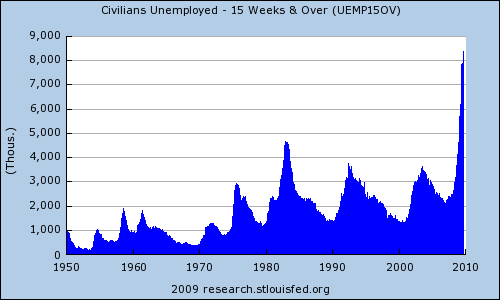
Long Term Unemployment
Drought: California Agriculture in Collapse
October 16th, 2009Via: AP:
As California prepares for its fourth year of drought, farmers are nervous in California’s San Joaquin Valley. The valley’s eight counties, if they were their own state, would be the top producing one in the nation. Nearly all the U.S. cantaloupes, garlic, almonds and processing tomatoes come from here. And so do nearly 400 other commodities — more than anywhere else.
The lack of water in the state’s reservoirs, coupled with the environmental collapse of the Sacramento-San Joaquin Delta where water from the state’s wet north is pumped south to irrigate fields, has restricted the amount of water some of the state’s most prolific farmers receive to as little as 10 percent of normal.
…
“You think we had a tough year this year?” said Marvin Meyers, an almond grower on Fresno County’s dry west side. “Wait ’til next year.”
Farmers and the advisory board of the California Department of Agriculture said the state’s $36 billion agriculture industry cannot afford another season of uncertainty. More packing houses they depend on to send their fruits, nuts and vegetables around the world will move to more reliable areas — across the border into Mexico they fear — if they cannot count on a reliable supply.
Another year of pumping salt-laden water from underground aquifers could kill their soil, they say. Board members warned that the Westlands Water District on the valley’s west side is the first to be hit by the crisis, but the water problems are spreading to the state’s other agricultural regions.
Some avocado growers in San Diego County are cutting trees back to stumps because the limited available water is too expensive.
“Where will the next shoe drop?” said board member Adan Ortega Jr.