Interpol and U.N. Back ‘Global Policing Doctrine’
October 13th, 2009I was thinking, “Wow, this seems very familiar. Where have I seen something like this before?” HAHA. This is just too much.
Start em’ young with Justice League International:
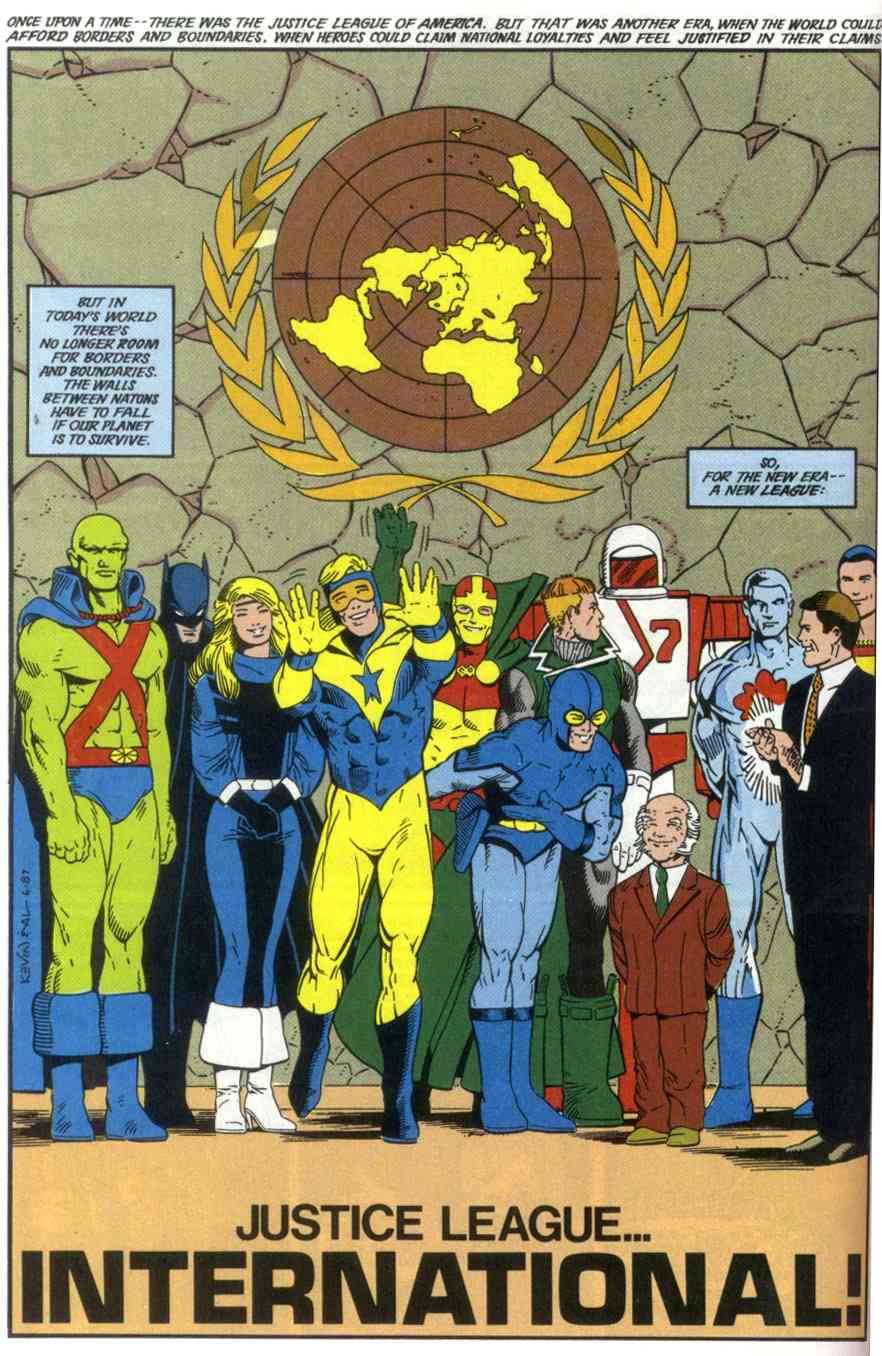
Justice League International
The text says:
Once upon a time—There was the Justice League of America. But that was another era, when the world could afford borders and boundaries, when heros could claim national loyalties and feel justified in their claims.
But in today’s world there’s no longer room for borders and boundaries. The walls between nations have to fall if our planet is to survive.
So, for a new era—A new League:
Justice League…
International!
In case you don’t recognize the logo on the wall, here’s the real one:

U.N. Logo
The Justice League International comic books were published in the 1980s and 1990s.
Via: New York Times:
Interpol and the United Nations are poised to become partners in fighting crime by jointly grooming a global police force that would be deployed as peacekeepers among rogue nations riven by war and organized crime, officials from both organizations say.
On Monday, justice and foreign ministers from more than 60 countries, including the United States and China, are gathering in Singapore for a meeting hosted by the two international organizations.
It is the first step toward creating what Interpol calls a “global policing doctrine” that would enable Interpol and the United Nations to improve the skills of police peacekeepers, largely by sharing a secure communications network and a vast electronic trove of criminal information, including DNA records, fingerprints, photographs and fugitive notices.
“We have a visionary model,” said Ronald K. Noble, secretary general of Interpol and the first American to head the international police organization, which is based in Lyon. More than 187 member nations finance the organization.
“The police will be trained and equipped differently with resources,” Mr. Noble said. “When they stop someone, they will be consulting global databases to determine who they are stopping.”
Modern peacekeeping has evolved dramatically since the blue-helmeted U.N. military force won a Nobel Peace Prize in 1988. Since 2005, the number of police officers within the total force of 95,400 peacekeepers has more than doubled from about 6,000 to 12,200 in 17 countries.
U.N. police are already battling kidnappings and drug crime in Haiti and illicit lumber trading in Liberia. The aim of the joint effort is to increase the ability to track the movement of criminals around the world by sharing resources and common standards, according to Mr. Noble. He is also pressing ahead with plans for special electronic passports for the agency’s staff of more than 600 Interpol investigators to speed border crossings.
The Norwegian Ministry of Foreign Affairs is contributing more than $2 million to finance the development of international global policing standards, according to Andrew Hughes, an Australian who currently heads the U.N.’s force of police officers.
The ambition is to create a series of networks to counter borderless organized criminal operations, Mr. Hughes said. Women, in particular, are being recruited, with a goal of reaching 20 percent of the U.N. force and the development of all-female units like the group of 140 peacekeepers from Bangladesh that is about to be deployed.
“We’re working with refugees,” Mr. Hughes said. “Many of the victims of atrocities are women, and they’ve had enough of men with guns and uniforms.”
He said that among the most critical tasks for a global police force were combating illegal arms and drug trafficking. His own officers in West Africa have watched the growth of cocaine smuggling by Colombian and Venezuelan drug cartels through weakened countries like Sierra Leone and Liberia to the lucrative consumer markets in Europe.
The United States remains the biggest market for cocaine, according to the U.N.’s annual report on drugs and crime. But in the past three years, South American cartels have moved more drugs to Europe using transit points like Guinea Bissau, where the president and the head of the military were killed in sophisticated bombing attacks in March. Each year, at least 50 tons of cocaine from Andean countries passes through West Africa to the streets of Europe, where the drugs are worth almost $2 billion, according to the U.N. report.
“Organized crime is a business that looks for opportunity to expand their market enterprise,” Mr. Hughes said. “When you have a breakdown in police and courts and corrections, organized crime is ripe. We also see the toxic effect of corruption, because they are able to corrupt officials, which makes it difficult to build a functioning society.”
In Afghanistan, where heroin and hashish trafficking is also a thorny issue, NATO announced plans this month to start training the local police — a move it has avoided in the past to concentrate on military responsibilities.
But Mr. Noble of Interpol says he takes a dim view of transforming warriors into beat cops, because the mind-sets are so different.
“We caution on making the delegation of civil police development tasks to military structures,” Mr. Noble said, citing the example of an attack that freed hundreds of Taliban from a prison in Kandahar, Afghanistan, last year. Although Interpol immediately asked for information about the missing prisoners, he said, “we were really shocked and dismayed to learn there were no fingerprints and photographs despite billions spent to train police there.”
With the meeting of justice ministers on Monday, which coincides with a general assembly of Interpol police members, the group is expected to debate the global police issue and to craft a declaration that would lead to an action plan for international police peacekeeping within 12 months.
Cryptogon Reader Affiliate Purchase (at Nitro-Pak)
October 13th, 2009Someone out there has made what amounts to an astonishing purchase at one of Cryptogon’s affiliates.
First of all, thank you. Second: Do you know about something specific that’s headed down the track?
Now, I’m sure this person knows who he or she is and the purchase that I’m referring to in this post. If you’re that person and feel like relating any information that might be of assistance to people out in Cryptogon land, I’d like to hear from you.
If you would like to check in, please identify yourself by stating the Cryptogon affiliate in question and the dollar amount of your order. I’m only asking you to provide those details so I know that you’re the one who made the purchase. Feel free to use a throw away email (gmail, yahoo, etc) if you like. Anything that you tell me would be kept between us by default (and whichever intelligence agencies are monitoring the emails). My public key is here, just in case. I understand if you don’t want to talk about this to me or anyone else. I’m just curious.
To everyone else, I’ll give this person a day or so to respond, or not, then I’ll update the Support list as usual.
I hope this doesn’t sound too woowoo. Don’t think that it’s a personal submarine or a 300 foot high jumbotron HDTV, etc. Once I tell you, you’ll probably wonder what all the fuss was about. But there aren’t many people thinking like this person. That’s why I’m curious to know if he or she has any information to share.
UPDATE: The Reader Emailed Me
The affiliate order in question was with Nitro-Pak. The order was for $7,989 worth of supplies. Cryptogon received a commission of $798.90.
I’ll just post the email I received, minus the Cryptogon reader’s name and email address, of course.
This speaks for itself:
Kevin,
reference: order to Nitro-Pak in the amount of $7,989.00.
I am answering your question out of respect for you, and the fact that you asked, not because I have some vital information to pass along.
No, I don’t know anything in the offing, as in being privy to some great secret. The information upon which I base my decisions is all publicly available. However, like everyone else, I am selective in what I pay attention to, and whose judgments and commentary I listen to and consider.
David Icke had a nice metaphor about how far outside the city limits of conventional viewpoints various people choose to pitch their tents. In each case of a person “well out there”, he will recognize that the people closer in to town are sadly naive. But there will be others who have pitched tents even further out. And the man says, “Those guys further out have gone crazy. The situation is not as wild as they say.”
I can testify to having repeatedly packed up my campsite and shifted yet further out. Folks that at first I felt were too wild now seem to make a lot of sense to me. The guys that make the most sense to me are waving all kinds of red flags and foreseeing big events soon. And really, as I keep reminding myself: we are already way into the collapse of our civilization. Stupendous bankruptcies and equivalent operations have already happened. Deficits beyond human comprehension are calmly admitted by the authorities. Our public institutions are corrupted beyond redemption. I don’t need to list this stuff for Cryptogon readers.
Now, as to the order I placed, my subjective experience is that it just developed totally naturally. I started with the fear that the wealth stored in my retirement plan was almost certainly doomed to destruction. Even with the degree of flexibility built into the plan — and there really is some — there was no investment into which I could divert the funds that seemed a credible place.
A few years back I did very well with the portion in foreign based mutual funds. Last couple of years, I was very disproportionately into PIMCO bond funds, and that has at least not gone down.
But of late, it is hard to place any faith in theoretically paper, but really totally digital wealth, being stored and managed by Wall Street firms. I pulled a substantial amount out of the account. Time to get local and get real. Let’s think about food.
I remembered you were an affiliate of Nitro-Pak, so I simply started there. And after perusing their offerings, and having some substantial funds to invest, there was this perfectly wonderful jump start on comprehensive crisis preparedness.
One of my sons, college aged, is way further out there in passionate preparedness. He participates actively on web sites dedicated to survival, and such matters. At first he was skeptical about the order I was about to place, and if only for family peace, I held off placing the order until he had vetted it by comparing the contents and costs with other offerings from other suppliers. He gave it his seal of approval. It really is a very good deal in terms of the contents, quality, coverage, and cost. And this contains not just food, but many other thoughtful additions. It is really comprehensive.
So if you did not have much in the line of crisis preparedness, but could pry loose some substantial money, this provides a great, quick jump start on the preparation process.
Nitro-Pak is very responsive. I immediately started getting emails with confirmation details. Very impressive response. We just received the bulk of the shipment. Some special sized items are being shipped separately, and one item is back ordered. The shipment arrived in pristine condition. I recommend these guys.
As for this message, you can use whatever you want from it, but I do not want you to give out my name or email address.
Warmest regards,
[Sender’s Name Kept Private]
Australia: Ban Screens of All Kinds for Children Under Two
October 13th, 2009Via: Telegraph:
Children under the age of two should be banned from watching television, according to guidelines prepared for the Australian government.
The guidelines warn that exposure to television at such an early age can delay language development, affect the ability of a child to concentrate and lead to obesity.
The recommendations also suggest that children aged two to five should watch no more than one hour of television a day.
The recommended viewing limits vary wildly from the actual amount of television and DVDs viewed by Australian children.
Australian statistics show that four-month-old infants watch an of average 44 minutes of television each day and that children under the age of four with pay television at home spend at least three hours a day in front of the screen.
The draft guidelines, which have been designed for childcare centres but also offer advice for parents, are intended to help curb the spread of obesity. Six to eight per cent of Australian schoolchildren are currently listed as obese and an additional one in five, while not obese, is overweight.
“Based on recent research, it is recommended that children younger than two years of age should not spend any time watching television or using other electronic media (DVDs, computer and other electronic games),” said a draft copy of the guidelines obtained by The Australian newspaper.
“Screen time … may reduce the amount of time they have for active play, social contact with others and chances for language development.
“(It may) affect the development of a full range of eye movement (and) … reduce the length of time they can stay focused.”
The government has refused to comment on the Get Up and Grow report for healthy eating and exercise in early childhood, devised by Melbourne’s Royal Children’s Hospital, saying only that the guidelines were still being finalised.
Gold: Next Leg Up
October 13th, 2009WARNING: This is not a recommendation to buy, sell or hold any financial instrument.
UPDATE 5: USDX: Anatomy of a Failed Bounce Operation, One Minute Interval
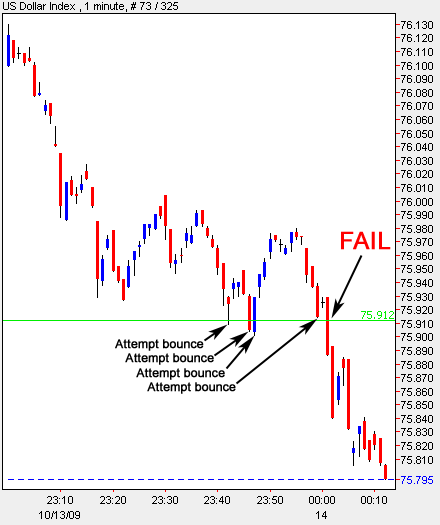
U.S. Dollar Index Bounce Fail
UPDATE 4: USDX PRINTS 75.805
UPDATE 3: USDX PRINTS 75.886
WEE!!!@$!$% Watch this…
UPDATE 2: USDX PRINTS 75.909
They’re definitely trying to bounce it, but it’s not working so far. Second try up now.
UPDATE 1: USDX MAKE OR BREAK
One would think that They’re going to try to bounce USDX at any moment, but gold is already up and out. 75.912 is the support on the USDX. Trading at 75.951 right now. I’m guessing gold knows something by breaking out first.
***Get Popcorn Ready***
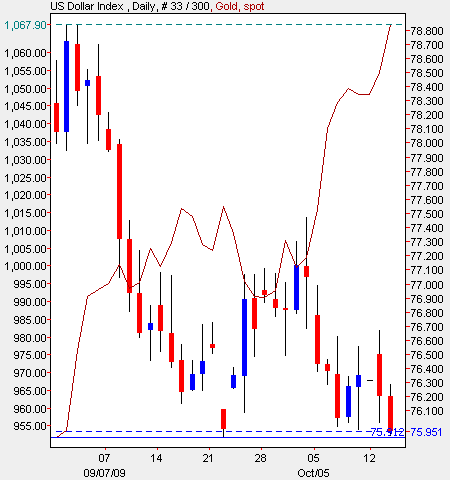
USDX vs. Gold Daily Interval
—End Update—
$1067.
FBI Doing Facial Recognition Scans on DMV Photo Records
October 13th, 2009Via: AP:
In its search for fugitives, the FBI has begun using facial-recognition technology on millions of motorists, comparing driver’s license photos with pictures of convicts in a high-tech analysis of chin widths and nose sizes.
The project in North Carolina has already helped nab at least one suspect. Agents are eager to look for more criminals and possibly to expand the effort nationwide. But privacy advocates worry that the method allows authorities to track people who have done nothing wrong.
“Everybody’s participating, essentially, in a virtual lineup by getting a driver’s license,” said Christopher Calabrese, an attorney who focuses on privacy issues at the American Civil Liberties Union.
FBI Building “Multi-Modal Biometrics” Database
October 13th, 2009Voice scans. You know, in case you use a phone that isn’t registered to you.
Via: ComputerWorld:
The Federal Bureau of Investigation is expanding beyond its traditional fingerprint-focused collection practices to develop a new biometrics system that will include DNA records, 3-D facial imaging, palm prints and voice scans, blended to create what’s known as “multi-modal biometrics.”
“The FBI today is announcing a rapid DNA initiative,” said Louis Grever, executive assistant director of the FBI’s science and technology branch, during his keynote presentation at the Biometric Consortium Conference in Tampa.
The FBI plans to begin migrating from its IAFIS database, established in the mid-1990s to hold its vast fingerprint data, to a next-generation system that’s expected to be in prototype early next year. This multi-modal NGI biometrics database system will hold DNA records and more.
Grever said that fingerprints and DNA appear to be the most mature and searchable biometrics possibilities, but the FBI is working to include iris-scan records among newer biometrics technologies to identify criminals and terrorists. The plan is to share this data with authorized U.S. and international investigative partners, as the agency does today.
The FBI’s current IAFIS database remains a workhouse; it processes about 200,000 daily transactions from its 370 million 10-fingerprint records, and it just crossed the 250 million transaction mark.
The next-generation FBI database system is under design by MorphoTrak and is expected to include DNA, iris scans, advanced 3-D facial imaging and voice scans among its multi-modal biometrics. Lower turnaround times for delivering information over wide-area networks are planned. The goal is to drop from a roughly two-hour response time for IAFIS urgent requests to less than 10 minutes.
Related: Scans Of Eyes, Fingerprints Help Army Find Insurgents
The Frankenfood Industry’s Strong Arm Tactics with Researchers
October 13th, 2009Via: GM Watch:
The increasingly fractious relationship between public sector researchers and the biotech seed industry has come into the spotlight in recent months. In July, several leading seed companies met with a group of entomologists, who earlier in the year had lodged a public complaint with the US Environmental Protection Agency (EPA) over restricted access to materials. In a letter to the EPA, the 26 public sector scientists complained that crop developers are curbing their rights to study commercial biotech crops. “No truly independent research can be legally conducted on many critical questions involving these crops [because of company-imposed restrictions],” they wrote.
In turn, the seed companies have expressed surprise at the outcry, claiming the issue is being overblown. And even though the July meeting, organized by the American Seed Trade Association in Alexandria, Virginia, did result in the writing of a set of principles for carrying out this research, the seed companies are under no compunction to follow them. “From the researchers’ perspective, the key for this meeting was opening up communication to discuss the problem,” says Ken Ostlie, an entomologist at the University of Minnesota in St. Paul, who signed the complaint. “It will be interesting to see how companies implement the principles they agreed upon.”
What is clear is that the seed industry is perceived as highly secretive and reluctant to share its products with scientists. This is fueling the view that companies have something to hide.
Who’s in control?
It’s no secret that the seed industry has the power to shape the information available on biotech crops, referred to variously as genetically engineered or genetically modified (GM) crops. Commercial entities developed nearly all of the crops on the US market, and their ownership of the proprietary technology allows them to decide who studies the crops and how. “Industry is completely driving the bus,” says Christian Krupke, an entomologist at Purdue University in West Lafayette, Indiana.
Company control starts with a simple grower’s contract. Anyone wishing to buy transgenic seeds has to sign what’s called a technology stewardship agreement that says, among many things, that the buyer cannot conduct research on the seed, nor give it to someone else for research. This means scientists can’t simply buy seeds for their studies, and farmers can’t slip them some on the side. Instead, scientists must get permission from the seed companies or risk a lawsuit. “You need permission from industry and you have to specify what you want to do with the plants,” says Bruce Tabashnik, an entomologist at the University of Arizona in Tucson.
Research Credit: efs
Russian Mafia/Government Crooks vs. Hedge Fund Crooks
October 13th, 2009Via: Guardian:
Thousands of Russians are watching a YouTube video that accuses their government and officials of high corruption.
A Russian version of a video by Hermitage Capital, the London-based hedge fund claiming to be victim of a $230m (£146m) scam, has attracted over 12,000 hits, and is the most viewed news clip on YouTube in Russia, the site shows. The English version has had almost 8,000 viewings.
William Browder, head of Hermitage Capital, hopes the video’s international impact will put pressure on the Russian authorities to listen to his claims of theft, gangsterism and government corruption.
“It’s a true Kafka-esque type of situation,” Browder says in the video. “It’s one thing to be victimised by a crime, it’s another thing to be blamed for the crime that you’re a victim of.”
Browder has been banned from entrance to the country and has removed his staff from the fund’s offices in Moscow after police raids. However, one lawyer working for Hermitage, a 37-year old father of two, is still in prison.
Hermitage alleges that its position as Russia’s largest foreign investor two years ago made the establishment nervous, leading to Browder being denied entry to the country. His petition for a new visa led to a string of threats that ended up with the police raiding Hermitage’s Moscow offices, seizing all its documentation.
The video contains reconstruction of the raids and also the transcript of a telephone call from a tax official which the company alleges contains blackmail threats.
The Russian interior ministry is still seeking to have Browder returned to Russia for questioning, Irina Dudukina, a ministry spokeswoman told Bloomberg News by phone today. The executive was placed on the ministry’s international wanted list on charges of tax evasion.
However, according to the fund, the criminals used a network of corrupt lawyers, police and judges to fake transactions and simulate that three profit-making Hermitage subsidiaries had turned a profit into losses – for which they demanded a tax rebate. The new owners of the stolen companies received Russia’s biggest ever rebate within two days, the video claims.
“The $230m which belonged to the Russian people had been stolen by the criminals in an organised conspiracy supported by corrupted officials in the higher reaches of the Russian state,” the video says. “The story sounds like a thriller but isn’t and it’s being repeated every day.”
Hermitage has several legal suits opened in Russia and plans to continue its battle: “We will overwhelm them with transparency. Evil tends to wither under the bright light of publicity,” Browder says.
Food Production ‘Must Rise 70%’ Over the Next 40 Years
October 13th, 2009Via: BBC:
Food production will have to increase by 70% over the next 40 years to feed the world’s growing population, the United Nations food agency predicts.
The Food and Agricultural Organisation says if more land is not used for food production now, 370 million people could be facing famine by 2050.
The world population is expected to increase from the current 6.7 billion to 9.1 billion by mid-century.
Climate change, involving floods and droughts, will affect food production.
The FAO said net investments of $83bn (£52.5bn) a year – an increase of 50% – had to be made in agriculture in developing countries if there was to be enough food by 2050.
Research Credit: R
Handgun Ammo Purchases in California: Driver’s License, Thumbprint and Sales Records for Police
October 12th, 2009Via: ABC News 10:
Before the midnight deadline, Gov. Schwarzenegger acted on 685 bills that were on his desk. He signed 456 and vetoed 229.
One of the bills that he signed was Assembly Bill 962. It requires handgun ammunition to be kept behind the counter where customers cannot access it without assistance. It also requires gun shop owners to thumbprint people who buy handgun ammunition, as well as record their identification and provide that information to police.
More:
Among other regulations, AB 962 would:
• Ban all mail-order and Internet sales of handgun ammunition.
• Prohibit the retail sale, the offer for sale or the display of handgun ammunition in a manner that allows ammunition to be accessible to a purchaser without assistance of a vendor or employee.
• Require that the delivery or transfer of ownership of handgun ammunition occur in a face-to-face transaction, with the deliverer or transferor being provided bona fide evidence of identity of the purchaser or other transferee.
That evidence of identity, which must be legibly recorded at the time of delivery, includes:
• The right thumbprint of the purchaser or transferee.
• The date of the sale or other transaction.
• The purchaser’s or transferee’s driver’s license or other identification number and the state in which it was issued.
• The brand, type and amount of ammunition sold or otherwise transferred.
• The purchaser’s or transferee’s signature.
• The name of the salesperson who processed the sale or other transaction.
• The purchaser’s or transferee’s full residential address and telephone number.
• The purchaser’s or transferee’s date of birth.




