Rogue Satellites to be Cleared from Earth’s Orbit by German Robots
October 12th, 2009I swear, it’s a real headline.
Via: Guardian:
Robots that rescue failing satellites and push “dead” ones into outer space should be ready in four years, it has emerged. Experts described the development by German scientists as a crucial step in preventing a disaster in the Earth’s crowded orbit.
Last year it was reported that critical levels of debris circling the Earth were threatening astronauts’ lives and the future of the multibillion-pound satellite communications industry. But senior figures at the German Aerospace Centre (DLR) told the Observer they have been given the go-ahead to tackle a crisis that will come to a head in the next five to 10 years as more orbiting objects run out of fuel.
Their robots will dock with failing satellites to carry out repairs or push them into “graveyard orbits”, freeing vital space in geostationary orbit. This is the narrow band 22,000 miles above the Earth in which orbiting objects appear fixed at the same point. More than 200 dead satellites litter this orbit. Within 10 years that number could increase fivefold, the International Association for the Advancement of Space Safety has warned.
Klaus Landzettel, head of space robotics at DLR, said engineering advances, including the development of machines that can withstand temperatures ranging from -170C (-274F) to 200C (392F), meant that the German robots will be “ready to be used on any satellite, whether it’s designed to be docked or not”.
In 2007, the US Orbital Express project succeeded in refuelling an orbiting satellite. However, that satellite had been specifically designed to dock with the device.
Why are Monsanto Insiders Now Appointed to Protect Your Food Safety?
October 12th, 2009Via: Mercola:
The New Secretary of Agriculture is a Fan of Factory Farms, GM Crops and More
Former Iowa Governor Tom Vilsack is now the Secretary of Agriculture, an appointment that took place despite massive public outcry. What was needed for an effective Secretary of Agriculture was someone who would develop and implement a plan that promotes family-scale farming and a safe and nutritious food system with a sustainable and organic vision.
What we got was yet another politician who’s already made room in his bed for the industry lobby. As the Organic Consumers Association (OCA) points out:[3]
* Vilsack has been a strong supporter of genetically engineered crops, including bio-pharmaceutical corn
* The biggest biotechnology industry group, the Biotechnology Industry Organization, named Vilsack Governor of the Year. He was also the founder and former chair of the Governor’s Biotechnology Partnership.
* When Vilsack created the Iowa Values Fund, his first poster child of economic development potential was Trans Ova and their pursuit of cloning dairy cows.
* The undemocratic and highly unpopular 2005 seed pre-emption bill was Vilsack’s brainchild. The law strips local government’s right to regulated genetically engineered seed (including where GE can be grown, maintaining GE-free buffers or banning pharma corn locally)
* Vilsack is an ardent supporter of corn and soy-based biofuels, which use as much or more fossil fuel energy to produce them as they generate, while driving up world food prices and literally starving the poor.
* Overall, Vilsack’s record is one of aiding and abetting Concentrated Animal Feeding Operations (CAFOs) or factory farms and promoting animal cloning.
You may also be interested to know that Vilsack is widely regarded as a shill for biotech giants like Monsanto (he even reportedly often travels in Monsanto’s jet)![4]
The New Senior Advisor for the FDA is a Former Monsanto VP!
Michael Taylor, a former vice president of public policy and chief lobbyist at Monsanto Company, is the new senior advisor for the U.S. Food and Drug Administration (FDA).
Who is Michael Taylor? He is the person who “oversaw the creation of GMO policy,” according to Jeffrey Smith, the leading spokesperson on the dangers of GM foods. Smith continues:
“If GMOs are indeed responsible for massive sickness and death, then the individual who oversaw the FDA policy that facilitated their introduction holds a uniquely infamous role in human history. That person is Michael Taylor. He had been Monsanto’s attorney before becoming policy chief at the FDA. Soon after, he became Monsanto’s vice president and chief lobbyist.”[5]
The FDA policy being referred to is the 1992 GMO policy, which stated:
“The agency is not aware of any information showing that foods derived by these new methods [genetic engineering] differ from other foods in any meaningful or uniform way.”
In reality, there was major concern among FDA scientists that GM foods were in fact different than natural foods, and that their creation could prompt unknown and unpredictable health problems.
Along with being a key player in the initial pushing of GM foods onto Americans’ plates (without any required safety studies), Taylor also oversaw the policy regarding Monsanto’s genetically engineered bovine growth hormone (rbGH/rbST).
This growth hormone, which has been banned in Canada, Europe, Japan, Australia and New Zealand because of cancer risks and other health concerns, was approved in the United States while Taylor was in charge at the FDA. Smith writes:
“Taylor also determined that milk from injected cows did not require any special labeling. And as a gift to his future employer Monsanto, he wrote a white paper suggesting that if companies ever had the audacity to label their products as not using rbGH, they should also include a disclaimer stating that according to the FDA, there is no difference between milk from treated and untreated cows.”
Taylor’s white paper, which again was untrue as even FDA scientists acknowledged differences in the rbGH milk, allowed Monsanto to sue dairies that labeled their products rbGH-free.
Dennis Wolff, Another Monsanto “Yes Man,” May be the Next Under-Secretary of Agriculture for Food Safety
In another ironic turn of events, it’s rumored that Pennsylvania Agriculture Secretary Dennis Wolff may be appointed the new Under-Secretary of Agriculture for Food Safety — the top food safety post at the USDA.
Wolff declared that labeling products rbGH-free was against the law, and ordered all such labels to be removed from Pennsylvania. Fortunately, due to consumer demand Pennsylvania’s Governor Ed Rendell stepped in and stopped the ban on rbGH-free labels (although he did require such claims to include Taylor’s FDA disclaimer that there is no difference between milk from treated and untreated cows).
As Jeffrey Smith explains:
“Rumor has it that the reason why Pennsylvania’s governor is supporting Wolff’s appointment is to get him out of the state — after he “screwed up so badly” with the rbGH decision. Oh great, governor. Thanks.”[6]
Not only did Dennis Wolff attempt to ban rbGH-free labels, but OCA points out that he has “also worked to deprive communities the right to ban toxic sewage sludge, factory farms, and GMOs.”[7]
Cold Temperatures Threaten Seed Potato Crop
October 12th, 2009Get Al on the job:
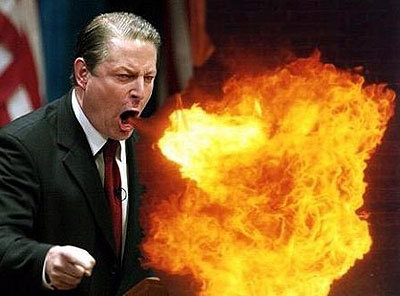
Al Gore
Via: AP:
Record-low temperatures in southwestern Idaho are threatening to destroy at least a portion of this season’s crop of seed potatoes.
Spuds still in the ground could be saved by a layer of snow; a dusting had fallen on Bozeman and the surrounding region by Sunday.
Nina Zydak, director of the Montana State University Potato Lab, said most area farmers have already started digging.
But many farmers expect to lose some of their potatoes.
“It’s over,” Larry Van Dyke, who owns Van Dyke Farms in Townsend, told the Bozeman Chronicle.
He says when it’s this cold for too long, the frost penetrates and the taters are toast.
The main goal now is to make sure the spoiled potatoes don’t make it into his cellar.
Temperatures on Saturday evening dipped to 17 degrees; the last time it was this cold, this early, in southwestern Idaho was more than two decades ago, in 1985.
Britain Has Worst Quality of Life in Europe?
October 12th, 2009Throw another CCTV at it, and send out some more idiots from the councils to look through people’s trash. That will sort it out for sure.
Via: Telegraph:
British people have the worst quality of life in Europe, according to a report which highlights the long hours, bad weather, low life expectancy and high price of many consumer goods.
In a study of ten of the largest European countries, Britain comes last followed by Ireland, with France and Spain topping the table.
Though British households enjoy the highest income, at £35,730 a year, £10,325 higher than the European average, British families have to contend with a high cost of living, with fuel, food and alcohol all costing more than the European average.
With a litre of unleaded petrol at £1.08 a litre, the UK is the second most expensive country in Europe. However, diesel is more expensive in the UK than anywhere else in Europe – £1.13 a litre, which is 19p or 20 per cent above the European average of £0.94.
The report by price comparison website uSwitch analyses 10 European countries against 17 different benchmarks, from the price of gas, electricity, fuel, food and drink to the amount each country spends on education, health to working conditions and the weather.
The top three countries are France, Spain and Denmark, with Sweden, Ireland and Britain coming eighth, ninth and tenth respectively.
The study comes less than a week after the United Nations moved Britain out of the top 20 list of most desirable countries to live in for the first time.
Cryptogon Readers Sign Up for Hosting with BlueHost
October 12th, 2009Thanks to the owners of truthistreason.net and headchip.net for signing up for hosting with BlueHost. Cryptogon received $180.
October Contributions
October 12th, 2009These generous readers have sent contributions in October:
Pookie $75
TB $30
RP $40
MS CA$25
SM $25
JS $25
ES €25
Thank you.
September Earnings
October 12th, 2009Earnings for September came to a total of $1332.14. That’s an excellent result. Here’s the earnings breakdown:
56% affiliate commissions
44% direct contributions
To all September Cryptogon supporters, thank you.
Why Obama Doesn’t Deserve the Nobel Peace Prize: An Unabridged List
October 11th, 2009Obama wins Nobel Peace Prize! Hell freezes over!
California Budget Is Already in the Red 10 Weeks After Passage
October 10th, 2009Sure, believe the shortfall is just a “one-time event.”
Via: Bloomberg:
California Governor Arnold Schwarzenegger will know within a month whether a $1.1 billion drop in revenue collections is part of a growing budget shortfall or an isolated event, his budget spokesman said.
Revenue in the three months ended Sept. 30 was 5.3 percent less than assumed in the $85 billion annual budget, state controller John Chiang reported yesterday. Income tax receipts led the gap, as unemployment reached 12.2 percent in August.
“The culprit here appears to be estimated quarterly personal income tax statements,” H.D. Palmer, the governor’s budget spokesman, said yesterday. “The numbers are cause for concern, but the issue now for us is to determine if this is a one-time event or whether it has more long-term implications.”
UK Faced ‘Bank Runs, Riots’ as RBS and HBOS Neared Collapse
October 10th, 2009Via: Bloomberg:
A year ago today, Royal Bank of Scotland Group Plc and HBOS Plc were close to collapse, causing a chain reaction that could have ended with riots in U.K. cities, security analysts and economists said.
Bank failures would have forced the government to cancel police leave and deploy troops as the breakdown of the financial payments system threatened the ability of utilities to provide essential services, said David Livingstone, a fellow at the Royal Institute for International Affairs in London, a former adviser to the government’s Cobra crisis response committee.
“You are talking about a situation with mass disorder and panic,” the former Royal Navy officer said in an interview. There would be “riots, pandemonium, everyone fending for themselves.”
Chancellor of the Exchequer Alistair Darling, Bank of England Governor Mervyn King and Financial Services Authority Chairman Adair Turner met at 5 p.m. on Oct. 7, 2008, and readied a 250 billion-pound ($398 billion) rescue for the banks in the 16 hours before they opened for business the following day. In response to a Freedom of Information Act request from Bloomberg News one year on, the Treasury declined to say if it had a contingency plan for the two banks, then or now.
Releasing such information would probably “have a destabilizing effect on financial markets,” damage the government decision-making process and cause commercial harm to the banks involved, the Treasury said in a letter.
“In the current economic climate, economic perception, even if totally misconceived, is important and has the capacity to alter market behavior,” the government said. “To confirm or deny whether or not the information is held, either in relation to the banks mentioned in your request or more generally” would hurt the banks and the U.K.’s economic interests.
‘Catastrophic’ Costs
The crisis last year was the worst Britain had faced in peacetime, Darling told the British Broadcasting Corp. last month. The two banks were not “confident they could get to the end of the day,” on Oct. 7, King told the same program.
“You would have had unmitigated panic and a bank run,” said Tom Kirchmaier, a fellow at the London School of Economics. “People would not have been able to buy bread. The cost to the economy would have been catastrophic.”