Max Keiser Commentary on U.S. Dollar
October 7th, 2009Gold Move
October 7th, 2009Warning: This is not a recommendation to buy, sell or hold any financial instrument.
I have to conclude that the immediate term direction on gold is up. It’s setting up an ascending triangle on the hourly interval and it has overlapping supports (daily) just below. Even if the hourly ascending triangle fails, a retracement to around $1028 could be considered part of a healthy pullback.
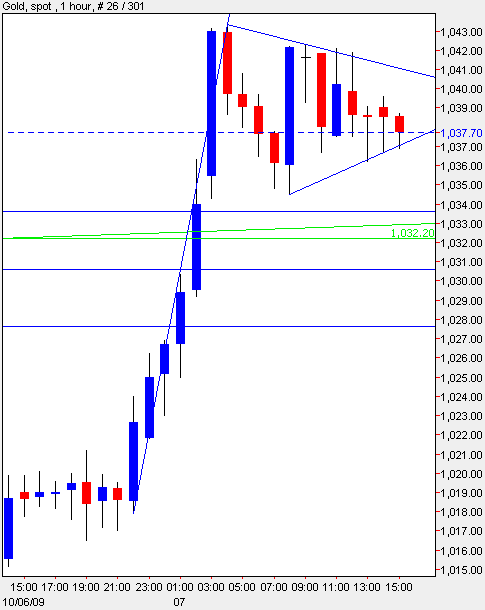
Spot gold, hourly interval
While gold looks set to make new highs, short term, this breakout is occurring without the U.S. Dollar Index breaking down and out of its range. That should concern gold longs here. 75.912 on the U.S. Dollar Index must be taken out to the downside, or gold is going to correct.

U.S. Dollar Index, daily interval
If you have large profits on a speculative gold position (and I know that many Cryptogon readers do), I would consider taking profit on a portion of your holdings, or buying protective puts; especially on the next push higher—if it happens—over the next several hours to days. A more important tripwire for gold longs to watch is the 77.475 level on the U.S. Dollar Index.
Prosecutor: CIA Kidnapping in Italy Too Grave to Cover Up
October 6th, 2009Via: AP:
The kidnapping of a terror suspect is too grave a crime to be covered up just to protect government secrets, a prosecutor declared Wednesday in the trial of 26 Americans and seven Italians charged in the abduction of an Egyptian cleric.
Prosecutor Armando Spataro gave his closing arguments in a trial that is the first in any country to scrutinize the CIA’s extraordinary renditions. Under that program, the U.S. spy agency transferred terrorism suspects to third countries for interrogation.
Human rights advocates say that renditions were the CIA’s way to outsource the torture of prisoners to countries where torture was practiced.
Italian prosecutors say Egyptian cleric Osama Moustafa Hassan Nasr, a suspected terrorist also known as Abu Omar, was kidnapped from a Milan street in broad daylight on Feb. 17, 2003. Nasr was then allegedly driven from Milan to the Aviano air base in Italy, flown to the Ramstein air base in southern Germany and then to Egypt, where he was allegedly tortured.
Nasr has been released but remains in Egypt and has not testified at the trial.
The CIA has declined to comment on the case. All the Americans are being tried in absentia and are considered fugitives. The Italian government has denied any involvement, and all defendants have denied the charges.
Criminalizing Everyone
October 6th, 2009Maniac fascism.
Via: Washington Times:
“You don’t need to know. You can’t know.” That’s what Kathy Norris, a 60-year-old grandmother of eight, was told when she tried to ask court officials why, the day before, federal agents had subjected her home to a furious search.
The agents who spent half a day ransacking Mrs. Norris’ longtime home in Spring, Texas, answered no questions while they emptied file cabinets, pulled books off shelves, rifled through drawers and closets, and threw the contents on the floor.
The six agents, wearing SWAT gear and carrying weapons, were with – get this- the U.S. Fish and Wildlife Service.
Kathy and George Norris lived under the specter of a covert government investigation for almost six months before the government unsealed a secret indictment and revealed why the Fish and Wildlife Service had treated their family home as if it were a training base for suspected terrorists. Orchids.
That’s right. Orchids.
By March 2004, federal prosecutors were well on their way to turning 66-year-old retiree George Norris into an inmate in a federal penitentiary – based on his home-based business of cultivating, importing and selling orchids.
Mrs. Norris testified before the House Judiciary subcommittee on crime this summer. The hearing’s topic: the rapid and dangerous expansion of federal criminal law, an expansion that is often unprincipled and highly partisan.
Chairman Robert C. Scott, Virginia Democrat, and ranking member Louie Gohmert, Texas Republican, conducted a truly bipartisan hearing (a D.C. rarity this year).
These two leaders have begun giving voice to the increasing number of experts who worry about “overcriminalization.” Astronomical numbers of federal criminal laws lack specifics, can apply to almost anyone and fail to protect innocents by requiring substantial proof that an accused person acted with actual criminal intent.
Mr. Norris ended up spending almost two years in prison because he didn’t have the proper paperwork for some of the many orchids he imported. The orchids were all legal – but Mr. Norris and the overseas shippers who had packaged the flowers had failed to properly navigate the many, often irrational, paperwork requirements the U.S. imposed when it implemented an arcane international treaty’s new restrictions on trade in flowers and other flora.
The judge who sentenced Mr. Norris had some advice for him and his wife: “Life sometimes presents us with lemons.” Their job was, yes, to “turn lemons into lemonade.”
Research Credit: ltcolonelnemo
Gold Jumps to Record as Inflation Outlook Fuels Investor Demand
October 6th, 2009Via: Bloomberg:
Gold rose to a record on speculation that inflation will accelerate and erode the value of the dollar, boosting the appeal of the precious metal for investors seeking to preserve their wealth.
Gold futures climbed as high as $1,038 an ounce in New York, topping the previous record of $1,033.90 in March 2008. The spot price headed for a ninth straight annual gain, the longest rally since at least 1948. The dollar dropped as much as 0.6 percent against a basket of six currencies. Copper, zinc and sugar have led a 2009 surge in commodity prices.
“Gold is acting like the ultimate currency,” said Chip Hanlon, president of Delta Global Advisors Inc. in Huntington Beach, California. “Central banks are following the same monetary course and trying to stimulate and inflate their way back to growth. Everyone’s concerned about the dollar but it’s not like you can hate the dollar and fall in love with the euro or the yen.”
Gold futures for December delivery traded $18.30, or 1.8 percent, higher at $1,036.10 an ounce at 9:08 a.m. on the Comex division of the New York Mercantile Exchange. Bullion for immediate delivery in London gained as much as 1.9 percent to a record $1,036.30 an ounce.
Oil States Say No Talks on Replacing Dollar
October 6th, 2009“America and Britain must be very worried. You will know how worried by the thunder of denials this news will generate.”
—Robert Fisk’s Chinese Banking Source
That didn’t take long.
Via: Reuters:
Big oil producing nations denied a British newspaper report on Tuesday that Gulf Arab states were in secret talks with Russia, China, Japan and France to replace the U.S. dollar with a basket of currencies in trading oil.
The dollar eased in response to the report, which was written by The Independent’s Middle East correspondent Robert Fisk and cited unidentified sources in Gulf Arab states and Chinese banking sources in Hong Kong.
It said the proposal was for trade in crude oil to move over nine years to a basket of currencies including the Japanese yen, the Chinese yuan, the euro, gold and a new, unified currency planned for nations in the Gulf Co-operation Council, which includes Saudi Arabia and Kuwait.
The report coincides with a wider debate on the role of the dollar as the world’s reserve currency, which has come under question. For most of this decade, the United States has struggled to maintain the dollar’s value.
But top officials of Saudi Arabia and Russia, speaking on the sidelines of International Monetary Fund meetings in Istanbul, denied there were such talks. The two countries are the world’s largest and second-largest oil exporters.
Asked by reporters about the newspaper story, Saudi Arabia’s central bank chief Muhammad al-Jasser said: “Absolutely incorrect.” He repeated the same response when asked whether Saudi Arabia was in such talks.
Kuwait’s oil minister and a well-placed source in the Organization of the Petroleum Exporting Countries made similar remarks. Russia’s deputy finance minister Dmitry Pankin said: “We did not discuss this at all.”
The dollar slipped in the wake of the newspaper story. The euro edged up as high as $1.4749, although it fell back to $1.4701 when the Saudi Arabian and Russian officials denied the report. Oil prices rose above $71 a barrel on Tuesday.
Algerian Finance Minister Karim Djoudi told Reuters: “Oil producing countries need to stabilize revenues but…I don’t see a need for oil trade to be denominated differently.
“But we are at the IMF conference where all sorts of subjects are raised and discussed,” he added.
‘NOT LIKELY’
Analysts said that while individual countries would find it relatively easy to stop using the dollar in oil trades, as Iran has done, replacing the currency in which oil is priced would require a massive effort.
The newspaper story did not make clear how the change would work, and many analysts doubted it would occur any time soon.
“I don’t think this is a likely scenario in the short to medium term,” said Carsten Fritsch, oil analyst at Commerzbank in Frankfurt. “Without Saudi Arabia’s support it is difficult to imagine that the dollar will be replaced.”
Saudi Arabia and some other Gulf states peg their currencies to the dollar.
Russia has in the past raised the idea of shifting its oil trade away from the dollar, which has been undermined by the U.S. trade and budget deficits. China has suggested that in the long term, the dollar should lose its role as the globe’s top reserve currency.
But strong political links between Gulf nations and the United States, as well as the lack of convertibility for many Gulf currencies and the yuan top the list of practical hurdles to replacing the dollar.
“If there was already a significant proportion of global oil trade being priced in non-U.S. dollar now, than perhaps there would be more pressure to price crude in another currency,” said Victor Shum, analyst at Purvin & Gertz in Singapore. “But we’re still far from that.”
‘WORTHLESS PIECE OF PAPER’
Iran, which a few years ago began increasing its sales of oil in currencies other than the dollar, has made a huge profit from the policy, Central Bank Governor Mahmoud Bahmani was quoted as saying on Tuesday.
Iranian President Mahmoud Ahmadinejad has called the U.S. currency a “worthless piece of paper.” The Islamic state is under U.S. and U.N. sanctions over its disputed nuclear programme.
The Independent’s story said: “Secret meetings have already been held by finance ministers and central bank governors in Russia, China, Japan and Brazil to work on the scheme, which will mean that oil will no longer be priced in dollars.”
France had also been involved in the talks, it said.
The Independent said U.S. authorities were aware that the meetings had taken place but had not discovered the details and were “sure to fight this international cabal.”
France Decides to Become a World Leader in Electric Vehicles
October 6th, 2009Here’s some very necessary context for this story: Nuclear power in France.
Via: AFP:
France launched the “battle of the electric car” Thursday as it unveiled plans to invest 1.5 billion euros on infrastructure for the two million electric and hybrid cars it wants on the road by 2020.
“No player can take the risk alone, but if all the actors take it at the same time, that works,” said Ecology Minister Jean-Louis Borloo, flanked by top executives from French carmakers Renault and PSA Peugeot Citroen.
The aim is to “make the French energy and car industry a world leader,” Borloo told reporters as he presented his government’s strategy on helping reduce C02 emissions via eco-friendly cars.
The project covers everything from industrial research, making batteries, producing clean cars and building a nation-wide network of battery-charging stations.
The electric car plan comes just a couple of weeks after Borloo said France would invest more than seven billion euros (10 billion dollars) to develop freight transport by rail and reduce road traffic.
The schemes are part of President Nicolas Sarkozy’s “green plan” for France that aims to reduce greenhouse gas emissions blamed for global warming.
Sarkozy last month announced a new carbon tax on businesses and individuals that will come into force next year to encourage consumers to cut down use of oil, gas and coal.
Currently only a few thousand of the 30 million cars on French roads are electric or hybrid vehicles, so building up that number to two million will require major investment.
Of the total 1.5 billion euros (2.2 billion dollars) earmarked, 900 million euros could come from a state loan due to be launched next year, said Borloo.
The money will be used mostly to build infrastructure but also to buy cars and on subsidies for both makers and buyers of clean vehicles.
Under the plan, a million battery-charging points will be built by 2015, 90 percent of them in private homes but also in car parks and at roadside sites.
From 2012 all new apartment blocks with parking lots will have to include charging stations, and the network will grow to a total of four million points by 2020, the equivalent of two per vehicle.
The state will help build up the battery production sector by contributing 125 million euros from its strategic investment fund to the overall cost of 625 million euros for a Renault battery plant at Flins, near Paris.
The state will also give Renault a loan of up to 150 million euros to build an electric car factory, also in Flins.
One hundred million euros will also be made available for other electric carmakers such as Peugeot or Daimler’s Smart division, officials said.
Joint purchases by state authorities and major private companies will see orders for 100,000 electric vehicles by 2015, according to the plan.
By 2030 the emissions-free vehicle sector in France is projected to be worth some 15 billion euros, representing 27 percent of the total market, according to the ecology ministry.
Borloo insisted on the importance of all actors in the sector committing themselves to victory in what he called “the battle of the electric car.”
Peugeot-Citroen chief executive Philippe Varin told the same press conference that “we share the ambitions of the government in terms of C02.”
Renault’s chief operating officer Patrick Pelata said “we are on the same wavelength as the government.”
The two French automakers presented their solutions for tomorrow’s cars — electric or hybrid — at the Frankfurt Motor Show earlier this month.
Renault introduced four electric prototypes in Frankfurt that cover the range from small urban to commercial vehicles.
The firm believes that by 2020 electric cars will make up more than 10 percent of the market and hopes to present its electric cars by 2011 and have them ready for the market the following year.
Electric vehicles were the star of the Frankfurt auto show but experts predict that cars will roll on a variety of power sources for quite a while.
Watching Gold: ALL TIME HIGH $1035
October 6th, 2009WARNING: This is not a recommendation to buy, sell or hold any financial instrument.
UPDATE 2: 10/6/2009 – 01:05GMT: INTRADAY PRINTS $1035
All time high.
—End Update—
UPDATE 1: 10/6/2009 – 12:25GMT: $1030
—End Update—
Brief heads up: Gold may be about to retest the all time high at $1032. Spot is trading around $1023 right now.
The Strange World of High End Real Estate in Southern California
October 6th, 2009Via: Los Angeles Times:
As spec mansions lie unsold across Southern California, stressed sellers may deflate the housing market’s high end by lowering their prices.
Two years ago, Larry Igarashi bet he could build a sprawling house in Orange County’s foothills that would sell for at least $10 million. These days, you can easily guess how that turned out.
On Saturday he put the eight-bedroom house in the gated Coto de Caza community on the auction block and got a high bid of $6.6 million — less than he was willing to accept.
Igarashi had gone all-out when he built the “Santa Barbara ranch” house: The master bedroom suite alone is 3,200 square feet, a bit smaller than the 10-car, climate-controlled garage, which measures 4,000 square feet. The driveway is long enough for a firetruck to turn around, and there’s a wine storage enclave with room for 1,400 bottles.
The 16,500-square-foot hilltop house — in the community that was the setting for “The Real Housewives of Orange County” television show — is just one of dozens of unsold mega-mansions across Southern California conceived during the real estate bubble, when builders waged an ill-timed arms race to ever-increasing extravagance.
Comparably deluxe houses now lie vacant in droves along the coasts and hillsides of Southern California, from Manhattan Beach to Irvine. Their owners could afford to keep them on the market for months, sometimes years, hoping to find buyers who would pay their asking prices.
That holding pattern has kept the most expensive segment of the home market from posting the kinds of sharp price drops seen just about everywhere else. But it’s now clear that there are too many palatial properties and too few princely buyers.
As more sellers like Igarashi decide to cut their losses and move on — or are compelled to do so by their lenders — the most expensive homes could slip from their perch at the top rung of the market.
“Sellers there now have to unload, and in order to do so, they must reduce their prices,” said Chapman University economist Esmael Adibi.
Fisk: Arab States, China, Russia and France Moving to Stop Using U.S. Dollar for Oil Trading
October 6th, 2009WARNING: This is not a recommendation to buy, sell or hold any financial instrument.
I have absolutely no doubt that the Chinese are aware of their ability to flip the kill switch on the U.S. economy. I also have no doubt that, while the blowback would be severe for them, it would be nothing compared to what would happen downrange, in the U.S.
What is this anti dollar coalition waiting for?
This is the way I see it:
A bunch of crooks have been screwed over by the leader of the gang and now they’re going to try whack him. But the plan to do that is roughly akin to lobbing a hand grenade inside a small room. The plotters know that they’re going to get bloody in the process. The trick is to determine how to emerge from the situation alive.
This is one for the True Crime section in bookstores. There are no protagonists here. Why did these states buy U.S. Treasuries in the first place? To perpetuate their own rackets by propping up the biggest racket of them all: The U.S. Ponzi Scheme. Now that the whole ugly show is breaking down, it’s time to roll up the existing scam and replace it with another one.
Via: Independent:
In the most profound financial change in recent Middle East history, Gulf Arabs are planning – along with China, Russia, Japan and France – to end dollar dealings for oil, moving instead to a basket of currencies including the Japanese yen and Chinese yuan, the euro, gold and a new, unified currency planned for nations in the Gulf Co-operation Council, including Saudi Arabia, Abu Dhabi, Kuwait and Qatar.
Secret meetings have already been held by finance ministers and central bank governors in Russia, China, Japan and Brazil to work on the scheme, which will mean that oil will no longer be priced in dollars.
The plans, confirmed to The Independent by both Gulf Arab and Chinese banking sources in Hong Kong, may help to explain the sudden rise in gold prices, but it also augurs an extraordinary transition from dollar markets within nine years.
The Americans, who are aware the meetings have taken place – although they have not discovered the details – are sure to fight this international cabal which will include hitherto loyal allies Japan and the Gulf Arabs. Against the background to these currency meetings, Sun Bigan, China’s former special envoy to the Middle East, has warned there is a risk of deepening divisions between China and the US over influence and oil in the Middle East. “Bilateral quarrels and clashes are unavoidable,” he told the Asia and Africa Review. “We cannot lower vigilance against hostility in the Middle East over energy interests and security.”
This sounds like a dangerous prediction of a future economic war between the US and China over Middle East oil – yet again turning the region’s conflicts into a battle for great power supremacy. China uses more oil incrementally than the US because its growth is less energy efficient. The transitional currency in the move away from dollars, according to Chinese banking sources, may well be gold. An indication of the huge amounts involved can be gained from the wealth of Abu Dhabi, Saudi Arabia, Kuwait and Qatar who together hold an estimated $2.1 trillion in dollar reserves.
The decline of American economic power linked to the current global recession was implicitly acknowledged by the World Bank president Robert Zoellick. “One of the legacies of this crisis may be a recognition of changed economic power relations,” he said in Istanbul ahead of meetings this week of the IMF and World Bank. But it is China’s extraordinary new financial power – along with past anger among oil-producing and oil-consuming nations at America’s power to interfere in the international financial system – which has prompted the latest discussions involving the Gulf states.
Brazil has shown interest in collaborating in non-dollar oil payments, along with India. Indeed, China appears to be the most enthusiastic of all the financial powers involved, not least because of its enormous trade with the Middle East.
China imports 60 per cent of its oil, much of it from the Middle East and Russia. The Chinese have oil production concessions in Iraq – blocked by the US until this year – and since 2008 have held an $8bn agreement with Iran to develop refining capacity and gas resources. China has oil deals in Sudan (where it has substituted for US interests) and has been negotiating for oil concessions with Libya, where all such contracts are joint ventures.
Furthermore, Chinese exports to the region now account for no fewer than 10 per cent of the imports of every country in the Middle East, including a huge range of products from cars to weapon systems, food, clothes, even dolls. In a clear sign of China’s growing financial muscle, the president of the European Central Bank, Jean-Claude Trichet, yesterday pleaded with Beijing to let the yuan appreciate against a sliding dollar and, by extension, loosen China’s reliance on US monetary policy, to help rebalance the world economy and ease upward pressure on the euro.
Ever since the Bretton Woods agreements – the accords after the Second World War which bequeathed the architecture for the modern international financial system – America’s trading partners have been left to cope with the impact of Washington’s control and, in more recent years, the hegemony of the dollar as the dominant global reserve currency.
The Chinese believe, for example, that the Americans persuaded Britain to stay out of the euro in order to prevent an earlier move away from the dollar. But Chinese banking sources say their discussions have gone too far to be blocked now. “The Russians will eventually bring in the rouble to the basket of currencies,” a prominent Hong Kong broker told The Independent. “The Brits are stuck in the middle and will come into the euro. They have no choice because they won’t be able to use the US dollar.”
Chinese financial sources believe President Barack Obama is too busy fixing the US economy to concentrate on the extraordinary implications of the transition from the dollar in nine years’ time. The current deadline for the currency transition is 2018.
The US discussed the trend briefly at the G20 summit in Pittsburgh; the Chinese Central Bank governor and other officials have been worrying aloud about the dollar for years. Their problem is that much of their national wealth is tied up in dollar assets.
“These plans will change the face of international financial transactions,” one Chinese banker said. “America and Britain must be very worried. You will know how worried by the thunder of denials this news will generate.”
Iran announced late last month that its foreign currency reserves would henceforth be held in euros rather than dollars. Bankers remember, of course, what happened to the last Middle East oil producer to sell its oil in euros rather than dollars. A few months after Saddam Hussein trumpeted his decision, the Americans and British invaded Iraq.