CIA Doctors Face Human Experimentation Claims
September 2nd, 2009Via: Guardian:
Doctors and psychologists the CIA employed to monitor its “enhanced interrogation” of terror suspects came close to, and may even have committed, unlawful human experimentation, a medical ethics watchdog has alleged.
Physicians for Human Rights (PHR), a non-profit group that has investigated the role of medical personnel in alleged incidents of torture at Guantánamo, Abu Ghraib, Bagram and other US detention sites, accuses doctors of being far more involved than hitherto understood.
PHR says health professionals participated at every stage in the development, implementation and legal justification of what it calls the CIA’s secret “torture programme”.
The American Medical Association, the largest body of physicians in the US, said it was in open dialogue with the Obama administration and other government agencies over the role of doctors. “The participation of physicians in torture and interrogation is a violation of core ethical values,” it said.
The most incendiary accusation of PHR’s latest report, Aiding Torture, is that doctors actively monitored the CIA’s interrogation techniques with a view to determining their effectiveness, using detainees as human subjects without their consent. The report concludes that such data-gathering was “a practice that approaches unlawful experimentation”.
Human experimentation without consent has been prohibited in any setting since 1947, when the Nuremberg Code, which resulted from the prosecution of Nazi doctors, set down 10 sacrosanct principles. The code states that voluntary consent of subjects is essential, and that all unnecessary physical and mental suffering should be avoided.
The Geneva conventions also ban medical experiments on prisoners and prisoners of war, which they describe as “grave breaches”.
Under CIA guidelines, doctors and psychologists were required to be present during the use of so-called enhanced interrogation techniques on detainees.
In April, a leaked report from the International Committee of the Red Cross found that medical staff employed by the CIA had been present during waterboarding, and had even used what appeared to be a pulse oxymeter, placed on the prisoner’s finger to monitor his oxygen saturation during the procedure. The Red Cross condemned such activities as a “gross breach of medical ethics”.
PHR has based its accusation of possible experimentation on the 2004 report of the CIA’s own inspector general into the agency’s interrogation methods, which was finally published two weeks ago after pressure from the courts.
An appendix to the report, marked “top secret”, provides guidelines to employees of the CIA’s internal Office of Medical Services “supporting the detention of terrorists turned over to the CIA for interrogation”.
Medical workers are given the task of “assessing and monitoring the health of all Agency detainees” subjected to enhanced techniques. These techniques include facial slaps, sleep deprivation, walling – where their padded heads are banged against walls – confinement in boxes, and waterboarding or simulated drowning.
The guidelines instruct doctors to carry out regular medical checks of detainees. They must ensure that prisoners receive enough food, though diet “need not be palatable”, and monitor their body temperature when placed in “uncomfortably cool environments, ranging from hours to days”.
If temperatures are lowered below 18C (64F), “detainees should be monitored for the development of hypothermia”.
Doctors can acquiesce in detainees being made to stand for up to 72 hours, “assuming no medical contra-indications”, as well as sleep deprivation beyond 72 hours if sanctioned from above.
The most controversial guideline refers to waterboarding, the technique where prisoners are made to feel as though they are drowning by having water poured over a cloth across their face. The guidelines stress that the method carries physical risks, particularly “by days 3-5 of an aggressive programme”.
In a highlighted note at the end of the guideline, medical staff are instructed to keep detailed notes of every time waterboarding is used, “in order to best inform future medical judgments and recommendations”. Doctors are told to record “how long each application lasted, how much water was used in the process, how exactly the water was applied, if a seal was achieved, if the naso- or oropharynx was filled … and how the subject looked between each treatment.”
Scott Allen, a professor of medicine at Alpert School of Medicine, Rhode Island, and an author of the PHR report, said more information was now needed to determine whether doctors had crossed the line.
However, he said: “Health professionals were being asked to take careful notes so that they could improve an unproven technique. That certainly has elements of experimentation.”
PHR is calling for an official investigation into the role of doctors in the CIA’s now widely discredited programme. It wants to know exactly how many doctors participated, what they did, what records they kept and the science that they applied.
The Obama administration has appointed a federal prosecutor to investigate alleged CIA mistreatment of terror suspects during the Bush era, though it is unclear whether the inquiry will take on board the role of physicians.
Gold Is Probably About to Put on a Show
September 2nd, 2009WARNING: This is not a recommendation to buy, sell or hold any financial instrument.
I’m not able to make a high confidence call on which way gold is going to go, but I think it’s about to make a strong move. If I was forced to guess, I’d say that it will break higher, which means the USDX will need to take another leg down below 77.49. The dollar is rangebound and the (weekly) Bollinger bands are starting to compress. With the USDX Bollinger bands squeezing like that, along with the triangle on gold reaching the end of the line: Something is probably about to give.
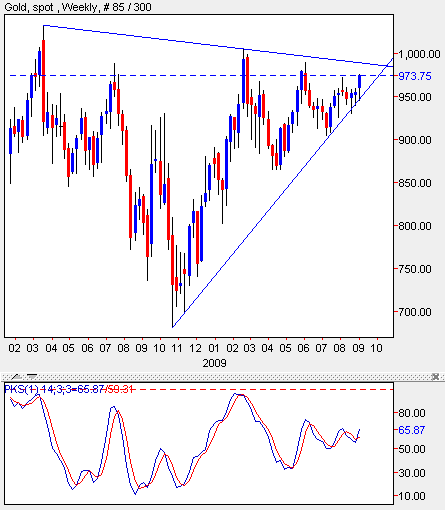
Spot gold, weekly interval
If gold does break higher, the $1032 resistance looms overhead. A move above $1032 could see it go sharply higher, as that would be THE BIG, BIGGY breakout. Of course, there would probably be some emergency (with system level implications) accompanying a move like that. (Take your pick of what it might be. Maybe the flu nonsense, maybe something else.) Gold is not just going to take a leisurely stroll over $1032 on no news. A wheel is going to have to fall off the apple cart. Something big is going to have to happen for $1032 to be taken out to the upside.
A break below the lower trend line would blow up this triangle formation and set the stage for a big move down… But it’s going into northern hemisphere Fall, when gold usually rallies… But then again, commercial traders are very short…
Again, this is an extremely tough call. It’s very blurry. I’d give it a 55% chance of breaking up and out of the triangle and a 51% chance of breaking above $1032 this Fall. The USDX looks like shit on a stick and if that thing can’t rally, it’s about to lean over hard. If that happens, gold longs should be aware that the all time low on the USDX is 70.79. Plan to hedge/pare down/sell out/diversify your long gold positions as necessary going into the low 70s on USDX. Personally, I won’t be selling one gram of my gold (because I use it as a hedge against cash).
Around 70.79, two doors emerge: Behind Door #1: The dollar will stage a massive rally/dead cat bounce/short squeeze from Hell. (Don’t ask me how this would happen.) Behind Door #2: A wildcard event; a system transformation. System transformation is lingo from International Relations. It means paradigm change; a break from past normative assumptions about the system and the actors within it. New rules.
There’s nothing but air under 70.79 and I doubt that the Them will just let the rocket sled of doom hit the wall at a thousand miles per hour. They’ll try some kind of nonsense, a New and Improved Global Confetti Currency, or maybe fewer national confetti currencies. The Amero, perhaps. Something of this nature.
But that’s getting way ahead of events. Let’s see if the dollar can hold above 77.49 in the near term, or not.
‘Pacific Garbage Patch’ Expedition Finds Plastic, Plastic Everywhere
September 2nd, 2009Via: San Jose Mercury News:
Scientists who returned to the Bay Area this week after an expedition to the “Great Pacific Garbage Patch” brought piles of plastic debris they pulled out of the ocean — soda bottles, cracked patio chairs, Styrofoam chunks, old toys, discarded fishing floats and tangled nets.
But what alarmed them most, they said Tuesday, was the nearly inconceivable amount of tiny, confettilike pieces of broken plastic. They took hundreds of water samples between the Farallon Islands near San Francisco and the notorious garbage patch 1,000 miles west of California, and every one had tiny bits of plastic floating in it. And the closer they sailed to the garbage patch, which some researchers have estimated to be twice the size of Texas, the more plastic pieces per gallon they found.
“Marine debris is the new man-made epidemic. It’s that serious,” said Andrea Neal, principal investigator on the Kaisei, a 151-foot research ship on the trip.
Neal, a Santa Barbara researcher who has a doctorate in molecular genetics and biochemistry, said crews on the three-week voyage discovered tiny jellyfish eating bits of the plastic debris. The jellyfish are, in turn, eaten by fish like salmon or tuna, which people eat.
Because the plastic pieces contain toxic chemicals — and are believed to be able to absorb now-banned chemicals such as DDT and PCBs, which can persist in the environment for decades — state toxicologists have taken hundreds of the objects, along with more than 300 fish, to an environmental chemistry lab in Berkeley to see if any chemicals are moving up the food chain.
“Every day, every night, we’d pull up samples and pour the water through a sieve. It would be completely clogged with tiny pieces of plastic,” said Margy Gassel, a research scientist with the California Environmental Protection Agency. “It was so disturbing.”
The research was the most extensive look yet at the garbage patch, a collection of mostly plastic debris located 1,000 miles north of Hawaii. The bobbing debris field, where currents swirl everything from discarded fishing line to plastic bottles into one soupy mess, was discovered in the mid-1990s.
Not much is known about it, including when it began forming or even its exact boundaries. It cannot be seen from the air or from satellites because most of the plastic has broken down into billions of tiny, confettilike pieces that float just below the surface.
Scientists believe the trash washes down storm drains and rivers from places such as the Bay Area or Japan, eventually drifting into several large ocean vortices where currents swirl together.
UN Chief Visits ‘Doomsday’ Seed Vault in Arctic
September 2nd, 2009Via: AFP:
UN chief Ban Ki-moon visited Wednesday a vault carved into the Arctic permafrost, filled with samples of the world’s most important seeds in case food crops are wiped out by a catastrophe.
“The world faces many daunting challenges today, one of the greatest of which is how to feed a growing population in the context of climate change,” a bundled-up Ban told reporters after he toured the site in the Svalbard archipelago some 1,200 kilometres (745 miles) from the North Pole.
“The seeds stored here in Svalbard will help us do just that. Sustainable food production may not begin in this cold Arctic environment, but it does begin by conserving crop diversity,” he said.
Aimed at safeguarding biodiversity in the face of climate change, wars and other natural and man-made disasters, the seed bank has the capacity to hold up to 4.5 million batches of seeds, or twice the number of crop varieties believed to exist in the world today.
The vault was inaugurated in February 2008, and so far some 25 international and national institutes from 22 countries have deposited some 400,000 batches, according to the Norwegian government.
Overlooking a fjord, the vault forms a long trident-shaped tunnel bored deep into the Svalbard sandstone and limestone.
Metal shelves lining three cold chambers will eventually be stacked with airtight bags filled with seed samples.
After passing through an airlock designed to keep temperatures inside the main vault at minus 18 degrees Celsius (minus 0.4 Fahrenheit), Ban looked on with interest as he was shown plastic boxes filled with samples.
“This site, collated by all the countries, is really creative. I’m inspired by this vision to sustain the world in the future,” he said.
Mercenaries in Afghanistan: “Lord of the Flies Environment”
September 2nd, 2009Via: New York Daily News:
Secretary of State Clinton ordered an investigation on Tuesday into the Animal House revels of private guards at the U.S. Embassy in Afghanistan – including booze, hookers and other “deviant behavior.”
“These are very serious allegations, and we are treating them that way,” State Department spokesman Ian Kelly said of photo and e-mail evidence of the “climate of fear and coercion” at the living quarters of ArmorGroup guards.
The investigation by the State Department’s inspector general follows a shocking report to Clinton by the nonprofit Project on Government Oversight detailing a “Lord of the Flies environment” at the Camp Sullivan compound a few miles from the embassy in Kabul. Prostitutes allegedly were brought in for birthday parties, drunken guards engaged in brawls and boozy lawn parties turned into naked affairs where guests urinated on one another, according to photos and videos obtained by the nonprofit group.
Clinton has “zero tolerance” for the behavior described and has directed a “review of the whole system” for farming out security to private contractors that may have threatened the safety of embassy personnel, Kelly said.
Earlier, hearings in June by Sen. Claire McCaskill (D-Mo.), head of the subcommittee on contractor oversight, questioned whether the contract with ArmorGroup, now owned by Wackenhut Services Inc., should be renewed.
In a separate letter to Clinton, McCaskill said the Project on Government Oversight report “calls into question the ability of the contractor to provide sufficient security for the embassy.”
Wackenhut did not immediately respond to requests for comment.
The report found sleep-deprived guards regularly logging 14-hour days, language barriers that impair critical communications and a failure by the State Department to hold the contractor accountable.
About 300 of the 450 ArmorGroup guards employed to protect 1,000 personnel at the embassy are Nepalese Gurkhas and the rest are a mix of Australian, South African and American expats, the oversight project report said.
Although the Gurkhas were described as “serious about their jobs,” their difficulty with English had forced the English speakers to “use pantomime in order to convey orders or instructions,” the report said.
“One guard described the situation as so dire that if he were to say to many of the Gurkhas, ‘There is a terrorist standing behind you,’ those Gurkhas would answer ‘Thank you, Sir, and good morning,'” the report said.
Cities’ Budget Problems Getting Worse
September 2nd, 2009Via: Bloomberg:
U.S. city officials say they expect to face further financial strains because tax collections won’t recover until after the economy emerges from the deepest recession since the Great Depression, a national survey found.
Eighty-eight percent of city finance officers said they are less able to cover the cost of running their governments than a year ago, up from 64 percent a year earlier, according to a survey of 379 cities by the National League of Cities between April and June. It was the most negative assessment since the survey began in 1986. Eighty-nine percent said the next budget year would be even worse.
Camp Grounds and Tent Cities Become Permanent Addresses
September 2nd, 2009Via: Christian Science Monitor:
A gravelly campground off Interstate 40 in central Tennessee is a last refuge for a hodgepodge of Americans: Here you can get a $275-a-month camping spot with a 30-amp electric outlet and a scratchy Wi-Fi signal emanating from “the bathhouse” down the lane.
“It’s my permanent home – for now,” says Terry Lee Ballard, who says he runs a small record label from his “tent condo,” which is replete with “redneck engineering” such as a tent-flap air-conditioning unit.
As cities from Sacramento, Calif., to Tampa, Fla., debate the merits of tent cities to house newly homeless people (many of them young families), this recession is starting to yield scenes that evoke the Great Depression, especially at places like Timberline Campground in Lebanon, Tenn.
Living in well-worn campers and tent compounds overstretched with 20-foot-long tarps, 85 percent of residents here are permanent, a good chunk of them “economic refugees.” It’s an increasingly familiar scene across the country as campgrounds, RV parks, national parks, and city-owned pockets become inundated with permanent campers, and as entire tent cities spring up and expand, with some hinting at permanence by voting on village bylaws.
“It’s not quite Hoovervilles, but it’s getting there,” says Leonard Heumann, a housing policy professor at the University of Illinois at Urbana-Champaign, referencing the massive tent cities and shantytowns erected during the Great Depression.
Oldest Swiss Bank Tells Clients to Sell U.S. Assets or Leave
September 2nd, 2009Via: Bloomberg:
Wegelin & Co., Switzerland’s oldest bank, is telling wealthy clients to sell their U.S. assets, or switch banks, because of concerns new rules will saddle investors with tax obligations in the world’s biggest economy.
U.S. proposals to extend reporting requirements for banks whose clients buy American stocks and bonds coupled with estate tax liabilities that may be inherited by the heirs of people who have such holdings prompted the advice from the St. Gallen, Switzerland-based bank, said Managing Partner Konrad Hummler.
“We came to the conclusion that it’s a threat to our clients,” Hummler, who is also president of the Swiss Private Bankers Association, said in an interview yesterday in Zurich. “It’s also a threat to us as a bank because as a custodian we are an executor to the estate. We find this aspect discomforting, so we recommend selling all American securities whatsoever.”
Hummler said he plans to raise the subject today at a meeting of the Private Bankers Association, which counts Pictet & Cie., Lombard Odier & Cie. and Mirabaud & Cie. among its members. Swiss banks, which manage $2 trillion, or 27 percent, of the world’s privately held offshore wealth, are struggling to protect bank secrecy after the government agreed to hand over the names of 4,450 UBS AG clients to U.S. tax authorities.
Hummler said he won’t ask every member of the association to follow Wegelin’s lead. Wegelin, founded in 1741, manages more than 20 billion Swiss francs ($18.7 billion) in client assets.
“Every member is free to decide and act on their own,” he said.
‘Real Threat’
The U.S. has proposed increasing reporting and oversight requirements for so-called qualified intermediaries — foreign banks that withhold taxes on behalf of the Internal Revenue Service. In addition, new rules may mean that people who spend limited periods of time in the U.S. acquire tax obligations, including estate taxes, creating an unacceptable risk for Wegelin’s clients, Hummler said.
If a client decides to keep his U.S. investments, “then finally he has to change banks,” Hummler said.
“We’re talking about probabilities,” Hummler said. “My responsibility toward clients has to include any kind of probability, and if I see a real threat then we have to act.”
Wegelin is finding alternative ways of investing in the U.S. that won’t impose reporting requirements on the bank or tax liabilities on clients, Hummler said.
“The good thing is that in today’s world you can build up U.S. exposure in equities and as well in bonds through derivatives and index funds and so on, so we are switching to a European-made American exposure.”
New Zealand Government Orders Take Down of Article Detailing Vodafone’s Secret Deal with 2Degrees
September 2nd, 2009Via: Wikileaks:
This is the text to a National Business Review (nbr.co.nz) article written by Chris Keall, detailing a secret interconnection deal ordered by former Labour Minister of Communications, David Cunliffe, between Vodafone New Zealand and mobile operator 2 Degrees.
The file contains information that directly affects public policy (telecommunications regulation). However, the regulator, the New Zealand Commerce Commission, has used its powers under section 100 of the Commerce Act to suppress the story, and have ordered New Zealand media not to publish any details of the deal. NBR was forced to take down the story as a result of this state censorship.
Stocks Tumble on Worry About More Bank Failures
September 2nd, 2009In other words, someone bought a pile of deep out of the money put options on some piece of crap and now it’s harvest time via rumor mill. Just another day at the office.
Via: Reuters:
U.S. stocks sank on Tuesday on increasing worries that there could be more bank failures and concerns that equity prices may have run ahead of the economic recovery.
A sharp drop in bank stocks in late morning trading pulled the Dow average.DJI and the broad Standard & Poor’s 500 .SPX down almost 2 percent, with investors fearing a revival of balance-sheet trouble in the financial sector.
“The chatter from (some) hedge funds is that there is a bank default”, said Jon Najarian, a founder of Web information site optionmonster.com.




