The Union of Soviet Indian Republics Is Rolling Out a National ID Card
June 28th, 2009Tens of millions of people who who can’t read or write (see: literacy in India) will need an identity card to get their government food handouts.
Yes, it has come to this.
Via: New York Times:
Policy makers see a national ID card as critical to improving the delivery of social services, subsidies and other government programs while also strengthening national security. The Indian government and outside observers have shown that the majority of aid earmarked for the poor does not reach them, and it is hard for the government to detect embezzlement and misuse of funds.
If administered properly, experts say a universal ID card could help ensure that most of the billions India and other organizations spend on aid reaches the people for whom it was intended. Today, Indians use a variety of documents to prove their identities, like state-issued driver’s licenses, ration cards used for food purchases at government-run stores and a tax identification card that is akin to the American Social Security card.
More Obama Lies: Signing Statement on $106B War Bill
June 28th, 2009Via: The Hill:
President Obama signed the $106 billion war-spending bill into law Friday, but not without taking a page from his predecessor and ignoring a few elements in the legislation.
Obama included a five-paragraph signing statement with the bill, including a final paragraph that outlined his objections to at least four areas of the bill.
President George W. Bush was heavily criticized for his use of signing statements, declaring he’d ignore some elements of legislation by invoking presidential prerogative.
The Obama administration announced in the statement it would disregard provisions of the legislation that, among other things, would compel the Obama administration to pressure the World Bank to strengthen labor and environmental standards and require the Treasury department to report to Congress on the activities of the World Bank and International Monetary Fund (IMF).
“Provisions of this bill…would interfere with my constitutional authority to conduct foreign relations by directing the Executive to take certain positions in negotiations or discussions with international organizations and foreign governments, or by requiring consultation with the Congress prior to such negotiations or discussions,” Obama said in a statement.
“I will not treat these provisions as limiting my ability to engage in foreign diplomacy or negotiations,” he added.
The sections in question would compel the administration to direct its World Bank representatives to pressure that institution to use metrics that “fairly represent the value of internationally recognized workers’ rights. Organized labor groups had pushed for a revision of those standards.
Sine Wave Google Searches
June 28th, 2009UPDATE: Vitamin D?
I told Becky about the “ringing ears” chart, and when the waves peaked.
She said, “Maybe it’s related to Vitamin D.” Indeed, the searches peak around the nadir of Vitamin D availability in the Northern Hemisphere.
—End Update—
I’m developing some tools on another website—partially to help me keep track of information in a more effective manner—and I started messing around with Google Trends.
I was punching in various queries, just to have a fiddle around.
Then the phone rang. Becky answered it.
I typed in ringing phone. Then ringing bell. Then ringing ears. I have no idea what I was looking for, but look at this chart for ringing ears:
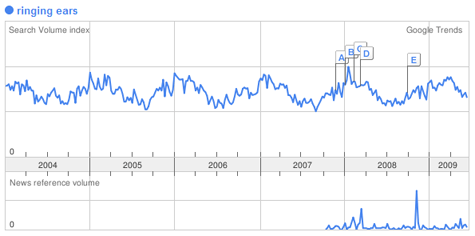
Is that weird?
Most of these charts look like a noise floor, with occasional news driven spikes. I looked at tinnitus, the clinical term for “ringing in the ears” and when I combined the chart from that with the one above, there’s a general correlation, as one would expect. (CSV datasets from all of these queries may be downloaded if you want to perform actual correlation calculations instead of just eyeballing it with the boneheaded charts Google is using.)
Next, I tried one with obvious seasonal correlates: gardening. That chart looks exactly as one would expect. Hay fever works the same way.
Are there seasonal correlates to tinnitus? I didn’t think so, but I’m definitely no expert. It seems to spike around the end of the year. Maybe it’s from listing to that Christmas music in China Mart.
What other queries describe sine waves, but without apparent seasonal or other correlates?
U.S. Confirms U-Turn in Afghan Counter-Narcotics Policy
June 28th, 2009My previous guess was that the USUK drug cartel was going to try to drive prices back up and then unload the tons of stuff that have been stockpiling. According to the information below, that doesn’t seem to be the case.
Perhaps the new goal is to get as many acres as possible going with opium production and take an economies of scale approach. Recall the British covert operation that was centered around training Taliban fighters in irrigation and farming techniques *cough* *cough* *wink* *wink*.
Maybe that program is coming out of the shadows.
Via: Financial Times:
The US counter-narcotics strategy in Afghanistan is to undergo a U-turn with money previously spent on controversial opium poppy eradication shifting to agricultural development, Richard Holbrooke, US special envoy to Afghanistan and Pakistan, told an international conference on Saturday.
Franco Frattini, Italy’s foreign minister who chaired the conference in the port city of Trieste, quoted Mr Holbrooke as saying the US would spend “several hundred million dollars” in promoting production of legal crops and cut back funding for eradication.
Research Credit: dano5050
IRAN: BRITISH EMBASSY STAFF ARRESTED
June 28th, 2009Via: CNN:
Local staff members at the British Embassy in Tehran have been arrested, the Foreign Office in London told CNN Sunday, confirming earlier reports from Iran’s government-backed Press TV.
Press TV said eight staffers had been seized for their role in the unrest following the disputed presidential elections on June 12. The Foreign Office did not confirm the number of people held.
Earlier Sunday the Foreign Office said it had recently “received a number of, sometimes confused, reports that British nationals or others with British connections had been detained. We continue to raise them with the Iranian authorities.”
A spokesman further added: “People with a connection to the UK have been arrested all week.”
Last week, Tehran expelled two British diplomats. London responded by kicking out two Iranian envoys.
Iran then recalled its ambassador to Britain, saying it would reconsider its diplomatic ties with the United Kingdom.
Withdrawing an ambassador is a very serious gesture in diplomatic circles.
The Iranian government has long accused other countries, especially Britain, of “meddling” in its affairs, but has offered no proof any outside forces have been involved in the unrest after the disputed June 12 presidential election.
On Wednesday, Iranian authorities said they had arrested several foreign nationals, some with British passports, for allegedly helping foment the disturbances.
At the time, the Foreign Office said it was looking into the claims. It said it was aware that one of the arrested nationals was Washington Times reporter Iason Athanasiadis, who also goes by Jason Fowden.
Athanasiadis holds British and Greek passports.
Meanwhile, the Iranian government will allow a demonstration at Tehran’s Ghoba mosque Sunday, CNN has confirmed.
The gathering is officially meant to honor Mohammad Beheshti, a hero of the 1979 Islamic Revolution who was killed in a bombing on this date in 1981.
Work Begins on World’s Deepest Underground Lab
June 28th, 2009Via: AP:
Far below the Black Hills of South Dakota, crews are building the world’s deepest underground science lab at a depth equivalent to more than six Empire State buildings — a place uniquely suited to scientists’ quest for mysterious particles known as dark matter.
Scientists, politicians and other officials gathered Monday for a groundbreaking of sorts at a lab 4,850 foot below the surface of an old gold mine that was once the site of Nobel Prize-winning physics research.
The site is ideal for experiments because its location is largely shielded from cosmic rays that could interfere with efforts to prove the existence of dark matter, which is thought to make up nearly a quarter of the mass of the universe.
The deepest reaches of the mine plunge to 8,000 feet below the surface. Some early geology and hydrology experiments are already under way at 4,850 feet. Researchers also hope to build two deeper labs that are still awaiting funding from Congress.
“The fact that we’re going to be in the Davis Cavern just tickles us pink,” said Tom Shutt of Case Western Reserve University in Cleveland, referring to a portion of the mine named after scientist Ray Davis Jr., who used it in the 1960s to demonstrate the existence of particles called solar neutrinos.
Davis and a colleague named John Bahcall won a share of the 2002 Nobel Prize for physics for their work.
The old Homestake Gold Mine in a community called Lead (pronounced LEED) was shut down in 2001 after 125 years. Pumps that kept the mine dry were turned off years ago, so workers have been drying it out to prepare for the new research.
Before the labs are built, crews must also stabilize the tunnels and install new infrastructure. The lab at 4,850 feet is not much to look at yet. A rusty orange film covers the walls, floors, ceilings and debris left behind by miners.
The first dark matter experiment will be the Large Underground Xenon detector experiment — or LUX — a project to detect weakly interacting particles that could give scientists greater insight into the Big Bang explosion believed to have formed the universe.
Shutt, along with Brown University’s Rick Gaitskell and nearly a dozen collaborators will work at the site to search for dark matter, which does not emit detectable light or radiation. But scientists say its presence can be inferred from gravitational effects on visible matter.
Scientists believe most of the dark matter in the universe contains no atoms and does not interact with ordinary matter through electromagnetic forces. They are trying to discover exactly what it is, how much exists and what effect it may have on the future of the universe.
Physicists have said that without dark matter, galaxies might never have formed. By learning more about dark matter, they hope to understand better whether the universe is expanding or contracting.
The research team will try to catch the ghostly particles in a 300-kilogram tank of liquid xenon, a cold substance that is three times heavier than water. If they tried to detect dark matter above ground, the highly sensitive detector would be bombarded by cosmic radiation.
Scientists hope to start construction on the two deepest labs by 2012 and open them by 2016. The projects are expected to cost $550 million.
Man Deposits $200 with Pot, Cocaine at Bank
June 28th, 2009A little Florida reading for the weekend.
Via: AP:
Authorities said a man using the drive-through at a Tallahassee bank deposited $200 and a small bag containing marijuana and cocaine. Police said an employee at the Wachovia Bank called police Wednesday after the unusual deposit. An officer arrested a 38-year-old man and found the remnants of three marijuana cigarettes inside his vehicle.
The man was charged with drug possession and later released on $3,000 bail.
It’s not clear why the man included the drugs with his deposit.
Where’s the Gold?
June 27th, 2009Via: Huffington Post:
The Comex is the name for the largest gold futures market in the world, traditionally centered in New York City. Although the market recently became part of the Chicago Mercantile Exchange, it has retained its old nickname. Also, the depositories which hold the actual bars of gold used to settle the futures contracts remain in New York City.
A gold depository must be the most boring business on earth. They charge a small monthly fee to store 100oz. standardized bars of gold in an insured vault. It is an industrial-sized version of a safe deposit box.
The owner of a 100oz. bar owns a specific chunk of gold. It has a manufacturer, a serial number, and an exact weight measured to the 1/100th of an ounce. A written depository receipt — similar to an old-fashioned paper share certificate — shows the exact date the bar entered the depository, and the entire chain of ownership since that date; they often change hands without leaving the depository. You can request to withdraw the bar from the depository, and you should receive exactly the bar indicated.
Interest in precious metals as an investment has been heating up, and some fund managers have begun to take very large positions. Demand for Comex gold bars has been increasing — especially as they are significantly cheaper per ounce than alternatives like 1oz. bullion coins or the kilogram bars popular in Europe.
Jim Sinclair of jsmineset.com, a legendary gold trader, reported that some of his contacts have told him that, when they request to withdraw their 100oz. bars from the Comex depositories, they have not received the proper indicted bars. They received a bar, but not one with the correct serial number or weight.
Why not? One possibility is that an honest mistake was made. The high demand recently has apparently kept the depository workers very busy. Wall Street veterans recall that delivery errors were chronic in the days of paper share certificates.
Another possibility is that the bar indicated on the warehouse receipt does not actually exist. The implications of that are rather dire.
This would not be so troubling if there were not already a series of very odd things happening down at the Comex. Delivery delays have been chronic. This could be a symptom of an overworked staff. Or, it could be a purposeful stalling tactic. In any case, it should not take weeks and possibly even months, and sometimes dozen of inquiries, to get the gold you already own out of the warehouse.
The Comex itself, however, has been reporting that business at the warehouse is very slow. The daily reports of warehouse movements show almost nothing happening, day after day. So which is it, busy or not busy?
As futures contracts expire, a certain number of holders elect to pay cash to receive the physical gold. The number of delivery notices has been very high since autumn of last year. For example, in May, investors requested the delivery of 20 million ounces of silver, against a dealer inventory of about 64 million ounces. Since then, there has been no record of anywhere near that amount of silver leaving dealer inventory, being delivered into the warehouse, entering customer inventory, or leaving the warehouse. Another 17.45 million ounces of silver were requested in March, evidence of which was nowhere to be seen in the warehouse reports.
In April, delivery notices were sent on a whopping 1.5 million ounces of gold, against 2.5 million ounces of dealer inventory. That month, Deutsche Bank alone delivered 850,000 ounces. This coincided, rather suspiciously, with a sale of 1.14 million ounces of gold by the European Central Bank that month, suggesting that Deutsche Bank was being bailed out in a big way. Nothing of this size turned up in the warehouse reports. Nothing followed similarly large deliveries in December 2008. By Comex rules, all physical deliveries must go through the warehouse. What happened? Until investors receive an explanation from the exchange, which has thus far been silent, we must regard it as being very suspicious. Very, very suspicious.
What does it all mean? First, there are indications that the seller side of futures contracts (such as Deutsche Bank in April) are having a difficult time making good on their commitments. Second, the information reported by the Comex regarding physical inflows and outflows is looking more and more like a convenient fiction. Third, there is some doubt as to whether there is gold in inventory — as there absolutely should be — to match existing warehouse receipts. Fourth, the Comex warehouse is one of the most secure forms of gold investment in the world. If they can’t be trusted, what does that say about ETFs, pooled accounts, futures, forwards, options, and all the other forms of “paper gold” out there? Fifth, if it becomes clearer that there is no physical supply to meet physical demand, the dollar price of gold could go much higher.
Research Credit: Lagavulin
FDIC Friday: Five More Banks Seized by Regulators
June 27th, 2009Via: Bloomberg:
Five U.S. banks with total assets of about $1.04 billion were seized by regulators, pushing this year’s tally of failures to 45 as a recession drives up unemployment and home foreclosures.
Community Bank of West Georgia, in Villa Rica, Georgia; Neighborhood Community Bank of Newnan, Georgia; Horizon Bank of Pine City, Minnesota; MetroPacific Bank of Irvine, California; and Mirae Bank of Los Angeles were closed yesterday by state regulators, according to statements from the Federal Deposit Insurance Corp. The FDIC was named receiver of the four banks.
Wilshire Bancorp’s Wilshire State Bank will take over all of Mirae’s $362 million in deposits, and will purchase $449 million of assets, the FDIC said in a statement.
Sunwest Bank of Tustin, California, acquired most of MetroPacific’s $73 million in deposits and $80 million in assets, the FDIC said. Stearns Bank of St. Cloud, Minnesota, bought Horizon Bank’s $69.4 million of deposits. Stearns will purchase $84.4 million of Horizon’s assets, the FDIC said.
The FDIC didn’t find a buyer for Community Bank of West Georgia, and said it will mail checks to reimburse insured depositors. The bank has deposits of $182.5 million. Charter Financial Corp.’s CharterBank will assume Neighborhood Community Bank’s $191.3 million of deposits and purchased some assets in a loss-share agreement with the FDIC, according to the agency.
“The loss-sharing arrangement is projected to maximize returns on the assets covered by keeping them in the private sector,” the FDIC said. “The agreement also is expected to minimize disruptions for loan customers.”
Regulators have seized the most U.S. banks this year since 1993. The U.S. economy has shed about 6 million jobs since the recession began in December 2007. Foreclosure filings surpassed 300,000 for the third straight month in May, according to RealtyTrac Inc.
Ben Bernanke on Ron Paul’s Proposed Leglslation to Audit the Federal Reserve
June 26th, 2009“My concern about that legislation is that if the GAO is auditing not only the operational aspects of our programs and the details of the programs, but is making judgments about our policy decisions, that would effectively be a takeover of monetary policy by the Congress, a repudiation of the independence of the Federal Reserve, which would be highly destructive to the stability of the financial system, the Dollar and our national economic situation.”