TWO JAPANESE CITIZENS CARRYING $134 BILLION WORTH OF UNDECLARED, POSSIBLY COUNTERFEIT U.S. BONDS DETAINED IN ITALY WHILE TRYING TO ENTER SWITZERLAND; ITALIAN AUTHORITIES ARE TRYING TO DETERMINE IF THE BONDS ARE AUTHENTIC
June 11th, 2009UPDATE: 11: New York Times Finally Reports That the Japanese Men Were Released
This article contradicts itself.
“…Although the Guardia di Finanza suspected the bonds were false…” STOP.
The Japanese men should then be in custody.
Let’s continue:
Italian law does not call for the criminal arrest of persons found to be taking funds without permission to another country. It might have been another matter if the police had determined immediately that the bonds were false.
Let’s boil this down:
“…Although the Guardia di Finanza suspected the bonds were false…” the Japanese men, “were released after being stopped.”
Now, get this: The men were held for many hours or days before being released. How do we know? Look at this:
“The men were questioned, but not arrested,” said Naoki Oyakawa, an official at the Japanese consulate in Milan, which contacted judicial officials in Como after reading about the seizure in the Italian papers.
The Japanese consulate learned of the incident from reporting in the Italian media. How long had the men not been under arrest at that point? Then, an official at the Japanese consulate in Milan contacted officials in Como. The Japanese men were released.
In summary:
Japanese men detained – Italian authorities suspect fake bonds – Japanese men should have been placed under arrest pending investigation – But instead, Italian authorities are contacted by someone at the Japanese consulate in Milan – Japanese men released.
I don’t know if this is what happened, but this is what it sounds like to me: Diplomatic Immunity:
Diplomatic immunity is a form of legal immunity and a policy held between governments, which ensures that diplomats are given safe passage and are considered not susceptible to lawsuit or prosecution under the host country’s laws (although they can be expelled).
Via: New York Times:
Ever since two middle-aged men with Japanese passports were caught in Italy this month trying to smuggle a purported $134.5 billion in United States government bearer bonds into Switzerland, the Internet has been abuzz with theories.
Was the Japanese government, or some other creditor nation, secretly trying to dump Treasury bonds to drive down the value of the dollar? Had the Italian mafia stolen the equivalent of 1 percent of the American gross domestic product, using the paper, which supposedly was instantly convertible into cash, to run a giant scam?
Adding spice was the whole Bond — James Bond — aspect of the tale. A crowded customs checkpoint near the Alps; two men traveling on a local train, professing that they had nothing to declare; and a false-bottom suitcase containing United States government bonds made out in stratospheric denominations.
In all, the Italian financial police and customs guards confiscated 249 paper bonds, each supposedly worth $500 million, and 10 bonds with a face value of $1 billion each.
Too bad the bonds were fake.
“The whole thing is a total fraud,” Stephen Meyerhardt, a spokesman for the Treasury Department, said Thursday. “They don’t look anything like real securities, which in any case were never issued in any of those denominations.”
The highest denomination ever issued by the Treasury Department was $10,000, he said. The Italian financial police claimed some of the paper was “Kennedy bonds” from the 1930s, but no such bonds ever existed. And the total of Treasury bearer bonds still outstanding is a mere $105 million; the Treasury has been issuing bonds in electronic form since 1986.
But none of this has stopped the rumor mill from grinding away. After reports of the seizure began to trickle out of Italy, the blogosphere sprang into action, the ponderings fueled by suspicions that the mainstream media was willfully ignoring the tale.
The story took on greater life after Italian authorities — who have refused to talk about the scandal — declined to declare the bonds fakes until they were examined by Washington. After all, although the Guardia di Finanza suspected the bonds were false, if they were not, the Italian treasury stood to profit from a law that permits the government to pocket up to 40 percent of the total value of cash or securities smuggled into the country over the legal export limit, which is 10,000 euros.
Repeated telephone calls to the prosecutors’ office in Como, Italy, that is handling the investigation were not returned.
Darrin Blackford, a spokesman for the United States Secret Service, which was contacted by the Italian financial police and the prosecutor’s office to determine the “legitimacy of the seized financial instruments,” said that his agency had verified the bonds were “fictitious instruments and were never issued by the United States government.”
Col. Rodolfo Mecarelli, the provincial commander of the financial police in Como, said the investigations were focused on “understanding who these men were and where they were from.”
Or where they might have been going. “Switzerland may not have been their final destination,” he said in a recent interview. “They could have taken a plane anywhere.”
Also unknown are the whereabouts of the two men, who were released after being stopped in early June. Italian law does not call for the criminal arrest of persons found to be taking funds without permission to another country. It might have been another matter if the police had determined immediately that the bonds were false.
“The men were questioned, but not arrested,” said Naoki Oyakawa, an official at the Japanese consulate in Milan, which contacted judicial officials in Como after reading about the seizure in the Italian papers.
He said the two men had valid Japanese passports, but he would not elaborate further on their identities. “We don’t know where they are now,” he said. “We have had no contact with the two men. They have not asked us for our help.”
What the bonds were for remains unclear. “It’s not the sort of thing that you can just go into a bank and convert,” said Colonel Mecarelli. “But they may have been useful to guarantee business deals among people who don’t use cash.”
Agencies that deal with financial crimes, including Europol, declined to comment while the Italian investigation was still under way.
The Treasury Department says it is stumped, too.
“I can’t speak to the motives of the person or persons who tried to do this,” Mr. Meyerhardt said. “I would guess that they were trying to find someone foolish enough to buy the securities for real money.”
—End Update—
UPDATE 10: ACCORDING TO MAINICHI SHIMBUN NEWS, THE JAPANESE MEN HAVE BEEN RELEASED BY THE ITALIAN AUTHORITIES; THEIR WHEREABOUTS ARE UNKNOWN
Financial Times Alphaville and Joe Weisenthal on Clusterstock linked to a 16 June 2009 article in the Japanese language publication, Mainichi Shimbun, that indicated that the Japanese men involved with this bond situation have been released by the Italian authorities without being charged with any crime.
I requested Japanese to English translations from Cryptogon readers. I received four independent translations. They all contain essentially the same information, the main point being that, YES, the Japanese men were released by the Italian authorities. According to the information below, because the men were not caught using the fake bonds in the commission of fraud, even though the bonds were fake, the men were released without charge.
Let that sink in for a moment…
Oh sure. Get caught trying to enter Switzerland with a load of fake bonds and see if you walk out of jail several days later. I wouldn’t count on it, but these Japanese guys had a get-out-of-jail free card, and now they’re gone.
This story continues to fester and mutate. I’ll keep an eye on it.
Many thanks to Cryptogon readers GB, K, T and P. GB and P produced the cleanest English translations of the Mainichi Shimbun article. I will post those below.
GB’s translation:
Italy: Are the 13 trillion yen worth of bonds forgeries? Two Japanese held on suspicion of smuggling are released without penalty
[Como (northern Italy)] Two Japanese men on June 3 were detained by Italian authorities trying to carry a total of 134 billion dollars (approx. 13 trillion yen) worth of U.S. bonds from Italy into Switzerland. By June 15 investigative work by the Mainichi Shinbun determined that the bonds were likely to be forgeries. And it turns out that in early April of this year there was another incident of seized bonds that appeared to involve Japanese. Seeing that there is systematic involvement including Japanese behind these successive cases of forged bonds of “colossal value,” Italian Financial Police and the Como Public Prosecutor’s Office are investigating.
The Como PPO is currently liaising with the American Embassy in Rome to look into the seized bonds. According to the concerned persons, it is highly likely that the U.S. bonds and Kennedy bonds that the two persons were in possession of do not exist in denominations of such high value and such dates of issue. By Italian law, if the bonds were genuine, the two persons would be subject to a massive fine for failure to declare the export of the bonds; in the case of forged bonds, however, if the bonds are not used or displayed, no punishment is applicable. So the two detained men were released after questioning. Apparently the Japan Consulate General in Milan does not know the current whereabouts of the two men.
In the incident of April this year, an Italian man tried to carry forged Japanese treasury bonds worth a total of 20 billion dollars into Switzerland, on the request of a Japanese person. The bonds were seized by the Italian Financial Police.
Mainich Shinbun June 16, 2009. Tokyo evening edition
P’s translation:
Italy: The 13 trillion Yen in bonds are fakes? The 2 Japanese held for attempting to smuggle them out have been released without charge
Como (Northern Italy). In March of this year, the Italian authorities took into custody two Japanese nationals for trying to bring from Italy into Switzerland U.S. securities certificates worth $134 billion (about 13 trillion yen) in total. By the 15th the Mainichi Newspaper had ascertained that there was a high possibility these certificates were forgeries. In addition, we have confirmation of another case from early April wherein a Japanese national was allegedly involved with other forged securities seized by authorities. The Italian financial police and the Como public prosecutor’s office have successively opened investigations into whether lurking behind these fradulent certificates priced at vast sums the activities of Japanese nationals is being organized at a higher level.
The same public prosecutor’s office investigated the seized securities in co-operation with the American embassy in Rome. According to those involved, in all likelihood the U.S. treasury bonds and Kennedy bonds that the two were carrying are not real. By Italian law, the two would have been charged with failing to declare the bonds upon importation and subjected to enormous fines had the bonds been real, but because the bonds were fakes and they neither attempted to execute or present them to anyone, they cannot be charged and were released after questioning. The Japanese consulate-general in Milan stated that they do not know the whereabouts of the two released from custody.
As for the incident from early April, the Swiss financial police had seized forged Japanese treasury bonds with a face value of $20 billion, which an Italian man had tried to bring into Switzerland at the behest of a Japanese person.
—End Update—
UPDATE 9: “Kennedy Bonds” Included Images of the Space Shuttle
Woops.
Via: Reuters:
A purported $134 billion in U.S. government bearer bond certificates seized by police near the Italian-Swiss border are fake, the U.S. Treasury said on Friday.
“Based on the photograph we’ve seen online, they are clearly fake. And not even good fakes,” said Stephen Meyerhardt, a spokesman for the Treasury’s Bureau of the Public Debt.
He added that there is only $105 million in Treasury bearer bond securities outstanding, so the $134 billion amount seized far exceeds the universe of outstanding securites.
The Treasury’s determination confirmed the suspicions of Italy’s Guardia di Finanza, or tax police, who seized the bond documents in early June from two Japanese nationals at the Chiasso rail station in northern Italy, close to the border with Switzerland.
The bonds comprised 249 “Federal Reserve” bonds of $500 million nominal value each and 10 “Bond Kennedy” with a $1 billion nominal value, the tax police said June 4 in a statement.
A senior tax police officer said Italian authorities also were checking whether the two travelers’ Japanese documents are genuine.
In the last two years, Italian authorities have seized some $800 million of U.S. bonds in the Como area in northern Italy.
Meyerhardt said U.S. government investigators believe that the seized bond forgeries were made using commercial photo enhancement software to alter the image of a $100 bill to increase the amount into millions or billions and add what appear to be interest coupons.
Another U.S. official said the seized bonds were purported to be issued during the Kennedy administration in the early 1960s, but the certificates showed a picture of a space shuttle on it — a spacecraft that first flew in 1981. Some of the bonds were purportedly issued in a $500 billion denomination that never existed.
The official, who spoke on background because he was not authorized to discuss specifics of the case, said that scam artists, rather than trying to exchange fake bearer bonds directly for cash, will sometimes try to use them as fraudulent collateral for loans.
The Treasury frequently uncovers scams involving bearer and other securities issued in the 1930s and 1940s. Images of some of these counterfeit bonds appear on a Treasury website aimed at combating fraud, here .
The U.S. Secret Service, which polices counterfeiting of U.S. currency, is assisting Italian authorities in tracing the source of the fake bonds, said Ed Donovan, a spokesman for the agency.
The forgery determination came a day after the Treasury warned U.S. banks against the potential for increased currency counterfeiting activity and large cash transactions by North Korea in an effort to evade U.N. sanctions aimed at cutting off financing for Pyongyang’s nuclear weapons and missile programs.
—End Update—
UPDATE 8: The Mafia Did It?
Well, that’s convenient…
Something weird is happening because nobody seems to be able to say:
1. The names of the suspects
2. The nationality of the suspects
3. Oh yeah, where are the suspects now?
Remember, the initial press release from the Italian authorities emerged on 4 June.
On one level, yes, it’s fraud. But on another level: What is it about fake bonds and Switzerland? This is a persistent theme.
Via: Financial Times:
One summer afternoon, two “Japanese” men in their 50s on a slow train from Italy to Switzerland said they had nothing to declare at the frontier point of Chiasso.
But in a false bottom of one of their suitcases, Italian customs officers and ministry of finance police discovered a staggering $134bn (€97bn, £82bn) in US Treasury bills.
Whether the men are really Japanese, as their passports declare, is unclear but Italian and US secret services working together soon concluded that the bills and accompanying bank documents were most probably counterfeit, the latest handiwork of the Italian Mafia.
Few details have been revealed beyond a June 4 statement by the Italian finance police announcing the seizure of 249 US Treasury bills, each of $500m, and 10 “Kennedy” bonds, used as intergovernment payments, of $1bn each. The men were apparently tailed by the Italian authorities.
The mystery deepened on Thursday as an Italian blog quoted Colonel Rodolfo Mecarelli of the Como provincial finance police as saying the two men had been released. The colonel and police headquarters in Rome both declined to respond to questions from the Financial Times.
“They are all fraudulent, it’s obvious. We don’t even have paper securities outstanding for that value,’’ said Mckayla Braden, senior adviser for public affairs at the Bureau of Public Debt at the US Treasury department. “This type of scam has been going on for years.’’
The Treasury has not issued physical Treasury bonds since the 1980s – they are handled electronically – though they still issue savings bonds in paper format.
In Washington a US Secret Service official said the agency, which is working with the Italian authorities, believed the bonds were fake.
Officials in Tokyo were nonplussed. Takeshi Akamatsu, a Japanese foreign ministry press secretary, said Italian authorities had confirmed that two men carrying Japanese passports had been questioned in the bond case but Tokyo had not been informed of their names or whereabouts.
“We don’t know where they are now,” Mr Akamatsu said.
Italian officials, while pointing out that hauls of counterfeit money and Treasury bills were not unusual, were stunned by the amount involved. Investigators are looking into the origin and destination of the fakes.
Italian prosecutors revealed last month that they had cracked a $1bn bond scam run by the Sicilian Mafia, with the alleged aid of corrupt officials in Venezuela’s central bank. Twenty people were arrested in four countries.
The fake bonds were to have been used as collateral to open credit lines with banks, Reuters news agency reported. The Venezuelan central bank denied the accusations.
—End Update—
UPDATE 7: U.S. Says Treasury Bonds Seized in Italy Are ‘Clearly Fakes’
I made the correct call five days ago, but here’s confirmation.
Via: Bloomberg:
U.S. government bonds found in the false bottom of a suitcase carried by two Japanese travelers attempting to cross into Switzerland are fake, a Treasury spokesman said.
“They’re clearly fakes,” Stephen Meyerhardt, a spokesman for the U.S. Bureau of the Public Debt in Washington, said yesterday. “That’s beyond the fact that the face value is far beyond what’s out there.”
Italy’s financial police last week said they asked the U.S. Securities and Exchange Commission to authenticate the seized bonds, with a face value of more than $134 billion. Colonel Rodolfo Mecarelli of the Guardia di Finanza in Como, Italy, said the securities, seized in Chiasso, Italy, were probably forgeries.
Meyerhardt said Treasury records show an estimated $105.4 billion in bearer bonds have yet to be surrendered. Most matured more than five years ago, he said. The Treasury stopped issuing bearer bonds in 1982, Meyerhardt said.
Had the notes been genuine, the pair would have been the U.S. government’s fourth-biggest creditor, ahead of the U.K. with $128 billion of U.S. debt and just behind Russia, which is owed $138 billion.
According to the Italian authorities, the seized notes included 249 securities with a face value of $500 million each and 10 additional bonds with a value of more than $1 billion, as well as securities purported to be “Kennedy” bonds. Meyerhardt said no such securities exist.
Nowadays, Treasury securities are issued electronically. The U.S. started converting all of its marketable debt from paper to electronic form in the 1980s.
—End Update—
UPDATE 6: Documents Show Issue Date of 1934: This Is Fraud
According to Bloomberg, the purported securities were issued in 1934:
Italy’s financial police said they asked the U.S. Securities and Exchange Commission to authenticate U.S. government bonds found in the false bottom of a suitcase carried by two Japanese travelers attempting to cross into Switzerland.
The bonds, with a face value of more than $134 billion, are probably forgeries, Colonel Rodolfo Mecarelli of the Guardia di Finanza in Como, Italy, said today. If the notes are genuine, the pair would be the U.S. government’s fourth-biggest creditor, ahead of the U.K. with $128 billion of U.S. debt and just behind Russia, which is owed $138 billion.
The seized notes include 249 securities with a face value of $500 million each and 10 additional bonds with a value of more than $1 billion, the police force said on its Web site. Such high denominations would not have existed in 1934, the purported issue date of the notes, Mecarelli said. Moreover, the “Kennedy” classification of the bonds doesn’t appear to exist, he said.
The bonds were seized in Chiasso, Italy. Mecarelli said he expects a determination from the SEC “within a few days.”
1934… 1934… It was registering faintly in the back of my brain somewhere. But why?
I posted about a similar scam in 2005. (You know that you’ve been running a blog for a long time when you go looking for information and find it on your own site from four years back, but forgot that you posted it in the first place.)
Since the original Philippine Star article is long gone, I’ll bring it forward from my archives:
$3-trillion fake federal bank notes seized from 2 Britons
By Evelyn Macairan
The Philippine Star 04/22/2005The National Bureau of Investigation (NBI) announced yesterday the arrest of two British nationals who were caught in possession of $3-trillion fake US federal bank notes in an entrapment operation.
Charges of forgery and illegal possession of bank notes were filed against Paul Edward John Flavell and Sam Beany, both residents of the CEO Apartments located on Jupiter street, Makati City.
Manuel Eduarte, head agent of the NBI Anti-Graft Division said charges against the suspects were filed before the Makati City Prosecutor’s Office last April 15. The two were granted temporary liberty after they each posted P16,000 bail last Tuesday.
However, NBI Director Reynaldo Wycoco said he has coordinated with the Bureau of Immigration and requested that the two suspects be included in its watchlist.
Two of their alleged cohorts, also British nationals, have yet to be apprehended by lawmen. They were identified as Zeki Mehmet Bayram and Peter Wittkamp.
The NBI recovered from Flavell and Beany a metal scroll and fake US federal bank reserves totaling $3 trillion, which were contained in an iron chest.
There were 13 boxes in the chest, each containing 50 reserve notes that amounted to $1 billion.
Eduarte said the notes were definite forgeries since the biggest amount the US government came out with was in the denomination of $10,000.
The counterfeit bonds were supposedly manufactured in 1934.
In a report submitted by the NBI-AGD to Wycoco, international courier company DHL Philippines informed their unit last April 14 that suspects Flavell and Beany were about to ship a cargo of fake US federal reserves to Zurich, Switzerland. They paid P53,967.24 as shipment fee.
Eduarte’s agents confirmed that the suspects went to the DHL office located at Pasong Tamo street in Makati City.
The two suspects allegedly paid the shipment fee and were asked to open the iron chest for inspection. Upon seeing that the contents were similar to the items they seized from a previous operation, the NBI agents accosted them.
There have been several like this over the years. See:
Customs Displays Phony 1930s Cash, Bonds:
They stink. Literally and figuratively.
Moldy bonds and bills that con artists used to try to bilk seniors were on display in downtown San Diego yesterday, the loot from two recent seizures by federal fraud cops.
The bonds and bills are dated 1934 and bear incredible denominations – $500,000, $100 million, $500 million – and portraits of former President Ulysses S. Grant and one-time Treasury Secretary Salmon P. Chase.
One set was seized last month in a San Diego-bound Federal Express shipment from the Philippines, agents said. The moldy bonds were hidden among pages of a photo album.
Four other sets were turned over this summer by a lawyer who said he got them from an El Cajon man indicted in Indiana on fraud charges, said Daniel Burke, who heads a fraud task force with U.S. Immigration and Customs Enforcement.
“Absent the story, absent the sales pitch, a normal person should believe they’re bogus,” he said.
Oh, the story.
That’s the key to understanding how crooks use these documents.
In both of these cases, they told potential victims that the bonds recently were recovered by Filipino tribes from a 1930s-era, CIA-owned DC-10 airplane that crashed, killing all aboard, Burke said.
The U.S. government was sending the bonds in a secret effort to help the Chinese government, the story goes. Only people with connections can cash the bonds, and investors can buy in for a few thousand dollars, getting three to five times their money back.
And, because of the secrecy, the government will deny their authenticity.
A little common sense reveals the lie behind the story. DC-10 jets didn’t exist in the 1930s. Or the CIA. And the U.S. government never printed bonds or money in such amounts.
“People don’t use their common sense,” Burke said.
There are other clues. ZIP codes – printed on some of the bonds – didn’t exist in 1934, and Grant appears on $50 bills, not $500 million.
Chase appears on a $10,000 bill used exclusively by banks that is no longer in production.
The largest currency ever printed by the United States was for $100,000, again used only by banks. The $100 bill is the largest made today.
Forensic scientists haven’t examined the bonds and bills displayed yesterday but have determined that similar documents were produced on computer printers within the past 10 years, he said.
Tricksters tried to make them look old by getting them wet and moldy.
“All part of the scam,” said Michael Unzueta, acting special agent in charge of the San Diego office of Immigration and Customs Enforcement.
No local victims have been identified and no arrests have been made directly related to the bonds and bills displayed yesterday, the agents said, requesting victims call authorities.
Burke, who investigated a case involving bogus bonds while working in Denver several years ago, said cheats target senior citizens with fat retirement accounts.
The Denver case, which involved a sting operation, fell apart because the sellers eventually offered the bonds as “historical documents” not guaranteed by the federal government. Jurors couldn’t agree that a crime had taken place.
In the local cases, the San Diego man who was to receive the album with the hidden bonds has agreed to cooperate with authorities and has not been arrested, Burke said.
Orin Aune, the El Cajon man who authorities say gave the lawyer four boxes with the other bonds, is being prosecuted in Indiana on fraud charges in a case involving bogus $100 million bills.
According to the indictment, Aune passed himself off as the sultanate to Sula and North Borneo and the deputy minister of finance for the non-existent country. He also took part in a conference call with a potential investor.
Federal officials say they get calls about the bonds most frequently from the Far East and cite three convictions in the United States in cases involving the fake bonds.
They also note a 2002 appeals court decision in a lawsuit by the holders of some of the bonds against the Federal Reserve Bank of Chicago, which refused to cash the bonds.
Justices called the claims “preposterous,” noting the national debt in 1934 was $28 billion, and say the reason few scammers have been prosecuted is “because no one could possibly be deceived by such obvious nonsense.”
U.S. Bond Scammer Jailed for Six Years:
A former Scotland Yard scientist who tried to perpetrate the world’s biggest fraud by authenticating $US2.5 trillion ($3.53 trillion) worth of fake US Treasury bonds has been jailed for six years.
Graham Halksworth, 69, claimed that the bonds had been secretly issued by the US government in 1934 to help nationalists undermine the communist revolution in China.
But, he said, the aircraft carrying them had crashed in the Philippines, where local tribesmen had discovered the 22 cases stamped with the American golden eagle and kept them for over 60 years.
Halksworth said a tribal elder had given them to Michael Slamaj, a former soldier in Yugoslavia, and they were brought to the vaults of a London bank.
This yarn was as untrue as it was colourful, Steven Perian, prosecuting, told a jury at Snaresbrook Crown Court in east London, which last month convicted both men of conspiracy to defraud.
He described Halksworth, from Mossley, Greater Manchester, as “an expert who has turned dishonest” out of greed.
Halksworth, who had been a leading fingerprint expert at Scotland Yard, was paid £60,000 ($144,000) to authenticate the bonds, redeemable for US gold.
But when two men tried to pass off $US25 million worth of the bonds at a Toronto bank in 2001, a Mountie noticed the bonds bore the word “dollar” instead of “dollars”.
Police raided the London bank vault and discovered the other bonds in boxes made of modern plastic, unknown at the time of the alleged plane crash.
Experts in America and Canada also found that the bonds – with a face value far more than the entire global gold stock – had been printed with an ink jet printer that had not been invented when the bonds were allegedly produced.
Zip codes were also used, even though they were not introduced until 1963.
Members of the conspiracy had intended to use the bonds around the world as a means of obtaining “enormous” sums in credit.
When confronted, Halksworth insisted that the bonds were genuine.
He accused the US government of lying about their authenticity because it could not afford to honour them.
But Mounties and FBI agents told the court that the bonds were fakes and had never been issued by the US authorities.
Jailing the scientist, Judge William Birtles told him:
“You were an essential part of the conspiracy. Your motivation could only have been one of greed and your reward was not to be just a fee for the authentication that you made.”
The judge said even though both men were incompetent conspirators, “the potential loss to a financial institution was enormous”.
Ok, so we know that there’s a long running scam out there involving fake bonds, but why does Switzerland keep coming up? Why are multiple scammers attempting to move fake bonds to Switzerland?
Hmm. Maybe the Bank for International Settlements needs new wallpaper?
For more on bond related fraud, see the U.S. Treasury: Frauds, Phonies, & Scams.
—End Update—
UPDATE 5: Spiegel Online Is Now Covering the Story
No new information is presented.
Via: Spiegel Online:
It is either the biggest smuggling operation in history — or a fraud of equally impressive proportions. Italian customs officials stopped two men at the Swiss border carrying bonds worth $134 billion (95.8 billion euros).
UPDATE 4: Japan Probes Report Two Seized With Undeclared Bonds
Yesterday, I emailed two Bloomberg reporters who cover bonds, asking them, simply, “Where’s the so-called financial press on this one?” I included a link to this compilation of information on Cryptogon. I didn’t expect a response and I didn’t get one, but at least Bloomberg is finally covering this story. The reporters on the piece below aren’t the reporters I emailed yesterday.
This article raises an extremely interesting question:
ARE THE MEN ACTUALLY JAPANESE?
Folks, whatever happens, don’t let this story disappear. Keep the heat on.
Via: Bloomberg:
Japan is investigating reports two of its citizens were detained in Italy after allegedly attempting to take $134 billion worth of U.S. bonds over the border into Switzerland.
“Italian authorities are in the midst of the investigation, and haven’t yet confirmed the details, including whether they are Japanese citizens or not,” Takeshi Akamatsu, a spokesman for the Ministry of Foreign Affairs, said by telephone today in Tokyo. “Our consulate in Milan is continuing efforts to confirm the reports.”
An official at the Consulate General of Japan in Milan, who only gave his name as Ikeda, said it still hasn’t been confirmed that the individuals are Japanese. “We are in contact with the Italian Financial Police and the Italian Public Prosecutor’s Office,” Ikeda said by phone today.
The Asahi newspaper reported today Italian police found bond certificates concealed in the bottom of luggage the two individuals were carrying on a train that stopped in Chiasso, near the Swiss border, on June 3.
The undeclared bonds included 249 certificates worth $500 million each, the Asahi said, citing Italian authorities. The case was reported earlier in Italian newspapers Il Giornale and La Repubblica and by the Ansa news agency.
If the securities are found to be genuine, the individuals could be fined 40 percent of the total value for attempting to take them out of the country without declaring them, the Asahi said.
The Italian embassy in Tokyo was unable to confirm the Asahi report.
—End Update—
UPDATE 3: Yosano Says Japan’s Trust in Treasuries ‘Unshakable’
Oh sure. Tell me another one.
Via: Bloomberg:
Japanese Finance Minister Kaoru Yosano said his government is confident about the outlook for U.S. Treasuries, signaling the second-biggest foreign holder of the securities will keep buying them amid record sales.
“We have complete trust in the fact that the U.S. views its strong-dollar policy as fundamental,” Yosano, 70, said in an interview in Tokyo on June 10 before attending a Group of Eight meeting of finance ministers starting today in Italy. “So our trust in U.S. Treasuries is absolutely unshakable.”
—End Update—
UPDATE 2: Picture of Seized Bonds
Via: adnkronos.com:
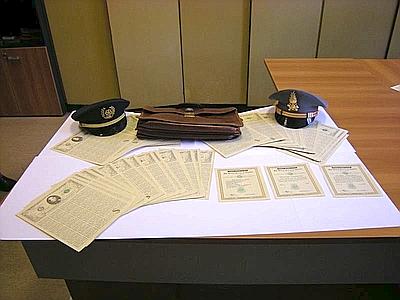
U.S. Treasury documents confiscated by Italian authorities
—End Update—
UPDATE 1: English Translation of Press Release Issued by the Guardia Italiana di Finanza (Italian Financial Police) on 4 June 2009
I received two different translations and a third offer to do a translation. (Thank you, CL, A and V.) The two translations I received were similar, so I’m going to post them both here. Here is CL’s translation:
Impounded at Chiasso [place] USA securities for 96 billion euros.
249 bonds of the Federal Reserve of the United States, each with nominal value of 500 million dollars, as well as 10 Kennedy bonds each of 1 billion dollars in value, hidden in the double bootom of a suit case, for a total of a good 134 billion dollars, equal to more than 96 billion euros.
This is how much was sequestered [don’t know legal implication of this term] at the internation railway station in Chiasso, at the Swiss-Italian border, functionaries of the Territorial Operational Section of Chiasso, in collaboration with soldiers/members of the Financial Police [Guardia di Finanzia] of Ponte Chiasso, during the checking of bags aimed at stopping the illegal trafficing of capital.
The amount was in the possession of to fifty year old Japanese men who had arrived at the Chiasso railway station on a train coming from Italy and who, when checked by customs, had stated that they had nothing to declare.
Instead an accurate check of the bags facilitated the discovery of the American securities, hidden in the bottom of the suitcase, in a closed section separated from the part of the bag containing personal items.
Apart from the securities the Japanese men were carrying a considerable sum of original bank documents.
Investigations are underway to establish the identity and the origin of both the bonds and the bank documents that have also been impounded. If the securities are authentic, based on regulations in place, the penalty applicable to the possessors [of the bonds] could reach 38 billion euros, equivalent to 40% of the sum in excess of the acceptable baggage allowance of 10 thousand euro.
Here’s A’s translation:
249 Federal Reserve Bonds for 500 million dollars of nominal value each, plus 10 Kennedy bonds of 1 billion dollars each was found in the hidden bottom of a suitcase for a total of 134 billion dollars, or around 96 billion euro.
That’s what has been confiscated during some checks for illicit capital traffic by operatives of Sezione Operativa Territoriale di Chiasso in the Chiasso train station, on the boundary between Italy and Switzerland, in collaboration with Guardia di Finanza del Gruppo di Ponte Chiasso.
The bonds where carried by two Japanese people in their fifties that got off in the Chiasso train station from a train coming from Italy. At customs they declared nothing of value.
An accurate search of their luggage showed up the bonds, well hidden in a special compartment of their suitcases, behind their personal effects.
In addition to the bonds the two Japanese were carrying a large amount of original banking documentation.
Investigations are underway for the bonds and the documents, which also have been confiscated, to understand their authenticity and origin. If the titles would be authentic, the administrative sanction applicable would amount 38 billion euro, equivalent to 40% of the exceeding of the maximum allowed amount of 10.000€.
—End Update—
There is a news blackout on this story. Please nail this one to the foreheads of the mainstream financial press until they cover it.
I am requesting an accurate English translation of the press release that was issued by the Guardia Italiana di Finanza (Italian Financial Police) on 4 June 2009 about this incident. If you have the ability to provide all of us with an accurate English translation of this press release, please contact me. Here is a machine translation of the press release.
Lagavulin submitted this Asia News Italy to the Cryptogon Subreddit two days ago. Here is the full text:
06/08/2009 15:18
ASIA – ITALY
US government securities seized from Japanese nationals, not clear whether real or fake Bonds worth US$ 134.5 billion are seized. This is the largest financial smuggling case in history. But are they real? Concern over ‘funny money’ or counterfeit securities is spreading in Asia. The international press is silent.
Milan (AsiaNews) – Italy’s financial police (Guardia italiana di Finanza) has seized US bonds worth US 134.5 billion from two Japanese nationals at Chiasso (40 km from Milan) on the border between Italy and Switzerland. They include 249 US Federal Reserve bonds worth US$ 500 million each, plus ten Kennedy bonds and other US government securities worth a billion dollar each.
Italian authorities have not yet determined whether they are real or fake, but if they are real the attempt to take them into Switzerland would be the largest financial smuggling operation in history; if they are fake, the matter would be even more mind-boggling because the quality of the counterfeit work is such that the fake bonds are undistinguishable from the real ones.
What caught the policemen’s attention were the billion dollar securities. Such a large denomination is not available in regular financial and banking markets. Only states handle such amounts of money.
The question now is who could or would counterfeit or smuggle these non-negotiable bonds.
In order to stop money laundering Italian law sets a ceiling of 10,000 euros per person for importing or exporting money without declaring it. The penalty for violating the law is 40 per cent of the money seized.
If the certificates were real, for Italy it would be like hitting the jackpot. The fine alone would amount to US$ 38 billion, five times the estimated cost of rebuilding quake-devastated Abruzzi region. It would help Italy’s eliminate its public deficit.
If the certificates are fakes the two Japanese nationals could get a very lengthy jail sentence for fraud.
As soon as the seizure was made the US Embassy in Rome was informed. Italian and US secret services were called in to assist the Italian financial police.
Some important international financial newspapers had already reported on the existence of ‘funny money’ circulating on parallel, i.e. unofficial, financial markets.
For AsiaNews a few points need considering:
1. When it comes to Italy the world press has tended to focus on Italian Prime Minister Berlusconi’s personal problems rather than on stories like the bonds smuggling affair which has been front page on Italian newspapers.
2. The fear of counterfeit bonds and securities has spread across Asia with the result that real securities are also considered with suspicion.
3. During the Second World War several countries at war printed and put in circulation perfectly counterfeit enemy money. It is also historically established that some central banks, like the Bank of Italy 65 years ago, issued the same securities twice (identical registered number and code). This way they could print more money with legal tender than they officially declared. The main difference though is that 65 years ago the world was involved in a bloody war, which is not the case today.
I was not able to find ANY English language translation of this story until today.
This is from Kyodo News Service, reposted on Japan Today:
2 Japanese carrying $134 bil worth of U.S. bonds detained in Italy
Thursday 11th June, 06:18 AM JST
ROME —
Two Japanese nationals were detained by Italian financial police last week after trying to enter Switzerland with $134 billion worth of undeclared U.S. bonds, mostly Treasury bonds, an Italian daily said Wednesday. The Japanese consulate general in Milan confirmed that the detention had taken place and said it was trying to confirm with Italian authorities whether the two were indeed Japanese nationals and their identities.
According to the report in il Giornale, two unidentified Japanese in their 50s concealed the bonds, including 249 U.S. Treasury bonds each worth $500 million, in a suitcase with a false bottom that was searched by the Italian authorities June 3 when they were in Chiasso, at the border with Switzerland, about 50 kilometers north of Milan. The daily did not say on what charges they have been detained, but the two may have been detained on suspicion of attempting to take a large amount of securities out of Italy without declaring it because the paper said they had not declared the bonds.
Here is the Italian language press release from Guardia Italiana di Finanza (Italian Financial Police) on 4 June 2009:
Sequestrati a Chiasso titoli USA per novantasei miliardi di euro
Milano, 4 giu. (Adnkronos)
Duecentoquarantanove bond della Federal Reserve statunitense, del valore nominale di 500 mln di dollari ciascuno, piu’ 10 bond Kennedy da 1 mld di dollari ciascuno, occultati nel doppio fondo di una valigia, per un totale di ben 134 mld di dollari, pari a oltre 96 mld di euro.
E’ quanto hanno sequestrato alla stazione ferroviaria internazionale di Chiasso, al confine tra Svizzera e Italia, funzionari della Sezione Operativa Territoriale di Chiasso, in collaborazione con i militari della Guardia di Finanza del Gruppo di Ponte Chiasso, nel corso dei controlli volti al contrasto del traffico illecito di capitali.
I valori erano posseduti da due cinquantenni giapponesi scesi alla stazione ferroviaria di Chiasso da un treno proveniente dall’Italia che, al momento del controllo doganale, hanno sostenuto di non avere nulla da dichiarare.
Un’accurata verifica dei bagagli ha consentito invece di trovare i titoli Usa, occultati sul fondo di una valigia, in uno scomparto chiuso e separato da quello contenente gli indumenti personali.
Oltre ai titoli, i due giapponesi trasportavano una cospicua documentazione bancaria in originale.
Per i bond e la documentazione che li accompagnava, anch’essa sottoposta a sequestro, sono in corso indagini volte a stabilirne autenticita’ e provenienza. Qualora i titoli risultassero autentici, in base alla vigente normativa, la sanzione amministrativa applicabile ai possessori potrebbe raggiungere i 38 miliardi di euro, pari al 40% della somma eccedente la franchigia ammessa di 10mila euro.
Research Credit: Lagavulin, LB, CL, and A
U.S. Government Will Own 34 Percent of Citigroup
June 11th, 2009Via: New York Times:
Many of its rivals are getting ready to throw back the government’s lifeline, but not Citigroup: To the contrary, Citi on Wednesday said it was moving forward with a plan to convert a large chunk of its preferred shares into common equity. The long-awaited move is expected to give the United States government a 34 percent ownership stake in the troubled bank.
Citi’s plan calls for about $58 billion worth of preferred stock and trust preferred securities, or TruUps, held by the government and private investors to become Citi common stock. The conversion will bolster the bank’s tangible common equity, which investors and regulators consider an important measure of capital strength.
Originally, Citi had planned to begin the stock swap in April, converting $52.5 billion of preferred stock into common stock at a price of $3.25 a share. Since then, the government stress tests determined that the bank needed to raise an extra $5.5 billion.
Citi’s delay in converting the stock has frustrated some investors and analysts and prompted all kinds of chatter about what might be going on behind the scenes. In a press release earlier this week, Citi called speculation that the conversion was delayed by federal banking regulators “entirely incorrect.”
Citi’s conversion is expected to flood the market with 18 billion new Citi common shares, diluting existing investors by 80 percent.
Former U.S. Defense Secretary William Cohen Inside Holocaust Museum During Shooting
June 11th, 2009The loose unit index has gone off the chart recently.
Via: WTOP:
A security guard shot in an exchange of gunfire Wednesday at the U.S. Holocaust Memorial Museum has died of his injuries.
Museum officials identified the guard as 39-year-old Stephen T. Johns of Temple Hills, Md. Johns, a special police officer, was a six-year veteran of the museum. In an e-mail to the Associated Press, director Sara Bloomfield says he “died heroically in the line of duty.”
The suspect, 88-year-old James W. von Brunn, remains in critical condition.
D.C. Police Chief Cathy Lanier said the suspect was acting alone when he entered the museum just before 1 p.m. Wednesday, raised his rifle and began shooting. The suspect started shooting before going through metal detectors.
“The second he stepped into the building he began firing,” Lanier said.
The weapon was a .22-caliber rifle, law enforcement officials told AP.
Von Brunn is said to be affiliated with white supremacist Web sites.
Channel 7-WJLA reports that a list was found in von Brunn’s with nine other locations on it, including the White House and U.S. Capitol, along with 2 news agencies. The Washington Post reports that the National Cathedral was also on that list.
Federal law enforcement sources tell WTOP von Brunn is a convicted felon. In 1983, he was convicted of attempting to kidnap members of the Federal Reserve Board and was found carrying a revolver, knife and sawed-off shotgun. He served more than six years in prison for the offense.
A Web site apparently linked to von Brunn contains Anti-Semitic and racist writings and promotes a book written by von Brunn. The biography section of the Web site says von Brunn was born in 1920, was a lieutenant in the U.S. Navy Reserves and a captain of a patrol torpedo boat during World War II and received four battle stars.
After a career in New York City as a copywriter and art director, von Brunn now lives in Annapolis, where he is an artist, according to the Web site.
According to a relative, von Brunn attended Washington University in St. Louis and is an artist.
A cousin, Virginia Gerker of St. Louis, said in an interview she hadn’t seen him in 50 years. She said her family had “disowned” him believed him to be mentally ill.
About a dozen years ago, he applied to have his art shown at a gallery in Easton, Md., according to two of the owners. Laura Era and Jennifer Wharton said they rejected his work and he stomped out.
Mark Potok of the Southern Poverty Law Center said von Brunn’s Web site has long been listed as a hate site.
The Rev. David Ostendorf, executive director of Center for a New Community in Chicago, a national civil rights group, said von Brunn has described in his own writings a long relationship with Willis Carto, founder of the Liberty Lobby, the Spotlight Newspaper and a well-known white supremacist and anti-Semite.
A law enforcement official said von Brunn’s vehicle was found near the museum and was tested for explosives. Law enforcement officials are also searching von Brunn’s home.
Joseph Persichini, assistant director in charge of the Washington FBI field office, said the shootings were being investigated as a possible hate crime or a case of domestic terrorism.
The shooting closed roads around the museum for several hours, tying up traffic downtown as authorities investigated.
The museum normally has a heavy security presence with guards positioned both inside and outside the museum. All visitors are required to pass through metal detectors at the entrance, and bags are screened.
Museum officials say the museum was full at the time of the shooting and estimate “a couple thousand” visitors were inside.
Among those inside the museum at the time of the shooting was former U.S. Defense Secretary William Cohen. Cohen was at the museum with his wife, who has a written a play entitled “Anne & Emmitt” that was to debut Wednesday night at the museum.
The play is an imaginary conversation between Anne Frank, the young girl who kept a diary while hiding from the Nazis during World War II, and Emmitt Till, a young black boy who was murdered for allegedly whistling at a white woman in 1955.
“This is something the world needs to stand up to,” Cohen told WTOP. “This is just another pathetic example of a hater.”
The museum, located just off the National Mall near the Washington Monument, is a popular tourist attraction. It draws about 1.7 million visitors each year.
Linda Elston, who is visiting the museum from Nevada City, Calif., said she was on the lower level of the museum watching a film when she and others were told to evacuate.
“It was totally full of people,” Elston said. “It took us a while to get out.”
She said she didn’t hear any shots and didn’t immediately know why there was an evacuation. The experience left her feeling “a little anxious,” she said.
Doctors Warn: Avoid Genetically Modified Food
June 10th, 2009The full text of this chilling article is below.
Via: Seeds of Deception:
Doctors Warn: Avoid Genetically Modified Food
By Jeffrey M. Smith
On May 19th, the American Academy of Environmental Medicine (AAEM) called on “Physicians to educate their patients, the medical community, and the public to avoid GM (genetically modified) foods when possible and provide educational materials concerning GM foods and health risks.”[1] They called for a moratorium on GM foods, long-term independent studies, and labeling. AAEM’s position paper stated, “Several animal studies indicate serious health risks associated with GM food,” including infertility, immune problems, accelerated aging, insulin regulation, and changes in major organs and the gastrointestinal system. They conclude, “There is more than a casual association between GM foods and adverse health effects. There is causation,” as defined by recognized scientific criteria. “The strength of association and consistency between GM foods and disease is confirmed in several animal studies.”
More and more doctors are already prescribing GM-free diets. Dr. Amy Dean, a Michigan internal medicine specialist, and board member of AAEM says, “I strongly recommend patients eat strictly non-genetically modified foods.” Ohio allergist Dr. John Boyles says “I used to test for soy allergies all the time, but now that soy is genetically engineered, it is so dangerous that I tell people never to eat it.”
Dr. Jennifer Armstrong, President of AAEM, says, “Physicians are probably seeing the effects in their patients, but need to know how to ask the right questions.” World renowned biologist Pushpa M. Bhargava goes one step further. After reviewing more than 600 scientific journals, he concludes that genetically modified organisms (GMOs) are a major contributor to the sharply deteriorating health of Americans.
Pregnant women and babies at great risk
Among the population, biologist David Schubert of the Salk Institute warns that “children are the most likely to be adversely effected by toxins and other dietary problems” related to GM foods. He says without adequate studies, the children become “the experimental animals.”[2]
The experience of actual GM-fed experimental animals is scary. When GM soy was fed to female rats, most of their babies died within three weeks—compared to a 10% death rate among the control group fed natural soy.[3] The GM-fed babies were also smaller, and later had problems getting pregnant.[4]
When male rats were fed GM soy, their testicles actually changed color—from the normal pink to dark blue.[5] Mice fed GM soy had altered young sperm.[6] Even the embryos of GM fed parent mice had significant changes in their DNA.[7] Mice fed GM corn in an Austrian government study had fewer babies, which were also smaller than normal.[8]
Reproductive problems also plague livestock. Investigations in the state of Haryana, India revealed that most buffalo that ate GM cottonseed had complications such as premature deliveries, abortions, infertility, and prolapsed uteruses. Many calves died. In the US, about two dozen farmers reported thousands of pigs became sterile after consuming certain GM corn varieties. Some had false pregnancies; others gave birth to bags of water. Cows and bulls also became infertile when fed the same corn.[9]
In the US population, the incidence of low birth weight babies, infertility, and infant mortality are all escalating.
Food designed to produce toxin
GM corn and cotton are engineered to produce their own built-in pesticide in every cell. When bugs bite the plant, the poison splits open their stomach and kills them. Biotech companies claim that the pesticide, called Bt—produced from soil bacteria Bacillus thuringiensis—has a history of safe use, since organic farmers and others use Bt bacteria spray for natural insect control. Genetic engineers insert Bt genes into corn and cotton, so the plants do the killing.
The Bt-toxin produced in GM plants, however, is thousands of times more concentrated than natural Bt spray, is designed to be more toxic,[10] has properties of an allergen, and unlike the spray, cannot be washed off the plant.
Moreover, studies confirm that even the less toxic natural bacterial spray is harmful. When dispersed by plane to kill gypsy moths in the Pacific Northwest, about 500 people reported allergy or flu-like symptoms. Some had to go to the emergency room.[11],[12]
The exact same symptoms are now being reported by farm workers throughout India, from handling Bt cotton.[13] In 2008, based on medical records, the Sunday India reported, “Victims of itching have increased massively this year . . . related to BT cotton farming.”[14]
GMOs provoke immune reactions
AAEM states, “Multiple animal studies show significant immune dysregulation,” including increase in cytokines, which are “associated with asthma, allergy, and inflammation”—all on the rise in the US.
According to GM food safety expert Dr. Arpad Pusztai, changes in the immune status of GM animals are “a consistent feature of all the studies.”[15] Even Monsanto’s own research showed significant immune system changes in rats fed Bt corn.[16] A November 2008 by the Italian government also found that mice have an immune reaction to Bt corn.[17]
GM soy and corn each contain two new proteins with allergenic properties,[18] GM soy has up to seven times more trypsin inhibitor—a known soy allergen,[19] and skin prick tests show some people react to GM, but not to non-GM soy.[20] Soon after GM soy was introduced to the UK, soy allergies skyrocketed by 50%. Perhaps the US epidemic of food allergies and asthma is a casualty of genetic manipulation.
Animals dying in large numbers
In India, animals graze on cotton plants after harvest. But when shepherds let sheep graze on Bt cotton plants, thousands died. Post mortems showed severe irritation and black patches in both intestines and liver (as well as enlarged bile ducts). Investigators said preliminary evidence “strongly suggests that the sheep mortality was due to a toxin. . . . most probably Bt-toxin.”[21] In a small follow-up feeding study by the Deccan Development Society, all sheep fed Bt cotton plants died within 30 days; those that grazed on natural cotton plants remained healthy.
In a small village in Andhra Pradesh, buffalo grazed on cotton plants for eight years without incident. On January 3rd, 2008, the buffalo grazed on Bt cotton plants for the first time. All 13 were sick the next day; all died within 3 days.[22]
Bt corn was also implicated in the deaths of cows in Germany, and horses, water buffaloes, and chickens in The Philippines.[23]
In lab studies, twice the number of chickens fed Liberty Link corn died; 7 of 20 rats fed a GM tomato developed bleeding stomachs; another 7 of 40 died within two weeks.[24] Monsanto’s own study showed evidence of poisoning in major organs of rats fed Bt corn, according to top French toxicologist G. E. Seralini.[25]
Worst finding of all—GMOs remain inside of us
The only published human feeding study revealed what may be the most dangerous problem from GM foods. The gene inserted into GM soy transfers into the DNA of bacteria living inside our intestines and continues to function.[26] This means that long after we stop eating GMOs, we may still have potentially harmful GM proteins produced continuously inside of us. Put more plainly, eating a corn chip produced from Bt corn might transform our intestinal bacteria into living pesticide factories, possibly for the rest of our lives.
When evidence of gene transfer is reported at medical conferences around the US, doctors often respond by citing the huge increase of gastrointestinal problems among their patients over the last decade. GM foods might be colonizing the gut flora of North Americans.
Warnings by government scientists ignored and denied
Scientists at the Food and Drug Administration (FDA) had warned about all these problems even in the early 1990s. According to documents released from a lawsuit, the scientific consensus at the agency was that GM foods were inherently dangerous, and might create hard-to-detect allergies, poisons, gene transfer to gut bacteria, new diseases, and nutritional problems. They urged their superiors to require rigorous long-term tests.[27] But the White House had ordered the agency to promote biotechnology and the FDA responded by recruiting Michael Taylor, Monsanto’s former attorney, to head up the formation of GMO policy. That policy, which is in effect today, denies knowledge of scientists’ concerns and declares that no safety studies on GMOs are required. It is up to Monsanto and the other biotech companies to determine if their foods are safe. Mr. Taylor later became Monsanto’s vice president.
Dangerously few studies, untraceable diseases
AAEM states, “GM foods have not been properly tested” and “pose a serious health risk.” Not a single human clinical trial on GMOs has been published. A 2007 review of published scientific literature on the “potential toxic effects/health risks of GM plants” revealed “that experimental data are very scarce.” The author concludes his review by asking, “Where is the scientific evidence showing that GM plants/food are toxicologically safe, as assumed by the biotechnology companies?”[28]
Famed Canadian geneticist David Suzuki answers, “The experiments simply haven’t been done and we now have become the guinea pigs.” He adds, “Anyone that says, ‘Oh, we know that this is perfectly safe,’ I say is either unbelievably stupid or deliberately lying.”[29]
Dr. Schubert points out, “If there are problems, we will probably never know because the cause will not be traceable and many diseases take a very long time to develop.” If GMOs happen to cause immediate and acute symptoms with a unique signature, perhaps then we might have a chance to trace the cause.
This is precisely what happened during a US epidemic in the late 1980s. The disease was fast acting, deadly, and caused a unique measurable change in the blood—but it still took more than four years to identify that an epidemic was even occurring. By then it had killed about 100 Americans and caused 5,000-10,000 people to fall sick or become permanently disabled. It was caused by a genetically engineered brand of a food supplement called L-tryptophan.
If other GM foods are contributing to the rise of autism, obesity, diabetes, asthma, cancer, heart disease, allergies, reproductive problems, or any other common health problem now plaguing Americans, we may never know. In fact, since animals fed GMOs had such a wide variety of problems, susceptible people may react to GM food with multiple symptoms. It is therefore telling that in the first nine years after the large scale introduction of GM crops in 1996, the incidence of people with three or more chronic diseases nearly doubled, from 7% to 13%.[30]
To help identify if GMOs are causing harm, the AAEM asks their “members, the medical community, and the independent scientific community to gather case studies potentially related to GM food consumption and health effects, begin epidemiological research to investigate the role of GM foods on human health, and conduct safe methods of determining the effect of GM foods on human health.”
Citizens need not wait for the results before taking the doctors advice to avoid GM foods. People can stay away from anything with soy or corn derivatives, cottonseed and canola oil, and sugar from GM sugar beets—unless it says organic or “non-GMO.” There is a pocket Non-GMO Shopping Guide, co-produced by the Institute for Responsible Technology and the Center for Food Safety, which is available as a download, as well as in natural food stores and in many doctors’ offices.
If even a small percentage of people choose non-GMO brands, the food industry will likely respond as they did in Europe—by removing all GM ingredients. Thus, AAEM’s non-GMO prescription may be a watershed for the US food supply.
International bestselling author and independent filmmaker Jeffrey M. Smith is the Executive Director of the Institute for Responsible Technology and the leading spokesperson on the health dangers of GMOs. His first book, Seeds of Deception is the world’s bestselling book on the subject. His second, Genetic Roulette: The Documented Health Risks of Genetically Engineered Foods, identifies 65 risks of GMOs and demonstrates how superficial government approvals are not competent to find most of them. He invited the biotech industry to respond in writing with evidence to counter each risk, but correctly predicted that they would refuse, since they don’t have the data to show that their products are safe.
[1] http://www.aaemonline.org/gmopost.html
[2] David Schubert, personal communication to H. Penfound, Greenpeace Canada, October 25, 2002.
[3] Irina Ermakova, “Genetically modified soy leads to the decrease of weight and high mortality of rat pups of the first generation. Preliminary studies,” Ecosinform 1 (2006): 4–9.
[4] Irina Ermakova, “Experimental Evidence of GMO Hazards,” Presentation at Scientists for a GM Free Europe, EU Parliament, Brussels, June 12, 2007
[5] Irina Ermakova, “Experimental Evidence of GMO Hazards,” Presentation at Scientists for a GM Free Europe, EU Parliament, Brussels, June 12, 2007
[6] L. Vecchio et al, “Ultrastructural Analysis of Testes from Mice Fed on Genetically Modified Soybean,” European Journal of Histochemistry 48, no. 4 (Oct–Dec 2004):449–454.
[7] Oliveri et al., “Temporary Depression of Transcription in Mouse Pre-implantion Embryos from Mice Fed on Genetically Modified Soybean,” 48th Symposium of the Society for Histochemistry, Lake Maggiore (Italy), September 7–10, 2006.
[8] Alberta Velimirov and Claudia Binter, “Biological effects of transgenic maize NK603xMON810 fed in long term reproduction studies in mice,” Forschungsberichte der Sektion IV, Band 3/2008
[9] Jerry Rosman, personal communication, 2006
[10] See for example, A. Dutton, H. Klein, J. Romeis, and F. Bigler, “Uptake of Bt-toxin by herbivores feeding on transgenic maize and consequences for the predator Chrysoperia carnea,” Ecological Entomology 27 (2002): 441–7; and J. Romeis, A. Dutton, and F. Bigler, “Bacillus thuringiensis toxin (Cry1Ab) has no direct effect on larvae of the green lacewing Chrysoperla carnea (Stephens) (Neuroptera: Chrysopidae),” Journal of Insect Physiology 50, no. 2–3 (2004): 175–183.
[11] Washington State Department of Health, “Report of health surveillance activities: Asian gypsy moth control program,” (Olympia, WA: Washington State Dept. of Health, 1993).
[12] M. Green, et al., “Public health implications of the microbial pesticide Bacillus thuringiensis: An epidemiological study, Oregon, 1985-86,” Amer. J. Public Health 80, no. 7(1990): 848–852.
[13] Ashish Gupta et. al., “Impact of Bt Cotton on Farmers’ Health (in Barwani and Dhar District of Madhya Pradesh),” Investigation Report, Oct–Dec 2005.
[14] Sunday India, October, 26, 2008
[15] October 24, 2005 correspondence between Arpad Pusztai and Brian John
[16] John M. Burns, “13-Week Dietary Subchronic Comparison Study with MON 863 Corn in Rats Preceded by a 1-Week Baseline Food Consumption Determination with PMI Certified Rodent Diet #5002,” December 17, 2002 http://www.monsanto.com/monsanto/content/sci_tech/prod_safety/fullratstudy.pdf
[17] Alberto Finamore, et al, “Intestinal and Peripheral Immune Response to MON810 Maize Ingestion in Weaning and Old Mice,” J. Agric. Food Chem., 2008, 56 (23), pp 11533–11539, November 14, 2008
[18] See L Zolla, et al, “Proteomics as a complementary tool for identifying unintended side effects occurring in transgenic maize seeds as a result of genetic modifications,” J Proteome Res. 2008 May;7(5):1850-61; Hye-Yung Yum, Soo-Young Lee, Kyung-Eun Lee, Myung-Hyun Sohn, Kyu-Earn Kim, “Genetically Modified and Wild Soybeans: An immunologic comparison,” Allergy and Asthma Proceedings 26, no. 3 (May–June 2005): 210-216(7); and Gendel, “The use of amino acid sequence alignments to assess potential allergenicity of proteins used in genetically modified foods,” Advances in Food and Nutrition Research 42 (1998), 45–62.
[19] A. Pusztai and S. Bardocz, “GMO in animal nutrition: potential benefits and risks,” Chapter 17, Biology of Nutrition in Growing Animals, R. Mosenthin, J. Zentek and T. Zebrowska (Eds.) Elsevier, October 2005
[20] Hye-Yung Yum, Soo-Young Lee, Kyung-Eun Lee, Myung-Hyun Sohn, Kyu-Earn Kim, “Genetically Modified and Wild Soybeans: An immunologic comparison,” Allergy and Asthma Proceedings 26, no. 3 (May–June 2005): 210-216(7).
[21] “Mortality in Sheep Flocks after Grazing on Bt Cotton Fields—Warangal District, Andhra Pradesh” Report of the Preliminary Assessment, April 2006, http://www.gmwatch.org/archive2.asp
[22] Personal communication and visit, January 2009.
[23] Jeffrey M. Smith, Genetic Roulette: The Documented Health Risks of Genetically Engineered Foods, Yes! Books, Fairfield, IA USA 2007
[24] Arpad Pusztai, “Can Science Give Us the Tools for Recognizing Possible Health Risks for GM Food?” Nutrition and Health 16 (2002): 73–84.
[25] Stéphane Foucart, “Controversy Surrounds a GMO,” Le Monde, 14 December 2004; referencing, John M. Burns, “13-Week Dietary Subchronic Comparison Study with MON 863 Corn in Rats Preceded by a 1-Week Baseline Food Consumption Determination with PMI Certified Rodent Diet #5002,” December 17, 2002 http://www.monsanto.com/monsanto/content/sci_tech/prod_safety/fullratstudy.pdf
[26] Netherwood et al, “Assessing the survival of transgenic plant DNA in the human gastrointestinal tract,” Nature Biotechnology 22 (2004): 2.
[27] See memos at www.biointegrity.org
[28] José Domingo, “Toxicity Studies of Genetically Modified Plants : A Review of the Published Literature,” Critical reviews in food science and nutrition, 2007, vol. 47, no8, pp. 721-733
[29] Angela Hall, “Suzuki warns against hastily accepting GMOs”, The Leader-Post (Canada), 26 April 2005.
[30] Kathryn Anne Paez, et al, “Rising Out-Of-Pocket Spending For Chronic Conditions: A Ten-Year Trend,” Health Affairs, 28, no. 1 (2009): 15-25
Radioactive Metals Found in Recliners, Handbags Due to Recycling Contamination
June 10th, 2009Bring a Geiger counter with you on that next trip to ChinaMart.
Via: GreenBiz:
Cheese graters, handbags, fencing and recliners are just some of the thousands of consumer products that have been manufactured with radioactive metals, according to U.S. Nuclear Regulatory Commission (NRC) records.
A Scripps Howard News Service investigation looked at NRC records and the current state of reporting on radioactive materials, turning up numerous flaws in the U.S.’s current system, and finding a wide range of cases in which radioactive materials and products were brought to the U.S.
NRC records show 18,740 documented cases involving radioactive materials in consumer products, in metal intended for consumer products or other public exposure to radioactive material. The U.S. Government Accountability Office estimates there are some 500,000 unaccounted for radioactively contaminated metal objects in the U.S., and the NRC estimates that figure is around is 20 million pounds of contaminated waste.
In some cases the products are made up primarily of the tainted materials, and in other cases it’s a small component that contaminated the products. Goods that have been found tainted with radioactive materials include:
* A China-made kitchen grater, found in a Flint, Mich., scrap plant, that was laced with the isotope Cobalt-60, giving off the equivalent of a chest X-ray over 36 hours of use.
* A 430,000-pound shipment of metal, tainted with Cobalt-60, that came from Brazil in 1998 and was used to make brackets for 1,000 La-Z-Boy recliners, giving off a chest X-ray’s worth of radiation every 1,000 hours.
* About 900 women’s handbags made in India and found in the Netherlands that had metal rings laced with Cobalt-60 on each bag’s shoulder strap.
* 500 sets of buttons made for Otis elevators in France and Sweden, using radioactive metal from India.
* Shipments of chain link fencing from India in 1991, and another shipment of tainted fencing from India a decade later.
The report also points out that the U.S. does not have enough regulation or oversight of the matter. Some of the findings from investigation:
— Reports are mounting that manufacturers and dealers from China, India, former Soviet bloc nations and some African countries are exporting contaminated material and goods, taking advantage of the fact that the United States has no regulations specifying what level of radioactive contamination is too much in raw materials and finished goods. Compounding the problem is the inability of U.S. agents to fully screen every one of the 24 million cargo containers arriving in the United States each year.
— U.S. metal recyclers and scrap yards are not required by any state or federal law to check for radiation in the castoff material they collect or report it when they find some.
— No federal agency is responsible for determining how much tainted material exists in how many consumer and other goods. No one is in charge of reporting, tracking or analyzing cases once they occur. In fact, the recent discovery of a radioactive cheese grater triggered a bureaucratic game of hot potato, with no agency taking responsibility.
— It can be far cheaper and easier for a facility stuck with “hot” items to sell them to an unwitting manufacturer or dump them surreptitiously than to pay for proper disposal and cleaning, which can cost a plant as much as $50 million.
— For facilities in 36 states that want to do the right thing, there is nowhere they can legally dump the contaminated stuff since the shutdown last year of a site in South Carolina, the only U.S. facility available to them for the disposal.
— A U.S. government program to collect the worst of the castoff radioactive items has a two-year waiting list and a 9,000-item backlog — and is fielding requests to collect an additional 2,000 newly detected items a year.
And when U.S. customs do find and reject radioactive shipments, no one tracks what happens to that load, so it could end up coming back to the U.S. another day.
In many cases, the contamination comes about through the recycling process, when radioactive metals get blended in with other materials. Some items in factories like industrial smoke detectors and measuring gauges contain small amounts of radioactive materials. If the items and other materials are scrapped (especially in the case of a factory shutting down and being demolished or gutted), that radiation can escape and contaminate recycled products.
Some recent examples of accidental contamination, from the report:
In 2006 in Texas, for example, a recycling facility inadvertently created 500,000 pounds of radioactive steel byproducts after melting metal contaminated with Cesium-137, according to U.S. Nuclear Regulatory Commission records. In Florida in 2001, another recycler unintentionally did the same, and wound up with 1.4 million pounds of radioactive material.
Russia May Swap Some U.S. Treasuries for IMF Debt
June 10th, 2009Via: Bloomberg:
Russia may switch some of its reserves from U.S. Treasuries to International Monetary Fund bonds, the central bank said today. The comment drove Treasuries and the dollar lower.
Alexei Ulyukayev, first deputy chairman of Russia’s central bank, said some reserves may be moved from Treasuries into IMF debt, reiterating comments made last month by Finance Minister Alexei Kudrin. Ulyukayev’s remarks were confirmed by a Bank Rossii official who declined to be named, citing bank policy.
Treasuries fell, pushing 10-year yields toward the highest level in seven months, in response to Ulyukayev’s statement. The dollar fell against the euro on speculation that Russia will reduce its holdings of U.S. debt.
About 30 percent of Russia’s international reserves, which stood at $401.1 billion on May 29, are currently held in Treasuries, Ulyukayev said. Kudrin said on May 26 that Russia planned to buy $10 billion of IMF bonds using money from its foreign reserves.
The IMF securities would give countries a different way to contribute to the fund and are unlike traditional bonds because they pay an interest rate pegged to the IMF’s basket of currencies, known as Special Drawing Rights.
China is expected to buy as much as $50 billion of the bonds, IMF Managing Director Dominique Strauss-Kahn said yesterday.
The IMF, which has rescued economies from Pakistan to Iceland in the past year, has never issued bonds before and is seeking more cash to finance loans and aid to member countries during the worst economic slump in the fund’s 64-year history.
London’s Metropolitan Police Accused of Waterboarding Suspects
June 10th, 2009Via: Times Online:
Metropolitan Police officers subjected suspects to waterboarding, according to allegations at the centre of a major anti-corruption inquiry, The Times has learnt.
The torture claims are part of a wide-ranging investigation which also includes accusations that officers fabricated evidence and stole suspects’ property. It has already led to the abandonment of a drug trial and the suspension of several police officers.
However, senior policing officials are most alarmed by the claim that officers in Enfield, North London, used the controversial CIA interrogation technique to simulate drowning. Scotland Yard is appointing a new borough commander in Enfield in a move that is being seen as an attempt by Sir Paul Stephenson, the Met Commissioner, to enforce a regime of “intrusive supervision”.
The waterboarding claims will fuel the debate about police conduct that has raged in the wake of hundreds of public complaints of brutality at the anti-G20 protests in April.
The part of the inquiry focusing on alleged police brutality has been taken over by the Independent Police Complaints Commission. It is examining the conduct of six officers connected to drug raids in November in which four men and a woman were arrested at addresses in Enfield and Tottenham. Police said they found a large amount of cannabis and the suspects were charged with importation of a Class C drug. The case was abandoned four months later when the Crown Prosecution Service said it would not have been in the public interest to proceed. It is understood that the trial, by revealing the torture claims, would have compromised the criminal investigation into the six officers.
None of the officers under suspicion has been arrested, but the IPCC said last night: “This is an ongoing criminal investigation and as such all six officers will be criminally interviewed under caution.”
A Scotland Yard spokesman said: “Whilst the investigation is ongoing it is not appropriate to make assumptions. These are serious allegations that raise real concern. The Met does not tolerate conduct which falls below the standards that the public and the many outstanding Met officers and staff expect.”
GM’s New Chairman: “I Don’t Know Anything About Cars”
June 10th, 2009That’s ok, because when the spooks say to jump he asks, “How high?”
Via: Bloomberg:
Edward E. Whitacre Jr. built AT&T Inc. into the biggest U.S. provider of telephone service over a 43-year-career. By his own admission, he becomes chairman of General Motors Corp. knowing nothing about the auto industry.
The 6-foot-4-inch Texan nicknamed “Big Ed” said steering the nation’s largest automaker after bankruptcy is “a public service.” People who know him say he can meet GM’s need for the type of transformation he orchestrated at Dallas-based AT&T.
“I don’t know anything about cars,” Whitacre, 67, said yesterday in an interview after his appointment. “A business is a business, and I think I can learn about cars. I’m not that old, and I think the business principles are the same.”
Trading Note
June 10th, 2009WARNING: This is not a recommendation to buy, sell or hold any financial instrument.
UPDATE 2: I Pared It Down at $39.60
I sold 80% of my position at $39.60, and stop-limited the rest at $39.
Shine on you wild diamond.
UPDATE 1: Stop Didn’t Get Hit
I didn’t get taken out yesterday and it’s up again today. I’m moving the stop up to $39.
“Pigs get slaughtered, Kevin. Pigs get slaughtered.”
That’s all I hear in my head as I look at that chart.
—End Update—
I’ve set a stop at $38.50 on my entire USO position. This has been an outstanding trade for me, and I want to keep it that way. I don’t like the way these indicators look and there’s a shooting star on the WTI 2 hour. That’s it for me until these oscillators unwind hard.
If it should manage to crank higher again, I’ll move the stop up.
Via: Wall Street Journal:
Crude futures surged above $71 a barrel Wednesday as an unexpectedly large decline in U.S. oil inventories confirmed that supplies are beginning to tighten.
Light, sweet crude oil for July delivery recently traded $1, or 1.4%, higher at $71.01 a barrel on the New York Mercantile Exchange. July crude set an intraday high of $71.65 a barrel, a seven-month high. Brent crude on the ICE Futures exchange traded 76 cents, or 1.1%, higher at $70.38 a barrel.
Oil prices began to rise late Tuesday after the American Petroleum Institute, an energy industry group, reported a 6 million-barrel draw on crude stockpiles in the week ended June 5. Analysts surveyed by Dow Jones Newswires had given an average forecast of a 700,000 barrel decline.
The Department of Energy will release its oil inventory data at 10:30 a.m. EDT.
“The market was surprised,” said Morgan Downey trader at Standard Chartered. “We are going to $90 dollars before OPEC opens the spigots.”
The Organization of Petroleum Exporting Countries has cut production by at least 3 million barrels a day, well above the amount that the global economic downturn has reduced demand, Downey said.
“Until OPEC increases production or consumers are reluctant to bear high prices we are going to see an increase in the crude price,” Downey said.
Prices topping $100 a barrel could prompt OPEC to raise production, a Kuwaiti official said Wednesday.
“All OPEC members are concerned about high oil prices and they do not want very high prices,” Nawal Al Fuzaia, the oil ministry’s assistant undersecretary of economic affairs, told Zawya Dow Jones. Fuzaia said $100 is a very high price for oil and a price range of $70-75 would be suitable for investment in oil production.
While analysts are expecting oil inventories to fall in U.S. government data, they also predict an 800,000 barrel increase in gasoline stockpiles, while distillates, including heating oil and diesel, are seen increasing by 1.5 million barrels. Analysts see U.S. refineries operating at 86.8% of capacity, up 0.5 percentage point.
Some market participants are still wary of the spike in oil prices in recent months, as demand remains weak and inventories were recently at their highest since 1990. The oil price has more than doubled from their February low.
The weakening of the dollar against the euro has also boosted the oil price in recent days, as investors are looking at commodities as a hedge against inflation. But tightening supplies are currently the main factor, traders said.
“The weakness in the dollar is taking a back seat over the inventory data today,” said Peter Donovan, vice president at Vantage Trading said.
Front-month July reformulated gasoline blendstock, or RBOB, recently traded 97 points, or 0.5%, higher at $1.9764 a gallon. July heating oil recently traded 1.41 cents, or 0.8%, higher at $1.8217 a gallon.
Bullion and Bandits: The Improbable Rise and Fall of E-Gold
June 9th, 2009Via: Wired:
Jackson drew his inspiration from economist Vera Smith’s influential 1936 treatise The Rationale of Central Banking and the Free Bank Alternative, which challenged the tenets of banking. “She wrote in the depths of the Depression, and poses some of the most compelling questions about central banking systems,” Jackson says. “Central banks should attenuate monetary disorder and prevent fluctuations, but ironically they sometimes amplify it.”
His commitment started to pay off in 2000, when some 50,000 transactions suddenly passed through his system in just two months — more than the previous three and a half years combined. By that November, E-Gold, now with 20 employees, had processed 1 million transactions, and Jackson’s business reputation was growing. He was invited to speak at the prestigious World Gold Council conference in Rome, the gold mining industry’s leading event. In 2001, the growth continued, with customer accounts expanding from 134,000 to nearly 288,000, holding about $16 million in value.
Initially, Jackson stored the company’s reserves of sovereign coins and ingots in safety deposit boxes in banks around town. When this proved inconvenient for auditing, the company bought an office safe to hold the gold and platinum. “The silver was just stacked around the office,” Jackson says. Ultimately, he converted the sovereigns and ingots to bars and moved them to bank vaults in London and Dubai. At E-Gold’s peak, the currency would be backed by 3.8 metric tons of gold, valued at more than $85 million.




