Poor, Misunderstood, Bewildered Hank
May 26th, 2009Newsweek is complicit in the crimes of Henry Paulson and the gang. Oh yes, poor, misunderstood, bewildered Hank.
Sure, the former CEO of Goldman Sachs didn’t know what was happening with the securitization of that toxic waste. Oh sure. Tell me another one. I’ll believe anything this morning!
Goldman Sachs made markets in the stuff, but *meh* Hank obviously lost touch with what those young whippersnappers were up to back at the office.
And what’s this about avoiding financial disaster??? Where the f*&% have the trillions of dollars gone, Newsweek?
All these psychopaths are thick as thieves, and they’re laughing at us because they got away with it. Again.
Via: Newsweek:
In retrospect, it appears that Paulson was not the callous titan of Wall Street, but rather an earnest, sometimes bewildered man caught in a whirlwind he could not tame or even fully understand. He did the best he could, reaching, sometimes lurching for answers, but in the end he was rescued by the sort of nerdy professor type who might have been devoured on the trading floors of Wall Street. To the extent that there was a hero during those weeks, it was arguably Ben Bernanke, the quiet, shy chairman of the Federal Reserve, whose problem-solving and salesmanship before a skeptical Congress were critical to avoiding financial disaster.
…
Paulson does not seem to have grasped the urgency of the looming disaster. Although top financial experts were warning about the housing bubble back in 2006, Paulson—by his own admission—was not paying much attention to the way banks were slicing and dicing mortgages and selling them as complex securities. “I didn’t understand the retail market; I just wasn’t close to it,” he told NEWSWEEK.
Families Line up for Child ID Program
May 26th, 2009Via: NorthJersey.com:
Judging by the line today outside the old stone Masonic Lodge in Park Ridge, one might think something very valuable was being given away.
And it was: Dozens of families lined up along Kinderkamack Avenue to take advantage of the Fulton-Friendship Lodge’s Child Identification Program which, through collecting data about youngsters in case they go missing, helps parents retain some precious things they already have.
“Basically, what we do is take a child and get their fingerprints, picture, a video and a dental imprint in case of a [kidnapping],” said Raul Ramos, a program representative from the New Jersey Grand Lodge Committee. “Then the parents take this home and have all of the information so if, God forbid, something happens, they can take that to the police to help find the child.”
From 10 a.m. to 4 p.m., parents swarmed the building on the first day of the free Mason-sponsored program, getting their children’s information recorded and then moving on to enjoy food, music and games in the parking lot.
“I wanted to get a microchip [implanted in their skin], but they wouldn’t do it,” joked Yale Glazer, of Montvale, as he shared popcorn with his daughter Ryan, 6, and son Justin, 4, and watched an acoustic band. “But this is great too. Every little bit helps, if it comes to that.”
Research Credit: PD
Secret Power by Nicky Hager Available as Free eBook
May 26th, 2009Nicky Hager’s Secret Power should be on every Cryptogon reader’s list. Doubly so if you’re a Kiwi Cryptogon reader.
Secret Power gives us a heretofore unprecedented look at how the UKUSA surveillance machine is really run. This was published in 1996, and when I read it back then I couldn’t believe what I was holding in my hands.
The book has been notoriously difficult to find for sale, but good university libraries will have it—which is how I managed to read it. This book is, quite literally, one of the gems that should be in your personal collection.
Thanks to Nicky Hager for making this available to everyone!
Secret Power, New Zealand’s Role in the International Spy Network by Nicky Hager
Research Credit: ltcolonelnemo
FBI ‘Lured Dimwits’ Into Terror Plot
May 25th, 2009Via: Times Online:
ON the steps of New York city hall on Friday, Michael Bloomberg, the mayor, praised the police officers and federal agents who helped disrupt an apparent terrorist plot to blow up a synagogue and shoot down military aircraft.
The mayor was flanked by more than 100 homeland security and counter-terrorist specialists, all of whom had a hand in an elaborate sting that netted four alleged Muslim extremists. Their plan, according to FBI agents, was to detonate a “fireball that would make the country gasp”.
The operation was acclaimed by New York officials for its success in averting what David Paterson, the state governor, described as “a heinous crime”.
Yet not every New Yorker was impressed by the latest in a long line of purported anti-terrorist triumphs that have supposedly averted tragedy in New York, Chicago, Toronto and several other North American cities since September 11, 2001.
“This whole operation was a foolish waste of time and money,” claimed Terence Kindlon, a defence lawyer who represented the last terror suspect to be tried in New York state. “It is almost as if the FBI cooked up the plot and found four idiots to install as defendants.”
Kindlon’s complaints were echoed by other legal experts who have repeatedly questioned the FBI’s reliance on undercover informants – known as confidential witnesses (CWs) – who lure gullible radicals into far-fetched plots that are then foiled by the agents monitoring them.
The last such plot purportedly involved an alleged attempt to blow up a fuel pipeline at John F Kennedy airport in New York in 2007; the defendants are awaiting trial in a case that depends heavily on evidence from an undercover CW.
“One question [about the synagogue case] that has to be answered is: did the informant go in and enlist people who were otherwise not considering trouble ?” said Kevin Luibrand, who represented a Muslim businessman caught up in another FBI sting three years ago. “Did the government induce someone to commit a crime?”
The other question that US security experts were debating was how much had been achieved by assigning more than 100 agents to a year-long investigation of three petty criminals and a mentally ill Haitian immigrant, none of whom had any connection with any known terrorist group. “They were all unsophisticated dimwits,” said Kindlon.
Billionaires Meet in Secret to Discuss Population Reduction Strategies – “Don’t Want to be Seen as a Global Cabal”
May 25th, 2009I wonder if Bill Gates released any of his pet flying syringes into the room? (See him practicing his antics at TED.)
Via: Times Online:
SOME of America’s leading billionaires have met secretly to consider how their wealth could be used to slow the growth of the world’s population and speed up improvements in health and education.
The philanthropists who attended a summit convened on the initiative of Bill Gates, the Microsoft co-founder, discussed joining forces to overcome political and religious obstacles to change.
Described as the Good Club by one insider it included David Rockefeller Jr, the patriarch of America’s wealthiest dynasty, Warren Buffett and George Soros, the financiers, Michael Bloomberg, the mayor of New York, and the media moguls Ted Turner and Oprah Winfrey.
These members, along with Gates, have given away more than £45 billion since 1996 to causes ranging from health programmes in developing countries to ghetto schools nearer to home.
They gathered at the home of Sir Paul Nurse, a British Nobel prize biochemist and president of the private Rockefeller University, in Manhattan on May 5. The informal afternoon session was so discreet that some of the billionaires’ aides were told they were at “security briefings”.
Stacy Palmer, editor of the Chronicle of Philanthropy, said the summit was unprecedented. “We only learnt about it afterwards, by accident. Normally these people are happy to talk good causes, but this is different – maybe because they don’t want to be seen as a global cabal,” he said.
Some details were emerging this weekend, however. The billionaires were each given 15 minutes to present their favourite cause. Over dinner they discussed how they might settle on an “umbrella cause” that could harness their interests.
The issues debated included reforming the supervision of overseas aid spending to setting up rural schools and water systems in developing countries. Taking their cue from Gates they agreed that overpopulation was a priority.
This could result in a challenge to some Third World politicians who believe contraception and female education weaken traditional values.
Gates, 53, who is giving away most of his fortune, argued that healthier families, freed from malaria and extreme poverty, would change their habits and have fewer children within half a generation.
At a conference in Long Beach, California, last February, he had made similar points. “Official projections say the world’s population will peak at 9.3 billion [up from 6.6 billion today] but with charitable initiatives, such as better reproductive healthcare, we think we can cap that at 8.3 billion,” Gates said then.
Patricia Stonesifer, former chief executive of the Bill and Melinda Gates Foundation, which gives more than £2 billion a year to good causes, attended the Rockefeller summit. She said the billionaires met to “discuss how to increase giving” and they intended to “continue the dialogue” over the next few months.
Another guest said there was “nothing as crude as a vote” but a consensus emerged that they would back a strategy in which population growth would be tackled as a potentially disastrous environmental, social and industrial threat.
“This is something so nightmarish that everyone in this group agreed it needs big-brain answers,” said the guest. “They need to be independent of government agencies, which are unable to head off the disaster we all see looming.”
Why all the secrecy? “They wanted to speak rich to rich without worrying anything they said would end up in the newspapers, painting them as an alternative world government,” he said.
North Korea Conducts Nuclear Test
May 25th, 2009Via: Reuters:
North Korea said it successfully conducted a nuclear test on Monday, a move certain to further isolate the impoverished state which argues it has no choice but to build an atomic arsenal to protect itself in a hostile world.
“(North Korea) successfully conducted one more underground nuclear test on May 25 as part of the measures to bolster up its nuclear deterrent for self-defense in every way,” the North’s official KCNA news agency said.
It added that the underground test “was safely conducted on a new higher level in terms of its explosive power and technology of its control.”
The news knocked South Korean financial markets with the main share index falling 4 percent at one stage on fears the test will raise tension in a region which accounts for one sixth of the global economy.
“The reported test appears to be aimed at securing ultimate endorsement of its nuclear power status from the United States and bringing Washington to the negotiation table,” said Kim Sung-han, a professor at Korea University.
“It could increase investor concerns about South Korea as the test may further worsen already soured inter-Korea relations,” he added.
North Korea has for weeks threatened to conduct the test — its first was in October 2006 — in response to tighter international sanctions following its launch of a rocket in April.
The communist state said that launch was to put a communications satellite into space. The international community said it was a disguised long-range missile.
Following the added sanctions, Pyongyang also said it would no longer be a party to regional talks on giving up attempts to build nuclear weapons in exchange for massive aid and an end to its status as a pariah state.
Some analysts have said the test may also be aimed at boosting the position at home of iron-leader Kim Jong-il, widely believed to have suffered a stroke last year.
Several say Kim, who succeeded his father to create the world’s first communist dynasty, may be trying secure the succession for one of his three sons and that a nuclear test in defiance of world opinion could help him win support to do so from his hardline military.
Red Bull: The Cocaine Energy Drink
May 25th, 2009Via: The Local:
Authorities in the German states of Hesse and North-Rhine Westphalia have ordered retailers to stop selling Red Bull Cola after they found traces of cocaine in the fizzy drink.
The consumer ministries in the two states confirmed on Friday they had ordered retailers to pull the drink off their shelves after a food safety institute in North-Rhine Westphalia found cocaine in samples of the beverage.
“The institute examined Red Bull Cola in an elaborate chemical process and found traces of cocaine,” Bernhard Kühnle, head of the food safety department at the federal ministry for consumer protection said.
Authorities said the cocaine levels do not pose a health threat but are not permitted in foodstuffs.
The Frankfurter Neuen Presse reported that the investigation was prompted by the use of a de-cocainized extract of coca leaf in the drink. That means the drink cannot be classified as a foodstuff but as a narcotic and needs a special license, authorities said.
The newspaper reported that German retail group Rewe had already issued orders to remove the fizzy drink from its shops. Wilhelm Deitermann, spokesman for the North-Rhine Westphalia consumer ministry said he expected other German states to follow suit and ban the drink.
But Red Bull Cola has protested the action. “De-cocainized extract of coca leaf is used worldwide in foods as a natural flavouring,” the paper quoted the company saying. The company added that Red Bull Cola as well as other food that contains coca leaf extract is considered safe in the EU as well as in the US.
The more popular Red Bull, dubbed the “clubbers’ drink,” is often mixed with vodka. It contains caffeine, vitamins, and sugar which, the company claims, kick-starts the body’s metabolism and keeps people alert.
Netherlands to Close Prisons Due to Lack of Criminals
May 25th, 2009Via: NRC Handelsblad:
The Dutch justice ministry has announced it will close eight prisons and cut 1,200 jobs in the prison system. A decline in crime has left many cells empty.
During the 1990s the Netherlands faced a shortage of prison cells, but a decline in crime has since led to overcapacity in the prison system. The country now has capacity for 14,000 prisoners but only 12,000 detainees.
Deputy justice minister Nebahat Albayrak announced on Tuesday that eight prisons will be closed, resulting in the loss of 1,200 jobs. Natural redundancy and other measures should prevent any forced lay-offs, the minister said.
The overcapacity is a result of the declining crime rate, which the ministry’s research department expects to continue for some time.
Belgian prisoners
Some reprieve might come from a deal with Belgium, which is facing overpopulation in its prisons. The two countries are working out an agreement to house Belgian prisoners in Dutch prisons. Some five-hundred Belgian prisoners could be transferred to the Tilburg prison by 2010.
The Netherlands would get 30 million euros in the deal, and it will allow the closing of the prisons in Rotterdam and Veenhuizen to be postponed until 2012.
Gold and the Dollar: Countertrend Elliot Wave Cycles Completed
May 24th, 2009WARNING: This is not a recommendation to buy, sell or hold any financial instrument.
DISCLOSURE: I own gold. I am a BullionVault client and affiliate.
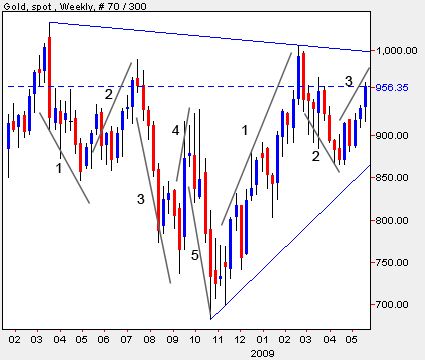
Summary: My best guess is that, on balance, gold is headed higher and will break above the high of $1032 set back on 17 March 2008. I’ve written on balance because there is going to be a lot of noise and volatility along the way as market participants struggle with the reality of the situation on the dollar. With regard to a timeline on the breakout occurring: Less than six months is my best guess. Short term (days to a couple of weeks): expect selling; lock and load to buy dips above around $875.
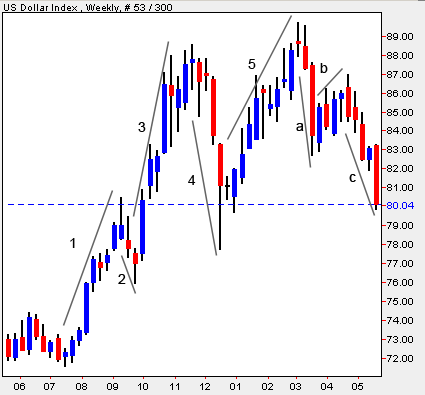
Technical Analysis: To my squinty eye, gold is carving out a giant pennant. A bullish pennant alone isn’t really enough to go on, so I looked at the dollar for insights and noticed (with my other squinty eye) a completed bullish Elliot Wave cycle; the classic 5-3 pattern.
As gold and the dollar move roughly opposite to each other, I looked back at gold and—squinting hard enough—I counted five bearish waves on the weekly interval. I know. That’s arguably not a bearish Elliot Wave wave sequence on gold, but since the bullish pattern is so clear on the dollar, I really tried to see it.
Spot gold, weekly interval
U.S. Dollar Index, weekly interval
Another bearish indicator on the U.S. Dollar Index is the formation of a Dark Cloud Cover/Hangman on the March 2009 candle. (Not illustrated here.)
I think we’re setting up the next phase (fractal) of the multi-year, uptrend on gold. Note the fairly obvious impulse wave beginning at the end of 2008. While the dollar would have a long way to fall to break below the previous all time low, I’m not convinced that the low would need to be taken out for gold to break higher. At this point, it’s much easier for gold to break out higher than it is for the dollar to break down and out of the range. That said, know that the dollar will eventually encounter hard support around 71-72.
It’s easy to turn Elliot Wave theory (or any other form of technical analysis) into a fully nuts study on apophenia, so I like to keep this stuff pretty simple. In summary: The argument for being long gold is a bullish Elliot Wave sequence occurring inside a quasi bullish pennant, meanwhile, on the dollar, we note a completed bullish Elliot Wave sequence. The monthly Dark Cloud Cover/Hangman candle adds more support for this view. Whether or not that “a” wave on the dollar index is a correction wave or, in fact, a new bearish impulse wave “1” is a matter that Elliot Wave practitioners might want to debate.
Saudi Arabian Oil Minister Naimi Says Oil to Reach $75 a Barrel
May 24th, 2009WARNING: This is not a recommendation to buy, sell or hold any financial instrument.
Disclosure: I’m long oil.
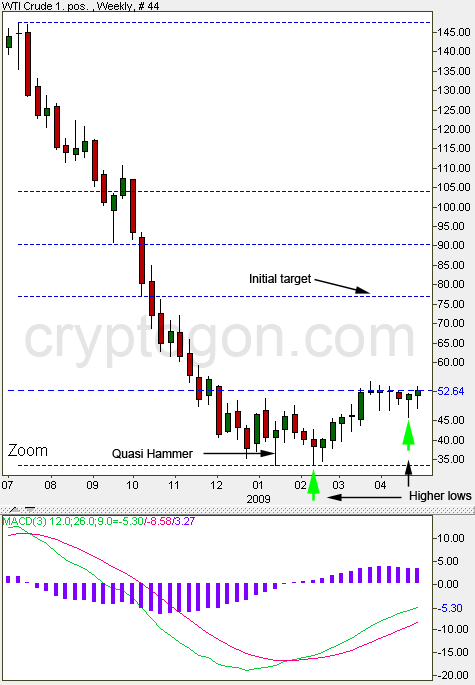
Remember this chart from May 2?
West Texas Intermediate Crude Oil, weekly interval
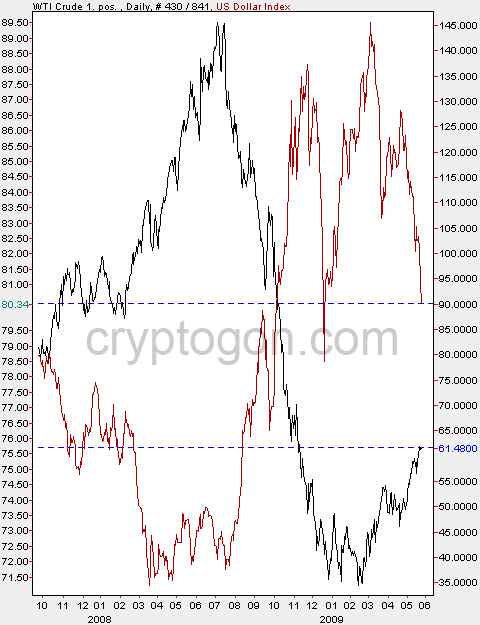
The relationship between oil prices and the U.S. Dollar Index:
U.S. Dollar Index vs. West Texas Intermediate Crude Oil, daily interval
Via: Bloomberg:
Saudi Arabian oil minister Ali al- Naimi said the price of oil will climb to $75 a barrel when demand picks up.
“We’ll get there eventually,” al-Naimi told reporters in Rome today where he will attend meetings with energy ministers from the Group of Eight industrialized nations. “The trick is keeping it between $70 and $80. It will be achieved as demand rises and the fundamentals are better than they are now.”