On Board Flight 3407: Beverly Eckert, 9/11 Widow, “My Silence Cannot Be Bought”
February 13th, 2009Update: She Met With Obama Days Before Crash
Via: The Buffalo News:
The usually joyful meet-and-greet area of the Buffalo Niagara International Airport was a corridor of tears and sorrow early this morning as family and friends of those aboard Continental Express Flight 3407 filed in to get official word of their loved ones’ fates.
For Sue Bourque, the wait for confirmation regarding her sister, Beverly Eckert, was all too familiar. Eckert is the widow of Sean Rooney, a Buffalo native who lost his life in the Sept. 11 terrorist attack on the World Trade Center.
Eckert was traveling to Buffalo for a weekend celebration of what would have been her husband’s 58th birthday. She also had planned to take part in presentation of a scholarship award at Canisius High School that she established in honor of her late husband.
Bourque said that while the family had not yet received official confirmation of her sister’s fate, the reality was settling in. “We know she was on that plane,” Bourque said, “and now she’s with him.”
Eckert, Rooney’s high school sweetheart, continued to live in their home in Stamford, Conn., after the terrorists’ attacks of 2001. As co-chairwoman of Voices of Sept. 11, she pushed for a formal commission to investigate intelligence failures and for a proper memorial to the victims.
—
My Silence Cannot Be Bought
by Beverly Eckert
I’ve chosen to go to court rather than accept a payoff from the 9/11 victims compensation fund. Instead, I want to know what went so wrong with our intelligence and security systems that a band of religious fanatics was able to turn four U.S passenger jets into an enemy force, attack our cities and kill 3,000 civilians with terrifying ease. I want to know why two 110-story skyscrapers collapsed in less than two hours and why escape and rescue options were so limited.
I am suing because unlike other investigative avenues, including congressional hearings and the 9/11 commission, my lawsuit requires all testimony be given under oath and fully uses powers to compel evidence.
The victims fund was not created in a spirit of compassion. Rather, it was a tacit acknowledgement by Congress that it tampered with our civil justice system in an unprecedented way. Lawmakers capped the liability of the airlines at the behest of lobbyists who descended on Washington while the Sept. 11 fires still smoldered.
And this liability cap protects not just the airlines, but also World Trade Center builders, safety engineers and other defendants.
The caps on liability have consequences for those who want to sue to shed light on the mistakes of 9/11. It means the playing field is tilted steeply in favor of those who need to be held accountable. With the financial consequences other than insurance proceeds removed, there is no incentive for those whose negligence contributed to the death toll to acknowledge their failings or implement reforms. They can afford to deny culpability and play a waiting game.
By suing, I’ve forfeited the “$1.8 million average award” for a death claim I could have collected under the fund. Nor do I have any illusions about winning money in my suit. What I do know is I owe it to my husband, whose death I believe could have been avoided, to see that all of those responsible are held accountable. If we don’t get answers to what went wrong, there will be a next time. And instead of 3,000 dead, it will be 10,000. What will Congress do then?
So I say to Congress, big business and everyone who conspired to divert attention from government and private-sector failures: My husband’s life was priceless, and I will not let his death be meaningless. My silence cannot be bought.
Beverly Eckert, whose husband died at the World Trade Center, is the founder of Voices of September 11th, a victims advocacy group.
Research Credit: AV
69 Computers Missing from Nuclear Weapons Lab
February 12th, 2009Maybe they’re with the missing VX.
Via: AP:
The Los Alamos nuclear weapons laboratory in New Mexico is missing 69 computers, including at least a dozen that were stolen last year, a lab spokesman said. No classified information has been lost, spokesman Kevin Roark said.
The watchdog group Project on Government Oversight on Wednesday released a memo dated Feb. 3 from the Energy Department’s National Nuclear Security Administration that said 67 computers were missing, including 13 that were lost or stolen in past 12 months.
Roark initially confirmed those figures, but later updated them. He said a total of 80 computers were lost or stolen in 2008, but 11 were recovered.
The lab was initiating a monthlong inventory to account for every computer, Roark said. The computers were a cybersecurity issue because they may contain personal information like names and addresses, but they did not contain any classified information, he said.
Also missing are three computers that were taken from a scientist’s home in Santa Fe, N.M., on Jan. 16, and a BlackBerry belonging to another employee was lost “in a sensitive foreign country,” according to the memo and an e-mail from a senior lab manager.
The e-mail was also released by the watchdog group.
The theft of the three computers in January triggered the inventory and a review of the lab’s policies regarding home use of government computers, Roark said.
Only one of the three computers stolen from the employee’s home was authorized for home use, which raised concerns “as to whether we were fully complying with our own policies for offsite computer usage,” he said.
Roark said computers with classified information are “kept completely separate from unclassified computing.”
“None of these systems constitute a breach of a classified system,” he said.
The e-mail from Los Alamos senior manager Stephen Blair to lab co-workers said the missing computers and Blackberry were “garnering a great deal of attention with senior management as well as (nuclear security administration) representatives.”
The security administration memo said the “magnitude of exposure and risk to the laboratory is at best unclear as little data on these losses has been collected or pursued given their treatment as property management issues.”
The lab, located in Los Alamos, N.M., employs about 10,000 people.
Parts for ‘Dirty Bomb’ Found in Slain U.S. Man’s Home
February 12th, 2009Via: Wikileaks:
James G. Cummings, who police say was shot to death by his wife two months ago, allegedly had a cache of radioactive materials in his home suitable for building a “dirty bomb.”
According to an FBI field intelligence report from the Washington Regional Threat and Analysis Center posted online by WikiLeaks, an organization that posts leaked documents, an investigation into the case revealed that radioactive materials were removed from Cummings’ home after his shooting death on Dec. 9.
The report posted on the WikiLeaks Web site states that “On 9 December 2008, radiological dispersal device components and literature, and radioactive materials, were discovered at the Maine residence of an identified deceased [person] James Cummings.”
Research Credit: Lagavulin
Army Suicides in January Outnumbered Combat Deaths
February 12th, 2009Via: Alternet:
The U.S. Army recently reported that for the month of January in 2009, the number of soldiers who committed suicide surpassed the number of soldiers who were killed in combat in Iraq and Afghanistan. While there were 16 U.S. combat deaths, the Army believes that there were 24 suicides (the Army has confirmed seven suicides, and it believes that investigators will confirm an additional 17 other deaths as suicides). The number of suicides in January 2009 is more than five times as many as the total in January 2008.
Overall in 2008, suicides in the Army rose for the fourth straight year. Army statistics, which include the Army Reserve and National Guard, confirm 128 suicides (with 15 more deaths under investigation). Suicides for the Marines also have been increasing, with 41 in 2008, up from 33 in 2007 and 25 in 2006.
Why the increase in suicides? Col. Kathy Platoni, chief clinical psychologist for the Army Reserve and National Guard, told CNN that she sees the multiple deployments and stigma associated with seeking treatment as two of the reasons. Another cause, Platoni added, may be the excessive use of antidepressants for troubled soldiers.
Why? According to the Food and Drug Administration “black box” warnings on Prozac and other so-called antidepressants, “Antidepressants increased the risk compared to placebo of suicidal thinking and behavior (suicidality) in children, adolescents and young adults.”
U.S. governmental officials want Americans to feel assured that the government is scientifically ascertaining the reasons why soldiers are increasingly killing themselves and how to prevent this. In November 2008, the National Institute of Mental Health announced that it and the Army had entered into an agreement to conduct a $50 million study on suicide and suicidal behavior among soldiers.
The NIMH press release states, “The joint project will strengthen the Army’s efforts to reduce suicide among its soldiers by identifying risk and protective factors for suicidal thinking and behavior.”
Do we need to give $50 million to NIMH psychiatrists and psychologists to discover that when one has been in, or is currently in, or is about to be deployed to a miserable, terrifying, traumatizing place, it is more likely that one will feel suicidal?
Don’t hold your breath waiting for a study sponsored by the NIMH and the U.S. Army to include this obvious recommendation: the best mental health treatment to prevent suicide in our soldiers is getting them the hell out of a war zone if the vast majority of Americans believe that the war is unnecessary.
Research Credit: Pookie
Biggest Solar Deal Ever Announced – We’re Talking Gigawatts
February 12th, 2009Via: Wired:
The largest series of solar installations in history, more than 1,300 megawatts, is planned for the desert outside Los Angeles, according to a new deal between the utility Southern California Edison and solar power plant maker, BrightSource.
The momentous deal will deliver more electricity than even the largest nuclear plant, spread out among seven facilities, the first of which will start up in 2013. When fully operational, the companies say the facility will provide enough electricity to power 845,000 homes — more than exist in San Francisco — though estimates like that are notoriously squirrely.
The technology isn’t the familiar photovoltaics — the direct conversion of sunlight into electricity — but solar thermal power, which concentrates the sun’s rays to create steam in a boiler and spin a turbine.
“We do see solar as the large untapped resource, particularly in Southern California,” said Stuart Hemphill, vice president of renewable energy and power at Southern California Edison. “It’s barely tapped and we’re eager to see it expand in our portfolio.”
BrightSource is the reincarnation of Luz International, which built the only currently operating solar thermal facility during the 1980s in the Mojave Desert. After natural gas and energy prices plunged in 1985, that operation became unprofitable. The group’s engineers and founders moved the business to Israel, where they continued to work on their technology.
The new deal breaks the company’s own record for the largest ever solar deal. The new installations, when completed, will produce 3.7 billion kilowatt hours of electricity per year. Previously, they’d cut a deal to deliver 900 megawatts of power to the Northern California utility, PG&E.
Research Credit: ltcolonelnemo
Scientologists Building 22,000-Square-Foot Underground Facility to Store Documents?
February 12th, 2009“I don’t care if it’s Church of Scientology, the Roman Catholic Church or, you know, Kraft Foods,” Barton said.
Classic.
Via: AP:
The construction began last summer, stirring up dust that wafted down this desert valley and into a small community of off-the-grid homes.
As many as 20 heavy trucks a day hauling construction materials and equipment rumbled down the valley’s main gravel road, passing into a gate marked with a “No Trespassing” sign. Helicopters flew in sling loads of cargo. Powerful work lights lit up the valley at night.
Public planners in southwest Wyoming’s Sweetwater County — a sagebrush expanse roughly the size of Massachusetts — say the contractor hired for the project has told them it intends to build a 22,000-square-foot underground storage vault to store documents.
Whose documents exactly? Apparently, the writings of the late L. Ron Hubbard, the Church of Scientology’s founder, and other church records.
But plans remain vague. County land use planner John Barton said the county also has been told the vault might hold any number of things besides documents.
“We’ve had everything from underground housing of sheep or hay,” Barton said. “We’ve had cemetery discussed. We’ve had mining discussed.”
The contractor, International Ground Support Systems of Santa Fe, N.M., also has said it plans to build a 3,500-square-foot caretaker house and an airstrip, county officials say. But they allege that IGSS has failed to apply for two required permits for work done so far.
The mysterious project has riled some neighbors, who value the solitude of their remote community, located about 150 miles east of Salt Lake City.
“I don’t care if it’s Church of Scientology, the Roman Catholic Church or, you know, Kraft Foods,” Barton said. “We have development activity occurring — has occurred and, rumor has it, continues to occur — without required permits.”
A local attorney representing IGSS, Robert Reese, said the earthwork already done is similar to improvements that would be made at any ranch. He said that’s consistent with the site’s agricultural zoning and past use as a cattle ranch. Therefore, he said, the contractor hasn’t needed to get a permit.
“Our position is that everything that has been done so far falls well within the agricultural use and no permit is required,” Reese said.
IGSS has a majority ownership stake in the 3,500-acre property along with a handful of locals who otherwise don’t appear to be directly involved in the project, according to county officials.
Neither the Los Angeles-based Church of Scientology — a roughly 50-year-old religion noted for its unconventional beliefs and celebrity followers — nor IGSS officials returned several phone messages seeking more information about the project.
However, an entity called the Church of Spiritual Technology has been known to build underground vaults to store Scientology documents, including near Petrolia, Calif., and Trementina, N.M. According to records from Humbolt County, Calif., IGSS received a permit in 1990 to build the Petrolia vault for the Church of Spiritual Technology, which is based in Los Angeles.
The Church of Spiritual Technology doesn’t have a listed phone number.
The Church of Spiritual Technology and the Church of Scientology are linked, according to Larry Brennan, of Bow, N.H., a former Scientologist who now writes a blog about the religion.
The Church of Spiritual Technology holds Scientology’s copyrights and trademarks and stores church documents in underground vaults to preserve the religion in case of nuclear war, he said.
The developer’s lack of permits prompted the county to issue a stop-work order in September. When work didn’t stop, the planners referred the matter to County Attorney Brett Johnson, who said he’s contemplating legal action if work continues without a permit.
“There’s been a lot of earth moved. It’s quite clear that they’re preparing to do a lot more work and we just want them to come in and get the proper permits,” Johnson said.
John Ledford lives in a solar-powered home within sight of the construction zone. He said the project has stirred up considerable dust and he worries that the construction could cause his water well to run dry.
“They’ve ruined the road, and we live with the fact that the road has gotten ruined. But the air and the water? It’s just not right,” Ledford said.
IGSS attorney Reese said that far from doing harm, the company has improved the property.
“They’re doing nothing but agricultural work out there in the last couple of months,” Reese said. “They’ve got grazing permits, cattle are being raised, they were cleaning stream beds, fixing up the property, getting a lot of trash out there. It’s much nicer than it was.”
Orbital Collision: Please Pick Up the Nearest Black Courtesy Phone
February 12th, 2009So, an Iridium satellite just happened to collide with a defunct Russian military satellite…
You’re about to learn how the sausage gets made, and, before we begin, you should know that it’s not pretty.
I don’t know the whole story about Iridium, but it has got to be one of the spookiest tales of them all.
In November 1998, Motorola activated the Iridium communications network, a constellation of low-earth orbit satellites that provides wireless telecom and data services to any location on the planet. The cost to build the system? About $5 billion. By August 1999, unable to sign up enough customers—because of extremely high handset costs and per minute usage fees—Iridium was facing bankruptcy.
(If you know of a more complete account of what happened next, please let me know about it.)
Iridium executive Dan Colussy put together a group of “private investors” to buy the Iridium system. According to Iridium:
In December 2000, a group of private investors led by Dan Colussy organized Iridium Satellite LLC. Iridium Satellite LLC acquired the operating assets of the bankrupt Iridium LLC including the satellite constellation, the terrestrial network, Iridium real property and intellectual capital.
How much did this group of private investors pay for the system that cost about $5 billion to build?
$25 million. That’s a discount of about 99.5% off the build cost.
Who were those private investors who just happened to be at the right place at the right time? I’ll be buggered if I know, but someone, somewhere probably knows.
But guess what happened next.
This is U.S. Department of Defense Press Release Number, 729-00, 26 December 2000:
DEPARTMENT OF DEFENSE ANNOUNCES CONTRACT FOR IRIDIUM COMMUNICATIONS SERVICES
The Department of Defense, through its Defense Information Systems Agency, last night awarded Iridium Satellite LLC of Arnold, Md., a $72 million contract for 24 months of satellite communications services. This contract would provide unlimited airtime for 20,000 government users over the Iridium satellite network.
The contract includes options which, if exercised, would bring the cumulative value of this contract to $252 million and extend the period of performance to December 2007.
The Department has taken this action because the Iridium system offers state-of-the-art technology. It features on-satellite signal processing and inter-satellite crosslinks allowing satellite-mode service to any open area on earth. It provides mobile, cryptographically secure telephone services to small handsets anywhere on the globe, pole-to-pole, 24 hours a day. The system and its DoD enhancements will provide handheld service currently not available.
Since the Navy has a requirement more than twice as large as the current capability, the Department of Defense needs the capacity Iridium uniquely offers small unit operations in areas without satellite constellation coverage or during periods when various assets are being used in other contingencies. Special Forces operations, combat search and rescue activities and polar communications will also be enhanced. Iridium will provide a unique resource to enhance DoD mobile satellite communications requirements.
“Iridium will not only add to our existing capability, it will provide a commercial alternative to our purely military systems. This may enable real civil/military dual use, keep us closer to the leading edge technologically, and provide a real alternative for the future,” said Dave Oliver, principal deputy undersecretary of Defense (Acquisition, Technology and Logistics).
Iridium Satellite LLC is now purchasing the operating assets of Iridium LLC and its existing subsidiaries, pursuant to a Nov. 22, 2000 order of the U.S. Bankruptcy Court for the Southern District of New York. Under the agreement, Iridium Satellite LLC will purchase all of the existing assets of Iridium LLC, including its constellation of low-orbiting satellites and its satellite control network, and will have Boeing operate the system. The new “bulk rate” service agreement offered and accepted by the Department stands to provide the same critical augmentation capability at substantially cheaper rates.
Early next year, Iridium will offer a classified capability. Classified service will not only be provided for users already registered to the DoD gateway, but will also be extended to new users from DoD, other federal agencies, and selected allied governments.
Woh! Wait a minute. The General Accounting Office tried to investigate, but while those spooky birds continued to fly, a big black National Security blanket fell from above and shut down the GAO with regard to the DoD and Iridium:
The U.S. General Accounting Office (GAO) is investigating the Department of Defense’s recently signed contract for satellite telephone services from Iridium Satellite LLC. Globalstar LP filed a protest with GAO shortly after the Pentagon announced the agreement with Iridium, because no competition was held for the telecommunications contract. GAO placed a hold on the Iridium contract pending its investigation, but the Pentagon was able to have the hold lifted by citing national security reasons. The GAO investigation has a 100-day limit.
Had enough? We’re just getting started.
This is from USA Today:
When the bankruptcy judge offered one last chance for a buyer to step in, nobody could put together a deal that made all parties happy — except for Dan Colussy, who for the previous 10 years had run United Nuclear, a company that refurbished aircraft and made nuclear reactors for submarines. “Basically, he was retired but viewed it as a shameful waste to see an extremely valuable asset done away with,” says Picasso, who Colussy hired to run Iridium.
So Colussy and a group of investors offered $25 million for a system that cost Motorola and its partners $5 billion to build. That’s one-half cent on the dollar. It’s like picking up a $150,000 Porsche 911 for $750. Or getting a $425-a-night room at the Ritz-Carlton in Laguna Nigel, Calif., for $2.
The last time anybody consummated a deal like that, the French wound up with just $15 million for the Louisiana Purchase, which is probably the underlying reason they’re ticked off at us.
In an odd twist, the new Iridium is 24% owned by an investment firm controlled by Prince Khalid bin Abdullah bin Abdulrahman of Saudi Arabia.
The prince used to own a minority chunk of the old Iridium in partnership with the Saudi Binladen Group, the company run by Osama bin Laden’s family. So in a way, some of the money that gave a start to the world’s most notorious terrorist partly funded a communications system helping the U.S. military blast Saddam’s army. Now that’s globalization.
Can you hear me now?
No? Ok, let’s try again.
BETHESDA, Md., Aug. 9 /PRNewswire/ — Iridium Satellite is pleased to announce that Alvin B. (“Buzzy”) Krongard has joined its Board of Directors. Buzzy Krongard is the former Chief Executive Officer and Chairman of the Board of Alex.Brown Incorporated, the nation’s oldest investment banking firm. In addition, Krongard served as Vice Chairman of the Board of Bankers Trust, in addition to holding other financial industry posts. He also served as Counselor to the Director of the U.S. Central Intelligence Agency (CIA), then as Executive Director of the CIA from 2001 to 2004.
Iridium, as the only provider of truly global satellite voice and data communications, helps government organizations and businesses around the world communicate where there are no other forms of communication available. Iridium is the only mobile satellite communications service that provides complete pole-to-pole coverage of the earth, making it ideal for remote and backup communications. As such, Iridium has experienced substantial business growth in providing services for mission critical communications, as well as for response to natural and manmade disasters. Iridium is tapping top-level counsel as it expands its Board. The company announced its appointment of Tom Ridge, Former Director of the U.S. Department of Homeland Security, to its Board in June.
“Iridium is at a pivotal point in growing its business and expanding its services,” said Dan A. Colussy, CEO and Chairman, Iridium Satellite. “With Buzzy’s deep knowledge base in investment banking and his unmatched experience with the intelligence community, we look forward to his direction as we expand our financial resources and further serve our important customer base.”
…
“I look forward to sharing my investment banking background, as well as my insight into the communications needs of the intelligence community, as an Iridium Board member,” said Mr. Krongard. “I am impressed with the unique aspects of the Iridium network and the power it brings to bear on the Global War On Terrorism (GWOT), homeland defense and other related operations. Iridium has an important customer base to serve and I am pleased to assist.”
Other related operations?
Like, growing tomatoes?
Oh sure. British intelligence had worked out a covert operation that was tasked with teaching the Taliban “farming and irrigation” techniques. Part of this back-to-the-land plan, for the producers of 95% of the global opium supplies, included training the Taliban, “To use secure satellite phones, so they could communicate directly with UK officials.”
Never mind all of that, because all’s well that ends well for “the biggest project failure in history”: Nine-Year Iridium Bankruptcy Saga Over for Motorola:
A judge has finally ruled that Motorola has nothing to pay over the bankruptcy of its Iridium satellite venture in 1999, described as the biggest project failure in history.
The satellites are still in use, with current owner, Iridium Satellite, claiming to have around 250,000 subscribers. A creditors’ committee had been seeking more than $4bn in damages against Motorola, which backed the original Iridium plan to cover the globe with 66 satellites providing phone coverage.
Founded in 1992, Iridium launched its service in 1998, but went into Chapter 11 bankruptcy in 1999, unable to sell enough subscriptions to the expensive service, in the face of competition from GSM mobile-phone services.
Yep, so that’s all I know about Iridium. And now back to our regularly scheduled broadcast.
I’m going to bold just one paragraph below about the, “accident.” I’ll let you do the math on the rest.
Via: Wall Street Journal:
A commercial satellite owned by a U.S. company was destroyed in a collision with a defunct Russian military satellite in what NASA said was the first such accident in orbit, raising new concerns about the dangers of space debris.
The crash, which happened Tuesday in low-earth orbit, involved one of the satellites owned by closely held Iridium Satellite LLC and a crippled Russian military satellite that apparently stopped functioning years ago, according to U.S. government and satellite-industry officials.
The collision created two large clouds of debris floating roughly 480 miles above Siberia, and prompted space scientists and engineers to assess the likelihood of further collisions.
The accident could have implications for U.S. space budgets and policy, partly because it comes amid a Pentagon campaign to increase spending on systems to protect U.S. high-tech space hardware by keeping better track of the thousands of pieces of debris and other satellites circling the earth.
As more and more satellites are blasted into orbit, the challenges of keeping them from hitting debris or each other are growing. Military planners also worry about enemies jamming, disabling or potentially even ramming U.S. satellites.
Industry officials say Iridium has identified the Russian craft as a Cosmos series satellite launched in 1993, weighing more than a ton and including an onboard nuclear reactor. A collision could release nuclear residue, though experts have argued for years that the chance of radioactive debris surviving a fall through the atmosphere and reaching inhabited areas is very small.
More than 220 active commercial satellites now orbit the globe, in addition to hundreds of military, spy and scientific satellites. Commercial satellites provide businesses with everything from data and video transmissions to support for automated bank teller systems and consumer navigation devices.
The Russian craft was being monitored by Pentagon organizations that keep track of space debris in order to prevent in-orbit collisions from damaging or destroying both commercial and government satellites. The National Aeronautics and Space Administration and the Pentagon track more than 10,000 pieces of high-speed debris, some no larger than a football.
Cosmos satellites have been designed for various uses, from spy missions to missile-warning systems to secure military communications. They have caused a number of scary incidents over the years, including a 1991 collision between one defunct model and debris from another; a near-collision with the space shuttle the same year; and another that crashed into Canadian wilderness in 1978.
Pentagon officials will face a barrage of questions about how they missed such an impending collision with an intact satellite, according to Tim Farrar, a satellite consultant familiar with Iridium. Commercial satellites are “routinely repositioned to avoid potential collision with smaller pieces of debris,” said Mr. Farrar.
Pentagon brass, satellite industry executives and NASA leaders for years have publicly expressed concern about the dangers of orbital debris. But the odds of a direct hit between satellites were considered so small as to be basically unthinkable. The ground-based and space-based reconnaissance tools available to the Pentagon generally were considered adequate to keep close track of larger objects.
Recently, large U.S. and European operators began reviewing contingency plans to move some telecommunications satellites away from a pair of malfunctioning satellites.
Space collision worries gained momentum in January 2007, when the Chinese government used a relatively simple antisatellite weapon to knock down one of its aged weather satellites.
NASA said there have been four earlier instances of accidental collisions in orbit, generally involving rocket parts and other debris. None involved a full-size satellite.
When satellites reach the end of their useful lives they often are parked in remote orbits where they are unlikely to endanger working satellites. But if a satellite’s onboard computers or other systems fail, or it runs out of battery power, it can be difficult for ground operators to maintain control. Without such orders from the ground, satellites can act unpredictably over months.
Iridium, of Bethesda, Md., uses more than 60 satellites to provide voice and data services for about 300,000 subscribers globally. It said the collision has “minimal impact” on service due to its backup capacity.
Cryptogon Readers Send Contributions
February 12th, 2009Thank you.
GB $50
KH $1
TM $25.75
DT $10
CW $50
Pookie $75
TM $25.75
AM £5
Blank Spots on the Map: The Dark Geography of the Pentagon’s Secret World
February 12th, 2009UPDATE: Contest Results
The target was a picture of my ancient, tattered Audio Technica headphones sitting on the concrete floor.
There were no direct hits, but 9 of 13 submissions had something to do with round things. For days, it looked like Evil Chopsticks was going to be the closest one, since he or she drew concentric ovals. The headphones are actually oval shaped, and consist of various sized oval things inside of other oval things. Then Joseph’s submission contained two distinct round/ovoid things, with the one on the left showing concentric ovals. Becky thought that his was the closest to the target. So did I.
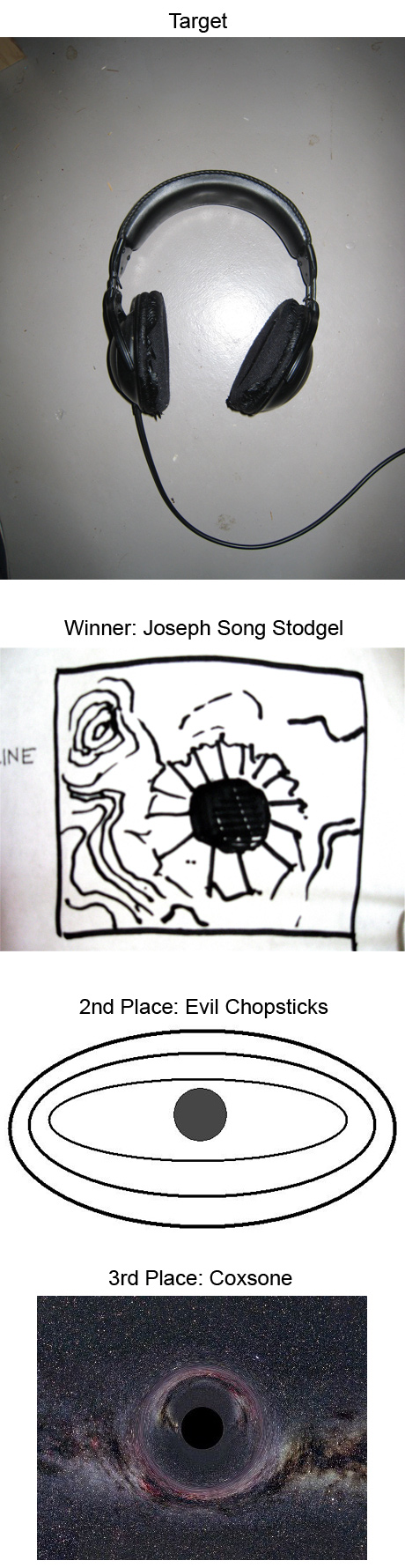
Off Target, But Worth Mentioning: Taters submitted two images that were totally off the mark. They were overhead representations of a warehouse and a then the warehouse and surrounding buildings. In other words, nothing to do with the target at all. Taters also wrote some text to go along with the submission, describing the warehouse… Again, off target.
However, in 928 words, that were describing something far off target, what are the odds that the phrases “concrete floor” and “audio equipment” would show up? It wasn’t “audio equipment on a concrete floor.” The phrases were describing different aspects of the warehouse, what Taters thought was the target, in different parts of the writeup. It was like off target, off target, off target and then concrete floor jumped out. Then, off target, off target, off target, audio equipment, off target, off target, off target…
Well, the target was headphones on a concrete floor.
I thought that was interesting; worth mentioning anyway.
Congratulations to Joseph and thanks to everyone else who participated!
—END UPDATE—
UPDATE: I Have to Run the Giveaway Myself
I’ve been back in contact with the promotions person at Dutton Books and it turns out that I have to run the giveaway myself. It could be anything I want.
After a few minutes of thinking up some boring and lame ways to do this, I had a much different idea and began emitting gleeful, mischievous, chortling sounds.
You’re going to have to remote view a target of my choice to win the signed copy of Blank Spots on the Map: The Dark Geography of the Pentagon’s Secret World by Trevor Paglen, and one of the creepy patches associated with some secret military project.
Instructions:
1. Your target is called BLANK SPOTS TARGET.
2. Remote view BLANK SPOTS TARGET using the method or protocol that works best for you. If you do not know how to remote view, this is a good place to start (totally free, includes practice targets).
3. Create a drawing of the BLANK SPOTS TARGET. It doesn’t matter what media you use to create your representation of the target as long as you email me a digital image of it (jpeg, gif, etc.). Please don’t send files larger than 1mb.
4. Email the image to [contest over]. (This email account will stop functioning at the end of the contest.) Include only a nickname that will be displayed on this post in the event that you win, place or show. I will display the winner’s image, the image that came in second and the image that came in third.
5. If you win, I will email you to let you know that you won and ask you to where you would like your book and patch sent. I will pass this information to my contact at Dutton Books, who will send you the book and patch.
Rules:
1. The contest ends on Friday, February 20, 2009 at 11:59 GMT.
2. Submissions will only be accepted via email. Someone will almost certainly ask if they can send in a hard copy of their RV work. Again, submissions will only be accepted via email.
3. One submission per person / email address.
4. My wife will pick the winning submission, the second place submission and the third place submission. This will avoid any possible subjective feelings that I may or may not have toward one reader or another. Becky will see the target and then the submissions that came in, but with all identifying information removed. Yes, the trolls that I have banned, you too can win.
5. I am not responsible if Dutton Books somehow doesn’t fulfill their end of the deal on this. I have absolutely no reason at all to believe that they wouldn’t send out the book and patch, but I’m not going to get stuck with the cost of doing that if they, for whatever reason, don’t perform. Besides, where the Hell would I buy one of those patches anyway?
6. By emailing your submission, you agree to allow me to post your RV work along with your designated nickname.
7. I know the target, so this is not an entirely clean RV session. There is a small chance that I could “leak” the result to someone who is skilled at ESP or other woowoo arts and crafts. So, if you’re somehow able to determine the nature of the target because I know it, and not via RV of the target directly, you’ll be cheating if you send in a submission based on those methods. No, I wouldn’t be able to tell the difference.
That’s it. Have fun!
—END UPDATE—
I’ve been contacted by someone at Dutton Books (Penguin Group) who’s working promotions for a just published book called:
Blank Spots on the Map: The Dark Geography of the Pentagon’s Secret World by Trevor Paglen
Oh yes, I took her up on the offer for a signed copy of the book, and I’m supposed to link to some sort of give-a-way for a signed copy of the book for you guys. I don’t know how long all of that will take, so I thought I’d just link to the info on this right away since many of you will be as interested in this as I am:
Blank Spots on the Map is an expose of an empire that continues to grow every year—and which, officially, it isn’t even there. It is the adventurous, insightful, and often chilling story of a young geographer’s road trip through the underworld of U.S. military and C.I.A. “black ops” sites. This is a shadow nation of state secrets: clandestine military bases, ultra-secret black sites, classified factories, hidden laboratories, and top-secret agencies making up what defense and intelligence insiders themselves call the “black world.” Run by an amorphous group of government agencies and private companies, this empire’s ever expanding budget dwarfs that of many good sized countries, yet it denies its own existence.
Author Trevor Paglen is a scholar in geography, an artist, and a provocateur. His research into areas that officially don’t exist leads him on a globe-trotting investigation into a vast, undemocratic, and uncontrolled black empire—the unmarked blank areas whether you are looking at Google Earth or a U.S. Geological Survey map. Paglen knocks on the doors of CIA prisons, stakes out the Groom Lake covert air base in Nevada from a mountaintop 30 miles away, observes classified spacecraft in the night sky with amateur astronomers, and dissects the Defense Department’s multibillion dollar black budget. Traveling to the Middle East, Central America, and even around our nation’s capital and its surrounding suburbs, he interviews the people who live on the edges of these blank spots.
Paglen visits the widow of Walter Kazra, who, while working construction at Groom Lake, was poisoned by the toxic garbage pits there. The U. S. Air Force defense to his estate’s suit? The base does not exist. The U. S. Supreme Court declined to review the case. Whether Paglen reports from a hotel room in Vegas, Washington D. C. suburbs, secret prisons in Kabul, buried CIA aircraft in Honduras, or a trailer in Shoshone Indian territory, he is impassioned, rigorous, relentless—and eye-opening. This is a human, vivid, and telling portrait of a ballooning national mistake.
EU Faces ‘Toxic’ Debt Spiral
February 12th, 2009Via: Telegraph:
It is not surprising that European Union finance ministers looked ashen faced in Brussels on Tuesday.
The breakfast meeting discussed how EU governments should deal with, in other words pay for, the “toxic” banking assets that triggered the economic crisis.
As discussed here on Monday, the European Commission warned that government attempts to buy up or underwrite “impaired” assets could plunge the EU into a deeper crisis, one that threatens the Union.
Everyone is terrified that a second bank bailout will push up government borrowing at a time when bond markets have growing doubts over the ability of countries such as Spain, Greece, Portugal, Ireland, Italy and Britain, to pay it back.
“Estimates of total expected asset write-downs suggest that the budgetary costs – actual and contingent – of asset relief could be very large both in absolute terms and relative to GDP in member states,” a confidential EC document, seen by The Daily Telegraph, cautioned.
“It is essential that government support through asset relief should not be on a scale that raises concern about over-indebtedness or financing problems.”
Spread yields are widening on bond markets as investors judge it riskier to buy the debt of a country like Italy than the debt of another like Germany.
In line with the risk, and the low performance of some EU economies compared to others, the markets have demand a higher premium on government bonds issued to raise the cash.
The more the doubt there is over high levels of government borrowing, the more the markets have asked governments to pay to service their borrowing and all the more indebted countries become.
Ministers and officials fear that the process could lead to vicious spiral that threatens to tear both the euro and the EU apart.
Research Credit: GP




