War Driving San Francisco Cloning RFID Passports
February 2nd, 2009Via: Engadget:
Chris Paget just did you a service by hacking your passport and stealing your identity. Using a $250 Motorola RFID reader and antenna connected to his laptop, Chris recently drove around San Francisco reading RFID tags from passports, driver licenses, and other identity documents. In just 20 minutes, he found and cloned the passports of two very unaware US citizens. Fortunately, Chris wears a white hat; his video demonstration is meant to raise awareness to what he calls the unsuitability of RFID for tagging people. Specifically, he’s hoping to help get the Western Hemisphere Travel Initiative — a homeland security project — scrapped.
Change We Can Believe In: Obama to Expand CIA Rendition Program
February 2nd, 2009I guess there’s no need for the secret prisons if the victims just happen to die during “rendention.”
Via: Chicago Tribune:
The CIA’s secret prisons are being shuttered. Harsh interrogation techniques are off-limits. And Guantanamo Bay will eventually go back to being a wind-swept naval base on the southeastern corner of Cuba.
But even while dismantling these discredited programs, President Barack Obama left an equally controversial counterterrorism tool intact.
Under executive orders issued by Obama last week, the CIA still has authority to carry out what are known as renditions, or the secret abductions and transfers of prisoners to countries that cooperate with the U.S.
Current and former U.S. intelligence officials said the rendition program is poised to play an expanded role because it is the main remaining mechanism—aside from Predator missile strikes—for taking suspected terrorists off the street.
The rendition program became a source of embarrassment for the CIA, and a target of international scorn, as details emerged in recent years of botched captures, mistaken identities and allegations that prisoners were turned over to countries where they were tortured.
The European Parliament condemned renditions as an “illegal instrument used by the United States.” Prisoners swept up in the program have sued the CIA as well as a subsidiary of Boeing Corp., which is accused of working with the agency on dozens of rendition flights.
But the Obama administration appears to have determined that the rendition program was one component of the Bush administration’s war on terrorism that it could not afford to discard.
The decision underscores the fact that the battle with Al Qaeda and other terrorist groups is far from over and that even if the U.S. is shutting down the prisons, it is not done taking prisoners.
“Obviously you need to preserve some tools, you still have to go after the bad guys,” said an Obama administration official, speaking on condition of anonymity when discussing legal reasoning behind the decision. “The legal advisers working on this looked at rendition. It is controversial in some circles and kicked up a big storm in Europe. But if done within certain parameters, it is an acceptable practice.”
One provision in one of Obama’s orders appears to preserve the CIA’s ability to detain and interrogate terrorism suspects as long as they are not held long-term. The little-noticed provision states that the instructions to close the CIA’s secret prison sites “do not refer to facilities used only to hold people on a short-term, transitory basis.”
Research Credit: cptmarginal
Questions, Questions: Gold, Aussie and Kiwi Dollars
February 1st, 2009WARNING: This is not a recommendation to buy, sell or hold any financial instrument.
I’ve received some emails from Aussies and Kiwis who are thinking about buying gold.
In summary: Hold off for now.
I looked at the U.S. Dollar Index, but that thing is so blurry, I can’t make much sense out of it. I see a lot of overhead resistance as well as a lower pivot on stochastic slow. I’m going to guess that upside potential on the dollar is limited and that there’s a marginally better chance of a move lower.
The picture on the Aussie dollar (AUD/USD) is also VERY blurry. If I was forced to make a call, I’d say there’s a 40% chance of a retest to .6000 and a 60% chance of a strong move higher. If .6000 doesn’t hold, the next stop is .5477.
The Kiwi dollar has wrecked in an astonishing manner, however, there’s a hard (monthly) support at (NZD/USD) .5026 just ahead. That’s a low from 1993. Shorts are very risky here. Any squeeze will drop the price of gold (priced in NZD) and provide a better opportunity for anyone looking to buy. I’m going to gradually start buying NZ$ again, since I’ve been holding off (leaving it in USD) during this crash.
If the squeeze materializes, very strong overhead resistance begins at .5928 and .6258 is the 38.2 fib retracement on the monthly.
Now, if it slips below .5026, the next stop could be .4788. Below that, around .4000.
Let’s quickly consider EUR/USD. It looks like there’s some downside potential into the 1.240 zone, but, again, while there’s potential to retest the low, it doesn’t seem worth it for shorts.
Does gold know something? We’ve got a break out higher on the weekly channel.
A weekly close above the upper channel line is a good thing for gold longs, right?
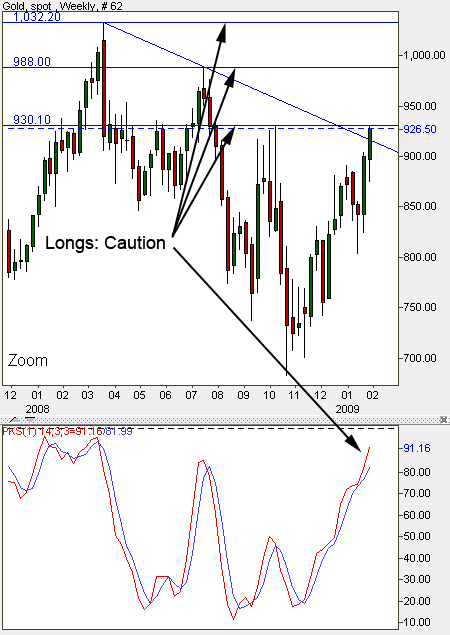
Spot gold, weekly interval
Well, you would think so, but my guess is that there’s going to be a concerted effort to keep gold rangebound (under $1030). While I won’t be selling even one gram of my physical gold, I’m going to buy deep out of the money February puts on GLD just in case things get weird again. I’ll do this as soon as Monday if it’s an up day.
What do I mean by weird? I mean that the U.S. Dollar Index somehow breaks out higher, above 88.
Don’t get me wrong, I’d like nothing more than for those puts to expire worthless, but gold is closing in on a major make-or-break level around $1030. Longs, you know the drill. Either this is it, or it isn’t. So many goldbugs are speaking in tongues now. Will it go to $1500, $2000, $3000, some wonder…
This worries me. A lot. I hope they’re right, but I’ll be taking those February puts anyway.
Russian Newspaper Mourns Another Murdered Reporter
February 1st, 2009Via: AP:
That journalist was Anastasia Baburova, a 25-year-old cub reporter. She and a human rights lawyer were shot execution-style by a masked man with a silenced pistol as they walked together a few blocks from the Kremlin.
In a country considered one of the most dangerous for journalists, no Russian newspaper has suffered like Novaya Gazeta. In a country where most media have been cowed into submission, no other newspaper publishes such probing investigative articles and acid commentary about government corruption, police-state politics and Chechnya war abuses.
“Every two or three years, we lose someone,” says Elena Kostyuchenko, a 21-year-old investigative writer for the paper. “But you just have to write, write, write and keep writing. You have to.”
Some 16 journalists have died in contract-style slayings or under suspicious circumstances in Russia since 2000. Many more have been assaulted or threatened.
Under Vladimir Putin, who became president in 2000 and now is prime minister, the TV networks watched by most Russians were taken over by the state, their news operations highly sanitized. Big-selling newspapers are either sympathetic to the Kremlin or owned by Kremlin-allied business groups.
Of the many free-spirited papers that sprang up when the Soviet Union collapsed, Novaya Gazeta — meaning New Newspaper — is a rare survivor.
Its most high-profile loss was Anna Politkovskaya, a reporter who savaged the Kremlin for its conduct of the war on Chechen separatists. Her shooting outside her Moscow apartment in 2006 provoked worldwide condemnation and major embarrassment for the Kremlin.
FDIC Friday: Three More Down
February 1st, 2009I stopped posting FDIC Friday stories because the amounts of money involved with most of them make for noise level events in the scheme of things. I picked an arbitrary threshold of $1 billion or more in total deposits for a bank failure to warrant a mention here.
But this week, we have three failures. While the deposits for the three failed banks are under 1$ billion, this seemed worth mentioning anyway.
The pace is picking up.
Via: Bloomberg:
Banks in Florida, Maryland and Utah were closed yesterday as regulators wrapped up the busiest month for failures since the housing slump began in 2006.
Ocala National Bank in Florida and Suburban Federal Savings Bank of Crofton, Maryland, were shut by federal regulators, according to statements sent by the Federal Deposit Insurance Corp. MagnetBank of Salt Lake City was seized by the Utah Department of Financial Institutions. The banks had total assets of $876.4 million and deposits of $790 million.
Six banks have failed this month as tumbling home prices and a 16-year high in unemployment boost foreclosures. The FDIC classified 171 banks as “problem” in the third quarter, a 46 percent jump from the previous period amid the worst housing crisis since the Great Depression.
Regulators closed 25 U.S. banks last year, the most since 1993, draining money from the FDIC deposit insurance fund, which had $34.6 billion as of Sept. 30. Ocala and Suburban Federal combined will cost the FDIC fund about $225.6 million, the regulator said. No estimate was provided for MagnetBank.
Suburban Federal’s seven offices were scheduled to open today as branches of The Bank of Essex of Tappahannock, Virginia, which acquired the deposits. The Office of Thrift Supervision said it seized the bank because of more than a year of losses stemming from soured residential, construction and land loans.
“The OTS determined that Suburban was critically undercapitalized and in unsound condition,” the regulator said in an e-mailed statement.
Deposits Insured
Ocala was closed by the Officer of the Comptroller of Currency. CenterState Bank of Florida in Winter Haven is assuming the deposits and four branches.
“Deposits will continue to be insured by the FDIC, so there is no need for customers to change their banking relationship to retain their deposit insurance coverage,” the FDIC said in the Ocala statement.
The FDIC said it was unable to find a buyer for MagnetBank’s deposits, the first time that’s happened since 2004. Insured customers will be mailed checks for their funds next week.
The FDIC, the Treasury Department and Federal Reserve have stepped up efforts to aid U.S. institutions that reported more than $500 billion in writedowns and credit losses, and raised more than $400 billion in capital last year. The U.S. on Jan. 16 gave Bank of America Corp., the largest bank by assets, $20 billion cash and $118 billion in asset guarantees to help absorb losses after the acquisition of Merrill Lynch & Co. Citigroup Inc. got $20 billion and $301 billion in guarantees in November.
Here Comes The BARF
February 1st, 2009Via: Forbes:
Why creating a Bad Asset Repository Fund for Wall Street’s toxic assets could make banking even sicker.
First there was TARP. Get ready for BARF.
They haven’t named it that yet, but calling a federal “bad bank” to soak up toxic assets the Bad Asset Repository Fund would be truth in advertising at least. Despite Washington’s renewed enthusiasm for the idea, there is a strong case to be made against it.
The problem boils down to bank profitability, which is depleted, and the industry’s ability and willingness to lend. Offloading the worst assets into an aggregator fund would still leave banks with loan books under pressure from rising defaults. Banks would still be forced to build reserves at a time when their earnings power is reduced, and that earnings power would only shrink more with a smaller asset base.
And there is no way a “bad bank” will induce banks to lend. “Lending standards have tightened dramatically and there is an unavoidable restructuring of risk taking place,” says Meredith Whitney, the Oppenheimer & Co. analyst who was among the first to point out the looming bank crisis. “Such causes money to come out of the system and lending to contract, with or without this ‘bad bank’ structure.”
But facing a mounting banking crisis, federal regulators and the new Obama administration have returned to the original idea of the Troubled Asset Relief Program as one way to solve the credit crisis. New Treasury Secretary Timothy Geithner said this week that a new plan is expected to be announced soon.
The End: Michael Lewis Revisits Wall Street Swindling
February 1st, 2009This piece makes a great epilogue for my 2006 Wall Street Chop Shop essay.
Via: Portfolio:
Now 36, Daniel grew up a lower-middle-class kid in Queens. One of his first jobs, as a junior accountant at Arthur Andersen, was to audit Salomon Brothers’ books. “It was shocking,” he says. “No one could explain to me what they were doing.” He left accounting in the middle of the internet boom to become a research analyst, looking at companies that made subprime loans. “I was the only guy I knew covering companies that were all going to go bust,” he says. “I saw how the sausage was made in the economy, and it was really freaky.”
…
By the spring of 2005, FrontPoint was fairly convinced that something was very screwed up not merely in a handful of companies but in the financial underpinnings of the entire U.S. mortgage market. In 2000, there had been $130 billion in subprime mortgage lending, with $55 billion of that repackaged as mortgage bonds. But in 2005, there was $625 billion in subprime mortgage loans, $507 billion of which found its way into mortgage bonds. Eisman couldn’t understand who was making all these loans or why. He had a from-the-ground-up understanding of both the U.S. housing market and Wall Street. But he’d spent his life in the stock market, and it was clear that the stock market was, in this story, largely irrelevant. “What most people don’t realize is that the fixed-income world dwarfs the equity world,” he says. “The equity world is like a fucking zit compared with the bond market.”
…
Later, when I sit down with Eisman, the very first thing he wants to explain is the importance of the mezzanine C.D.O. What you notice first about Eisman is his lips. He holds them pursed, waiting to speak. The second thing you notice is his short, light hair, cropped in a manner that suggests he cut it himself while thinking about something else. “You have to understand this,” he says. “This was the engine of doom.” Then he draws a picture of several towers of debt. The first tower is made of the original subprime loans that had been piled together. At the top of this tower is the AAA tranche, just below it the AA tranche, and so on down to the riskiest, the BBB tranche—the bonds Eisman had shorted. But Wall Street had used these BBB tranches—the worst of the worst—to build yet another tower of bonds: a “particularly egregious” C.D.O. The reason they did this was that the rating agencies, presented with the pile of bonds backed by dubious loans, would pronounce most of them AAA. These bonds could then be sold to investors—pension funds, insurance companies—who were allowed to invest only in highly rated securities. “I cannot fucking believe this is allowed—I must have said that a thousand times in the past two years,” Eisman says.
…
Here he’d been making these side bets with Goldman Sachs and Deutsche Bank on the fate of the BBB tranche without fully understanding why those firms were so eager to make the bets. Now he saw. There weren’t enough Americans with shitty credit taking out loans to satisfy investors’ appetite for the end product. The firms used Eisman’s bet to synthesize more of them. Here, then, was the difference between fantasy finance and fantasy football: When a fantasy player drafts Peyton Manning, he doesn’t create a second Peyton Manning to inflate the league’s stats. But when Eisman bought a credit-default swap, he enabled Deutsche Bank to create another bond identical in every respect but one to the original. The only difference was that there was no actual homebuyer or borrower. The only assets backing the bonds were the side bets Eisman and others made with firms like Goldman Sachs. Eisman, in effect, was paying to Goldman the interest on a subprime mortgage. In fact, there was no mortgage at all. “They weren’t satisfied getting lots of unqualified borrowers to borrow money to buy a house they couldn’t afford,” Eisman says. “They were creating them out of whole cloth. One hundred times over! That’s why the losses are so much greater than the loans. But that’s when I realized they needed us to keep the machine running. I was like, This is allowed?”
This particular dinner was hosted by Deutsche Bank, whose head trader, Greg Lippman, was the fellow who had introduced Eisman to the subprime bond market. Eisman went and found Lippman, pointed back to his own dinner companion, and said, “I want to short him.” Lippman thought he was joking; he wasn’t. “Greg, I want to short his paper,” Eisman repeated. “Sight unseen.”
Nigerian Victims of Pfizer’s Involuntary Medical Experimentation Can Sue Under International Law Established in Responce to Atrocities Commited by the Third Reich
February 1st, 2009Via: MSNBC / AP:
Nigerian families can sue Pfizer in U.S. courts with claims that the giant drug maker violated international law banning involuntary medical experimentation on humans when it tested an antibiotic to treat meningitis, an appeals court ruled Friday.
The 2nd U.S. Circuit Court of Appeals overturned rulings by a lower court judge who had tossed out the lawsuits in litigation that began in 2001.
The lawsuits sought unspecified damages on behalf of children and infants who were part of a 1996 study of the oral antibiotic Trovan. The testing occurred during a meningitis epidemic that killed more than 15,000 Africans.
Story continues below ?advertisement | your ad here
The lawsuits claimed Pfizer violated international law, federal regulations and medical ethics by rushing to test the experimental antibiotic without their consent or knowledge — an assertion Pfizer denies.
Pfizer said it “remains confident that it will prevail in these cases, and is weighing its options on how to best respond to this decision.”
Peter Safirstein, a plaintiffs’ lawyer who argued the appeal, called the ruling “very, very important.”
The lawsuits were dismissed on grounds they could not be pursued under the Alien Tort Statute, an 18th century law that allows foreigners to sue in U.S. courts over international law violations.
The appeals panel ruled 2-to-1 Friday that the statute can be used.
It cited international law banning the nonconsensual medical experimentation on humans that was established with the war crimes trials at Nuremberg, where 15 doctors were convicted of war crimes and crimes against humanity for conducting medical experiments without consent. Seven of the doctors were sentenced to death and eight were sent to prison.
In 1996, Pfizer sent three American physicians to work with four Nigerian doctors to experiment with Trovan on children who were hospital patients in Kano, Nigeria.
The lawsuits say the two-week experiment on 200 sick children led to 11 deaths and left many others blind, paralyzed or brain-damaged.
The plaintiffs said Pfizer, working with the Nigerian government, failed to secure the informed consent of either the children or their guardians and failed to disclose or explain the experimental nature of the study or the serious risks involved.
FDA Admits Cloned Meat, Milk May Have Already Entered Food Supply
February 1st, 2009Via: Natural News:
The FDA has admitted that meat and milk from the offspring of cloned mammals such as cows, pigs, goats and sheep could very well have already entered the food supply in the United States.
“It is theoretically possible,” agency spokesperson Siobhan DeLancey said.
In January, the FDA declared that foods derived from cloned animals and their offspring were safe for human consumption. The U.S. Department of Agriculture, however, asked food companies to voluntarily maintain a ban on products from clones.
The voluntary ban did not extend to the offspring of cloned animals.
Clones are organisms artificially developed directly from the DNA of a single organism, rather than the mixing that is difficult in sexual reproduction. They are made by implanting the nucleus of an adult cell into an egg cell, which is then incubated by a surrogate mother.
According to critics of the technology, very little research has been conducted on the safety of consuming meat or dairy products from clones or their offspring, thus making it premature to bring such products to market.
“It worries me that this technology is out of control in so many ways,” said Charles Margulis of the Center for Environmental Health. He said that the FDA’s announcement that clones’ offspring might already been food supply “is just another element of that.”
A number of major U.S. food producers have announced that they will not use any ingredients derived from cloned animals, due in part to safety concerns. Companies enforcing a ban on clone products include Smithfield Foods, General Mills, Campbell Soup, Nestle, California Pizza Kitchen, Supervalu, Kraft Foods and Tyson Foods, the largest meat company in the United States.
Kraft said that consumer demand influenced its decision.
“Research in the United States indicates that consumers are currently not receptive to ingredients from cloned animals,” said Director of Corporate Affairs Susan Davison.
ICE STORM: TOTAL ACTIVATION OF KENTUCKY ARMY NATIONAL GUARD
February 1st, 2009Via: Courier Journal:
Gov. Steve Beshear deployed every last one of his Army National Guardsmen on Saturday, with his state still reeling after a deadly ice storm encrusted it this week.
More than half a million homes and businesses, most of them in Kentucky, remained without electricity from the Ozarks through Appalachia, though temperatures creeping into the 40s helped a swarm of utility workers make headway. Finding fuel — heating oil along with gas for cars and generators — was another struggle for those trying to tough it out at home, with hospitals and other essential services getting priority over members of the public.
The addition of 3,000 soldiers and airmen makes 4,600 Guardsmen pressed into service. It’s the largest call-up in Kentucky history, which Beshear called an appropriate response to a storm that cut power to more than 600,000 people, the state’s largest outage on record. Many people in rural areas cannot get out of their driveways due to debris and have no phone service, the governor said.
“With the length of this disaster and what we’re expecting to be a multi-day process here, we’re concerned about the lives and the safety of our people in their own homes,” Beshear said, “and we need the manpower in some of the rural areas to go door-to-door and do a door-to-door canvass … and make sure they’re OK.”
Staff Sgt. Erick Duncan of Murray said he and his colleagues have been putting in long shifts to open tree-littered roads. Duncan, who manned a chain saw, said he expects the assignment to last quite a while.
“It’s a mess and we’re just in the city limits,” he said. “We’re not even out in the county yet. And there’s plenty of cities and counties to go to.”
Thousands of people were staying in motels and shelters, asked to leave their homes by authorities who said emergency teams in some areas were too strapped to reach everyone in need of food, water and warmth. The outages disabled water systems, and authorities warned it could be days or weeks before power was restored in the most remote spots.
That uncertainty had many appealing for help and officials urging those in dark homes to leave, if they could — many were stuck in place by blocked roads and other obstacles.




