Financial Crisis Tab Already In The Trillions; More Than What Was Spent on World War 2, If Adjusted for Inflation
November 18th, 2008* muttering, sputtering sounds *
Via: CNBC:
Given the speed at which the federal government is throwing money at the financial crisis, the average taxpayer, never mind member of Congress, might not be faulted for losing track.
CNBC, however, has been paying very close attention and keeping a running tally of actual spending as well as the commitments involved.
Try $4.28 trillion dollars. That’s $4,284,500,000,000 and more than what was spent on WW II, if adjusted for inflation, based on our computations from a variety of estimates and sources*.
Not only is it a astronomical amount of money, its’ a complicated cocktail of budgeted dollars, actual spending, guarantees, loans, swaps and other market mechanisms by the Federal Reserve, the Treasury and other offices of government taken over roughly the last year, based on government data and new releases. Strictly speaking, not every cent is directed a result of what’s called the financial crisis, but it arguably related to it.
Some 68-percent of the sum falls under the Federal Reserve’s umbrella, while another 16 percent is the under the Treasury Asset Relief Program, TARP, as defined under the Emergency Economic Stabilization Act, signed into law in early October. (The TARP alone is bigger than virtually any other US government endeavor dating back to the Louisiana Purchase.)
Study: Unhappy People Watch More TV
November 18th, 2008I’ve noticed a profound link between poverty and TV. I don’t know if it’s a symptom of poverty or one of the possible causes of it, but poor people tend to watch a lot of TV.
I don’t mean poor, in terms of intentionally choosing a low income lifestyle. I mean poor as in, broke, trapped, miserable, mongrel-on-chain-in-driveway poor. The TV will be on most of the time.
Via: The Feed:
An extensive new research study has found that unhappy people watch more TV while those consider themselves happy spend more time reading and socializing.
The University of Maryland analyzed 34 years of data collected from more than 45,000 participants and found that watching TV might make you feel good in the short term but is more likely to lead to overall unhappiness.
“The pattern for daily TV use is particularly dramatic, with ‘not happy’ people estimating over 30% more TV hours per day than ‘very happy’ people,” the study says. “Television viewing is a pleasurable enough activity with no lasting benefit, and it pushes aside time spent in other activities — ones that might be less immediately pleasurable, but that would provide long-term benefits in one’s condition. In other words, TV does cause people to be less happy.”
The study, published in the December issue of Social Indicators Research, analyzed data from thousands of people who recorded their daily activities in diaries over the course of several decades. Researchers found that activities such as sex, reading and socializing correlated with the highest levels of overall happiness.
Watching TV, on the other hand, was the only activity that had a direct correlation with unhappiness.
“TV is not judgmental nor difficult, so people with few social skills or resources for other activities can engage in it,” says the study. “Furthermore, chronic unhappiness can be socially and personally debilitating and can interfere with work and most social and personal activities, but even the unhappiest people can click a remote and be passively entertained by a TV. In other words, the causal order is reversed for people who watch television; unhappiness leads to television viewing.”
Unhappily married couples also watch more TV: “(Happily married couples) engage in 30% more sex, and they attend religious services more and read newspapers on more days,” reports the study. “While those not happy with their marriages watch more TV.”
Yet there may be good news here for broadcasters. Commenting on the study, co-author John P. Robinson said the worsening economy could boost TV viewing.
“Through good and bad economic times, our diary studies, have consistently found that work is the major activity correlate of higher TV viewing hours,” Robinson says. “As people have progressively more time on their hands, viewing hours increase.”
Concludes the study: “These points have parallels with addiction; since addictive activities produce momentary pleasure but long-term misery and regret. People most vulnerable to addiction tend to be socially or personally disadvantaged, with TV becoming an opiate.”
Florida Pension Fund Loses a Quarter Its Value
November 18th, 2008This isn’t your usual Florida story. It also contains the phrase, “No need to panic.”
Via: Forbes – AP:
Florida’s public employee pension plan has lost more than a quarter of its peak value, but Gov. Charlie Crist and other officials Monday said the fund is built for the long haul and there’s no need to panic.
They said Florida has fared no worse than most big investors – a bit better than some major Wall Street indicators – due to slumps in the stock market, real estate and other segments of the national and world economies.
The fund, which covers state and local government employees including teachers, lost $37.9 billion – 27 percent – over 13 months through Oct. 31, said Dennis MacKee, spokesman for the State Board of Administration. That dropped its value to $100.5 billion.
The three-member board chaired by Crist manages 34 public funds totaling $125.4 billion, including investments for the Lottery, the state’s hurricane catastrophe fund and local governments. The largest by far, though, is the retirement plan covering almost 1 million public employees, retirees and their families.
“All funds are down all over the country, let’s face it,” Crist said. “Florida’s a lot better off than most.”
The other board members are Attorney General Bill McCollum and Chief Financial Officer Alex Sink.
“No need to panic with this at all,” McCollum said. “We should expect to be where we are now and we should expect as the market recovers so will this fund, and handsomely so.”
Pirates Hijack Saudi Oil Tanker Off African Coast
November 18th, 2008Via: AFP:
Pirates have seized control of the Saudi-owned oil super tanker Sirius Star off the east coast of Africa and are taking it towards a Somali port, the US Navy and the ship’s operator said.
The 318,000 deadweight tonnes Very Large Crude Carrier is the largest vessel to be seized in an epidemic of piracy in the region.
The hijacking of the Sirius Star some 450 miles east of Kenya on Sunday was also the furthest out to sea Somali pirates have attacked a ship, according the US Navy.
“According to the latest report we have, the ship is approaching the Somali coast, heading towards Eyl (port),” a spokeswoman for the Bahrain-based US Fifth Fleet told AFP by telephone from Dubai Monday. “Can we assume that the pirates are Somalis? Yes.”
Sirius Star, which is owned by Saudi Aramco, carried 25 crew members from Croatia, Britain, Philippines, Poland and Saudi Arabia, according to a US Navy statement.
The South Korea-built ship, launched earlier this year, is operated by Vela International and registered in Liberia.
Vela said the tanker was fully loaded when seized by a group of armed men on Sunday.
“All 25 crew members on board are reported to be safe. Vela response teams have been established and are working to ensure the safe release of the crew members and the vessel,” the company said.
The International Maritime Bureau has reported that at least 83 ships have been attacked off Somalia since January, of which 33 were hijacked. Of those, 12 vessels and more than 200 crew were still in the hands of pirates.
The seizure of the Sirius Star took place further south than where NATO warships, along with ships and aircraft from several other nations have been deployed to protect commercial shipping.
“Our presence in the region is helping deter and disrupt criminal attacks off the Somali coast, but the situation with the Sirius Star clearly indicates the pirates’ ability to adapt their tactics and methods of attack,” Vice Admiral Bill Gortney said in the US Navy statement.
The top US military officer, Admiral Michael Mullen, said he was “stunned” by the reach of the Somali pirates.
The huge, oil laden prize, which is three times the size of a US aircraft carrier, was some 450 miles east of Kenya when it was boarded, said the chairman of the Joint Chiefs of Staff told reporters in Washington.
That is the farthest out at sea that a ship has been seized in the latest surge of piracies, according to Mullen.
“I’m stunned by the range of it, less so than I am the size,” Mullen said.
The pirates are “very good at what they do. They’re very well armed. Tactically, they are very good.”
Pirates are well organised in the area where Somalia’s northeastern tip juts into the Indian Ocean, preying on a key maritime route leading to the Suez Canal through which an estimated 30 percent of the world’s oil transits.
They operate high-powered speedboats and are heavily armed, sometimes holding ships for weeks until they are released for large ransoms paid by governments or owners.
Last week, the European Union started a security operation off the coast of Somalia, north of Kenya, to combat growing acts of piracy and protect ships carrying aid agency deliveries. It is the EU’s first-ever naval mission.
Dubbed Operation Atlanta, the mission, endorsed by the bloc’s defence ministers at talks in Brussels, is being led by Britain, with its headquarters in Northwood, near London.
Norwegian shipping company Odfjell said on Monday it will no longer sail through the pirate-plagued Gulf of Aden, choosing instead the longer, more expensive but also safer route around Cape of Good Hope.
Somalia has lacked an effective government since the 1991 ouster of president Mohamed Siad Barre touched off a bloody power struggle that has defied numerous attempts to restore stability.
Crash of U.S. Carmakers Risks Three Million Jobs
November 17th, 2008WARNING: This is not a recommendation to buy, sell or hold any financial instrument.
Options expiration this week. Anything can happen.
Via: Guardian:
Three million jobs could be lost in a year if America’s so called ‘Big Three’ carmakers – General Motors, Ford and Chrysler – are allowed to collapse, an expert predicts.
David Cole, head of the Centre for Automotive Research (CAR), an influential Detroit think-tank, said that so many US businesses depended on the Big Three for survival that allowing even one of the carmakers to fail would lead to tens of thousands of jobs losses nationwide.
‘The immediate shock to the economy would be felt well beyond the Detroit companies, negatively impacting the US operations of international manufacturers and suppliers as well. Nearly three million jobs would be lost in the first year if there was a 100 per cent reduction in Big Three US operations,’ Cole said.
His grim prediction came as US politicians continue to debate whether the government should extend financial relief to the carmakers by allowing them access to a portion of the $700bn (£382bn) bail out offered to the nation’s banks.
A bill to rescue GM, Chrysler and Ford with $25bn in emergency loans will be taken up in the Senate tomorrow, but its passage is far from guaranteed as many Republican senators object to government intervention in industry. Even if it is passed, many experts fear that tens of thousands of job losses can not be avoided.
Patrick Anderson, chief executive of the Anderson Economic Group, a US consultancy, believes that at least 35,000 jobs will be lost if the government intervenes to save the industry. ‘The necessary restructuring to take capacity out of the market would lead to between 30,000 and 40,000 job losses nationwide,’ he said.
He said the failure of one carmaker would lead to between 60,000 and 80,0000 job losses nationwide.
Cole said: ‘The likelihood of one or two of the Big Three ending operations is very real.’
Job losses among suppliers of car parts and car sales companies, as well as those on the production lines, would be compounded by a massive drop in taxes and consumer spending power that would further cripple the already hobbled American economy.
‘Our model estimates that a complete shutdown of Detroit three US production would have a major impact on the US economy in terms of lost wages, reductions in social security receipts, personal income taxes paid, and an increase in transfer payments,’ said Sean McAlinden, CAR’s chief economist.
‘The government stands to lose $60bn in the first year alone, and the three-year total is well over $156bn.’
CITIGROUP TO CUT ANOTHER 53,000 JOBS
November 17th, 2008Via: AP:
A person briefed on Citigroup’s plans says the banking giant is cutting another 53,000 jobs in the coming quarters.
CEO Vikram Pandit is revealing the plan at the company’s town hall meeting Monday with employees.
The person didn’t want to be identified because the plans haven’t been made public yet.
The 53,000 job cuts are in addition to the 22,000 already being eliminated from Citigroup Inc.’s 375,000-member work force as of the end of 2007. The latest cuts bring the total job reductions to 20 percent.
Traders to Collect Big on Slick Bet
November 17th, 2008WARNING: This is not a recommendation to buy, sell or hold any financial instrument.
Here’s a different kind of Peak Oil chart than the one you’re used to seeing.
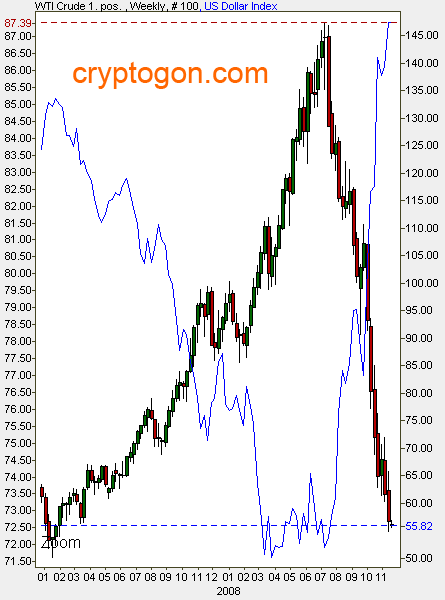
West Texas Intermediate Crude Oil vs. U.S. Dollar Index, weekly interval
Via: Financial Times:
Investors who placed summer bets that oil prices would fall below $100 a barrel are set to make huge profits on Monday, with some speculators reaping a return of more than 2,000 per cent in less than six months.
The expiry of the December put options – derivatives that give holders the right to sell at a predetermined price and date – means some investors will be selling oil at prices as high as $100-$120 a barrel, well above Friday’s close of $57.04 a barrel.
Traders warned the expiry was likely to trigger volatility in the oil market.
UK: Poachers Feed a Burgeoning Black Market in Food
November 17th, 2008Via: Independent:
Once, the poacher was a man with big pockets in his raincoat sneaking on to an aristocrat’s land to steal game for his family pot. Now he is likely to be part of a gang from town, in it for hard cash, rampaging through the countryside with guns, crossbows or snares.
Police in rural areas across Britain are reporting a dramatic increase in poaching, as the rise in food prices and the reality of recession increases the temptation to deal in stolen venison, salmon, or rarer meat and fish.
Organised and sometimes armed gangs of poachers are accused of behaving dangerously, intimidating residents, causing damage to crops or to gates and fences. Squads have also been out in the countryside “lamping”, poachers using lights to transfix animals.
There have even been reports of drive-by poachers, aiming guns through the open windows of moving vehicles to pick off deer or other game. Others go about their work more discreetly, knowing that in some parts of the countryside, if they are careful, their activities can pass unnoticed for weeks.
UK: Housing Market ‘Far Worse’ Than Figures Suggest
November 17th, 2008Via: Independent:
House prices across the UK have already fallen far further than official data and market indicators suggest, Rightmove, the online estate agent warned yesterday, as it revealed that up to 300 estate agents were quitting its service every month.
While the latest figures from leading mortgage lenders such as Halifax suggest that prices are down by 15 per cent from their peak, Rightmove said the falls were up to two-thirds higher.
Miles Shipside, the commercial director of Rightmove, said: “Estate agents tell us that the actual prices that are being achieved [initially between buyers and sellers] for property are down by about 20 to 25 per cent beneath peak asking prices. That has not come out in the national indices.”
His revelation suggests that house prices have not only fallen much further than the highly regarded surveys of Halifax and Nationwide, which both track house prices based on agreed mortgages, but could also be lagging behind the situation on the ground.
Nationwide’s latest survey said prices in October were down by 14.6 per cent on the same month last year, while the Halifax’s revealed they were 15 per cent lower in the same month.
Seema Shah, property economist at Capital Economics, said: “We are expecting a trough of 35 per cent down by the end of 2009.” Asked about house prices for next year, Mr Shipside said: “It hinges on unemployment and repossessions. If there are more repossessions then prices will drop further.”
U.S. Senator Jim Inhofe: “There Is No Way of Knowing,” Where Paulson Transferred Bailout Money
November 17th, 2008Via: Tulsa World:
U.S. Sen. Jim Inhofe said Saturday that Congress was not told the truth about the bailout of the nation’s financial system and should take back what is left of the $700 billion “blank check” it gave the Bush administration.
“It is just outrageous that the American people don’t know that Congress doesn’t know how much money he (Treasury Secretary Henry Paulson) has given away to anyone,” the Oklahoma Republican told the Tulsa World.
“It could be to his friends. It could be to anybody else. We don’t know. There is no way of knowing.”
More: Bailout Oversight Panel Empty





