California 7-Eleven Store Received Over 100 Applicants for Position That Pays $8.50 Per Hour
November 13th, 2008Grim.
Via: AP:
The odds of landing a part-time job at department store operator Bealls Outlet Stores Inc. this holiday season are slimmer than getting into Harvard: It’s one out of every 45.
Don’t think the chances are any better at 7-Eleven. One California store received more than 100 applicants in a week and a half for jobs that pay $8.50 per hour — and the retailer doesn’t even usually hire holiday workers.
From department stores and convenience chains to call centers, managers who only a year ago had to scramble to fill holiday jobs are seeing a surge in the number of seasoned applicants — many of them laid off in other sectors and desperate for a way to pay the bills.
The flood of jobseekers comes even as the retail industry drastically cuts back on holiday hiring because of the drop-off in consumer spending, and the applicants — who differ from the usual pool, teens or stay-at-home moms looking for extra spending money — reflect the nation’s fast-deteriorating job market.
“I thought it was going to be pretty easy, but I am not the only one looking for a job. There are thousands of us going for the same thing,” said Kimberly Caparo of Chesterfield, Mich., who has applied for part-time jobs at Toys “R” Us Inc., Home Depot Inc. and Lowe’s Cos. Inc. in recent weeks since she and her husband were laid off by American Axle & Manufacturing Holdings Inc.
At UPS Inc., which is just starting to ramp up its holiday hiring, as much as 30 percent of the seasonal hires in the Northeast are coming from the ranks of the recently laid off, said spokeswoman Ronna Charles Branch. In the past, she said, applicants for holiday jobs at the world’s biggest shipping carrier were largely students.
Jean Telfort, a 41-year-old Army veteran, has applied for dozens of part-time jobs, including at Macy’s and Nordstrom Inc., with no success. He needs money to help pay the rent and to pay down his $60,000 credit card bill, which includes his college tuition charges.
Research Credit: ottilie
Firms Scan Brain Waves to Improve Ads in Japan
November 13th, 2008Via: Physorg:
US research firm Nielsen and its partner NeuroFocus said Wednesday they would offer a new service in Japan to scan the brain waves of potential customers to help companies improve their marketing.
The service will review brain waves, eye movements and other physical features of potential customers to precisely study the impact of commercial messages or products, the two firms said.
Nielsen will collect the necessary data in Japan and the California-based NeuroFocus will use its teams of experts, including physicians, to examine the effects of the tested products or commercial messages, they said.
The service measures the attention level and emotional engagement of possible customers and the message’s retention level, they said.
Genetically Modified Maize Lowers Fertility in Mice
November 13th, 2008Via: Earth Times:
Feeding mice with genetically engineered maize developed by the US-based Monsanto corporation led to lower fertility and body weight, according to a study conducted by the University of Veterinary Medicine in Vienna presented Tuesday. In the study, mice fed with the NK603 x MON810 sweetcorn variety over a period of 20 weeks showed a smaller litter size and lighter offspring than mice fed with non-engineered maize.
The differences “were statistically significant in the third and fourth litters,” according to an abstract of the study led by Professor Juergen Zentek and commissioned by Austria’s Environment Ministry.
Although in an alternative set-up of the study the differences between the groups of mice were found to be less pronounced and statistically not significant, the environmental organization Global 2000 said this meant that further long-term tests were needed.
Austria has long resisted calls by the European Commission to allow the use of genetically modified food, but it finally had to lift its ban on MON810 maize as animal feed last year.
However, Austrian feed companies have so far agreed to a self- imposed ban on MON810.
The tested corn breed is a cross of MON810 and another variety and is designed to be resistant against herbicides and insects.
An expert panel of the European Food Safety Authority (EFSA) found in 2005 that the hybrid was “safe for human and animal health.”
Following the release of the study at a conference in Vienna, Global 2000 and Greenpeace criticized EFSA’s approval of the variety and called for a ban of genetically engineered maize.
“It is now vital to keep animal feed in Austria free of genetically engineered maize, and an immediate ban on the use of genetically engineered maize MON810 in Austria is the order of the day,” Global 2000 spokesman Jens Karp said.
Obama’s Bailout Bunch Brings Us More of the Same
November 13th, 2008Via: Bloomberg:
It’s hard to believe Barack Obama would even think of calling this change.
Take a good look at some of the 17 people our nation’s president-elect chose last week for his Transition Economic Advisory Board. And then try saying with a straight face that these are the leaders who should be advising him on how to navigate through the worst financial crisis in modern history.
First, there’s former Treasury Secretary Robert Rubin. Not only was he chairman of Citigroup Inc.’s executive committee when the bank pushed bogus analyst research, helped Enron Corp. cook its books, and got caught baking its own. He was a director from 2000 to 2006 at Ford Motor Co., which also committed accounting fouls and now is begging Uncle Sam for Citigroup- style bailout cash.
Two other Citigroup directors received spots on the Obama board: Xerox Corp. Chief Executive Officer Anne Mulcahy and Time Warner Inc. Chairman Richard Parsons. Xerox and Time Warner got pinched years ago by the Securities and Exchange Commission for accounting frauds that occurred while Mulcahy and Parsons held lesser executive posts at their respective companies.
Mulcahy and Parsons also once were directors at Fannie Mae when that company was breaking accounting rules. So was another member of Obama’s new economic board, former Commerce Secretary William Daley. He’s now a member of the executive committee at JPMorgan Chase & Co., which, like Citigroup, is among the nine large banks that just got $125 billion of Treasury’s bailout budget.
There’s More
Obama’s economic crew might as well be called the Bailout Bunch. Another slot went to former White House economic adviser Laura Tyson. She’s been a director for about a decade at Morgan Stanley, which in 2004 got slapped for accounting violations by the SEC and a month ago got $10 billion from Treasury.
That’s not all. There’s Penny Pritzker, the Obama campaign’s national finance chairwoman. She was on the board of the holding company for subprime lender Superior Bank FSB. The Chicago-area thrift, in which her family held a 50 percent stake, was seized by the Federal Deposit Insurance Corp. in 2001. The thrift’s owners agreed to pay the government $460 million over 15 years to help cover the FDIC’s losses.
Even some of the brighter lights on Obama’s board, like Warren Buffett and former SEC Chairman William Donaldson, come with asterisks. Buffett was on the audit committee of Coca-Cola Co.’s board when the SEC found the soft-drink maker had misled investors about its earnings. Donaldson was on the audit committee from 1998 to 2001 at a provider of free e-mail services called Mail.com Inc. Just before he left the SEC, in 2005, the agency disciplined the company over accounting violations that had occurred on his watch.
Telling Stories
So, by my tally, almost half the people on Obama’s economic advisory board have held fiduciary positions at companies that, to one degree or another, either fried their financial statements, helped send the world into an economic tailspin, or both. Do you think any of that came up in the vetting?
Let’s say we give Buffett a pass — smart move he made, skipping the group photo-op last week in Chicago. What about the rest of them? Donaldson, for one, was chairman when the SEC voted in 2004 to let the big Wall Street banks, including Lehman Brothers Holdings Inc. and Bear Stearns Cos., lever up their balance sheets like drunks. Talk about blowing it.
And whom did Obama tap for White House chief of staff? Rahm Emanuel, the Illinois congressman who was a director at Freddie Mac in 2000 and 2001 while it was committing accounting fraud.
Ideally, this job would go to someone who can’t be easily fooled. Think about it: Of all the people Obama could have chosen as his chief of staff, couldn’t he have found someone who wasn’t once on the board of Freddie Mac?
Renewed Confidence
The president-elect needs some new advisers — fast. We are in a crisis of confidence in American capitalism. These aren’t the right people to re-instill its sense of honor.
Many of them should be getting subpoenas as material witnesses right about now, not places in Obama’s inner circle. Did Obama learn nothing from the ill-fated choice of James Johnson, the former Fannie Mae boss, to lead his vice- presidential search committee?
Does he think people like Robert Rubin or Richard Parsons will offer any helpful advice on how to stop crooked bankers or sleep-walking directors from sinking our economy? Or that they won’t mistake the nation’s needs for their own corporate interests? Or that the people who helped get us into our long financial nightmare have any clue how to get us out?
Obama has created hope that our nation can stand for all that is good in the world again. It’s not too late to change course.
Start by scrapping this board.
Dow Jones Industrial Average Facing Make or Break Situation
November 13th, 2008WARNING: This is not a recommendation to buy, sell or hold any financial instrument.
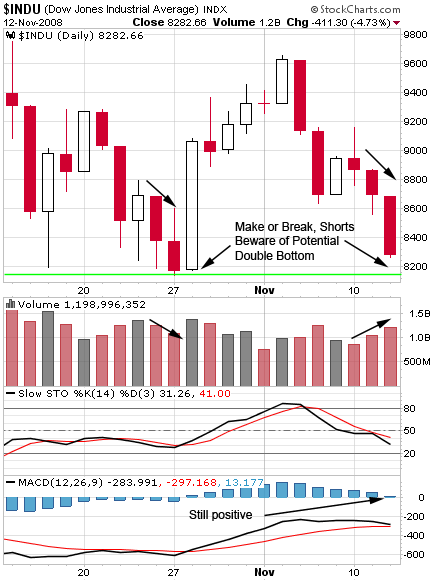
The Dow is facing a strategic price level at around 8200. Right up front, I want to state that I have no idea which way it’s going to break. What I can say, though, is that a violent move is probably coming, one way or the other.
I just bought some ridiculously risky November GM calls, strike 7s. Here’s my logic:
1. The news is universally grim.
2. Shorts are happier than pigs in slop.
3. There’s a potential double bottom dead ahead on the Dow.
Is Hank going to try to paint a double bottom on that Dow chart?
I don’t know, but if he does, it could touch off an astonishing short squeeze.
Hank says he’s all about buying equity positions in the banks now. If American Express can become a “bank” overnight to qualify for the lolly scramble, what other nonsense lies ahead?
If the Dow starts going up from here—that is, if Hank starts buying Dow futures—shorts will be gazing down the barrel of a double bottom and the Soviet Ministry of Glorious Free Markets and Plunge Protection.
Dow Jones Industrial Average, daily interval
Are there reasons to believe that 8200 will break to the downside.
Yes.
Obviously, the trend is down, but look at the volume.
Notice how the October low was put in on declining volume? One factor in trying to determine if you’re looking at a reversal or a continuation pattern is the volume; in general, increasing volume confirms the trend. If the trend is up, volume should be increasing. If the trend is down, volume should be increasing. If an asset is either rising or falling on declining volume, watch out, a reversal may be at hand. (See: Divergence.)
On the Dow, the signals are very blurry.
We have a potential double bottom ahead, but the volume has been increasing on the down days.
The thing to watch for today will be a bullish hammer. In other words, the Dow makes a new low, but then Hank and his Merry Plunge Protection Team force a positive finish—wait for it—near this 8200 level.
If They can paint a hammer on a double bottom, this would be a pants shitting development for the bears. I’m not saying that it’s going to happen, but keep an eye out for it just in case.
Below 8200 I’d expect to see massive program selling kick in.
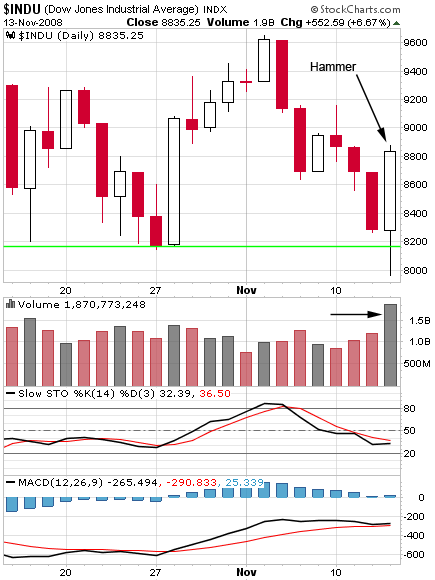
Update: The Hammer Is In
Welcome to Market Manipulation and Painting Candles with Hank Paulson.
He botched his signature at the end, however, with a gain of 6.67%. Nice effort though.
Dow Jones Industrial Average, daily interval
Of course, now, the question is: Will follow through occur?
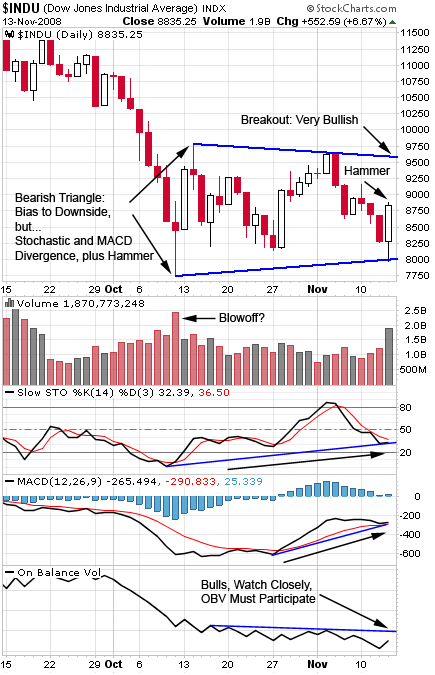
While the bigger picture shows a bearish triangle, MACD and stochastic divergence, coupled with yesterday’s hammer call the validity of the bearish triangle into question.
Dow Jones Industrial Average, daily interval
Contrarian swingers will look at taking on long positions during the next intraday pullback, with the stop being a break below the lower triangle line. I wouldn’t chase this if it keeps running. Wait for a pullback.
Take profit on declining volume at the upper triangle line, pare it, or let it ride long, depending on your appetite for risk. I would be very careful with any immediate shorts in the face of that hammer. Additionally, as we approach options expiration (November 21), the most crooked crooks (and the most cunning outsiders) stand to make the most money.
Bulls, watch your on balance volume. If any sustained nonsense crank rally is going to happen, OBV needs to participate, trending higher with the index. Moves higher, on decreasing volume or flattening OBV should be seen as potential shorting opportunities. If that happens near overhead resistance levels, watch out.
* phew * I need to go wash dirty nappies now.
NOW U.S. WON’T BUY TOXIC WASTE LOANS
November 12th, 2008I’m confused. Could this have something to do with “Bretton Woods 2” in a few days?
Via: Reuters:
U.S. Treasury Secretary Henry Paulson on Wednesday said he was backing away from buying troubled mortgage assets using a $700 billion bailout fund, instead favoring a second round of capital injections into financial institutions that would match private funds.
Paulson, in an update on the Treasury’s financial rescue efforts, said his staff has continued to examine the benefits of purchasing illiquid mortgage assets under the so-called Troubled Asset Relief Program.
“Our assessment at this time is that this is not the most effective way to use TARP funds, but we will continue to examine whether targeted forms of asset purchase can play a useful role, relative to other potential uses of TARP resources,” Paulson told a news conference.
When Treasury was selling the $700 billion bailout plan to Congress, it initially promoted it as a vehicle that would purchase illiquid mortgage assets from banks and other institutions to cushion potential losses.
But it became quickly apparent that setting up such purchases would take time, and Treasury opted for the faster method of injecting capital directly into banks by buying preferred stock. The Treasury has allocated $250 billion of the fund to such purchases so far.
Paulson said the Treasury is evaluating a second program that would provide government investments that would match private investments in capital raisings.
“In developing a potential matching program, we will also consider capital needs of non-bank financial institutions not eligible for the current capital program,” Paulson said.
He also said support was needed for the markets that securitize credit outside the banking system for products such as car loans, credit cards and student loans. The Treasury and Federal Reserve are exploring the development of a potential liquidity facility for highly rated AAA asset-backed securities.
“We are looking at ways to possibly use the TARP to encourage private investors to come back to this troubled market, by providing them access to federal financing while protecting the taxpayers’ investment,” Paulson said.
American Express Seeking Taxpayer Bailout
November 12th, 2008Don’t leave home without it.
Via: AP:
American Express Co. is seeking $3.5 billion in funds under the government’s plan to directly invest in financial firms, according to a Wednesday report in The Wall Street Journal citing unnamed sources.
Earlier this week, American Express received approval from the Federal Reserve to become a bank holding company, which is a similar structure to traditional commercial banks. The credit card company now has access to financing from the Fed and the ability to grow a large deposit base.
The increased funding opportunities through government programs, including the potential $3.5 billion investment, could be a huge boost to American Express as one of its primary sources of funding has nearly disappeared amid the ongoing credit crisis.
American Express relied on packaging pools of credit card debt and selling them to investors in the securitization market. As investors have shied away from purchasing all but the safest forms of debt, the market for credit card-backed securities has dwindled.
American Express is also facing a slowdown in the broader economy, which has led to more customers missing payments and cutting back on spending, hurting the company’s profitability.
“Families Hemorrhaging Into Homelessness”
November 12th, 2008Via: Reuters:
Families are flooding homeless shelters across the United States in numbers not seen for years, camping out in motels or staying with friends and relatives, homeless advocates say.
“There are lots of families hemorrhaging into homelessness and we need to figure out how to put a tourniquet on the hemorrhaging,” Philip Mangano, the homelessness czar appointed by President George W. Bush in 2002, told Reuters.
There is little time to waste. The U.S. unemployment rate is at a 14-year high and more job losses are forecast, while the Mortgage Bankers Association says nearly 1.5 million homes are in the process of foreclosure.
The U.S. Congress approved a massive housing market rescue bill in July that sets aside $3.9 billion that can be used partly by local authorities to buy foreclosed properties. Those could potentially house homeless families.
Mangano, whose official title is director of the Interagency Council on Homelessness, described the $3.9 billion as an “opening salvo” and said the new administration and Democratic-controlled Congress must be prepared to move quickly to invest more money to help homeless families and slow the flood of foreclosures.
Citigroup Freezes U.S. Home Repossessions
November 12th, 2008In other words, Citigroup doesn’t want to have to pay property taxes and HOA fees on any more properties that will just wind up being vandalized, looted or worse.
If you’re one of these upside buyers, be very careful when considering any offer that these bastards present to you. It may not feel like it, but you’ve actually got Citigroup over the barrel now.
Look at this:
Citi said it was imposing a moratorium on foreclosures for all clients willing to work “in good faith” to restructure mortgages, as long as they have sufficient income to make payments of some sort.
For Citigroup, whatever bum change you can come up with is better than the alternative. Whatever you do, think strategically.
Via: Guardian:
The US bank Citigroup is halting repossessions for most of its struggling mortgage borrowers in response to pressure for a softer approach in tackling the vast American sub-prime loans crisis.
Citi said it was imposing a moratorium on foreclosures for all clients willing to work “in good faith” to restructure mortgages, as long as they have sufficient income to make payments of some sort.
The initiative came amid fresh signs of the turmoil gripping the financial sector. Late on Monday, the credit card company American Express revealed it was turning itself into a bank, which makes it eligible for aid under the US government’s $700bn (£444bn) bail-out fund. American Express has struggled with a surge in bad debts on customers’ cards. The 158-year-old firm said offering high-street bank accounts would “build a larger deposit base to broaden our funding sources”.
Political momentum has been gathering for aid to homeowners to help “main street” alongside the US treasury’s rescue of Wall Street banks.
Citi, which is getting a $25bn equity investment from the US government, has written off more than $70bn of losses on mortgages and delinquent derivatives, making it one of the worst-hit surviving institutions. In addition to freezing foreclosures, the financial services group is launching a programme to pre-empt problems with some 500,000 loan customers who are not yet behind on payments but who may need help.
“We will pre-emptively reach out to help homeowners before they become delinquent, which is critical to avoiding the loss of a home and protecting their credit score and future borrowing potential,” said Sanjiv Das, chief executive of Citi’s mortgage arm.
The Mortgage Bankers’ Association recently revealed 4 million US borrowers are at least one payment behind on their loans, with 500,000 in the process of losing their property. America’s two government-sponsored mortgage aggregators, Fannie Mae and Freddie Mac, are close to announcing a far broader initiative to keep families in their properties, in an extension of a programme — Hope Now — to slow the rate of repossessions. It is backed by the Bush administration.
But experts say a halt on foreclosures is far from a panacea. Barry Zigas, director of housing policy at the Consumer Federation of America, said: “A moratorium on foreclosure will be effective at stopping foreclosure, it won’t be effective at stopping the underlying reasons of why people are in trouble.”
Flawed AVG Antivirus Update Cripples Windows XP PCs
November 12th, 2008Via: Tech World:
A flawed signature update to AVG Technologies’ antivirus software over the weekend crippled some Windows XP PCs by mistakenly deleting a critical system file, the company has confirmed.
According to messages on AVG’s support forums and its own support site, an update released late Saturday for the company’s security software fingered the “user32.dll” file as a Trojan horse. As per the program’s settings, the AVG software, including the newest version 8.0 and its predecessor 7.5, shut the .dll away in quarantine. The result: A crippled computer.
The problem only affects users of the Dutch, French, Italian, Portuguese, and Spanish language versions of Windows XP.
“If you have chosen ‘heal’ or ‘quarantine,’ your PC will no longer restart,” said a panicked user named “pa3bar” in a message Sunday. “It shows a blue screen at start up and tells you it cannot find winsvr, error c0000135. System recovery has no effect.”
The problem only affects users of the Dutch, French, Italian, Portuguese, and Spanish language versions of Windows XP, according to the company. English versions of AVG are not affected.
AVG, best known for its free Antivirus, confirmed the error in a FAQ on its support site. “In case you are not able to run your Windows XP operating system after AVG 8.0 virus definition update, it may be caused by a false positive on a specific ‘user32.dll’ system file,” the company said. “The file was moved to the AVG Virus Vault and deleted. Therefore it is not possible to start Windows.”
Although some systems refused to boot, others rebooted endlessly instead.
On its support site, AVG posted instructions for affected users that involved running Windows XP’s Recovery Console, disabling several AVG services and restoring the user32.dll file by copying it from the operating system’s install CD. For users unable to locate their installation disc, AVG offered a utility that fixed the problem; those users also needed to create a bootable CD or USB drive.
The utility work-around was for AVG Antivirus 8.0 only; a similar utility for AVG Antivirus 7.5 will be available “soon,” according to a message posted by a support forum moderator Tuesday.




