U.S Foreclosure Filings Up 71 Percent in Third Quarter
October 23rd, 2008Via: AP:
The number of homeowners ensnared in the foreclosure crisis grew by more than 70 percent in the third quarter of this year compared with the same period in 2007, according to data released Thursday.
Nationwide, nearly 766,000 homes received at least one foreclosure-related notice from July through September, up 71 percent from a year earlier, said foreclosure listing service RealtyTrac Inc.
By the end of the year, RealtyTrac expects more than a million bank-owned properties to have piled up on the market, representing around a third of all properties for sale in the U.S.
That’s bad news for anyone who lives nearby and wants to sell their home. While foreclosure sales are booming in many areas, those properties are commanding deep discounts and pulling down neighboring property values. “It has a pretty significant impact in terms of pricing,” said Rick Sharga, RealtyTrac’s vice president for marketing.
RealtyTrac monitors default notices, auction sale notices and bank repossessions. More than 250,000 properties were repossessed by lenders nationwide in the third quarter, 81,000 of which were taken back last month.
Six states — California, Florida, Arizona, Ohio, Michigan and Nevada — accounted for more than 60 percent of all foreclosure activity in the quarter, with California alone making up more than a quarter of all U.S. foreclosure filings.
Detroit and Atlanta were the only cities outside California, Florida, Nevada and Arizona to make RealtyTrac’s list of the 20 hardest-hit metropolitan areas.
The combination of sinking home values, tighter mortgage lending criteria and an economy that many economists think has already slipped into recession has left hundreds of thousands of homeowners with few options. Many can’t find buyers or owe more than their home is worth and can’t refinance into an affordable loan, with the global credit crisis making loans far less available.
Have You Checked the Prices of Technocrack Lately?
October 23rd, 2008My six-year-old Dell Inspiron 4150 laptop is experiencing some sort of heat management issue. The fan is running fast most of the time now. I’ve fooled around with all the settings, trying to underclock the CPU, etc. No luck. There are no rogue processes to blame either. Additionally, the graphics card is sometimes failing to sync resolution with my external display. The problems started when a lightning ground strike blew up the modem on the system. (I personally know three other people in the area who also have blown modems from that same storm.) How my laptop was running at all after that is a mystery to me. I need to have the modem for backup, so…
With my laptop dying a slow death and with the NZ$ crashing, I figured that computers weren’t going to get any cheaper in the near term. I went looking for a replacement. I was initially going to get a Mac, but in New Zealand, they’re absurdly overpriced. The hardware specs on the Mac Mini, for the price, are a joke. I know, they’re expensive, no matter what, but in NZ, it’s funny farm pricing. So, no Mac.
I went to Dell New Zealand and was shocked by what was available for the money!
I wound up buying a tower with:
Intel Core 2 Quad Processor 2.66GHz
3GB RAM
500GB hard drive
256MB PCIe ATI Radeon video card
CD/DVD burner
Windows XP Pro (Dell did the “downgrade” from Vista at the factory so I don’t have to see Vista at all.)
The price (delivered) was NZ$1,104 or US$652. It was actually a much better deal to take their display, but I already have a flat panel that I’m happy with, so I had them reprice it for the box alone.
Since I’ve been using computers (almost 30 years), I think that six years is the longest period of time that I’ve gone without changing systems, so I decided to let it rip this time. The difference in price between that overpowered beast that I bought and the lowest end models was a couple of hundred dollars. Comparing the hardware, it seemed silly to go for a lower end option.
Now, if I can just train that thing to go outside, pull weeds, dig garden beds, collect manure, milk the cow, fix the fence, wash Owen’s nappies… Hmm.
Bill Gates Funds Research Into ‘Flying Syringe’ Mosquitoes to Deliver Vaccines
October 23rd, 2008Madness.
Via: AFP:
The Bill and Melinda Gates Foundation awarded 100,000 dollars each on Wednesday to scientists in 22 countries including funding for a Japanese proposal to turn mosquitos into “flying syringes” delivering vaccines.
The charitable foundation created by the founder of software giant Microsoft said in a statement that the grants were designed to “explore bold and largely unproven ways to improve global health.”
The grants were awarded for research into preventing or curing infectious diseases such as HIV/AIDS and tuberculosis and limiting the emergence of drug resistance.
They are the first round of funding for the Gates Foundation’s “Grand Challenges Explorations,” a five-year 100-million-dollar initiative to “promote innovative ideas in global health.”
The funding was directed to projects that “fall outside current scientific paradigms and could lead to significant advances if successful,” the Gates Foundation statement said.
“We were hoping this program would level the playing field so anyone with a transformational idea could more quickly assess its potential for the benefit of global health,” said Tachi Yamada, president of global health at the Gates Foundation.
The Gates Foundation said 104 grants were awarded from nearly 4,000 proposals. The recipients included universities, nonprofit organizations, government agencies, and six private companies.
“It was so hard for reviewers to champion just one great idea that we selected almost twice as many projects for funding as we had initially planned,” Yamada said.
Among the proposals receiving funding was one from Hiroyuki Matsuoka at Jichi Medical University in Japan.
“(Matsuoka) thinks it may be possible to turn mosquitoes that normally transmit disease into ‘flying syringes,’ so that when they bite humans they deliver vaccines,” the Gates Foundation said.
It said Pattamaporn Kittayapong at Mahidol University in Thailand received a grant to “explore new approaches for controlling dengue fever by studying bacteria with natural abilities to limit the disease.”
Founded in 1994, the Seattle, Washington-based Gates Foundation is the largest private philanthropical organization in the world.
Research Credit: AV
Organic Farming ‘Could Feed Africa’
October 22nd, 2008Via: Independent:
Organic farming offers Africa the best chance of breaking the cycle of poverty and malnutrition it has been locked in for decades, according to a major study from the United Nations to be presented today.
New evidence suggests that organic practices – derided by some as a Western lifestyle fad – are delivering sharp increases in yields, improvements in the soil and a boost in the income of Africa’s small farmers who remain among the poorest people on earth. The head of the UN’s Environment Programme, Achim Steiner, said the report “indicates that the potential contribution of organic farming to feeding the world maybe far higher than many had supposed”.
The “green revolution” in agriculture in the 1960s – when the production of food caught and surpassed the needs of the global population for the first time – largely bypassed Africa. Whereas each person today has 25 per cent more food on average than they did in 1960, in Africa they have 10 per cent less.
A combination of increasing population, decreasing rainfall and soil fertility and a surge in food prices has left Africa uniquely vulnerable to famine. Climate change is expected to make a bad situation worse by increasing the frequency of droughts and floods.
It has been conventional wisdom among African governments that modern, mechanised agriculture was needed to close the gap but efforts in this direction have had little impact on food poverty and done nothing to create a sustainable approach. Now, the global food crisis has led to renewed calls for a massive modernisation of agriculture on the hungriest continent on the planet, with calls to push ahead with genetically modified crops and large industrial farms to avoid potentially disastrous starvation.
Last month the UK’s former chief scientist Sir David King said anti-scientific attitudes among Western NGOs and the UN were responsible for holding back a much-needed green revolution in Africa. “The problem is that the Western world’s move toward organic farming – a lifestyle choice for a community with surplus food – and against agricultural technology in general and GM in particular, has been adopted across the whole of Africa, with the exception of South Africa, with devastating consequences,” he said.
The research conducted by the UN Environment Programme suggests that organic, small-scale farming can deliver the increased yields which were thought to be the preserve of industrial farming, without the environmental and social damage which that form of agriculture brings with it.
An analysis of 114 projects in 24 African countries found that yields had more than doubled where organic, or near-organic practices had been used. That increase in yield jumped to 128 per cent in east Africa.
“Organic farming can often lead to polarised views,” said Mr Steiner, a former economist. “With some viewing it as a saviour and others as a niche product or something of a luxury… this report suggests it could make a serious contribution to tackling poverty and food insecurity.”
The study found that organic practices outperformed traditional methods and chemical-intensive conventional farming. It also found strong environmental benefits such as improved soil fertility, better retention of water and resistance to drought. And the research highlighted the role that learning organic practices could have in improving local education. Backers of GM foods insist that a technological fix is needed to feed the world. But this form of agriculture requires cash to buy the patented seeds and herbicides – both at record high prices currently – needed to grow GM crops.
Regional farming experts have long called for “good farming”, rather than exclusively GM or organic. Better seeds, crop rotation, irrigation and access to markets all help farmers. Organic certification in countries such as the UK and Australia still presents an insurmountable barrier to most African exporters, the report points out. It calls for greater access to markets so farmers can get the best prices for their products.
Kenyan farmer: ‘I wanted to see how UK did it’
Henry Murage had to travel a long way to solve problems trying to farm a smallholding on the western slopes of Mount Kenya. He spent five months in the UK, studying with the experts at Garden Organic a charity in the Midlands. “I wanted to see how it was being done in the UK and was convinced we could do some of the same things here,” he says.
On his return 10 years ago, he set up the Mt Kenya Organic Farm, aimed at aiding other small farmers fighting the semi-arid conditions. He believes organic soil management can help retain moisture and protect against crop failure. The true test came during the devastating drought of2000-02, when Mr Murage’s vegetable gardens fared better than his neighbours’. At least 300 farmers have visited his gardens and taken up at least one of the practices he espouses. “Organic can feed the people in rural areas,” he says. “It’s sustainable and what we produce now we can go on producing.”
Saving money on fertilisers and pesticides helps farmers afford better seeds, and composting and crop rotation are improving the soil. Traditional maize, beans and livestock farming in the area have been supplemented with new crops from borage seeds to cayenne peppers and honey, with buyers from the US to Europe. Now he is growing camomile for herbal tea, with buyers from the UK and Germany both interested.
Research Credit: RB
Dollar Hits 2-Year High
October 22nd, 2008WARNING: This is not a recommendation to buy, sell or hold any financial instrument.
This last leg up on the dollar prompted a couple of emails.
Who? What? How? Am I holding US$ now? Etc. etc.
Please recall, U.S. Dollar Index: Bears, the Squeeze Is On, from August. Remember this chart?
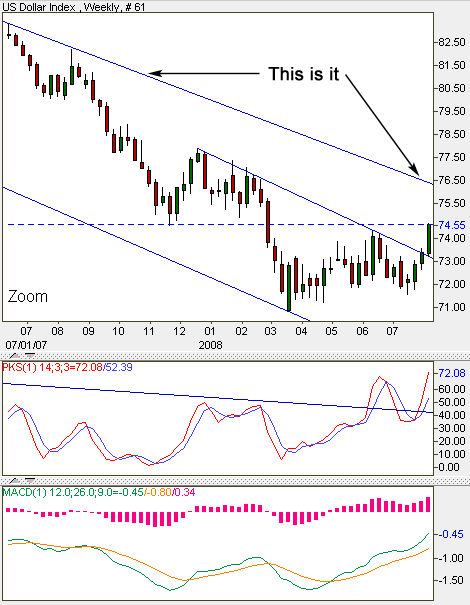
Old U.S. Dollar Index, Weekly Interval Chart from Previous Post
What part of “This is it” didn’t you understand?
The beauty of diversification is not having to sweat it. And yes, when that upper channel line was taken out, I started accumulating US$ again, just like I said I’d do, and spending down our NZ$.
If you know how to trade options, you might consider some deep out of the money calls on GLD, November expiration, 105 strike, or so. You know, just in case a black swan shits on this dollar rally. I’m starting to see quotes from traders in the financial press saying things like, the dollar rise can’t be stopped. Mmm hmm.
Look at that dollar index today. Do you think that there’s any rational explanation for what’s happening right now? I know, I know. It’s related to the ongoing stock market crash and unwinding carry-trades. People are holding US$ instead of equities and higher yielding currencies. But is that rational behavior, knowing what we know about the dollar? This is why, in a matter of seconds, I can ditch my long dollar position, reverse it short, and/or buy some other flim flam slop (Swiss Franc, for example) that’s moving the other way. For now, the dollar is a “safe-haven” currency. HA! The Reuters story below says so!
That said, I haven’t sold a single gram of gold. In fact, I’ve been buying tiny amounts with each gap down as my US$ increases in value. Again, I buy and hold the real stuff as a strategic hedge against our cash positions.
Throughout all of this chaos, the net effect on our savings has been, * meh *. No big deal. As the NZ$ sold off sharply in recent weeks, gold in NZ$ climbed to an all time high. So, while some Kiwis and other investors in NZ$ fumbled over each other running for the exits, Becky and I kicked back, knowing that the net effect on us was * pfft *.
Many eggs, many baskets.
Via: Reuters:
The dollar jumped to a two-year high against a basket of currencies on Wednesday as investors bet that interest rates outside the United States will be cut sharply to try to bolster global growth.
Concerns there may be a deep slowdown in the world economy prompted investors to liquidate more bets against the dollar built up in recent years, which at one point this year sent the euro to a record high above $1.60, traders said.
The yen also climbed to a four-year high against the euro as investors further unwound risky carry trades that had been a worldwide fad since the early 2000s.
Traders said investors, from Japanese life insurance firms to hedge funds, were dumping riskier assets in thin trade, bolstering safe-haven currencies like the U.S. dollar and yen. Some said the euro’s recent slide against the dollar and yen also likely reflected fund repatriation by U.S. and Japanese investors.
“The pattern among investors has been toward avoiding risk,” said Kimihiko Tomita, head of foreign exchange for State Street Global Markets in Tokyo. “Repatriation is a main driver of the market now,” he said.
Thin volumes exaggerated the moves, with bid/ask spreads unusually wide. Even speculators were reluctant to step into the market, adding to the volatility, traders said.
Selling of the dollar and the yen to fund investment in the euro and other higher-yielding currencies and assets — different forms of carry trades — was most beneficial to investors when the global economy grew steadily and emerging markets boomed.
But all that has changed now, traders said.
“People are shifting from high leverage to low leverage and to cash, and this shift is expected to continue,” said Satoshi Okagawa, head of FX forwards trading group at Sumitomo Mitsui Banking Corp.
Mutant Seeds for Mesopotamia
October 22nd, 2008Via: Uruknet:
One would think that Iraqi farmers, now prospering under “freedom” and “democracy,” would be able to plant the seeds of their choosing, but that choice, under little-known Order 81, would be illegal.
…
What makes this Order 81 even more outrageous is that Iraqi farmers have been saving wheat and barley seeds since at least 4000 BC, when irrigated agriculture first emerged, and probably even to about 8000 BC, when wheat was first domesticated. Mesopotamia’s farmers have now been trumped by white-smocked, corporate bio-engineers from Florida who strive to replace hundreds of natural varieties with a handful of genetically scrambled hybrids.
Where does such hubris come from? It comes from the entire mission surrounding the invasion of Iraq, which, upon closer inspection, had been planned years in advance by a faction of “neo-cons” who adopted Leon Trotsky’s glorification of the state, his theory “permanent revolution,” and his goal of exporting revolution worldwide. The neo-con revolution aims to alter the economic, political and cultural foundations of nations on the other side of the planet (rejecting old-fashioned notions of self-determination, popular sovereignty and even the nation-state system). This mission includes the transformation of agriculture and the establishment of “food control” over local populations.
Order 81 fits into this revolutionary program, and it is quite diabolical upon closer inspection. First, it forces Iraq’s commercial farmers to use registered terminator seeds (the “protected variety”). Then it defines natural seeds as illegal (the “infringing variety”), in a classic Orwellian turn of language.
This is so incredible that it must be re-stated: the exotic genetically scrambled seeds are the “protected variety” and the indigenous seeds are the “infringing variety.”
As Jeffrey Smith explains, author of Order 81: Re-Engineering Iraqi Agriculture:
“To qualify for PVP [Plant Variety Protection], seeds have to meet the following criteria: they must be ‘new, distinct, uniform and stable’… it is impossible for the seeds developed by the people of Iraq to meet these criteria. Their seeds are not ‘new’ as they are the product of millennia of development. Nor are they ‘distinct’. The free exchange of seeds practiced for centuries ensures that characteristics are spread and shared across local varieties. And they are the opposite of ‘uniform’ and ‘stable’ by the very nature of their biodiversity.” (3)
Order 81 comes with the Orwellian title of “Plant Variety Protection.” Any self-respecting scientist knows, however, that imposing biological standardization accomplishes the exact opposite: It reduces biodiversity and threatens species. So Order 81 comes with an Orwellian title and consists of Orwellian provisions.
Jeffrey Smith peels away the layers of mischief behind Order 81, finding it nonsensical that six varieties of wheat have been developed for Iraq:
“Three will be used for farmers to grow wheat that is made into pasta; three seed strains will be for ‘breadmaking.’
Pasta? According to the 2001 World Food Programme report on Iraq, ‘Dietary habits and preferences included consumption of large quantities and varieties of meat, as well as chicken, pulses, grains, vegetables, fruits and dairy products.’ No mention of lasagna. Likewise, a quick check of the Middle Eastern cookbook on my kitchen shelves, while not exclusively Iraqi, reveals a grand total of no pasta dishes listed within it.
There can be only two reasons why 50 per cent of the grains being developed are for pasta. One, the US intends to have so many American soldiers and businessmen in Iraq that it is orienting the country’s agriculture around feeding not ‘Starving Iraqis’ but ‘Overfed Americans’. Or, and more likely, because the food was never meant to be eaten inside Iraq at all…”
Just in case Iraqi farmer can’t read, Order 81 enforces the new monopoly on seeds with the jackboot. Order 81 makes this clear in its own text, buried at the bottom of the document, as is most screw-you fine print:
“The court may order the confiscation of the infringing variety as well as the materials and tools substantially used in the infringement of the protected variety. The court may also decide to destroy the infringing variety as well as the materials and tools or to dispose of them in any noncommercial purpose.”
Order 81 is about power and profit, but it disguises itself as humanitarian legislation.
Research Credit: EB
Cryptogon Reader Sent $50
October 22nd, 2008An anonymous reader sent $50 via the Amazon Honor System. Thank you.
U.S. Policymakers Mull Creation of Domestic Intelligence Agency
October 22nd, 2008Via: CNN:
The United Kingdom has MI-5, which roots out spies and terrorists in the British Isles.
Canada has CSIS — the Canadian Security Intelligence Service.
Now Congress is asking: Should the U.S. have its own domestic intelligence agency?
On Monday, at the request of Congress, the RAND Corporation outlined the pros and cons of establishing a domestic intelligence agency. It also discussed different ways to organize a new entity, either as part of an existing department or as a new agency.
Muslim Fanatic Prisoners to be ‘De-Programmed’ Using Controversial Techniques to ‘Cure’ Them of Beliefs
October 21st, 2008Via: This Is London:
Psychologists in the Prison Service will try to ‘cure’ extremist Muslim inmates of their political beliefs with controversial therapies similar to those used to ‘de-programme’ members of religious cults.
The experimental treatments are being developed by a special Extremism Unit set up by the Ministry of Justice in January last year, The Mail on Sunday has discovered.
Sources say the therapy forms part of a wide-ranging strategy to combat Islamic extremism in Britain’s jails.
Research Credit: DrFrost501
Colin Powell: “There’s going to be a crisis come along on the 21st or 22nd of January that we don’t even know about right now.”
October 21st, 2008What do you make of this one?
Additionally, Joe Biden mentioned a “generated crisis”:
“Mark my words,” the Democratic vice presidential nominee warned at the second of his two Seattle fundraisers Sunday. “It will not be six months before the world tests Barack Obama like they did John Kennedy. The world is looking. We’re about to elect a brilliant 47-year-old senator president of the United States of America. Remember I said it standing here if you don’t remember anything else I said. Watch, we’re gonna have an international crisis, a generated crisis, to test the mettle of this guy.”
“I can give you at least four or five scenarios from where it might originate,” Biden said to Emerald City supporters, mentioning the Middle East and Russia as possibilities. “And he’s gonna need help. And the kind of help he’s gonna need is, he’s gonna need you – not financially to help him – we’re gonna need you to use your influence, your influence within the community, to stand with him. Because it’s not gonna be apparent initially, it’s not gonna be apparent that we’re right.”




