Israeli Army Blindfolds, Handcuffs Palestinian Man, Stands Him Up and Shoots Him in the Leg with a Rubber Bullet at Point Blank Range
July 21st, 2008Via: Youtube:
China’s Expansion Into Africa
July 20th, 2008I wasn’t aware of the extent of China’s interest in Africa. I thought it was much more piecemeal. Their grand strategy makes perfect sense, given the dire problems China is facing.
There are some howlers in this article, though, such as, “Despite Britain’s commendable colonial legacy of a network of roads, railways and schools, the British are now being shunned.” HAHA! Even so, the piece is worth reading.
Via: This Is London:
Likened to one race deciding to adopt a new home on another planet, Beijing has launched its so-called ‘One China In Africa’ policy because of crippling pressure on its own natural resources in a country where the population has almost trebled from 500 million to 1.3 billion in 50 years.
China is hungry – for land, food and energy. While accounting for a fifth of the world’s population, its oil consumption has risen 35-fold in the past decade and Africa is now providing a third of it; imports of steel, copper and aluminium have also shot up, with Beijing devouring 80 per cent of world supplies.
Enlarge President Robert Mugabe leaving the eleventh ordinary session of the assembly of the African Union heads of State and government in Sharm el-Sheikh, Egypt
Fuelling its own boom at home, China is also desperate for new markets to sell goods. And Africa, with non-existent health and safety rules to protect against shoddy and dangerous goods, is the perfect destination.
The result of China’s demand for raw materials and its sales of products to Africa is that turnover in trade between Africa and China has risen from £5million annually a decade ago to £6billion today.
However, there is a lethal price to pay. There is a sinister aspect to this invasion. Chinese-made war planes roar through the African sky, bombing opponents. Chinese-made assault rifles and grenades are being used to fuel countless murderous civil wars, often over the materials the Chinese are desperate to buy.
Take, for example, Zimbabwe. Recently, a giant container ship from China was due to deliver its cargo of three million rounds of AK-47 ammunition, 3,000 rocket-propelled grenades and 1,500 mortars to President Robert Mugabe’s regime.
After an international outcry, the vessel, the An Yue Jiang, was forced to return to China, despite Beijing’s insistence that the arms consignment was a ‘normal commercial deal’.
Indeed, the 77-ton arms shipment would have been small beer – a fraction of China’s help to Mugabe. He already has high-tech, Chinese-built helicopter gunships and fighter jets to use against his people.
Ever since the U.S. and Britain imposed sanctions in 2003, Mugabe has courted the Chinese, offering mining concessions for arms and currency.
While flying regularly to Beijing as a high-ranking guest, the 84-year-old dictator rants at ‘small dots’ such as Britain and America.
He can afford to. Mugabe is orchestrating his campaign of terror from a 25-bedroom, pagoda-style mansion built by the Chinese. Much of his estimated £1billion fortune is believed to have been siphoned off from Chinese ‘loans’.
The imposing grey building of ZANU-PF, his ruling party, was paid for and built by the Chinese. Mugabe received £200 million last year alone from China, enabling him to buy loyalty from the army.
In another disturbing illustration of the warm relations between China and the ageing dictator, a platoon of the China People’s Liberation Army has been out on the streets of Mutare, a city near the border with Mozambique, which voted against the president in the recent, disputed election.
Almost 30 years ago, Britain pulled out of Zimbabwe – as it had done already out of the rest of Africa, in the wake of Harold Macmillan’s ‘wind of change’ speech. Today, Mugabe says: ‘We have turned East, where the sun rises, and given our backs to the West, where the sun sets.’
Maryland Police Infiltrated Activist Groups, Turned Over Information to Feds, Listed Citizens in Database as Committing Anti-War and Anti-Government Terrorism
July 20th, 2008Most of what is commonly referred to as “political activism” is viewed by the corporate state’s counterinsurgency apparatus as a useful and necessary component of political control.
Political activism amounts to an utterly useless waste of time, in terms of tangible power, which is all the American Corporate State understands. Political activism is a cruel guise that is sold to people who are dissatisfied, but who have no concept of the nature of tangible power. Counterinsurgency teams routinely monitor these activities, attend the meetings, join the groups and take on leadership roles in the organizations.
The Prius driving sign wavers, with Fair Trade shoes and subscriptions to The Nation have some very hard lessons ahead.
Via: Current:
Undercover Maryland state troopers infiltrated three groups advocating peace and protesting the death penalty — attending meetings and sending reports on their activities to U.S. intelligence and military agencies, according to documents released Thursday.
The documents show the activities occurred from at least March 2005 to May 2006 and that officers used false names, which the documents referred to as “covert identities” – to open e-mail accounts to receive messages from the groups.
Also included in the 46 pages of documents, obtained by the Maryland chapter of the American Civil Liberties Union through a Freedom of Information Act lawsuit, is an account of an activist’s name being entered into a federally funded database designed to share information among state, local and federal law-enforcement agencies on terrorist and drug trafficking suspects.
ACLU attorney David Rocah said state police violated federal laws prohibiting departments that receive federal funds from maintaining databases with information about political activities and affiliations.
The activist was identified as Max Obuszewski. His “primary crime” was entered into the database as “terrorism – anti govern(ment).” His “secondary crime” was listed as “terrorism – anti-war protestors.” The database is known as the Washington-Baltimore High Intensity Drug Trafficking Area, or HIDTA.
“This is not supposed to happen in America,” said Mr. Rocah. “In a free society, which relies on the engagement of citizens in debate and protest and political activity to maintain that freedom … you should be able to attend a meeting about an issue you care about without having to worry that government spies are entering your name into a database used to track alleged terrorists and drug traffickers.”
Mr. Rocah called the surveillance “Kafka-esque insanity.”
…
Documents released by the prosecution revealed that the protesters had been under surveillance by an entity called the Baltimore Intelligence Unit.
The Maryland ACLU sued last month, claiming the state police refused to release public documents about the surveillance of peace activists.
The documents, which include intelligence reports and printouts from the database, show that several undercover officers from the state police’s Homeland Security and Intelligence Division attended meetings of three groups: Mr. Obuszewski’s group; the Coalition to End the Death Penalty; and the Committee to Save Vernon Evans, a convicted murderer who was slated for execution.
The documents show at least 288 hours of surveillance over the 14-month period. The undercover officers attended at least 20 organizing meetings at community halls and churches and a dozen rallies against the death penalty, including several at the state’s SuperMax jail in Baltimore.
Included in the documents are references to a proposed sit-in at the offices of Baltimore County State’s Attorney SandraA. O’Connor. However, they show no trooper reports of violence or threats of violence. Organizers repeatedly stressed the importance of peaceful and orderly demonstrations, the documents show.
It’s Unanimous: Banks Have Bottomed! (Not)
July 20th, 2008Via: The Big Picture:
Very strange confluence of media coverage this morning on the banking sector. All three major financial papers (WSJ, NYT, Barron’s) have stories on the bottom of the banking sector:
WSJ: Jitters Ease as Citi, Rivals Show Signs of Bottoming Out
NYT: Hope, and Hints, That Financial Stocks Have Finally Touched Bottom
Barron’s: Buy Banks -Selectively (cover story)
Can you recall the last time 3 major media players all picked the bottom in a market or sector on the exact same day — and were all proven correct?
…
A long time ago, Banks were 3-6-3 spread players. Pay your depositors 3%, make loans at 6%, be on the golf course at 3pm. But the end of Glass Steagell, and the mergers with investment banks, have put an end to that simple but profitible business. For the past 10 years or so, we seen a model that involved taking on a lot of risk, then leveraging it up 25X, 35X, even 65X (for Fannie).
Now that model has come unglued. Banks of all types are unwinding risk, de-leveraging (selling off assets held on borrowed money) and raising capital. This means that until a new model is developed, profits will be anemic and the shareholder capital structure is about to get wildly diluted.
Bad_but_better Freddie Mac (FRE), with its $6B cap, is seeking to raise $10B. That will be enormously dilutive to both future earnings, and shareholder equity. Remember that Lehman Brothers (LEH) capital raise? $6 Billion secondary priced at $28 with 8.75% coupon and an %18 conversion premium? The stock is now $19m, the cap is $13.3B. After the last debacle, good luck with future capital raises — they are likely to be treated much more skeptically.
Is “the” bottom in?
Well, it certainly looks like “a” bottom is in.
But longer term, this is a sector that is likely to have continued write downs, weak earnings prospects, and a whole lot more regulation and government supervision than it got away with in the past. P/E compression may also be in the cards — especially if we see some dividend cuts from some of the bigger houses.
Unless you have a decade long time horizon, does that make you want to rush out and own these things anytime soon? Me neither . . .
Concern Mounts About FDIC Deposit Fund; Roubini Says, “They’re Going to Run Out of Money, with Certainty”
July 20th, 2008Via: RTT News:
The FDIC is looking for ways to shore up its depleted deposit fund, including charging higher premiums on riskier brokered deposits, FDIC Chairman Sheila Bair said Friday.
However, that fund is “a myth,” according to longtime banking consultant Bert Ely, and consumers may end up paying the price of what is expected to be a growing wave of bank failures.
NYU Economics Professor Nouriel Roubini predicts that Congress will have to intervene in order to bail out the deposit fund.
“They’re going to run out of money, with certainty,” he predicted. “Congress is going to have to recapitalize the FDIC, those $50 billion plus is not going to be enough, by no means.”
Indeed, on Friday afternoon FDIC Chairman Sheila Bair said in an interview on C-SPAN television that banks holding brokered deposits may be charged higher premiums in order to bring back the reserve to an acceptable size.
“I think that is something we need to factor into our premiums and charge higher premiums to banks that fit that profile,” she said in the interview, noting that the IndyMac failure was a big factor in the need for additional funds in the deposit insurance fund.
This means higher premiums for FDIC insured banks, analyst Ely noted, further complicating an already tenuous situation for the U.S. banking system. Banks will most likely pass the increased costs onto their customers, he said.
“Banks are going to pass it through to their customers through higher interest rates on loans, lower interest on deposit,” Ely predicted.
The FDIC has around $53 billion set aside to back up bank deposits up to $100,000 per depositor, one of the ways the organization is designed to ensure confidence in the banking industry. However, according to Ely, that $53 billion is “not really available.”
“The deposit insurance fund is as real as the social security trust fund,” Ely said, noting that only a “small fraction” of the $53 billion is actually available and “any losses beyond that will be assessed on the banks.”
The reserve, as of March 31, was valued at $52.843 billion, or 1.19 percent of the total insured deposits of $4.431 trillion. According to the Deposit Insurance Reform Act, the FDIC must have at minimum 1.15 percent of all insured deposits in the fund, with a target rate of 1.25 percent.
The failure of IndyMac, which is estimated to cost the deposit fund at minimum $4 billion, brings the target below 1.15 percent, forcing the FDIC to adopt a restoration plan that will restore the Deposit fund to 1.15 percent within 5 years, according to the Reform Act.
“The $4 billion loss would drop the fund down to about 1.10 ratio,” Ely explained.
Fannie, Freddie Spent Millions on Lobbying
July 20th, 2008Via: AP:
For years, mortgage giants Fannie Mae and Freddie Mac tenaciously worked to nurture, and then protect, their financial empires by invoking the political sacred cow of homeownership and fielding an army of lobbyists, power brokers and political contributors.
New attention is being focused on the bruised mortgage companies as the Bush administration presses its rescue plan to Congress. Some lawmakers have challenged the plan’s open-ended nature and expressed fears of a potential big taxpayer bailout in an election year.
Over the past decade, both Fannie and Freddie made the list of Washington’s top 20 lobbying spenders. They spent a combined $170 million to cultivate allies during that period, a bit less than the American Medical Association and a bit more than General Electric. At the same time, their executives have consistently led the mortgage-banking sector in campaign giving to members of Congress, contributing a combined $16.2 million since 1997.
People who have lobbied on their behalf have played or are playing roles in the presidential campaigns of both Republican John McCain and Democrat Barack Obama.
Defenders, including President Bush and Treasury Secretary Henry Paulson, say the nation’s two major mortgage companies — which own or guarantee roughly half of the nation’s $12 trillion in outstanding mortgage debt — are more vital than ever to the smooth functioning of the nation’s jittery financial markets.
Why Are Tens of Thousands of Plastic “Burial Vaults” Stacked in a Field Near Madison, Georgia?
July 20th, 2008I have no idea what to make of this one. All of the sites I was able to find that reference this stockpile assume that it has something to do with an upcoming American holocaust and martial law, etc. Again, I have no idea.
Let’s try to work trough this one a bit…
First of all, what are they?
The product is called a “Burial Vault.” They are made by PolyGuard Vaults. Their website describes the product as follows:
A Burial Vault is an outside receptacle or container, in which the casket and remains are placed, at the time of burial. This helps to maintain the above ground aesthetics of the grave site.
Polyguard Burial Vaults are now manufactured using an injection moulding process, and constructed of non-biodegradable, water and chemical resistant polymers.
So, they’re not coffins, but liners in which coffins would be placed before burial.
I did some more research to determine if the government did business with PolyGuard Vaults. Indeed, the U.S. Veterans Administration has been buying Burial Vaults from PolyGuard Vaults for years. Use fedspending.org to look up the contracts. Click the Contracts tab and type in Polyguard.
You can go back to the year 2000. When you use the Level of Detail: Complete (all information) setting, this will show more detail. In the “Contract Description” fields you’ll see: THERMOPLASTIC GRAVELINERS. So, it seems to make sense that the VA would be buying these things…
Here’s a reference with regard to casket burials in a cemetery in Hawaii. This is from the Aloha Chapter of the Military Officers Association of America:
Casket burials now require Polyguard Burial Vault at a cost of $220 for family members and no charge for the Retiree, Veteran or Active Duty personnel. The vaults were required to prevent the burial site from settling and collapsing following the burial.
Anyone looking into this situation in Georgia might find the VA contracts and just think, “Yep, the VA bought them, nothing to see here.” An interesting question would be: How many units did the VA get? I haven’t been able to determine that. If we knew that, we’d be able figure out roughly how many casket burials were happening at VA run cemeteries vs. how many Burial Vaults were ordered. If there was a large difference, well, we would have a pretty good idea of where the extra units went…
Where are they?
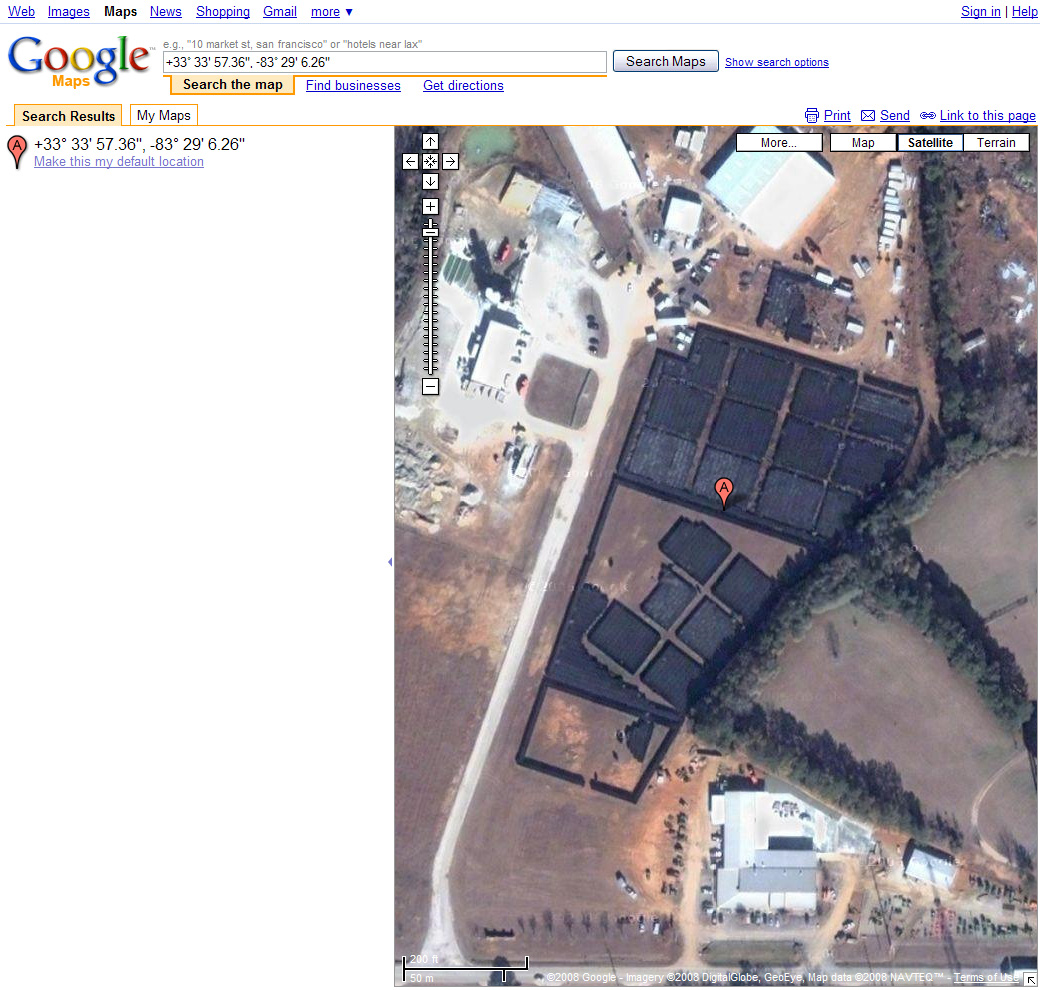
They are in a field near Madison, Georgia, just off of Lion’s Club Road and next to (as far as I can tell) a Fowler Flemister Concrete plant. See coordinates: +33° 33′ 57.36″, -83° 29′ 6.26″.
I’ll host a local screen shot of the map above, just in case Google decides to disappear it.
Here’s a video taken at the site:
How many?
I tried to figure out a way to count them, but I couldn’t do it. I felt like my estimates could easily be off by an order of magnitude. To say that it’s tens of thousands is probably conservative.
Who owns the land?
I haven’t been able to figure that out. The legend that I keep running across is that a private individual leased the land to FEMA. I suppose that’s possible, or it could be absolute nonsense. I don’t know. With all of the U.S. Government’s vast land holdings and facilities, FEMA leased this field from someone to store these Burial Vaults??? Again, I suppose that anything is possible.
If these Burial Vaults do belong to FEMA, that would be very interesting. I went through all of the government contracts with PolyGuard going back to 2000 and FEMA hasn’t done any (on the books) business with them. Since 2000, the government contracts that went to PolyGuard were all awarded by the VA.
Why?
That’s the question. I have no idea and I haven’t found any good guesses either. The consensus on the foil sites is that these Burial Vaults are to be used in the aftermath of some kind of false flag attack or holocaust/final solution situation. Initially, I thought the same thing, but when I thought about it more carefully, wouldn’t FEMA just stockpile body bags?
The anonymous comments on some sites say that it’s probably related to contingency planning for a natural disaster. Again, wouldn’t FEMA just stockpile body bags?
One thing that I haven’t seen mentioned anywhere is how much money is represented by this Burial Vault stockpile. The newsletter above puts the cost at $220. I have not been able to determine what the government pays, per unit, but let’s not even assume that $220 is the cost. Let’s say it’s just $100 each. At that rate, ten thousand units would be worth $1 million. So, there’s easily several million dollars worth of inventory sitting in that field.
To the imbeciles who suggest that this is some sort of routine private inventory for a mortuary business (yes, I have seen people suggesting that): There is A) no way that a mortuary company would spend millions of dollars for so many of these at once and B) no way that a mortuary company would leave them sitting unguarded in a field for years.
I’d love for someone to provide a This-Is-Normal-There’s-Nothing-To-See-Here explanation, but so far, I haven’t been able to find such an explanation.
One last thing: This isn’t a new story
Infowars just posted this story and that’s where I saw it, but the earliest reference that I can find to this was from 2006. ATS has a thread from December 2007 that covers this situation.
Hardware Failure
July 20th, 2008The server that hosts Cryptogon experienced a hardware failure last night. Cryptogon was down for several hours while BlueHost restored user accounts from backup. Everything seems to be functioning normally again.
I’ll update later today.
Banks Place Extended Hold on IndyMac Checks
July 18th, 2008Via: AP:
The frustration didn’t end for some IndyMac customers when they finally were able to withdraw their funds from the failing Southern California bank seized last week by federal regulators.
Some people have run into more problems when they tried to deposit IndyMac cashier checks at other banks.
Sheryl MacPhee said she waited in line two hours Tuesday at an IndyMac branch in San Marino to liquidate a certificate of deposit. But when she took it to a Washington Mutual branch in South Pasadena to deposit, she said a manager told her their new policy was not to accept IndyMac checks. If the customer insisted, she said she was told, it could take eight weeks or more to access the full amount.
“Sure, IndyMac will give you a check,” MacPhee told the Los Angeles Times, “but what good is it if no other institution will accept it?”
WaMu spokeswoman Olivia Riley said her bank is accepting IndyMac checks, “but depending on the specifics, funds will be subject to an extended hold period.”
Officials at the Office of Thrift Supervision said that regulating agency is investigating complaints about the checks.
U.S. Air Force Comfort Capsules
July 18th, 2008The U.S. is a banana republic with nuclear weapons.
Via: Washington Post:
The Air Force’s top leadership sought for three years to spend counterterrorism funds on “comfort capsules” to be installed on military planes that ferry senior officers and civilian leaders around the world, with at least four top generals involved in design details such as the color of the capsules’ carpet and leather chairs, according to internal e-mails and budget documents.
Production of the first capsule — consisting of two sealed rooms that can fit into the fuselage of a large military aircraft — has already begun.
Air Force officials say the government needs the new capsules to ensure that leaders can talk, work and rest comfortably in the air. But the top brass’s preoccupation with creating new luxury in wartime has alienated lower-ranking Air Force officers familiar with the effort, as well as congressional staff members and a nonprofit group that calls the program a waste of money.
Air Force documents spell out how each of the capsules is to be “aesthetically pleasing and furnished to reflect the rank of the senior leaders using the capsule,” with beds, a couch, a table, a 37-inch flat-screen monitor with stereo speakers, and a full-length mirror.
The effort has been slowed, however, by congressional resistance to using counterterrorism funds for the project and by lengthy internal deliberations about a series of demands for modifications by Air Force generals. One request was that the color of the leather for the seats and seat belts in the mobile pallets be changed from brown to Air Force blue and that seat pockets be added; another was that the color of the table’s wood be darkened.
Changing the seat color and pockets alone was estimated in a March 12 internal document to cost at least $68,240.