IMF to Conduct “X-Ray of the Entire U.S. Financial System”
June 30th, 2008What becomes of the IMF if this audit is actually carried out? The U.S. has the largest quota of SDRs and largest percentage of votes in the IMF. The whole system would be shown to be the farce that we already know it to be if the most powerful member (and one of the founding members) has its dirty laundry placed on display.
Could this be part of some wider “receivership” plan?
Via: Der Spiegel:
Officials with the International Monetary Fund (IMF) have informed Bernanke about a plan that would have been unheard-of in the past: a general examination of the US financial system. The IMF’s board of directors has ruled that a so-called Financial Sector Assessment Program (FSAP) is to be carried out in the United States. It is nothing less than an X-ray of the entire US financial system.
As part of the assessment, the Fed, the Securities and Exchange Commission (SEC), the major investment banks, mortgage banks and hedge funds will be asked to hand over confidential documents to the IMF team. They will be required to answer the questions they are asked during interviews. Their databases will be subjected to so-called stress tests — worst-case scenarios designed to simulate the broader effects of failures of other major financial institutions or a continuing decline of the dollar.
Under its bylaws, the IMF is charged with the supervision of the international monetary system. Roughly two-thirds of IMF members — but never the United States — have already endured this painful procedure.
For seven years, US President George W. Bush refused to allow the IMF to conduct its assessment. Even now, he has only given the IMF board his consent under one important condition. The review can begin in Bush’s last year in office, but it may not be completed until he has left the White House. This is bad news for the Fed chairman.
When the final report on the risks of the US financial system is released in 2010 — and it is likely to cause a stir internationally — only one of the people in positions of responsiblity today will still be in office: Ben Bernanke.
More: IMF Finally Knocks on Uncle Sam’s Door
U.S. Issues Health Warning Over Mercury Fillings
June 29th, 2008I never thought that this would be officially acknowledged.
Via: Independent:
Amalgam dental fillings – which contain the highly toxic metal mercury – pose a health risk, the world’s top medical regulatory agency has conceded.
After years of insisting the fillings are safe, the US government’s Food and Drug Administration (FDA) has issued a health warning about them. It represents a landmark victory for campaigners, who say the fillings are responsible for a range of ailments, including heart conditions and Alzheimer’s disease.
Earlier this month, in an unprecedented U-turn, the FDA dropped much of its reassuring language on the fillings from its website, substituting: “Dental amalgams contain mercury, which may have neurotoxic effects on the nervous systems of developing children and foetuses.” It adds that when amalgam fillings are “placed in teeth or removed they release mercury vapour”, and that the same thing happens when chewing.
The FDA is now reviewing its rules and may end up restricting or banning the use of the metal.
Hersh: Congress Approved Major Escalation of Covert Operations Against Iran; Funding Groups That May Be Described as Al Qaeda
June 29th, 2008Via: New Yorker:
Late last year, Congress agreed to a request from President Bush to fund a major escalation of covert operations against Iran, according to current and former military, intelligence, and congressional sources. These operations, for which the President sought up to four hundred million dollars, were described in a Presidential Finding signed by Bush, and are designed to destabilize the country’s religious leadership. The covert activities involve support of the minority Ahwazi Arab and Baluchi groups and other dissident organizations. They also include gathering intelligence about Iran’s suspected nuclear-weapons program.
Clandestine operations against Iran are not new. United States Special Operations Forces have been conducting cross-border operations from southern Iraq, with Presidential authorization, since last year. These have included seizing members of Al Quds, the commando arm of the Iranian Revolutionary Guard, and taking them to Iraq for interrogation, and the pursuit of “high-value targets” in the President’s war on terror, who may be captured or killed. But the scale and the scope of the operations in Iran, which involve the Central Intelligence Agency and the Joint Special Operations Command (JSOC), have now been significantly expanded, according to the current and former officials. Many of these activities are not specified in the new Finding, and some congressional leaders have had serious questions about their nature.
Under federal law, a Presidential Finding, which is highly classified, must be issued when a covert intelligence operation gets under way and, at a minimum, must be made known to Democratic and Republican leaders in the House and the Senate and to the ranking members of their respective intelligence committees—the so-called Gang of Eight. Money for the operation can then be reprogrammed from previous appropriations, as needed, by the relevant congressional committees, which also can be briefed.
“The Finding was focussed on undermining Iran’s nuclear ambitions and trying to undermine the government through regime change,” a person familiar with its contents said, and involved “working with opposition groups and passing money.” The Finding provided for a whole new range of activities in southern Iran and in the areas, in the east, where Baluchi political opposition is strong, he said.
Although some legislators were troubled by aspects of the Finding, and “there was a significant amount of high-level discussion” about it, according to the source familiar with it, the funding for the escalation was approved. In other words, some members of the Democratic leadership—Congress has been under Democratic control since the 2006 elections—were willing, in secret, to go along with the Administration in expanding covert activities directed at Iran, while the Party’s presumptive candidate for President, Barack Obama, has said that he favors direct talks and diplomacy.
…
The Democratic leadership’s agreement to commit hundreds of millions of dollars for more secret operations in Iran was remarkable, given the general concerns of officials like Gates, Fallon, and many others. “The oversight process has not kept pace—it’s been coöpted” by the Administration, the person familiar with the contents of the Finding said. “The process is broken, and this is dangerous stuff we’re authorizing.”
…
Fallon’s early retirement, however, appears to have been provoked not only by his negative comments about bombing Iran but also by his strong belief in the chain of command and his insistence on being informed about Special Operations in his area of responsibility. One of Fallon’s defenders is retired Marine General John J. (Jack) Sheehan, whose last assignment was as commander-in-chief of the U.S. Atlantic Command, where Fallon was a deputy. Last year, Sheehan rejected a White House offer to become the President’s “czar” for the wars in Iraq and Afghanistan. “One of the reasons the White House selected Fallon for CENTCOM was that he’s known to be a strategic thinker and had demonstrated those skills in the Pacific,” Sheehan told me. (Fallon served as commander-in-chief of U.S. forces in the Pacific from 2005 to 2007.) “He was charged with coming up with an over-all coherent strategy for Iran, Iraq, and Afghanistan, and, by law, the combatant commander is responsible for all military operations within his A.O.”—area of operations. “That was not happening,” Sheehan said. “When Fallon tried to make sense of all the overt and covert activity conducted by the military in his area of responsibility, a small group in the White House leadership shut him out.”
…
Admiral Fallon, who is known as Fox, was aware that he would face special difficulties as the first Navy officer to lead CENTCOM, which had always been headed by a ground commander, one of his military colleagues told me. He was also aware that the Special Operations community would be a concern. “Fox said that there’s a lot of strange stuff going on in Special Ops, and I told him he had to figure out what they were really doing,” Fallon’s colleague said. “The Special Ops guys eventually figured out they needed Fox, and so they began to talk to him. Fox would have won his fight with Special Ops but for Cheney.”
The Pentagon consultant said, “Fallon went down because, in his own way, he was trying to prevent a war with Iran, and you have to admire him for that.”
…
Admiral Cosgriff’s caution was well founded: within a week, the Pentagon acknowledged that it could not positively identify the Iranian boats as the source of the ominous radio transmission, and press reports suggested that it had instead come from a prankster long known for sending fake messages in the region. Nonetheless, Cosgriff’s demeanor angered Cheney, according to the former senior intelligence official. But a lesson was learned in the incident: The public had supported the idea of retaliation, and was even asking why the U.S. didn’t do more. The former official said that, a few weeks later, a meeting took place in the Vice-President’s office. “The subject was how to create a casus belli between Tehran and Washington,” he said.
…
The Administration may have been willing to rely on dissident organizations in Iran even when there was reason to believe that the groups had operated against American interests in the past. The use of Baluchi elements, for example, is problematic, Robert Baer, a former C.I.A. clandestine officer who worked for nearly two decades in South Asia and the Middle East, told me. “The Baluchis are Sunni fundamentalists who hate the regime in Tehran, but you can also describe them as Al Qaeda,” Baer told me. “These are guys who cut off the heads of nonbelievers—in this case, it’s Shiite Iranians. The irony is that we’re once again working with Sunni fundamentalists, just as we did in Afghanistan in the nineteen-eighties.”
…
One of the most active and violent anti-regime groups in Iran today is the Jundallah, also known as the Iranian People’s Resistance Movement, which describes itself as a resistance force fighting for the rights of Sunnis in Iran. “This is a vicious Salafi organization whose followers attended the same madrassas as the Taliban and Pakistani extremists,” Nasr told me. “They are suspected of having links to Al Qaeda and they are also thought to be tied to the drug culture.” The Jundallah took responsibility for the bombing of a busload of Revolutionary Guard soldiers in February, 2007. At least eleven Guard members were killed. According to Baer and to press reports, the Jundallah is among the groups in Iran that are benefitting from U.S. support.
The C.I.A. and Special Operations communities also have long-standing ties to two other dissident groups in Iran: the Mujahideen-e-Khalq, known in the West as the M.E.K., and a Kurdish separatist group, the Party for a Free Life in Kurdistan, or PJAK.
The M.E.K. has been on the State Department’s terrorist list for more than a decade, yet in recent years the group has received arms and intelligence, directly or indirectly, from the United States. Some of the newly authorized covert funds, the Pentagon consultant told me, may well end up in M.E.K. coffers. “The new task force will work with the M.E.K. The Administration is desperate for results.” He added, “The M.E.K. has no C.P.A. auditing the books, and its leaders are thought to have been lining their pockets for years. If people only knew what the M.E.K. is getting, and how much is going to its bank accounts—and yet it is almost useless for the purposes the Administration intends.”
Gold: Technical Analysis
June 29th, 2008WARNING: This is not a recommendation to buy, sell or hold any financial instrument.
The weekly interval gold chart is looking interesting. The stochastic has been extreme oversold and hasn’t uncoiled yet. The big picture uptrend is still intact. So, with that stochastic still quite compressed (it’s no longer extreme), there’s a good chance that gold could move substantially higher from here pretty quickly.
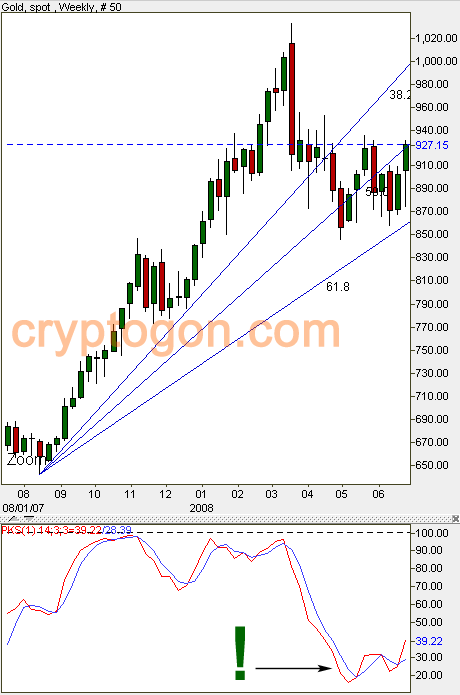
Spot gold, weekly interval
Forget the fireworks on the 4th of July. The European Central Bank action on the 3rd will be much more interesting.
By the looks of this chart, gold investors are betting on an ECB rate hike.
U.S. Dollar Index: Technical Analysis
June 29th, 2008WARNING: This is not a recommendation to buy, sell or hold any financial instrument.
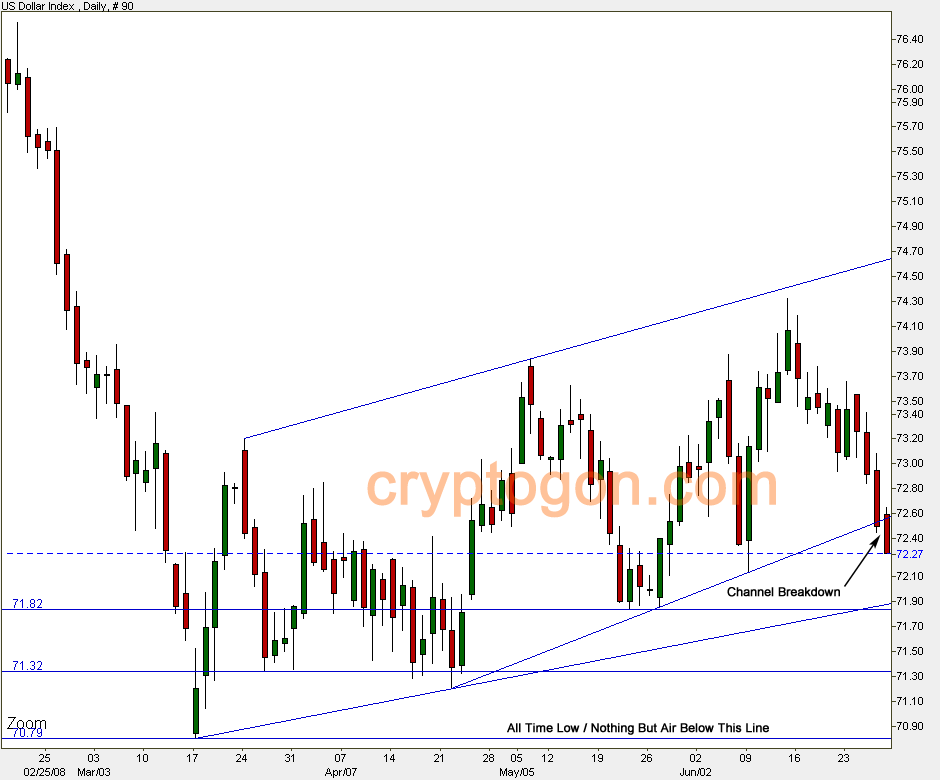
The U.S. Dollar Index has been meandering higher, but Friday’s close represented a break down and out of the recent, uptrending channel. Well, it depends on how you draw the channel. It might still be in a longer term channel, but it’s clearly retesting recent lows. The 71.90 area has a couple of supports running through it.
There are several supports down here, but if the European Central Bank does raise rates on July 3rd, that could cause [more] trouble for the dollar. That maybe break below the channel could be insiders positioning themselves ahead of the news.
The Fed has backed itself into a corner. If it raises rates, it crashes the already declining stock market and who knows how many banks. If it cuts, Americans will be burning their dollars to stay warm this winter.
Here’s the USDX daily chart. It shows the channel break down and various supports.
I’ve been short the dollar for months with UDN and I’m holding, for now, despite the supports ahead.
Oil: Technical Analysis
June 29th, 2008WARNING: This is not a recommendation to buy, sell or hold any financial instrument.
Summary (In English): The oil price uptrend looks set to continue, with short term pullbacks along the way.
—
I made large charts this time:
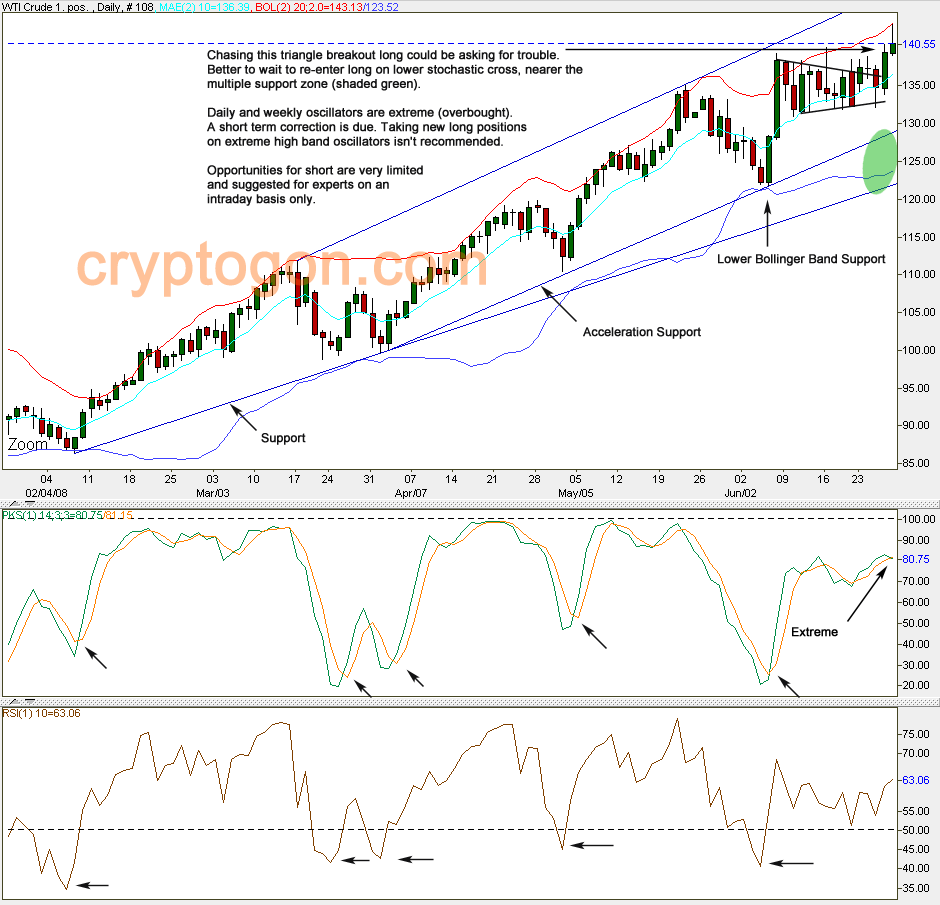
Oil has settled into a healthy (roughly 45 degree), uptrending channel. After consolidating into a messy bullish triangle last week, a breakout to fresh highs occurred. Chasing this triangle breakout long could be asking for trouble, short term. A better idea might be to wait to re-enter long on a lower stochastic cross, nearer the multiple support zone (shaded green on the daily chart).
Daily and weekly oscillators are extreme (overbought). A short term correction is due. Taking new long positions on extreme high band oscillators isn’t recommended.
Opportunities for short are limited and suggested for experts on an intraday basis only. Aggressive traders will work the short side off of pullbacks from the upper Bollinger band and crosses below the 20EMA on the faster intervals.
The longer that daily and weekly oscillators stay extreme, the more sense it makes to try short, but this is for traders with many notches in their pistol grips. (This is the opposite of trying to catch a falling knife.) In markets like this, the countertrend down cranks are there to shake longs out right before prices move violently higher. If you want to try for a Black Swan play short, buy some very cheap, deep out of the money put options right here. That’s a sensible move, especially if you’re holding oil for the long term.
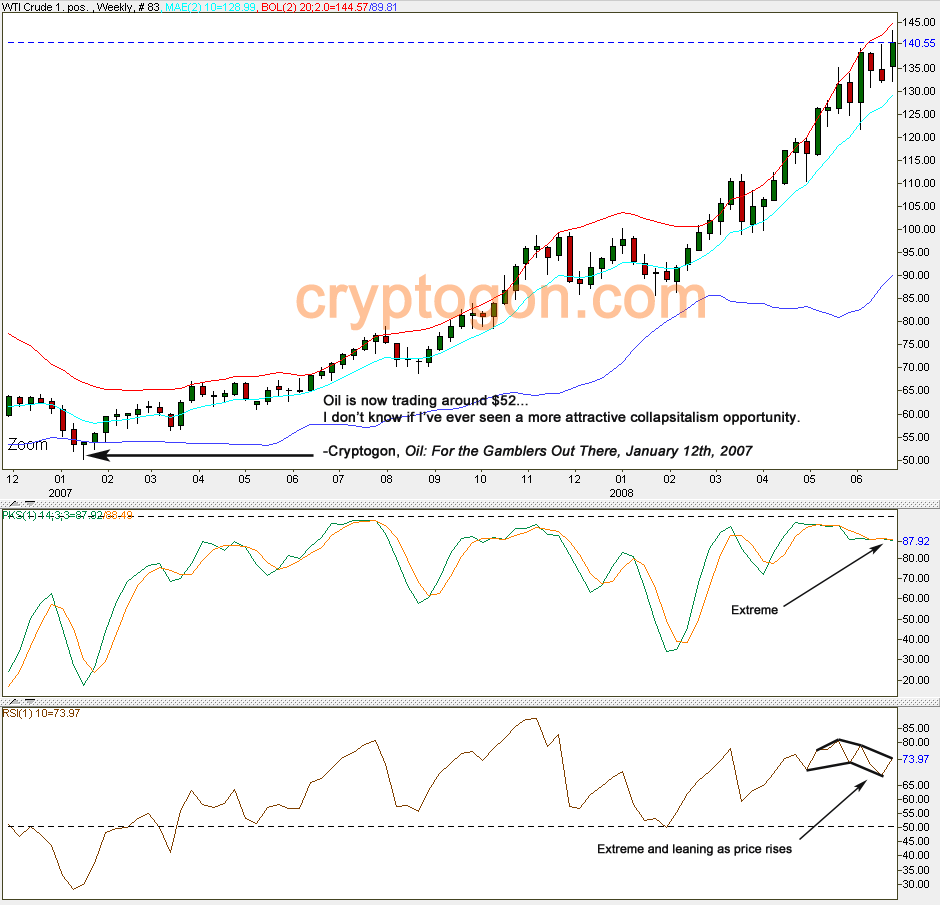
The weekly chart shows remarkable and sustained strength. We have not seen a candle body close under the 20EMA in months. In other words, it just keeps working itself higher between the 20EMA and the upper Bollinger band. This is a textbook, strong bull run. (Contrarians lick their chops when that upper band gets tapped higher for so long.)
It’s not pictured on the weekly, but I also added a parabolic SAR and it’s unbroken bullish since February.
This move needs to consolidate to find a new level to base.
Just because it looks overbought doesn’t mean that it can’t crank higher. It absolutely can. As a rule, however, high band entries tend to result in pain.
Oil Rises Above $142 for First Time as Investors Spurn Stocks
June 29th, 2008WARNING: This is not a recommendation to buy, sell or hold any financial instrument.
Welcome to the public participation phase on oil… UPDATE: Actually, no. I take that back. I just looked at the charts and the daily interval doesn’t show the tell tale gap of public participation. Check back later for look at oil from a technical perspective.
Via: Bloomberg:
Crude oil rose above $142 a barrel for the first time as falling stock markets spurred investment in commodities.
Oil has climbed 46 percent this year as the U.S. dollar declined against the euro and the MSCI World Index of global equity markets dropped 12 percent. Oil may extend gains if the European Central Bank boosts rates on July 3, further weakening the U.S. currency.
`The trend to hard assets, and energy in particular, is unabated,” said John Kilduff, vice president of risk management at MF Global Ltd. in New York. “There’s a lack of confidence in stocks and other markets right now, which has investors looking for safe havens.”
Crude oil for August delivery rose 57 cents, or 0.4 percent, to settle at $140.21 a barrel at 3:05 p.m. on the New York Mercantile Exchange, a record close. The August contract rose $4.85, or 3.6 percent, this week.
Prices, which are up 38 percent this quarter, are heading for the biggest quarterly gain since the first three months of 1999, when oil traded between $11 and $17.
“This market is very volatile,” said Justin Fohsz, a broker at Starsupply Petroleum, a division of GFI Group Inc. in Englewood, New Jersey. “Prices fell from almost $143 to $140 between 2:00 p.m. and 2:30 p.m. on nothing. There’s very little volume, which makes it a lot easier to move the market.”
Futures advanced to $142.99 at 1:58 p.m. today, the highest since trading began in 1983.
Yesterday, the contract jumped $5.09, or 3.8 percent, to $139.64 a barrel as Libya threatened to cut output and the president of the Organization of Petroleum Exporting Countries said prices may reach between $150 and $170 within months.
Continuing Rally
“I don’t know when this rally will end because there are too many folks in the finance community betting on prices to rise,” said Rick Mueller, director of oil practice at Energy Security Analysis Inc. in Wakefield, Massachusetts. “Gains have nothing to do with the physical market.”
“Some Guests Left Wearing Strange Featureless Human Masks”
June 28th, 2008UPDATE 2: Ad Campaign for Automobile Firm
Faceless Droids Stalk the Wealthy
UPDATE 1: It’s Some Kind of PR/Marketing Stunt
For what, though?
More pics from Dlisted.
— End Update —
Leaving an Elton John party… Woh.
Via: Mail on Sunday:


Marc Faber: ‘Misleading’ Fed Should Let Banks Fail
June 28th, 2008His chortles at the CNBC bozos were great.
It gets really good at the end of Part 2.
Part 1:
Part 2:
The Price Of Food: 2007 – 2008
June 28th, 2008I noted a few of the most shocking increases. Remember, these are changes over just one year.
Via: Cattle Network:
Eggs, Grade A +28.32%
Barley +52.56%
Beans, Dry Edible +64.29%
Corn +46.70%
Flaxseed +134.46%
Lentils +147.73%
Oats +38.96%
Peas, Dry Edible +62.38%
Rice, Rough +50.00%
Sorghum +41.45%
Soybeans +72.75%
Sunflower +65.06%
Wheat +80.33%
Research Credit: Cartosys