Britain: Emergency Procedures Activated Ahead of Tanker Driver Strike
June 10th, 2008Via: Guardian:
Downing Street today urged motorists not to indulge in panic-buying as the government confirmed that it had activated emergency procedures in preparation for a planned strike by tanker drivers.
The prime minister’s spokesman said that it was “disappointing” that the four-day strike, which is due to start at 6am on Friday and which could affect deliveries to up to 10% of filling stations, was still set to go ahead.
“The most responsible thing the public can do is to continue to buy as normal,” the spokesman said.
Ministers have already activated procedures intended to safeguard fuel for emergency services and to ensure that stocks are moved around the country to areas where there are shortages.
But the government believes it is “inevitable” that some stations could run out of fuel if the strike goes ahead.
One effect of the contingency arrangements, which were last used at the time of the strike at the Grangemouth refinery in April, is to allow oil companies to share information about their supplies by exempting them from the anti-cartel rules that normally prevent this kind of information-sharing.
About 500 drivers who work for haulage companies Hoyer UK and Suckling Transport are due to go on strike. They are the sole suppliers to around 1,000 Shell petrol stations, mainly in south-east England, the north west, central Scotland and the Midlands.
The prime minister’s spokesman told reporters today that the government was “encouraged” that both sides were taking their dispute to Acas, the conciliation service. “We would encourage both sides to get back to the table and to reach a resolution,” he said.
“We do not believe that any strike action is justified because that would disproportionately impact on the lives and livelihoods of millions of people in the country not involved in this dispute.”
Asked if he feared panic-buying, he said: “We want the public to continue to buy as normal so as to avoid creating problems that might otherwise not exist.”
John Hutton, the business secretary, activated the emergency procedures to ensure continuity of supply without publicity on Friday. Downing Street described them as “established procedures”.
Oil, Dollar Form Record Negative Correlation
June 9th, 2008Mmm hmm.
Via: Bloomberg:
When leaders of the Group of Eight industrialized countries meet June 13-14 in Japan, they may look to the joint actions taken ahead of a similar event in 2000, when oil prices were surging and a major currency was at a record low.
On Sept. 22, 2000, U.S. President Bill Clinton ordered the release of oil from the nation’s strategic reserve as crude had reached a 10-year high. Concurrently, the central banks of the U.S., Europe, Japan, U.K. and Canada bought euros in the first- ever concerted attempt to stem the currency’s slide, after it fell below 85 U.S. cents for the first and only time.
“The market has linked a weaker U.S. dollar to higher oil prices, and vice-versa,” DBS Group Holdings Ltd. said in a report. “That’s why a lot is riding on the weekend meeting.”
The chart of the day shows the correlation between the daily percentage change in the dollar index and crude oil, which formed a record negative last week. The link between the two peaked in positive territory on December 18, 2000, shortly after the unprecedented dual intervention and a Supreme Court ruling that cemented George W. Bush’s election victory over then-Vice President Al Gore.
The chart also shows that the most-recent positive correlation was in September 2007, after the Federal Reserve started cutting its benchmark rate in response to the worsening U.S. credit crisis.
Lowering Expectations
The negative correlation is “either because people are marking down their expectations for the U.S. outlook, or oil exporters wanting to preserve their returns do raise the price,” Sophia Drossos, chief currency strategist at Morgan Stanley and former manager of the Federal Reserve’s foreign-exchange portfolio, said in an interview June 6.
“We should see that negative correlation — that inverse correlation — persist, and if we do see energy prices rise, I think the dollar will fall,” she said.
The G-8 — the U.S., Japan, Canada, Germany, France, U.K., Italy and Russia — along with China, India and South Korea, which will also send officials for meetings on the sidelines, account for about 65 percent of global energy demand.
The negative oil-dollar correlation wasn’t the only record set last week. Oil rose $10.75, or 8.4 percent, to $138.54 a barrel in New York on June 6, the biggest-ever gain in dollar terms. The gain alone almost equaled the lowest price for a barrel of crude the past decade, set Dec. 10, 1998.
New York Fed Chief Urges Global Bank Framework
June 9th, 2008Why now?
Below is a screen shot of Total Borrowings of Depository Institutions from the Federal Reserve:
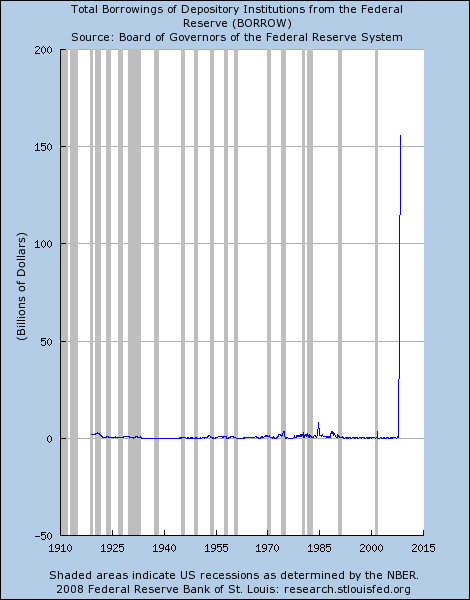
So, what happens after the banks default on the loans that they’ve taken out from the Federal Reserve (that unprecedented, nearly vertical blue line on the chart above)?
Ah, yes. The phrase, Global Bank Framework might make a lot of sense, if the biggest banks in the world go bust. Actually, they went bust already, but the Fed ate it, for a time. Again, consult that unprecedented, nearly vertical blue line on the chart above if you doubt it.
Via: Financial Times:
Banks and investment banks whose health is crucial to the global financial system should operate under a unified regulatory framework with “appropriate requirements for capital and liquidity”, according to Timothy Geithner, president of the Federal Reserve Bank of New York.
Writing in Monday’s Financial Times, Mr Geithner, a key US policymaker throughout the credit crisis and one of the main architects of the rescue of Bear Stearns, says that the US Federal Reserve should play a “central role” in the new regulatory framework, working closely with supervisors in the US and round the world.
“At present the Fed has broad responsibility for financial stability not matched by direct authority and the consequences of the actions we have taken in this crisis make it more important that we close that gap,” Mr Geithner says, in an excerpt of a speech to be delivered today at the Economic Club of New York.
The credit crisis has heightened pressure on US policymakers to consider sweeping changes to a regulatory system for financial institutions which has commercial banks such as JPMorgan Chase and Citigroup regulated by the Fed and investment banks such as Goldman Sachs and Lehman Brothers more loosely regulated by the Securities and Exchange Commission.
Mr Geithner called the system “a confusing mix of diffused accountability, regulatory competition and a complex web of rules that create perverse incentives and leave huge opportunities for arbitrage and evasion”.
However, legislation to overhaul US financial regulation is unlikely to start advancing through Congress until next year when the new administration takes office.
In his speech, Mr Geithner will also say the Fed is examining whether to make “permanent” some of the new liquidity facilities put in place during the credit crisis, and called for central banks to establish a “standing network of currency swaps, collateral policies and account arrangements” to bolster liquidity during a future crisis.
Meanwhile, Malcolm Knight, the general manager of the Bank of International Settlements, the Basel-based central banking group, told the FT that the financial system now faces a growing risk of exchange-rate volatility as investors and central banks grapple with the impact of rising commodity prices and other inflationary pressures.
“It is not clear if the rest of the world is going to continue to fund the US current account deficit at current levels of exchange rates,” he said. “The pattern of the exchange rates is subject to considerable uncertainty now.”
The comments are likely to be closely watched by investors and policymakers, since they come at a time of renewed market focus on the outlook for the dollar relative to the euro and other currencies. Last week, Ben Bernanke, Fed chairman, broke with the US central bank’s traditional silence on currency matters to make clear that it does not want any further dollar weakness.
While the dollar rallied on Mr Bernanke’s remarks, it retreated later in the week after European Central bank comments suggested an interest rate rise and as the price of crude oil soared, heightening inflation fears.
“There is a perception that after a long period of quiescent inflation, things are changing,” Mr Knight said. “This is quite visible in terms of commodity prices in energy markets but also in terms of what is happening with other commodities too.”
Research Credit: Pookie
British Police Opening Thousands of Safe Deposit Boxes, Searching for Gold, Other “Criminal Assets”
June 9th, 2008Via: BBC:
Six suitcases packed with suspected gold dust and about £30m in cash has been found during searches of safety deposit centres in London, police say.
…
The Met Police believe criminals used the centres in Park Lane, Hampstead and Edgware to store criminal assets.
Armed police continue to guard the buildings as specialist officers search the 7,000 safety deposit boxes.
So far only a third of the boxes have been opened and the finds have also included a firearm, counterfeit currency, several works of Renaissance art and a substantial amount of high value jewellery.
Speaking after the raids Commander Allan Gibson said: “Search teams have been working around the clock to open all the boxes at the location and are progressing well, although we are likely to remain at the locations for some time yet.
Cryptogon Readers Sign Up for Hosting with BlueHost
June 9th, 2008Thanks to the owners of shaw8.com and comradesimba.com for signing up for hosting with BlueHost. Cryptogon received $130.
Australian PM Wants Europe-Style Asia-Pacific Union
June 8th, 2008Sure.
Via: Reuters:
Australian Prime Minister Kevin Rudd said on Wednesday that he wants to see an Asia-Pacific Community by 2020 structured similar to the European Union.
Rudd said there was a “brittleness” in bilateral ties, and that while regional bodies like ASEAN and APEC had achieved much, there was a need for a region-wide architecture to tackle the growing challenges of the Asia-Pacific century.
“Terrorism in Southeast Asia will remain a continuing challenge. Across wider continental Asia, the rise of India and China represent great economic, environmental, energy policy and security reverberations for the future,” Rudd said in a speech to the Asia Society Australiasia in Sydney.
“I believe it is time that we started to think about where we want to be with our regional architecture in 2020. We need to have a vision for an Asia-Pacific Community,” he said, adding the world could learn from Europe where centuries of animosity had been transformed into transnational cooperation.
Rudd said an Asia-Pacific Community, which should include the United States, Japan, China, India, Indonesia and the other states of the region, would encourage cooperation and action on economic, political and security issues but also develop a “genuine and comprehensive sense of community”.
“The danger in not acting is that we run the risk of succumbing to the perception that future conflict within our region may somehow be inevitable,” said Rudd.
“At present none of our existing regional mechanisms as currently configured are capable of achieving these purposes.”
Rudd, a Mandarin-speaking former diplomat, came to power last November and aims to forger closer ties with the region. He visited Beijing earlier this year, where he won wide praise, and he is set to travel to Japan and Indonesia later this month.
Bilderberg 2008 Photos
June 8th, 2008Via: Cryptome:
The Bilderberg Meeting is taking place at the Westfields Marriott Hotel, Chantilly, VA, June 6-8, 2008.
Cryptogon Readers Send Contributions
June 7th, 2008JW sent $35 and AS sent $50. Thank you.
Oil: The Event
June 7th, 2008WARNING: This is not a recommendation to buy, sell or hold any financial instrument.
Before I begin, I want to emphasize that this market is for experts only. Unless you trade for a living, I wouldn’t go near this either way.
Oil has formed a bullish engulfing candle formation on the weekly chart. It has also broken out of its previous range and closed at a fresh record high. On their own, these are very bullish developments. While the weekly stochastic remains in extreme overbought territory, price levels trump oscillators. Oil strategies should favor long positions ABOVE about $135.20 as long as you remember the state of the weekly stochastic. Below $135.20, consider shorts again, with the premise being that a full oscillation down could be due. Shorts must be managed carefully, as they are countertrend and very vulnerable to squeezes/reversals like we saw today. Consider a straddle if it retries $135.
NEAR TERM: VERY VOLATILE, DO NOT EXPECT SMOOTH SAILING HIGHER ON OIL FROM HERE.
The oil story is being driven by several factors, however, the dollar is the most critical of these. Note below that the U.S. Dollar Index is still range bound. There are two supports directly ahead for the dollar, around 71.90 and 71.40 (see chart below).
INTERMEDIATE TERM: ABOVE $135, BULLISH; STRONG CORRECTION POSSIBLE BELOW $135.
The uptrend is very much intact. If the dollar does not find support between present levels and 71.40, oil will be headed higher. My strategic positioning on the dollar is bearish, regardless of the shorter term, countertrend cranks we’ve been seeing.
I rarely include fundamental analysis in my technical work, but today’s move on oil was so unusual that I went looking for an “event.” Extreme oil moves are usually driven by supply disruption events, but that wasn’t the case today. What single event was potentially behind the largest gap higher in oil prices—ever?
On June 5, 2008 at 5:38 p.m. the Wall Street Journal published a piece about the Ambac and MBIA credit rating downgrades (Cryptogon post here). While the news was circulating before this, I’m using this story as the benchmark. I’ve indicated the release of that news on four hour charts of West Texas Intermediate crude oil, spot gold and EUR/USD. I also indicated the news on the U.S. Dollar Index daily interval chart.
A lot of people are saying a lot of things about oil right now.
Nobody, as far as I’ve seen, has drawn an arrow on an intraday oil chart indicating what happened after something like one trillion dollars worth of debt was downgraded in one fell swoop. I emphasized the point by including several other dollar affected assets.
What do you see?
I see dollars trying to hide in many different places, all at once.
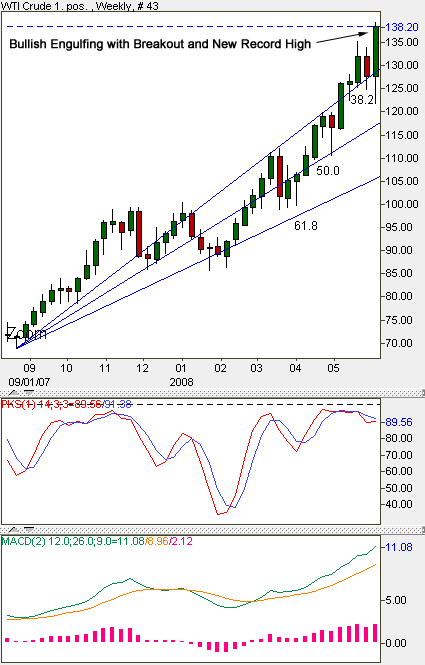
Weekly Interval West Texas Intermediate Crude Oil
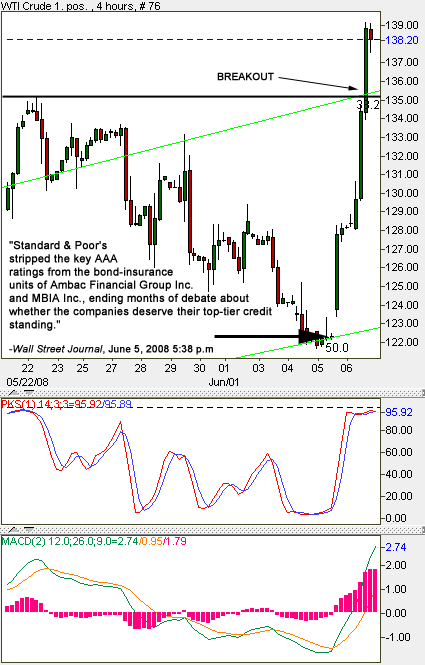
Four Hour Interval West Texas Intermediate Crude Oil
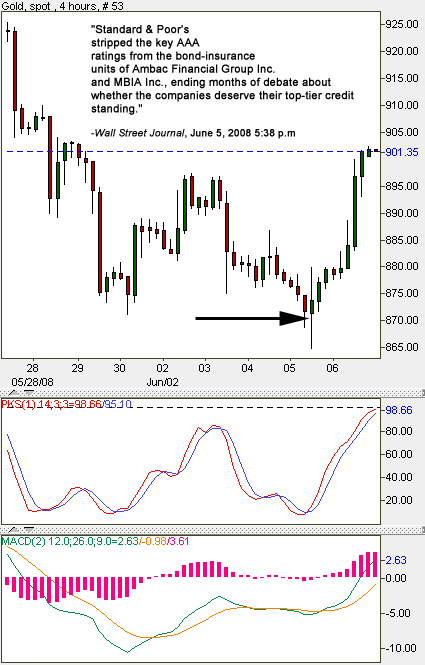
Four Hour Interval Spot Gold
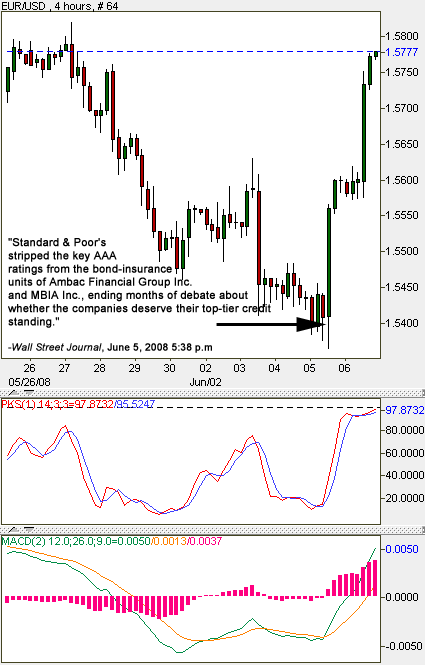
Four Hour Interval EUR/USD
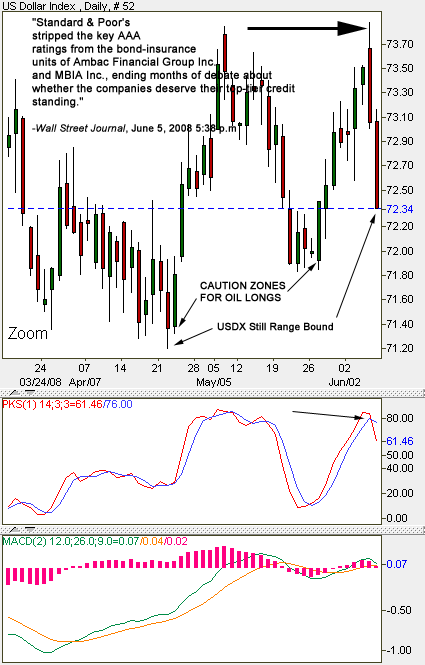
Daily Interval U.S. Dollar Index
OIL SURGES $11 to RECORD $138
June 7th, 2008This was an insane move. I’ll have some charts up next post.
Earlier, I wrote, “Gold, oil and the U.S. Dollar Index are all rangebound slop now. Know that your indicators contain more noise here.”
That was midway through the session. With this weekly candle in, the picture is substantially different now. We’ll look at the charts.
Via: CNN:
Oil prices shot up nearly $11 a barrel and settled Friday at a record $138.54 on geopolitical jitters, a dollar decline and a forecast that oil would hit $150 by July 4.
Friday’s spike in the July contract for light crude on the New York Mercantile Exchange marks the largest single-day increase in oil prices on record. The contract hit an intraday record of $139.12, breaking the previous trading record of $135.09.
“The bulls are running rampant and the bears have panicked,” said oil industry analyst Stephen Schork, editor of the Schork Report. “It’s pure hysteria, absolute panic,” he added.
The rally highlighted concerns that retail gas prices, which have surged near a nationwide average of $4 a gallon, will continue to crimp consumer spending and fuel inflation.
Stocks fell more than 400 points Friday due to the rally in crude prices and a report from the Labor Department that showed the unemployment rate rose to 5.5% in May from 5% in April, the biggest monthly jump in more than two decades. The economy lost 49,000 jobs, marking the fifth straight month of job losses.
Meanwhile, the dollar continued its slide versus the euro on the weak jobs report and comments Thursday that the European Central Bank could potentially raise interest rates. The dollar also tanked versus the yen.
Concerns about instability in the Middle East flared after hawkish comments from Israeli Deputy Prime Minister, Shaul Mofaz, about possible attacks on Iran.
Also contributing to the surge: Morgan Stanley (MS, Fortune 500) analyst Ole Slorer released a report saying that he expected a “short-term spike in oil prices,” as high as $150 a barrel by July 4.
Softening dollar
The dollar began its slide Thursday after European Central Bank president Jean-Claude Trichet said the bank might raise interest rates, which would strengthening the value of the euro. If the euro gains, oil becomes cheaper, European investors buy more oil, raising the price of oil in U.S. dollars, according to Phil Flynn, senior market analyst at Alaron Trading.
The “European Central Bank pulled the rug out from under us,” said Flynn.
Trichet’s comments came the day after Federal Reserve Chairman Ben Bernanke said he wanted to try to support the dollar to bring energy prices into check. “The two central banks are out of step with each other,” he said.
Global demand, especially for gas and distillates in emerging markets, supported the record build in crude prices.
However, the governments of a number of countries, such as India and Malaysia, have started lifting their government fuel subsidies, prompting gas prices to rise in those nations.




