Teenage Student Isolates Microbe that Breaks Down Plastic
May 26th, 2008This is incredible. Full text follows.
Via: TheRecord:
Getting ordinary plastic bags to rot away like banana peels would be an environmental dream come true.
After all, we produce 500 billion a year worldwide and they take up to 1,000 years to decompose. They take up space in landfills, litter our streets and parks, pollute the oceans and kill the animals that eat them.
Now a Waterloo teenager has found a way to make plastic bags degrade faster — in three months, he figures.
Daniel Burd’s project won the top prize at the Canada-Wide Science Fair in Ottawa. He came back with a long list of awards, including a $10,000 prize, a $20,000 scholarship, and recognition that he has found a practical way to help the environment.
Daniel, a 16-year-old Grade 11 student at Waterloo Collegiate Institute, got the idea for his project from everyday life.
“Almost every week I have to do chores and when I open the closet door, I have this avalanche of plastic bags falling on top of me,” he said. “One day, I got tired of it and I wanted to know what other people are doing with these plastic bags.”
The answer: not much. So he decided to do something himself.
He knew plastic does eventually degrade, and figured microorganisms must be behind it. His goal was to isolate the microorganisms that can break down plastic — not an easy task because they don’t exist in high numbers in nature.
First, he ground plastic bags into a powder. Next, he used ordinary household chemicals, yeast and tap water to create a solution that would encourage microbe growth. To that, he added the plastic powder and dirt. Then the solution sat in a shaker at 30 degrees.
After three months of upping the concentration of plastic-eating microbes, Burd filtered out the remaining plastic powder and put his bacterial culture into three flasks with strips of plastic cut from grocery bags. As a control, he also added plastic to flasks containing boiled and therefore dead bacterial culture.
Six weeks later, he weighed the strips of plastic. The control strips were the same. But the ones that had been in the live bacterial culture weighed an average of 17 per cent less.
That wasn’t good enough for Burd. To identify the bacteria in his culture, he let them grow on agar plates and found he had four types of microbes. He tested those on more plastic strips and found only the second was capable of significant plastic degradation.
Next, Burd tried mixing his most effective strain with the others. He found strains one and two together produced a 32 per cent weight loss in his plastic strips. His theory is strain one helps strain two reproduce.
Tests to identify the strains found strain two was Sphingomonas bacteria and the helper was Pseudomonas.
A researcher in Ireland has found Pseudomonas is capable of degrading polystyrene, but as far as Burd and his teacher Mark Menhennet know — and they’ve looked — Burd’s research on polyethelene plastic bags is a first.
Next, Burd tested his strains’ effectiveness at different temperatures, concentrations and with the addition of sodium acetate as a ready source of carbon to help bacteria grow.
At 37 degrees and optimal bacterial concentration, with a bit of sodium acetate thrown in, Burd achieved 43 per cent degradation within six weeks.
The plastic he fished out then was visibly clearer and more brittle, and Burd guesses after six more weeks, it would be gone. He hasn’t tried that yet.
To see if his process would work on a larger scale, he tried it with five or six whole bags in a bucket with the bacterial culture. That worked too.
Industrial application should be easy, said Burd. “All you need is a fermenter . . . your growth medium, your microbes and your plastic bags.”
The inputs are cheap, maintaining the required temperature takes little energy because microbes produce heat as they work, and the only outputs are water and tiny levels of carbon dioxide — each microbe produces only 0.01 per cent of its own infinitesimal weight in carbon dioxide, said Burd.
“This is a huge, huge step forward . . . We’re using nature to solve a man-made problem.”
Burd would like to take his project further and see it be used. He plans to study science at university, but in the meantime he’s busy with things such as student council, sports and music.
“Dan is definitely a talented student all around and is poised to be a leading scientist in our community,” said Menhennet, who led the school’s science fair team but says he only helped Burd with paperwork.
Other local students also did well at the national science fair.
Devin Howard of St. John’s Kilmarnock School won a gold medal in life science and several scholarships.
Mackenzie Carter of St. John’s Kilmarnock won bronze medals in the automotive and engineering categories.
Engineers Without Borders awarded Jeff Graansma of Forest Heights Collegiate a free trip to their national conference in January.
Zach Elgood of Courtland Avenue Public School got honourable mention in earth and environmental science.
Research Credit: Idleworm
Cryptogon Reader Sends $20
May 26th, 2008MW sent $20. Thank you.
New Zealand: Business Booming for Debt Collectors
May 25th, 2008Via: New Zealand Herald:
The credit crunch has hit home for thousands of New Zealanders as debt collection agencies report up to a 500 per cent increase in workload over the past few months.
Debt collectors who have been in the industry for more than 15 years say they have never been busier, with small-time borrowers and businesses “across the board” defaulting on loans and payment for services.
Meanwhile, budgeting advisory services are swamped with people needing help as debts spiral out of control. One service says its waiting time to see new clients is up to five weeks.
Graeme Byers, owner of debt collector Guardian Credit Services, told the Herald on Sunday his business had increased by between 400 and 500 per cent this year.
“There’s just more debt out there. Poorer people are getting hammered.”
Byers said the collapse of numerous finance companies had put many people into positions where they could not pay everyday debts. “One feeds off the other. It snowballs,” he said.
Mary Will from Final Call said she had never been busier. She estimated her business had expanded by 200 per cent in the past six months and she was having to turn down jobs.
She was working mainly for tradespeople such as earth movers, builders and carpet layers who hadn’t been paid by developers. The sums varied “from $2000 to $20,000”.
“The collapse of Bridgecorp was the beginning,” said Will. “Some developers are going under, others are very slow to pay bills. Some of the big developers are really struggling. A lot of it is at the top end. People who used to spend a lot of money just aren’t.”
She said she was getting calls from clients she hadn’t heard from in two years.
“All of them are saying they will have a lot more work for me in the future. When there is a downturn that’s when business gets good.”
Simon Freeman, from Auckland District Collections, said it was “without a doubt” the busiest time in the industry for 15 years.
He said he had 500-700 active collection jobs on his books, which ranged from domestic debts of $1000 to a case last week which involved $1.2 million.
“We are extremely busy. It’s companies supplying restaurants, trucking firms, plumbing firms, everything.”
Freeman said much of his work came from the property industry where developers had come unstuck and failed to pay suppliers and tradespeople.
“It’s the poor old painter, the finisher, the landscaper, the concreter.”
He said the worst of the credit crunch was yet to come and predicted he would be just as busy for the next five years.
Energy Fears Looming, New Survivalists Prepare
May 25th, 2008Via: AP:
A few years ago, Kathleen Breault was just another suburban grandma, driving countless hours every week, stopping for lunch at McDonald’s, buying clothes at the mall, watching TV in the evenings.
That was before Breault heard an author talk about the bleak future of the world’s oil supply. Now, she’s preparing for the world as we know it to disappear.
Breault cut her driving time in half. She switched to a diet of locally grown foods near her upstate New York home and lost 70 pounds. She sliced up her credit cards, banished her television and swore off plane travel. She began relying on a wood-burning stove.
“I was panic-stricken,” the 50-year-old recalled, her voice shaking. “Devastated. Depressed. Afraid. Vulnerable. Weak. Alone. Just terrible.”
Convinced the planet’s oil supply is dwindling and the world’s economies are heading for a crash, some people around the country are moving onto homesteads, learning to live off their land, conserving fuel and, in some cases, stocking up on guns they expect to use to defend themselves and their supplies from desperate crowds of people who didn’t prepare.
The exact number of people taking such steps is impossible to determine, but anecdotal evidence suggests that the movement has been gaining momentum in the last few years.
These energy survivalists are not leading some sort of green revolution meant to save the planet. Many of them believe it is too late for that, seeing signs in soaring fuel and food prices and a faltering U.S. economy, and are largely focused on saving themselves.
Some are doing it quietly, giving few details of their preparations — afraid that revealing such information as the location of their supplies will endanger themselves and their loved ones. They envision a future in which the nation’s cities will be filled with hungry, desperate refugees forced to go looking for food, shelter and water.
“There’s going to be things that happen when people can’t get things that they need for themselves and their families,” said Lynn-Marie, who believes cities could see a rise in violence as early as 2012.
Lynn-Marie asked to be identified by her first name to protect her homestead in rural western Idaho. Many of these survivalists declined to speak to The Associated Press for similar reasons.
These survivalists believe in “peak oil,” the idea that world oil production is set to hit a high point and then decline. Scientists who support idea say the amount of oil produced in the world each year has already or will soon begin a downward slide, even amid increased demand. But many scientists say such a scenario will be avoided as other sources of energy come in to fill the void.
On the PeakOil.com Web site, where upward of 800 people gathered on recent evenings, believers engage in a debate about what kind of world awaits.
Some members argue there will be no financial crash, but a slow slide into harder times. Some believe the federal government will respond to the loss of energy security with a clampdown on personal freedoms. Others simply don’t trust that the government can maintain basic services in the face of an energy crisis.
The powers that be, they’ve determined, will be largely powerless to stop what is to come.
Determined to guard themselves from potentially harsh times ahead, Lynn-Marie and her husband have already planted an orchard of about 40 trees and built a greenhouse on their 7 1/2 acres. They have built their own irrigation system. They’ve begun to raise chickens and pigs, and they’ve learned to slaughter them.
The couple have gotten rid of their TV and instead have been reading dusty old books published in their grandparents’ era, books that explain the simpler lifestyle they are trying to revive. Lynn-Marie has been teaching herself how to make soap. Her husband, concerned about one day being unable to get medications, has been training to become an herbalist.
By 2012, they expect to power their property with solar panels, and produce their own meat, milk and vegetables. When things start to fall apart, they expect their children and grandchildren will come back home and help them work the land. She envisions a day when the family may have to decide whether to turn needy people away from their door.
“People will be unprepared,” she said. “And we can imagine marauding hordes.”
So can Peter Laskowski. Living in a woodsy area outside of Montpelier, Vt., the 57-year-old retiree has become the local constable and a deputy sheriff for his county, as well as an emergency medical technician.
“I decided there was nothing like getting the training myself to deal with insurrections, if that’s a possibility,” said the former executive recruiter.
Laskowski is taking steps similar to environmentalists: conserving fuel, consuming less, studying global warming, and relying on local produce and craftsmen. Laskowski is powering his home with solar panels and is raising fish, geese, ducks and sheep. He has planted apple and pear trees and is growing lettuce, spinach and corn.
Whenever possible, he uses his bicycle to get into town.
“I remember the oil crisis in ’73; I remember waiting in line for gas,” Laskowski said. “If there is a disruption in the oil supply it will be very quickly elevated into a disaster.”
Breault said she hopes to someday band together with her neighbors to form a self-sufficient community. Women will always be having babies, she notes, and she imagines her skills as a midwife will always be in demand.
For now, she is readying for the more immediate work ahead: There’s a root cellar to dig, fruit trees and vegetable plots to plant. She has put a bicycle on layaway, and soon she’ll be able to bike to visit her grandkids even if there is no oil at the pump.
Whatever the shape of things yet to come, she said, she’s done what she can to prepare.
California Home Prices Drop 32% Amid Foreclosures
May 25th, 2008Via: Bloomberg:
California home prices tumbled 32 percent in April from a year earlier as “distressed” properties and a lack of financing cut demand, the state realtors group said.
The median existing home price fell to $403,870, the California Association of Realtors said in a statement today. Sales increased 2.5 percent, ending 30 months of consecutive year-on-year declines. Homes priced under $500,000 accounted for 64 percent of sales compared with 40 percent a year earlier.
California had the second-highest U.S. foreclosure rate in April, one for every 204 households, and the most foreclosure filings for the 16th consecutive month, RealtyTrac Inc., a seller of default data, reported on May 14.
U.S. Rice Farmers Want Class Action Against Bayer
May 25th, 2008Via: Reuters:
Germany’s Bayer AG is battling to keep thousands of U.S. rice farmers from becoming part of a massive class-action lawsuit over the contamination of commercial rice supplies by a Bayer biotech rice not approved for human consumption.
In hearings this week in federal court in St. Louis, Missouri, lawyers representing rice farmers said about 7,000 long-grain producers in Missouri, Arkansas, Louisiana, Mississippi and Texas should be allowed to seek unspecified damages against Bayer for contamination that was uncovered in August 2006.
Farmers suffered extensive losses, both from a plunge in rice prices, and in a drop in export business as Japan and the European Union moved to restrict U.S. rice from crossing their borders.
Many farmers also were not able to plant a crop the following year because of seed shortages tied to the contamination, and had to undertake costly clean-up efforts, according to plaintiffs’ attorneys.
Bayer is fighting the class-action move, and both sides are now awaiting a ruling from U.S. District Judge Catherine D. Perry .
“We believe that the individual actions brought by plaintiffs are not appropriate for consolidation under the rules governing class-action proceedings,” Bayer attorney Bruce Mackintosh said in a statement.
Plaintiffs’ attorney Don Downing said class-action status was the best way to help farmers who lost money, markets, and in some cases, an entire season’s crop.
…
The genetically engineered long-grain rice in question has a protein known as Liberty Link, which allows the crop to withstand applications of a herbicide used to kill weeds.
The U.S. Department of Agriculture and Food and Drug Administration said there was no public health or environmental risks associated with the genetically engineered rice and the two agencies elected not to punish Bayer for the contamination.
Student Researching al-Qaida Tactics Held for Six Days
May 24th, 2008Via: Guardian:
A masters student researching terrorist tactics who was arrested and detained for six days after his university informed police about al-Qaida-related material he downloaded has spoken of the “psychological torture” he endured in custody.
Despite his Nottingham University supervisors insisting the materials were directly relevant to his research, Rizwaan Sabir, 22, was held for nearly a week under the Terrorism Act, accused of downloading the materials for illegal use. The student had obtained a copy of the al-Qaida training manual from a US government website for his research into terrorist tactics.
The case highlights what lecturers are claiming is a direct assault on academic freedom led by the government which, in its attempt to establish a “prevent agenda” against terrorist activity, is putting pressure on academics to become police informers.
Sabir was arrested on May 14 after the document was found by a university staff member on an administrator’s computer. The administrator, Hisham Yezza, an acquaintance of Sabir, had been asked by the student to print the 1,500-page document because Sabir could not afford the printing fees. The pair were arrested under the Terrorism Act, Sabir’s family home was searched and their computer and mobile phones seized. They were released uncharged six days later but Yezza, who is Algerian, was immediately rearrested on unrelated immigration charges and now faces deportation.
Dr Alf Nilsen, a research fellow at the university’s school of politics and international relations, said that Yezza is being held at Colnbrook immigration removal centre, due to be deported on Tuesday.
“If he is taken to Algeria, he may be subjected to severe human rights violations after his involvement in this case. He has been in the UK for 13 years. His work is here, his friends are here, his life is here.”
Oil Correction Likely
May 24th, 2008WARNING: This is not a recommendation to buy, sell or hold any financial instrument.
The U.S. Dollar Index is getting down into a support zone, along with a low band daily stochastic. A crank rally on the dollar would likely blow the columns out from underneath the oil; short term, anyway. Why? Look at the weekly oil chart. The stochastic is wound up like a three day clock, and it has been extreme for weeks. If the dollar does anything but decline sharply, oil could decline sharply.
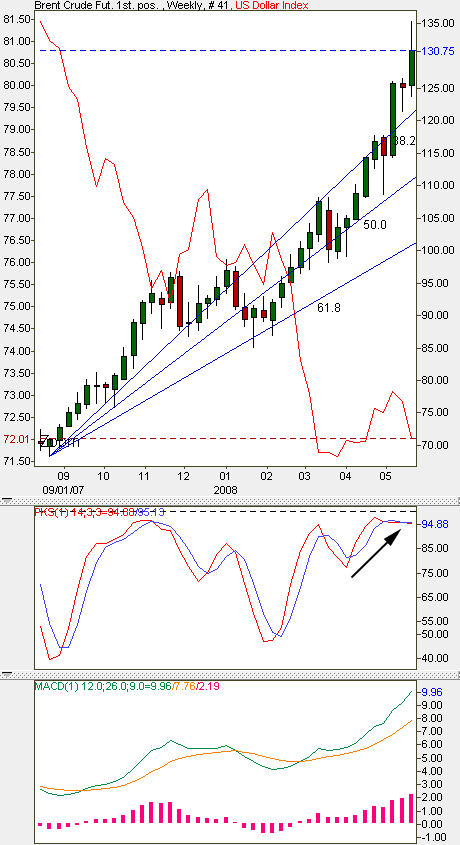
Brent crude weekly, U.S. Dollar Index overlay

U.S. Dollar Index, daily
Clinton Still In Race Because Obama Might Be Assassinated
May 24th, 2008As you know, I make an attempt to block out “news” related to the meaningless Selection. However, there was no avoiding this one. Many of my feeds were polluted with this story, as well as my inbox. Sorry to inflict it upon you again, as I’m sure you’ve already seen it a thousand times over already, but this one was remarkably nuts. A rare moment of clarity from that creature.
Via: AP:
Sen. Hillary Rodham Clinton quickly apologized Friday after citing the June 1968 assassination of Robert F. Kennedy as a reason to remain in the race for the Democratic presidential nomination despite increasingly long odds.
“I regret that if my referencing that moment of trauma for our entire nation and in particular the Kennedy family was in any way offensive. I certainly had no intention of that whatsoever,” the former first lady said.
The episode occurred as Clinton campaigned in advance of the June 3 South Dakota primary.
Responding to a question from the Sioux Falls Argus Leader editorial board about calls for her to drop out of the race, she said: “My husband did not wrap up the nomination in 1992 until he won the California primary somewhere in the middle of June, right? We all remember Bobby Kennedy was assassinated in June in California. You know I just, I don’t understand it,” she said, dismissing the idea of abandoning the race.
Clinton said she didn’t understand why, given this history, some Democrats were calling for her to quit.
Her remark about an assassination during a primary campaign drew a quick response from aides to Democratic presidential front-runner Barack Obama.
“Senator Clinton’s statement before the Argus Leader editorial board was unfortunate and has no place in this campaign,” said Obama spokesman Bill Burton.
Clinton spokesman Mo Elleithee said the senator was only referring to her husband and Kennedy “as historical examples of the nominating process going well into the summer and any reading into it beyond that would be inaccurate and outrageous.”
Even so, Clinton decided within a couple of hours to make a personal apology.
Unmarked Chopper Patrols New York, Scanning Faces and License Plates
May 24th, 2008Via: AP:
On a cloudless spring day, the NYPD helicopter soars over the city, its sights set on the Statue of Liberty.
A dramatic close-up of Lady Liberty’s frozen gaze fills one of three flat-screen computer monitors mounted on a console. Hundreds of sightseers below are oblivious to the fact that a helicopter is peering down on them from a mile and a half away.
“They don’t even know we’re here,” said crew chief John Diaz, speaking into a headset over the din of the aircraft’s engine.
The helicopter’s unmarked paint job belies what’s inside: an arsenal of sophisticated surveillance and tracking equipment powerful enough to read license plates — or scan pedestrians’ faces — from high above the nation’s largest metropolis.
Police say the chopper’s sweeps of landmarks and other potential targets are invaluable in helping guard against another terrorist attack, providing a see-but-avoid-being-seen advantage against bad guys.
“It looks like just another helicopter in the sky,” said Assistant Police Chief Charles Kammerdener, who oversees the department’s aviation unit.
Police Commissioner Raymond Kelly has said that no other U.S. law enforcement agency “has anything that comes close” to the surveillance chopper, which was designed by engineers at Bell Helicopter and computer technicians based on NYPD specifications.
The chopper is named simply “23” — for the number of police officers killed in the Sept. 11, 2001, attacks.
The $10 million helicopter is just part of the department’s efforts to adopt cutting-edge technology for its counterterrorism operations.
The NYPD also plans to spend tens of millions of dollars strengthening security in the lower Manhattan business district with a network of closed-circuit television cameras and license-plate readers posted at bridges, tunnels and other entry points.
…
Police insist that law-abiding New Yorkers have nothing to fear.
“Obviously, we’re not looking into apartments,” Diaz said during a recent flight. “We don’t invade the privacy of individuals. We only want to observe anything that’s going on in public.”
The helicopter’s powers of observation come from a high-powered robotic camera mounted on a turret projecting from its nose like a periscope. The camera has infrared night-vision capabilities and a satellite navigation system that allows police to automatically zoom in on a location by typing in the address on a computer keyboard.
The surveillance system can beam live footage to police command centers or even to wireless hand-held devices.
“The commander on the ground can see what we’re seeing,” Diaz said.
On this flight, the helicopter used the camera to look for signs of trouble at several key transportation sites: the decks of Staten Island ferry terminal, the stanchions of the Verrazzano-Narrows Bridge, the giant air vents feeding the Lincoln Tunnel. All of them passed inspection.
Without leaving Manhattan airspace, the chopper also was able to get a crystal-clear picture of jetliners waiting to take off from LaGuardia Airport and to survey Kennedy International Airport’s jet fuel lines, which were targeted in a plot uncovered last year.




