UK: Bank Bail-Outs to be Kept Secret
April 28th, 2008Off the rails.
Via: ThisIsMoney:
The Bank of England has imposed a permanent news blackout on its £50bn-plus plan to ease the credit crunch.
Ferocious and unprecedented secrecy means taxpayers will never know the names of the banks that have been supported through the special liquidity scheme, which was unveiled by Bank Governor Mervyn King last week.
Requests under the Freedom of Information Act are to be denied. Details will be kept secret even after 30 years – the period after which all but the most sensitive state documents are released.
Any Bank of England employee leaking the names of institutions involved will face court action for breach of contract.
Even a figure for the overall amount advanced will not be published until October. Meanwhile the Bank is expected to issue at least £50bn of Treasury bills to banks in exchange for their mortgages – entirely in secret.
This hypersensitive official stance is thought to be a response to the events of last year when a huge stigma was attached to any lender suspected of going to the Bank for cash help.
The scheme is intended to steady the markets, but it is feared that reports of banks making widespread use of the facility could trigger further instability.
Barclays and HBoS have both confirmed they will use the Bank of England scheme. ‘We welcome the Bank facility and we will participate in it,’ confirmed Andy Hornby, chief executive of HBoS.
Other banks declined to comment, but it is expected that this week all of the leading banks, with the exception of Lloyds TSB, will tender some of their mortgages to the Bank of England.
HBoS confirmed last week it had packaged up £9bn of mortgages ready either for securitisation – in effect, selling them on in the wholesale financial markets – or to be offered to the Bank in return for Treasury bills.
The scheme, drawn up by King and approved by Chancellor Alistair Darling, aims to improve banks’ liquidity by temporarily swapping bundles of mortgages and credit card debt for Treasury bills, which are short-dated Government debt that matures within nine months.
The scheme will run for three years so these bills will be replaced by new ones when required.
Under the plan, bills will be exchanged only for securities rated triple-A – the highest possible grade of security – by at least two of the three big ratings agencies, Fitch, Moody’s and Standard & Poor’s.
It would not normally be considered acceptable for big companies to arrange billions of pounds of financial support without telling their shareholders.
The Rise of the Sanford and Son Global Economy: Urban Miners Look for Precious Metals in Cell Phones
April 28th, 2008“A tonne of ore from a gold mine produces just 5 grams (0.18 ounce) of gold on average, whereas a tonne of discarded mobile phones can yield 150 grams (5.3 ounce) or more…”
This is a remarkable story, on a number of levels. Anyone who thinks business as usual is going to continue needs to check this one out. Clearly, business as usual is already over, whether people want to admit it, or not.
Via: Reuters:
Thinking of throwing out your old cell phone? Think again. Maybe you should mine it first for gold, silver, copper and a host of other metals embedded in the electronics — many of which are enjoying near-record prices.
It’s called “urban mining”, scavenging through the scrap metal in old electronic products in search of such gems as iridium and gold, and it is a growth industry around the world as metal prices skyrocket.
The materials recovered are reused in new electronics parts and the gold and other precious metals are melted down and sold as ingots to jewellers and investors as well as back to manufacturers who use gold in the circuit boards of mobile phones because gold conducts electricity even better than copper.
“It can be precious or minor metals, we want to recycle whatever we can,” said Tadahiko Sekigawa, president of Eco-System Recycling Co which is owned by Dowa Holdings Co Ltd.
A tonne of ore from a gold mine produces just 5 grams (0.18 ounce) of gold on average, whereas a tonne of discarded mobile phones can yield 150 grams (5.3 ounce) or more, according to a study by Yokohama Metal Co Ltd, another recycling firm.
The same volume of discarded mobile phones also contains around 100 kg (220 lb) of copper and 3 kg (6.6 lb) of silver, among other metals.
Recycling has gained in importance as metals prices hit record highs. Gold is trading at around $890 (449 pounds) an ounce, after hitting a historic high of $1,030.80 in March.
Copper and tin are also around record highs and silver prices are well above long term averages.
RECYCLING METALS
Recycling electronics makes sense for Japan which has few natural resources to feed its billion dollar electronics industry but does have tens of millions of old cell phones and other obsolete consumer electronic gadgets thrown away every year.
“To some it’s just a mountain of garbage, but for others it’s a gold mine,” said Nozomu Yamanaka, manager of the Eco-Systems recycling plant where mounds of discarded cell phones and other electronics gadgets are taken apart for their metal value.
At the factory in Honjo, 80 km (50 miles) southwest of Tokyo, 34-year-old Susumu Arai harvests some of that bounty.
A ribbon of molten gold flows into a mould where it sizzles and spits fire for a few minutes before solidifying into a dull yellow slab, on its way to becoming a 3 kg (6.6 lb) gold bar, worth around $90,000 at current prices.
Wearing plastic goggles to protect his eyes while he works, Arai said he was awestruck when he started his job two years ago.
“Now I find it fun being able to recover not just gold, but all sorts of metals,” he said.
The scrap electronics and other industrial waste is first sorted and dismantled by hand. It is then immersed in chemicals to dissolve unwanted materials and the remaining metal is refined.
Eco-System, established 20 years ago near Tokyo, typically produces about 200-300 kg (440-660 lb) of gold bars a month with a 99.99 percent purity, worth about $5.9 million to $8.8 million.
That’s about the same output as a small gold mine.
Eco-System also recovers metals from old memory chips, cables and even black ink which contain silver and palladium.
RECYCLING CELL PHONES
But despite growing interest in the environment and recycling, the industry struggles to get enough old mobile phones to feed its recycling plants.
Japan’s 128 million population uses their cell phones for an average of two years and eight months.
That’s a lot of cell phone phones discarded every year, yet only 10-20 percent are recycled as people often opt to store them in their cupboards due to concerns about the personal data on their phones, said Yoshinori Yajima, a director at Japan’s Ministry of Economy, Trade and Industry.
Just 558 tonnes of old phones were collected for recycling in the year to March 2007, down a third from three years earlier, industry figures show.
As metals prices rise, the Japanese industry faces growing competition for scrap, which is pushing up prices.
“We are seeing more competition from Chinese firms, and naturally the goods go where the money is,” Dowa’s Takashi Morise said.
In response, Japanese firms are importing used circuit boards from Singapore and Indonesia, as they also contain valuable minor metals that Japan is particularly eager to recover.
These minor metals such as indium, a vital component in the production of flat panel televisions and computer screens, antimony and bismuth are indispensable for producing many high-tech products.
However, they are often not easy to acquire as China has tightened export controls, making it harder for Japanese manufacturers to buy these metals.
That’s where the “urban miners” step in.
“Our wish is to be able to help Japanese manufacturers that need these metals,” Eco-System President Sekigawa said.
Gold: Possible Buying Opportunity
April 27th, 2008WARNING: This is not a recommendation to buy, sell or hold any financial instrument.
For aggressive investors who know how to manage risk, consider buying some gold. Here are some technical factors that I find interesting across two different intervals:
DAILY INTERVAL
1. The support at around $885.50 has held three times in recent weeks.
2. Higher lows. Note the positive slope on the line drawn between the two most recent lows. That support is currently going just under $880.
3. 61.8 Fibonacci fan line support.
4. Stochastic is in extreme oversold territory, but hasn’t yet crossed up.
8 HOUR INTERVAL
1. Stochastic has crossed up below 10.
2. MACD histogram slope has turned positive.
I would use the line described by the recent lows as the stop loss on this trade. That’s around $879 at the moment. Below that, $850 is a real possibility.
Also note the stochastic oscillator on the weekly interval (not pictured). We’re seeing a full oscillation down and it’s currently in the low 30s; not extreme (under 20) but very low by the standards of recent years.
I’ve appended the 8 hour indicators to the bottom of the daily chart.
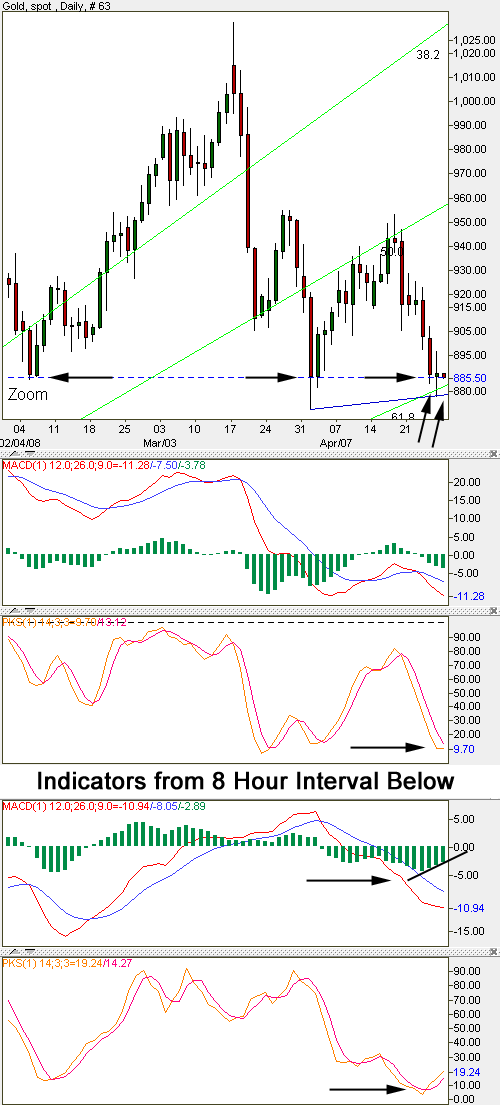
Spot gold daily candle chart with daily and 8 hour indicators
Nitro-Pak Pushes Back Ship Times to 10-18 Days
April 26th, 2008Note: Cryptogon is a Nitro-Pak affiliate.
Nitro-Pak was running only 4-8 days behind for a long time. They just now increased order processing times to 10-18 days.
Like I said, I’m not going to preach about this. Just FYI.
Via: Nitro-Pak:
PLEASE NOTE 04/26/08 UPDATE:
Due to EXTREMELY high customer demand and market volatility, our order processing time for most orders is currently taking 10-18 business days to ship. Orders with food or food units will take longer. Some food items may temporarily be backordered. Thanks for your patience!
Cutoffs and Pleas for Aid Rise With Heat Costs
April 26th, 2008Via: New York Times:
After struggling with soaring heating costs through the winter, millions of Americans are behind on electric and gas bills, and a record number of families could face energy shut-offs over the next two months, according to state energy officials and utilities around the country.
The escalating costs of heating oil, propane and kerosene, most commonly used in the Northeast, have posed the greatest burdens, officials say, but natural gas and electricity prices have also climbed at a time when low-end incomes are stagnant and prices have also jumped for food and gasoline.
In New Hampshire, applicants for fuel subsidies under the federal Low Income Home Energy Assistance Program received an average of $600 in a one-time grant and up to $975 for the extremely poor who rely on heating oil or propane, the costliest fuels. But those grants, which in recent years have covered 60 percent of heating costs, covered only about 35 percent of those costs this winter, said Celeste Lovett, director of the state’s energy aid program. The state will have given aid to about 34,500 people by the end of April, Ms. Lovett said, a 5 percent increase over last year and the highest number ever.
The most immediate challenge is to help the high number of consumers who are far behind in electric and gas payments, said Mark Wolfe, director of the National Energy Assistance Directors’ Association, which represents state aid officials in Washington.
“Based on discussions with major utility companies around the country, we will see record numbers of families facing shut-offs,” Mr. Wolfe said.
Research Credit: JH
Cryptogon Readers Send Contributions
April 26th, 2008Thank you.
MW $20
TM $20
BP $10
Anonymous2 $10
U.S. Cargo Ship Fires Warning Shots at Iranian Boats in Persian Gulf
April 26th, 2008Via: AP:
Oil prices rose sharply Friday on news that a ship under contract to the U.S. Defense Department fired warning shots at two boats in the Persian Gulf. Retail gas prices as expected rose further into record territory, nearing $3.60 a gallon.
Crude prices rose on initial reports that a U.S. ship had fired on two Iranian boats; the news raised concerns that a conflict between U.S. and Iranian forces could cut oil supplies from the region. A Navy spokeswoman said the origin of the boats was unclear.
The news was enough to send light, sweet crude for June delivery up to $119.55 before the contract retreated to settle up $2.46 at $118.52 a barrel on the New York Mercantile Exchange.
The incident worried investors because at first it appeared to be the latest in a series of encounters between U.S. forces and Iranian boats in the Gulf. Early this month, the USS Typhoon fired a flare at an Iranian boat that came within about 200 yards of the ship.
FBI Wants to Move Hunt for Criminals Into Internet Backbone
April 26th, 2008In other words, FBI wants to look for “illegal activity” in the intercepts that the NSA is already collecting.
Via: Ars Technica:
I think legislation has to be developed that balances on one hand, the privacy rights of the individual who are receiving the information, but on the other hand, given the technology, the necessity of having some omnibus search capability utilizing filters that would identify the illegal activity as it comes through and give us the ability to preempt that illegal activity where it comes through a choke point as opposed to the point where it is diffuse on the Internet.
UK: BP Shutting Key Oil, Gas Pipeline System Over Ineos Strike
April 26th, 2008Via: MarketWatch:
BP will begin shutting down its Forties Pipeline System, Saturday night due to a strike at Ineos’ 210,000-barrel-a-day Grangemouth refinery, a BP spokeswoman told Dow Jones Newswires Saturday.
“We will begin ramping down production through Forties overnight tonight,” a BP spokeswoman said.
“(The Forties Pipeline System) is to be completely shut down by 6 a.m. (0500 GMT) tomorrow,” she added.
The closure of the 700,000-barrel-a-day FPS will knock out 40% of the U.K.’s oil production and 25% of its gas supplies.
Workers at Grangemouth plan a 48-hour strike Sunday over changes to an employee pension scheme and have so far refused to maintain crucial power and steam supplies to BP’s Kinneil gas-processing plant, which relies on utilities from the refinery. The Kinneil plant is crucial in processing oil and gas output from the FPS.
Ineos PLC said earlier it planned to meet with union representatives at 0830 GMT for talks over the provision of utilities for Kinneil during the strike.
Talks between Ineos and the Unite union broke down without an agreement Wednesday and no new pension negotiations are scheduled.
The refinery is now fully shut down apart from limited power and steam supplies which remain online for safety reasons, Ineos said Friday.
More: Petrol Stations Run Dry Ahead of Grangemouth Refinery Strike
Computer Security Community Warns High Street Chains
April 26th, 2008Via: Times Online:
High street chains will be the next victims of cyber terrorism, some of the world’s elite hackers have warned.
They claim it is only a “matter of time” before the likes of Tesco and Marks & Spencer are targeted.
Criminals could use the kind of tactics which crippled Estonia’s government and some firms last year, they warned.
The experts were members of the infamous “Hackers Panel” which convened in London this week at the InfoSecurity Europe conference.
The panel includes penetration testers and so-called “white hat” hackers, who help companies tighten up their digital security by searching for flaws in their defences.
Previous panellists include Gary McKinnon, known as Solo, alleged by the US government to have hacked into dozens of US Army, Navy, Air Force, and Department of Defense computers.
The “hackers” usually remain anonymous, “for security reasons”, but this year’s panellists agreed to break cover.
…
“That’s the beauty of asymmetric warfare. You don’t need a lot of money, or an army of people. You can do it from the comfort of your living room, with a beer in your hand.




