U.S. Dollar Falling Down; USDX Under 75
February 1st, 2008WARNING: This is not a recommendation to buy, sell or hold any financial instrument.
“The strategic view still looks promising for dollar bears.”
—A Look at the U.S. Dollar Index, January 17, 2008
Yeee HA! Lean over you pig. Leeeeeeeeeeaaaan! For dollar bears/foreign currency holders: It’s got to take out 74.50 on the downside, though. That’s the all time low. See my mid January analysis on this for more detail on what lies ahead. * chuckle *
And gold is behaving with a shocking gap up. Nice. (I don’t look at the gold charts anymore. Seriously. I don’t. I’m not trading it. Why look at it?)
The resistance on EUR/USD is 1.4967, FYI.
I love it when a plan comes together as much as the next well positioned Cryptogon crash trader, but keep your eye on the action on the dollar. We’re just under 75 now on the U.S. Dollar Index, that’s gooooooood! But we don’t want to see a double bottom on 74.50. Say it with me now! No bounce off 74.50.
I’d be handling snakes and speaking in tongues if I thought it would help that thing take out 74.50. Well, there are no snakes in New Zealand. Does possum count?
Via: Bloomberg:
The dollar fell, headed for its biggest weekly decline in a month against the euro, as traders bet the Federal Reserve will cut interest rates again to avert a recession.
The dollar dropped versus 15 of the 16 most-traded currencies this week, falling the most against the Australian and New Zealand dollars. Growth in U.S. payrolls probably accelerated in January from the weakest pace in more than four years, while staying at a level that indicates a softening job market, economists said before a government report today.
Sold-to-Close: DIA Call Options Strike 133 @ .20
February 1st, 2008WARNING: This is not a recommendation to buy, sell or hold any financial instrument.
How could it possibly go up? Right? With every media source saying we’re in recession and the world is ending, doom, etc… I mean, sure, maybe it is The End.
But, then again, maybe not.
…
I have this thing about being upwind when the media starts a fire. When things look so totally obvious, and the mainstream media is in on it, I just go the other way.
—EMERGENCY: GLOBAL FINANCIAL MARKETS COLLAPSING
Remember those DIA calls that I bought back when the blood was flowing in the streets… I paid .05 for them.
My GTC sell order got taken out at .20 during yesterday’s session. I’m not bragging. I’m worried about those of you out there in Internet land who might be thinking about playing or sticking with DIA long.
I’m going to explain the technical arguments for why this move looks like it might continue, and then the reason why I pulled the plug.
Truth be known: I would have tried to let it ride (after all, this is the options lotto), but my PBW calls (strike 29) aren’t doing so hot. I paid .05 for those and that’s pretty much where they sit. Expiration is still a couple of weeks out, though. I figured I’d take profit on the DIA calls in case the PBW calls don’t work. Bird in the hand… Pigs get slaughtered. Nobody ever went broke taking profit. Etc.
Now, if you were insane/smart/reckless/in-the-know enough to buy calls down there, when the panicked herd was selling everything that wasn’t bolted down, letting greed win out over fear right here might be justified. That is a BIG FAT—might.
Obviously, I considered the following argument myself, but took profit anyway. Let’s be clear: I’m completely out. But, I’ll consider buying puts soon if the daily squiggly wigglies go extreme overbought.
Ok, so here are the arguments for sticking with DIA long:

Squeeze
* There is a daily green candle close above the fib fan AND the 50% fib retracement grid line. Did They paint that candle to get the shorts to give up? I have no idea, but shorts probably needed a change of shorts as they watched that thing develop.
* Daily MACD has crossed up and is diverging, indicating increasing momentum.
* Daily stochastics might be going for a full oscillation, and the oscillator isn’t extreme yet (just under 70).
* Same with daily RSI at 48.8.
* OBV has formed a channel with a slightly positive slope. If I was holding out long, I would want to see that OBV slope a bit steeper. (OBV is one of my favorite indicators, by the way. The volume studies are the key ingredient to the special sauce, I’m pretty sure.)
Now, I don’t know if it’s a deal breaker just yet, but I don’t like how those MAs I’ve applied to the volume are coming back together. If I’m in a trade, I want to see increasing volume with a net flow my way. I know, I apply MAs to my volume. I’m weird that way. This chart leaves a bit to be desired, in terms of believing the volume, even with OBV showing a positive slope. Never mind, of course, that this bounce is an absurd, sucker baiting, whipsaw, clock-cleaning-waiting-to-happen farce. But, bet against short squeezes at your peril.
Remember what I said about buying those calls? Actually, I quoted Blade Runner:
“I’ve seen things you people wouldn’t believe.”
It’s because I know the psychology of short squeezes. They lay on short squeezes when almost EVERYONE believes THE END of the world is upon us. Lots of “dumb money,” meaning retail investors (Their term, not mine), are taking in the meme payload of DOOM from media. Then They paint a few red candles by selling the futures… What do the sheep do? They read the idiot financial press and listen to the money honies and they think, “OH MY GOD, IT IS THE END,” and they sell.
At the bottom. Or a near term bottom.
Now, if I made 300% on that bet, sitting here in my underwear, try to imagine what They’ve made off of this racket! Personally, I doubt that They’ll be able to convince the sheep to go “bargain hunting” because the sheep are too busy worrying about very worrying things. My guess is that more upside will be about decapitating speculators who are playing what I think will ultimately turn out to be a dead cat bounce.
I buy during red candles. I sell during green candles. That’s why I cut my position loose right here. Don’t get me wrong, they could squeeze this thing until those 133s I bought are in the money, but I won’t regret getting out when I did. Here’s why: the reversals off of short squeezes are usually brutal, whip saw moves. They come on suddenly and there’s really no way to see them coming (that I’ve been able to find). That’s why I’m not waiting for stochastics and RSI to go extreme, because the wizards behind the curtain know that lots of slobs who are long still think this move has legs and that the slobs are thinking, a little more, a little more…
Thanks, Jack. I’ll take my .20, my cigarette butts and my bottle caps, but I’m splittin’.
Research Credit: Brad
Brad recommended ThinkorSwim for charts. Indeed, I can create some pretty weird charts with that thing, and get up to some of the antics I used to get up to on the professional platforms. I pull the trigger using TradeKing, because their prices are right, but their chart package blows (and that is kind understatement). Thanks, Brad! Anyway, I created the chart above with the ThinkOrSwim client.
City Sues Man for Canceling Trash Service
January 31st, 2008Via: Examiner:
A man who claims to have reduced his waste to nearly nothing out of concern for the environment now faces a lawsuit from San Carlos for canceling his garbage-collection service.
Eddie House, 53, says he was shocked when he was served with a lawsuit Sunday at his Cedar Street home.
The lawsuit, filed by San Carlos Deputy City Attorney Linda Noeske in San Mateo Superior Court on Jan. 22, seeks a permanent injunction forcing House to maintain garbage service. City officials are also seeking to recoup from House the costs of the lawsuit.
The lawsuit claims House broke the city’s municipal code requiring all residential, commercial and industrial properties to contract with Allied Waste for pickup at least once a week — a standard requirement in most cities, San Carlos Deputy City Manager Brian Moura said.
House says he stopped his service with Allied Waste about a year ago after realizing that his garbage cans were nearly always empty.
“It’s just me and my dog, so I don’t have a whole lot of garbage to begin with and I recycle everything,” he said.
S&P Cuts, May Cut Up to $534 Billion of Subprime Bonds
January 31st, 2008Via: Reuters:
Standard & Poor’s on Wednesday said it cut or may cut its ratings on $270 billion worth of U.S. mortgage-backed securities while putting $264 billion of collateralized debt obligations on watch for a possible downgrade.
The ratings action affects 6,389 classes of U.S. residential mortgage-backed securities backed by first-lien subprime loans and 1,953 ratings from 572 global CDOs backed by asset-backed securities and other CDOs.
S&P’s actions on mortgage-backed securities follow its announcement on January 15 of further changes and planned changes to its methods for analyzing mortgage-backed securities and CDOs, respectively.
Earlier this month, S&P raised its expectations of losses on subprime loans originated in 2006 to 19 percent from 14 percent.
“Today’s rating actions incorporate our most recent economic assumptions and reflect our expectation of further defaults and losses on the underlying mortgage loans,” S&P said.
S&P slashed the ratings on $34.7 billion of RMBS originated in 2006 while placing another $136 billion under review for potential downgrade. In addition, S&P cut $15.4 billion of RMBS securities from 2007, while placing $34.8 billion on review for downgrade, it said. In addition, it affirmed the ratings on 1,735 RMBS classes from 2006 and 691 RMBS tranches from 2007.
The rating agency said the CDO downgrades and credit reviews were a result of RMBS credit deterioration and overall stress affecting the residential mortgage market. CDO managers were large buyers of RMBS, which they layered into their securities over recent years.
“The housing market, especially the subprime sector, will continue to decline before it improves and housing prices will come under stress,” said S&P. “We expect losses to continue to increase with borrowers experiencing rising loan payments as adjustable rate mortgages reset.”
Tough Call: Sold DBA
January 31st, 2008WARNING: This is not a recommendation to buy, sell or hold any financial instrument.
Just a quick FYI: I took profit on my entire DBA position. It could easily go higher (Bullish Fibonacci fans intact no matter how you draw them, and beginnings of a symmetrical triangle?), but we have a lower high on the daily chart, lower volume on each of the past four up days and MACD cross down. It may also be about to BARF. Taken together, I started to believe the fear that I’ve had for a while about the weekly chart being way overdone. I’ll look at buying it again when the weekly stochastics and RSI unwind.
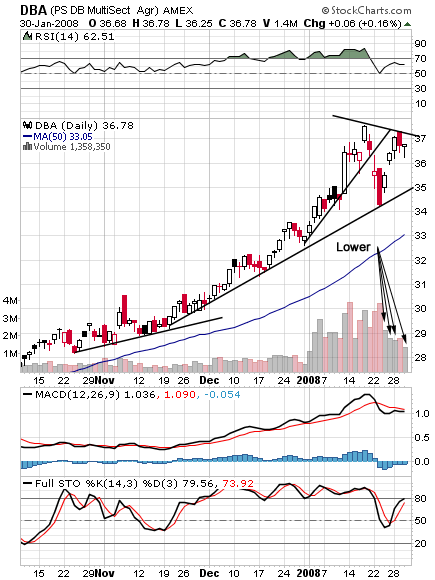
DBA Daily
Best of luck to DBA traders.
Cut Fiber: Internet Services in India and Egypt Disrupted
January 30th, 2008Via: Reuters:
A breakdown in an international undersea cable network badly disrupted Internet links to India and Egypt on Wednesday.
Egypt’s Telecommunications Ministry said a communications cable in the Mediterranean was cut, disrupting 70 percent of the country’s Internet network.
The ministry said in a statement it was not known how the cable was cut but that services would probably take several days to return to normal.
India reported serious disruptions to its services and one Indian Internet service provider linked the problem to the Egyptian outage.
“There has been a cable cut on several cable systems in Alexandria, Egypt which has impacted internet connectivity in India,” Videsh Sanchar Nigam Ltd (VSNL), an internet service provider, said in a statement.
VSNL said its service had been “largely restored” by diverting to another cable.
India said it had lost more than half of its capacity.
“There has been a 50 to 60 percent cut in bandwidth,” Rajesh Chharia, president of the Internet Service Providers’ Association of India, told Reuters.
He told the Headlines Today news channel that a “degraded” service would be activated by Wednesday night, but full restoration will take 10 to 15 days.
Chharia said companies, including some of India’s many outsourcing businesses, had been affected.
Former Chief Global Strategist at Morgan Stanley: Head for the Hills
January 30th, 2008Via: Bloomberg:
Barton Biggs has some offbeat advice for the rich: Insure yourself against war and disaster by buying a remote farm or ranch and stocking it with “seed, fertilizer, canned food, wine, medicine, clothes, etc.”
The “etc.” must mean guns.
“A few rounds over the approaching brigands’ heads would probably be a compelling persuader that there are easier farms to pillage,” he writes in his new book, “Wealth, War and Wisdom.”
Biggs is no paranoid survivalist. He was chief global strategist at Morgan Stanley before leaving in 2003 to form hedge fund Traxis Partners. He doesn’t lock and load until the last page of this smart look at how World War II warped share prices, gutted wealth and remains a warning to investors. His message: Listen to markets, learn from history and prepare for the worst.
Research Credit: BW
Poor Haitians Resort to Eating Dirt
January 30th, 2008Via: AP:
It was lunchtime in one of Haiti’s worst slums, and Charlene Dumas was eating mud. With food prices rising, Haiti’s poorest can’t afford even a daily plate of rice, and some take desperate measures to fill their bellies. Charlene, 16 with a 1-month-old son, has come to rely on a traditional Haitian remedy for hunger pangs: cookies made of dried yellow dirt from the country’s central plateau.
The mud has long been prized by pregnant women and children here as an antacid and source of calcium. But in places like Cite Soleil, the oceanside slum where Charlene shares a two-room house with her baby, five siblings and two unemployed parents, cookies made of dirt, salt and vegetable shortening have become a regular meal.
“When my mother does not cook anything, I have to eat them three times a day,” Charlene said. Her baby, named Woodson, lay still across her lap, looking even thinner than the slim 6 pounds 3 ounces he weighed at birth.
Though she likes their buttery, salty taste, Charlene said the cookies also give her stomach pains. “When I nurse, the baby sometimes seems colicky too,” she said.
Food prices around the world have spiked because of higher oil prices, needed for fertilizer, irrigation and transportation. Prices for basic ingredients such as corn and wheat are also up sharply, and the increasing global demand for biofuels is pressuring food markets as well.
The problem is particularly dire in the Caribbean, where island nations depend on imports and food prices are up 40 percent in places.
The global price hikes, together with floods and crop damage from the 2007 hurricane season, prompted the U.N. Food and Agriculture Agency to declare states of emergency in Haiti and several other Caribbean countries. Caribbean leaders held an emergency summit in December to discuss cutting food taxes and creating large regional farms to reduce dependence on imports.
At the market in the La Saline slum, two cups of rice now sell for 60 cents, up 10 cents from December and 50 percent from a year ago. Beans, condensed milk and fruit have gone up at a similar rate, and even the price of the edible clay has risen over the past year by almost $1.50. Dirt to make 100 cookies now costs $5, the cookie makers say.
Still, at about 5 cents apiece, the cookies are a bargain compared to food staples. About 80 percent of people in Haiti live on less than $2 a day and a tiny elite controls the economy.
Merchants truck the dirt from the central town of Hinche to the La Saline market, a maze of tables of vegetables and meat swarming with flies. Women buy the dirt, then process it into mud cookies in places such as Fort Dimanche, a nearby shanty town.
Carrying buckets of dirt and water up ladders to the roof of the former prison for which the slum is named, they strain out rocks and clumps on a sheet, and stir in shortening and salt. Then they pat the mixture into mud cookies and leave them to dry under the scorching sun.
The finished cookies are carried in buckets to markets or sold on the streets.
A reporter sampling a cookie found that it had a smooth consistency and sucked all the moisture out of the mouth as soon as it touched the tongue. For hours, an unpleasant taste of dirt lingered.
Assessments of the health effects are mixed. Dirt can contain deadly parasites or toxins, but can also strengthen the immunity of fetuses in the womb to certain diseases, said Gerald N. Callahan, an immunology professor at Colorado State University who has studied geophagy, the scientific name for dirt-eating.
Haitian doctors say depending on the cookies for sustenance risks malnutrition.
“Trust me, if I see someone eating those cookies, I will discourage it,” said Dr. Gabriel Thimothee, executive director of Haiti’s health ministry.
Marie Noel, 40, sells the cookies in a market to provide for her seven children. Her family also eats them.
“I’m hoping one day I’ll have enough food to eat, so I can stop eating these,” she said. “I know it’s not good for me.”
Related: The Failed State and You
Washington Post: Identities of Storm Worm Operators Are Known to Authorities
January 30th, 2008This is interesting, but take your pick about what to believe.
Via: Washington Post:
Dmitri Alperovitch, director of intelligence analysis and hosted security for San Jose, Calif.-based Secure Computing, said federal law enforcement officials who need to know have already learned the identities of those responsible for running the Storm worm network, but that U.S. authorities have thus far been prevented from bringing those responsible to justice due to a lack of cooperation from officials in St. Petersburg, Russia, where the Storm worm authors are thought to reside. In a recent investigative series on cyber crime featured on washingtonpost.com, St. Petersburg was fingered as the host city for one of the Internet’s most profligate and cyber-crime enabling operation — the Russian Business Network.
Alperovitch blames the government of Russian President Vladimir Putin and the political influence of operatives within the Federal Security Service (the former Soviet KGB) for the protection he says is apparently afforded to cybercrime outfits such as RBN and the Storm worm gang.
“The right people now know who the Storm worm authors are,” Alperovitch said. “It’s incredibly hard because a lot of the FSB leadership and Putin himself originate from there, where there are a great deal of people with connections in high places.”
FBI Investigates Sub-Prime Crisis
January 30th, 2008Things started to get interesting when They sent a memo to all employees on what to say to anyone who presented themselves as auditors or investigators. We were to refer them to some flunkie.
I thought, “Oh goodie, we’re going to get raided by a three-letter agency and guys wearing guns and blue wind-breakers are going to wheel the servers out on dollies! PHBs are going to be handcuffed and frog marched into a waiting paddy wagon!”
—Life Inside a Wall Street Chop Shop
I’ve set up a news alert for “FBI subprime [Name of Wall Street Megafirm that I used to work for]”. That company was one of the ringleaders of the securitization racket. That’s why They were in the subprime game in the first place. They weren’t interested in actually making the loans. The BIG money was made in selling the toxic waste to some sucker (bank, pension fund, insurance company, clueless country) at the end of the month. Every month. It will be very interesting to see how They get out of this one—which They will, I have no doubt.
My guess is that They have devised plans to frame the executive management staffs of the subprime firms They acquired. Oh man. It all makes sense now. I used to think, “Why are They keeping these coked-out slobs around?”
Patsies.
The Porsche driving A-holes—that came with the acquisitions—are probably going to be the patsies.
Via: BBC:
The FBI is investigating 14 companies embroiled in the sub-prime mortgage crisis as part of a crackdown on improper lending.
It did not identify the companies but said the investigation encompassed developers, sub-prime lenders and investment banks.
FBI officials said the agency was looking at instances of accounting fraud and insider trading.
The cases could lead to potential civil or criminal charges, the FBI said.
The FBI said it viewed mortgage fraud as an increasing threat to the national economy.
It said that there had been 1,200 cases of mortgage fraud for the 2007 financial year compared with just 400 in 2006.
The crisis in the sub-prime lending market has hit financial markets worldwide.
Joint investigation
The FBI said it was investigating the cases with the US market regulator, the Securities and Exchange Commission.
The SEC has opened about three dozen investigations into the collapse of the sub-prime market.
Targets of the SEC probe include Swiss bank UBS and US banks Morgan Stanley, Merrill Lynch and Bear Stearns, Reuters news agency reported.
It was not clear whether any of these firms were involved in the FBI investigation.
The sub-prime market is focused on providing home loans to those with poor or limited credit histories.
Many of these borrowers have been unable to keep up with payments and face losing their homes.
The wider crisis emerged as many of these mortgages were converted into financial instruments and sold on to investors including the big investment banks.
Defaults on these loans caused a steep drop in the value of related investments and has led to more than $100bn of losses at banks worldwide.




