Gold: Strong Rally
December 27th, 2007WARNING: This is not a recommendation to buy, sell or hold any financial instrument.
We’ve got gold in strong rally right now. It’s still range bound, but keep $845 in mind. That’s the overhead resistance.
The current move is happening on thin, holiday order flows. I find it interesting that some players see the need to take long positions right now; during a low liquidity time to trade. It’s even more interesting if you read Paul Tustain’s recent analysis with December 31, 2007 as a date to watch. Indeed, the media is talking about the weak dollar, but the dollar is well off recent lows. My guess is that this is much more about Sterling and Euro holders who are frightened by those central banks’ recent decision to strap themselves to the mast of the sinking dollar.
Where oh where is all of that paper going to go??? * chuckle *
Let me check my crystal ball:
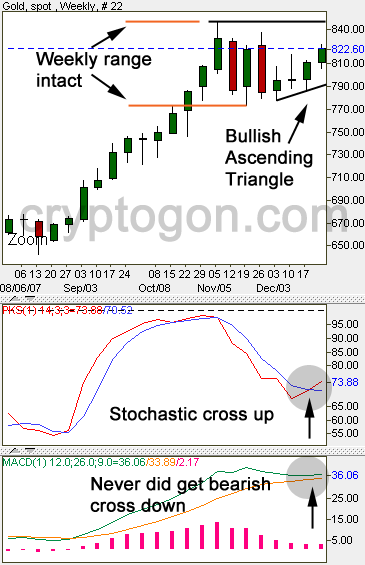
From a technical perspective, the argument for long is stronger than the argument for short.
That weekly stochastic cross up is probably a good sign for gold longs. Of course, a by-the-book-reading of this is that it’s not significant because it happened with the oscillators in the 70s. The traditional bullish trigger for the slow stochastic is a cross under 20. But why might we not write off this higher band cross?
Look at the MACD. It never turned down. Momentum slowed, but it didn’t cross down.
Next, the weekly range is intact.
Finally, a bullish ascending triangle (higher lows under a significant overhead resistance) appears to be gearing up for a run at $845.
Alternative explanation: Of course, this could be short interests trying to squeeze prices higher on some low volume sessions in order to short from higher highs. That seems unlikely, though, because of the several green weekly candles in a row giving us a positive slope. Watch the line that describes the positive slope underneath the lows. If red candles start bleeding through to the down side, the support to watch is $773, with a drop dead stop at $765. Under $765, I would stop accumulating until much lower lows were reached.
Note the word accumulating. I’m not trading gold. I actually wish it would go lower so I could buy more. Yes, diversification is critical.
Via: Reuters:
Gold soared to a one-month peak in U.S. trade Wednesday, driven by strong oil prices and a weak dollar, and platinum hit record highs on lingering supply concerns.
Trading volumes were thin, however, with U.K. precious metals markets closed for the post-Christmas Boxing Day and many U.S. traders and investors away, or keeping light positions, due to year-end holidays.
Most-active gold futures for February were up $12 or 1.3 percent to $828.50 an ounce on the COMEX metals division of the New York Mercantile Exchange by 10:55 a.m. EST, for a session high as well as new peak since November 27.
COMEX platinum for January was up $11.70 or 0.8 percent at $1,547.90 an ounce after hitting a record high of
$1,550.
Dealers of precious metals in New York attributed the rally to the run-up in oil due to the escalating Turkish-Kurdish conflict and declining U.S. crude inventories.
The weakness in the dollar was also a supporting factor.
Cryptogon Readers Send Contributions
December 27th, 2007Over the last several days, Cryptogon readers sent the following contributions:
Pookie $57
Eileen $50
MW $20
TH $12
PR $50
CP $20
KM $50
BW $100
Eileen $50
Wow! Thank you all very much.
I took a few moments to share a bit of the wealth that you have provided to me with others who are doing outstanding work:
It’s up to all of us to support people who are doing good work, raising consciousness and living thoughtfully.
If we don’t do it, who will?
Home Prices Post Record Annual Drop
December 27th, 2007Captain Obvious strikes again.
Via: Reuters:
Prices of existing U.S. single-family homes recorded their biggest annual drop in October, suggesting the housing slump is far from over, a national home price gauge released on Wednesday showed.
The Standard & Poor’s/Case-Shiller year-over-year index of 10 metropolitan areas fell to 209.68 in October, down 6.7 percent from a year earlier. The decline surpassed the 6.3 percent drop in April 1991.
“No matter how you look at these data, it is obvious that the current state of the single-family housing market remains grim,” said Robert Shiller, chief economist at MacroMarkets LLC, in a statement.
The firms’ newer, composite home price index on 20 metropolitan areas declined to 192.89 in October, down 6.1 percent from a year ago.
On a month-over-month basis, both indexes lost 1.4 percent in October compared with September.
The bleak housing data spurred more selling in stocks, which were already under downward pressure on worries over weak Christmas tallies among retailers. Bond prices were also stuck in the red, as the data failed to stoke hopes of more interest rate cuts from the Federal Reserve.
Eleven of the 20 metropolitan areas recorded their largest monthly decline on record in October, led by San Diego, where home prices fell 2.6 percent, according to S&P/Case-Shiller.
On an annual basis, single-family home prices in Miami recorded the biggest decline, down 12.4 percent in October, followed by Tampa with an 11.8 percent fall.
New York Town Lets Poor Seniors Work to Pay Property Taxes
December 27th, 2007This is an unusually grim story, even by my standards. What’s the innovative solution for seniors who are lonely, broke and unable to pay their property taxes? Have them work for penury for the tax man!
Of course, the ghastly Associated Press represents this as a human interest/happy ending story. The seniors get to hang out in the community (working), and everyone benefits… Sure, it’s part of a revenue collection scheme, but isn’t it nice? Of course, people can’t even remember when elders were revered and integrated into the fabric of everyday life, or know that, in many countries, any politicians who suggested something like this would be taken out and shot on the spot. No. America is different.
What’s next? Positive spin on a minimum income law? Maybe the benefits to society of debtors prisons…
Just FYI: In New Zealand, in and around the more affluent areas, people who have owned properties for generations are being rated off their land. (In NZ, property taxes are called rates.) As long as property values increase, property taxes increase. Some farmers who make modest livings on land near the big cities are seeing increasing amounts of income being swallowed up in rate payments because of the skyrocketing values of property here. This is forcing them to choose between: 1) More intensive/destructive agriculture, or 2) selling/sub-dividing their property.
Via: AP:
Audrey Davison lives alone, gets a $620 Social Security check each month and worries about the sharply rising taxes on her four-bedroom house. Davison, 76, raised her family there and after 43 years, she really doesn’t want to leave Greenburgh.
Greenburgh doesn’t want her to leave, either.
The town is pushing a program that would let seniors work part-time, for $7 an hour, to help pay off some of their property taxes.
“People shouldn’t have to sell their house, move away to a place with less taxes, leave behind their family and friends,” said Town Supervisor Paul Feiner.
He envisions retired doctors mentoring schoolchildren, retired accountants helping with the town’s finances, retired lawyers offering their services for a discount. But there are plenty of less-skilled jobs that need doing, he said.
“It’s not like we’re going to see grandma running the snowplow,” he said. “There are lots of things people can do for the town and it wouldn’t cost us that much to pay them.”
The proposal has caused a stir in Greenburgh, a town of 90,000 in Westchester County, which has the nation’s third-highest homeowner property taxes. The plan would be unusual if not unique in New York, but similar programs are considered successes in Colorado, Massachusetts, South Carolina and elsewhere.
Davison, who suffers from arthritis and sciatica and needs a walker to get around on her bad days, said she pays about $12,000 a year in property taxes — perhaps $2,000 to the town — and has already taken out a reverse mortgage to pay her bills.
Talking to Feiner last week at the town senior center, she said, “I would work as long as it was a job where I could sit.”
“You could be a receptionist!” Feiner said. “You could greet people right here, when they come in.”
“That I would love,” Davison said.
Soil and Health Library
December 26th, 2007The Soil and Health Library represents the most astonishing collection of materials on small scale agriculture and homesteading that I have ever come across. And that’s just the beginning of what’s on offer.
Special thanks to IL for telling me about this digital library.
Train Wreck Imminent?
December 26th, 2007WARNING: This is not a recommendation to buy, sell or hold any financial instrument.
Paul Tustain is the Director of BullionVault. He recently sent this email out to BullionVault clients.
I am a BullionVault client and affiliate:
Hello,
Seasons Greetings from all of us here at BullionVault.
I append a few thoughts concerning prosperity in the New Year.
Next week may hold some unpleasant surprises for some, and I think you may profit from an early warning.
Kind regards
Paul Tustain
Director, BullionVault
Train Wreck Imminent?
=====================
We learned yesterday that the British government’s guarantee to bail out Northern Rock’s creditors is worth a staggering £100 billion. That’s £5,000 [$10,000] per British household. This week the European Central Bank made $500 billion available through money market operations. And only last week $110bn of new money was created by central bank loans with artificially low rates and reduced-quality security. This is money creation on an epic scale.
Why is this happening now? Here’s my theory: 31st December is a major day on the financial calendar. If you take a sample of bonds you’ll find that a disproportionate number of them are due for interest and/or redemption on 31st December. Redeeming bonds is very cash intensive, and cash is not freely available in the banking system right now.
So it seems likely that some frantic finance directors will be working long hours to find the cash that will enable them to avoid a default next week.
If that’s right the festive season could see the announcement of some nasty shocks. June 30th won’t be much fun either, for the same reasons. The credit crunch is deepening, and will go on doing so until at least next summer.
For those of us who like to take responsibility for ourselves (it’s called freedom by the way) it’s getting just a little tiresome that money creation is diluting our savings, and making us pay – again – for the excesses of the buy-now-think-later generation. Some of us would prefer to see the government react with a shrug and a sympathetic “bad luck” to the losers in the next financial train wreck. But it’s not the mood of the nation. Politicians have begun one of their competitive caring phases, and they’re rescuing victims everywhere. Every clapped out bank, every busted pension scheme, every industrial zombie, and absolutely every government department will be nurtured in the warm embrace of the public purse.
This causes a natural backlash. Issuing new money reduces depositors’ returns, prompting savers to switch to better stores of wealth. This capital flight should be easy to spot, but modern economic statistics can obscure it. You see, the main way economists measure economic health is by counting the money spent in the economy, and now that savers are dumping currency (and buying better wealth stores) the effect is tough to distinguish from the economist’s beloved GDP growth. Our healthy GDP figures are a distortion, and the economy is not making a steady booming noise but an ominous hissing – the noise of savers abandoning the currency.
You can see this at the key entry points to the real economy:
1. Oil is multiplying in price.
2. All the grains are multiplying in price.
3. All the base metals are multiplying in price.
4. Gold is multiplying in price.
5. Producer prices are through the roof.
In spite of this the monetary authorities are racing to issue more money, and economists are clamouring for cuts in interest rates. They’re caught ‘twixt the devil and the deep blue sea, because although they could address these serious inflationary indicators, doing so risks the revenge of a giant economic threat – a rout in the housing market. And that would mean depression.
So it looks increasingly likely that low rates are staying, and the hot global investment money, sucked in by Britain’s recent and comparatively high interest rates, is about to quit Britain and send the currency into a tailspin. This produces higher prices for imported goods. At the same time our public finances are in a serious mess, and the biggest contributor to our service-based economy – the City – is the main victim of current turbulence. And please don’t ask about the trade figures because they’re just ugly.
It is becoming genuinely possible that people will refuse to hold sterling for more than a fleeting moment. Inflation could turn so severe that the ‘hyper’ prefix is justified.
I know – it’s too far-fetched to be believable. Or is it? For 150 years the values of Western currencies have stayed way above purchasing power parity levels with Asia. Being a developed country is what drove this premium, as money flowed down a one way street to our advanced economies. These were the only places where sophisticated products could be built or bought.
Today things are different. You could measure circuit board production in two factories in Indonesia and in Britain, and get the output per worker priced in local currency. Multiply both by their conversion rate into US dollars, and the British factory seems to have produced 5 – 7 times more US dollar denominated output. So our GDP looks good, but only through the distorting lens of a western currency conversion. There’s another way to measure that same output: simply count the circuit boards. Do that and you’ll see there’s no material difference in productivity between a British and an Indonesian worker. Perhaps the root cause of western currency premium has evaporated, and the anomaly is now that sterling really is 5 – 7 times overvalued against Asian money.
You could switch to euros. But looking at their policy they’re creating as much money as the Bank of England. And the US Federal Reserve is doing it too, while all of Asia is battling to hold down their currencies so that their exports can continue apace. It’s a bizarre race to the bottom for the world’s currencies.
It’s time to sidestep the financial consequences of this largesse. What can we savers do?
If you’re as bothered as I am, then currency should be struck off your Christmas list and replaced with something more reliably rare. I think gold could soon look so highly priced in sterling that many of us will be too frightened to buy it. But it isn’t there yet, so perhaps buy just a little now, and if it makes you a small profit it will be easier to buy a little more next month. If that makes you a profit too, then allow yourself to build a proper stash. I’m not sure we’ll ever again be able to buy it for much under £400 an ounce.
I have just instructed my bank to transfer all my remaining cash deposits to BullionVault to Buy Gold, and I look forward to spending 2008 long gold and completely sterling free.
Paul Tustain, 20 Dec ’07
Suburban Tent Cities
December 26th, 2007Via: Reuters:
Between railroad tracks and beneath the roar of departing planes sits “tent city,” a terminus for homeless people. It is not, as might be expected, in a blighted city center, but in the once-booming suburbia of Southern California.
The noisy, dusty camp sprang up in July with 20 residents and now numbers 200 people, including several children, growing as this region east of Los Angeles has been hit by the U.S. housing crisis.
The unraveling of the region known as the Inland Empire reads like a 21st century version of “The Grapes of Wrath,” John Steinbeck’s novel about families driven from their lands by the Great Depression.
As more families throw in the towel and head to foreclosure here and across the nation, the social costs of collapse are adding up in the form of higher rates of homelessness, crime and even disease.
While no current residents claim to be victims of foreclosure, all agree that tent city is a symptom of the wider economic downturn. And it’s just a matter of time before foreclosed families end up at tent city, local housing experts say.
“They don’t hit the streets immediately,” said activist Jane Mercer. Most families can find transitional housing in a motel or with friends before turning to charity or the streets. “They only hit tent city when they really bottom out.”
Steve, 50, who declined to give his last name, moved to tent city four months ago. He gets social security payments, but cannot work and said rents are too high.
“House prices are going down, but the rentals are sky-high,” said Steve. “If it wasn’t for here, I wouldn’t have a place to go.”
‘SQUATTING IN VACANT HOUSES’
Nationally, foreclosures are at an all-time high. Filings are up nearly 100 percent from a year ago, according to the data firm RealtyTrac. Officials say that as many as half a million people could lose their homes as adjustable mortgage rates rise over the next two years.
California ranks second in the nation for foreclosure filings — one per 88 households last quarter. Within California, San Bernardino county in the Inland Empire is worse — one filing for every 43 households, according to RealtyTrac.
Maryanne Hernandez bought her dream house in San Bernardino in 2003 and now risks losing it after falling four months behind on mortgage payments.
“It’s not just us. It’s all over,” said Hernandez, who lives in a neighborhood where most families are struggling to meet payments and many have lost their homes.
She has noticed an increase in crime since the foreclosures started. Her house was robbed, her kids’ bikes were stolen and she worries about what type of message empty houses send.
The pattern is cropping up in communities across the country, like Cleveland, Ohio, where Mark Wiseman, director of the Cuyahoga County Foreclosure Prevention Program, said there are entire blocks of homes in Cleveland where 60 or 70 percent of houses are boarded up.
“I don’t think there are enough police to go after criminals holed up in those houses, squatting or doing drug deals or whatever,” Wiseman said.
“And it’s not just a problem of a neighborhood filled with people squatting in the vacant houses, it’s the people left behind, who have to worry about people taking siding off your home or breaking into your house while you’re sleeping.”
Health risks are also on the rise. All those empty swimming pools in California’s Inland Empire have become breeding grounds for mosquitoes, which can transmit the sometimes deadly West Nile virus, Riverside County officials say.
Research Credit: Idleworm
Christmas Miracle: Shane MacGowan Turns 50
December 25th, 2007If this piss drunk maniac can live to see 50, it indicates to me that ANYTHING is possible.
Happy Christmas!*

Shane MacGowan
Via: AFP:
The Pogues singer Shane MacGowan, whose Christmas song “Fairytale of New York” remains a classic hit, told a newspaper he never thought he would live to celebrate his 50th birthday Tuesday.
“Smoking, drinking, partying — that’s why I’ve stayed alive as long as I have,” the hard-boozing MacGowan told Britain’s Daily Mirror, while flat out on his back in a trashed London hotel room.
“And I’ve got better with age, that’s what’s meant to happen. I party my way through life, it’s what I like to do.
“To be honest, I never thought too much about getting to 50. But if everyone keeps making bets that you are going to die at 4:30 tomorrow afternoon, you just tend to think ‘F(expletive) it, I’m not going to die as long as those f(expletive) are alive’.”
The Irishman said in the interview published Monday that he planned to celebrate his Christmas Day birthday in trademark style.
“I’ll just drink wine, cider and gin — and anything else I can find,” he said.
Irish folk-rock group The Pogues’ 1987 festive hit “Fairytale of New York” has been in the headlines recently after the BBC Radio 1 station bleeped out the words “slut” and “faggot”, before reversing the decision in the face of criticism.
The furore helped propel the song to number four in the British music charts this Christmas.
“That’s just typical of the way this country is going down. I mean, it’s practically a police state,” MacGowan said.
The frontman reckoned boozing was good for his voice.
“I was actually four when I started drinking,” he said.
“There have been loads of times when I was doing loads of acid when I didn’t drink so much, but I don’t like not having a drink around.”
MacGowan said he does not have own mobile phone, a computer or an iPod, but might treat himself to some teeth in the new year. MacGowan’s mouth is rock’s most notorious dental disaster zone.
“I am going to get my teeth done — emergency dentures to stop my face falling apart,” he said.
The Voice of God Weapon
December 25th, 2007Via: Wired:
The Voice of God weapon — a device that projects voices into your head to make you think God is speaking to you — is the military’s equivalent of an urban myth. Meaning, it’s mentioned periodically at defense workshops (ironically, I first heard about it at the same defense conference where I first met Noah), and typically someone whispers about it actually being used. Now Steven Corman, writing at the COMOPS journal, describes his own encounter with this urban myth:
At a government workshop some time ago I head someone describe a new tool that was described as the “voice of Allah.” This was said to be a device that would operate at a distance and would deliver a message that only a single person could hear. The story was that it was tested in a conflict situation in Iraq and pointed at one insurgent in a group, who whipped around looking in all directions, and began a heated conversation with his compatriots, who did not hear the message. At the time I greeted this story with some skepticism.
Is there any basis to this technology? Well, Holosonic Research Labs and American Technology Corporation both have versions of directed sound, which can allow a single person to hear a message that others around don’t hear. DARPA appears to be working on its own sonic projector. Intriguingly, Strategy Page reports that troops are using the Long Range Acoustic Device as a modified Voice of God weapon:
It appears that some of the troops in Iraq are using “spoken” (as opposed to “screeching”) LRAD to mess with enemy fighters. Islamic terrorists tend to be superstitious and, of course, very religious. LRAD can put the “word of God” into their heads. If God, in the form of a voice that only you can hear, tells you to surrender, or run away, what are you gonna do?
And as Corman also notes, CNET recently wrote about an advertisement in New York for A&E’s TV show Paranormal State, which uses some of this technology. Beyond directed sound, it’s long been known that microwaves at certain frequencies can produce an auditory effect that sounds like it’s coming from within someone’s head (and there’s the nagging question of classified microwave work at Brooks Air Force Base, that the Air Force stubbornly refuses to talk about).
“Adverse Self-Reinforcing Dynamic”: Financial Crisis May Make 1929 Look a “Walk in the Park”
December 25th, 2007Some Christmas cheer from the Telegraph.
Via: Telegraph:
Twenty billion dollars here, $20bn there, and a lush half-trillion from the European Central Bank at give-away rates for Christmas. Buckets of liquidity are being splashed over the North Atlantic banking system, so far with meagre or fleeting effects.
As the credit paralysis stretches through its fifth month, a chorus of economists has begun to warn that the world’s central banks are fighting the wrong war, and perhaps risk a policy error of epochal proportions.
“Liquidity doesn’t do anything in this situation,” says Anna Schwartz, the doyenne of US monetarism and life-time student (with Milton Friedman) of the Great Depression.
“It cannot deal with the underlying fear that lots of firms are going bankrupt. The banks and the hedge funds have not fully acknowledged who is in trouble. That is the critical issue,” she adds.
Lenders are hoarding the cash, shunning peers as if all were sub-prime lepers. Spreads on three-month Euribor and Libor – the interbank rates used to price contracts and Club Med mortgages – are stuck at 80 basis points even after the latest blitz. The monetary screw has tightened by default.
York professor Peter Spencer, chief economist for the ITEM Club, says the global authorities have just weeks to get this right, or trigger disaster.
“The central banks are rapidly losing control. By not cutting interest rates nearly far enough or fast enough, they are allowing the money markets to dictate policy. We are long past worrying about moral hazard,” he says.
“They still have another couple of months before this starts imploding. Things are very unstable and can move incredibly fast. I don’t think the central banks are going to make a major policy error, but if they do, this could make 1929 look like a walk in the park,” he adds.
The Bank of England knows the risk. Markets director Paul Tucker says the crisis has moved beyond the collapse of mortgage securities, and is now eating into the bedrock of banking capital. “We must try to avoid the vicious circle in which tighter liquidity conditions, lower asset values, impaired capital resources, reduced credit supply, and slower aggregate demand feed back on each other,” he says.
New York’s Federal Reserve chief Tim Geithner echoed the words, warning of an “adverse self-reinforcing dynamic”, banker-speak for a downward spiral. The Fed has broken decades of practice by inviting all US depositary banks to its lending window, bringing dodgy mortgage securities as collateral.
Quietly, insiders are perusing an obscure paper by Fed staffers David Small and Jim Clouse. It explores what can be done under the Federal Reserve Act when all else fails.
Section 13 (3) allows the Fed to take emergency action when banks become “unwilling or very reluctant to provide credit”. A vote by five governors can – in “exigent circumstances” – authorise the bank to lend money to anybody, and take upon itself the credit risk. This clause has not been evoked since the Slump.




