Cryptogon Reader Signs Up for Hosting with Blue Host
December 6th, 2007Thanks to the owner of Orgonise Africa for signing up for webhosting with Blue Host. Cryptogon received $65 as a result.
Cryptogon Reader Sends $10
December 6th, 2007Thanks AB.
U.S. Department of Defense Acquiring System to Scan Irises of Many People in a Crowd at Once
December 6th, 2007Wave your stupid sign and smile for the birdy. Congratulations, you’re now f*cked for life.
Enjoy your protest, though.
Via: USA Today:
A growing number of sheriff’s departments are using iris scans to identify sex offenders, runaways, abducted children and wandering Alzheimer’s patients.
More than 2,100 departments in 27 states are taking digital pictures of eyes and storing the information in databases that can be searched later to identify a missing person or someone who uses a fake name, says Sean Mullin, president of BI{+2} Technologies, which sells the devices.
“It’s evolving quickly,” he says. Most of the sheriffs are doing voluntary iris scans of senior citizens and children.
At least 10 metro areas are doing scans of criminals to identify them should another crime occur or to be sure the right inmate is released.
“This is the wave of the future. This will become as common as fingerprinting,” says Sheriff Greg Solano of Santa Fe County, N.M. Last month, his department began scanning the irises of convicted sex offenders. He says the level of detail and central database can make matches within seconds, compared with weeks for fingerprints and months for DNA.
Iris recognition technology has been used by airports to expedite security checks of low-risk travelers and by the government to track possible terrorists. When a patent expired last year, other companies rushed in to expand its uses.
“We’re seeing tremendous growth,” says Barry Morse, CEO of Retica Systems, because of concerns about terrorism, immigration and identity theft.
Mullin says the laptop, camera and software cost $10,000. The cameras use harmless infrared light to record the iris’ minute ridges and valleys. They can detect 235 unique details and differentiate between right and left eyes and those of identical twins, Mullin says. A fingerprint has about 70 details.
Irises aren’t affected by age, Lasik eye surgery or disease.
The widening use of iris recognition concerns privacy advocates. Some advocates for children say it could give parents a false sense of security.
“It’s part of the growing surveillance society. We’re going to be identified and tracked everywhere we go,” says Barry Steinhardt, technology program director at the American Civil Liberties Union.
Morse says his company will deliver test devices to the Defense Department next year that will allow it to scan a crowd and store iris data for many people at once.
Mullin says the technology has not identified a missing person because the database is small, but it is gaining more than 2,000 scans every week.
Fed About to Drown U.S. Dollar Holders with “Liquidity”
December 6th, 2007Via: Bloomberg:
Federal Reserve officials, who are forecast to lower their main interest rate next week, are signaling that they are looking for additional ways to increase credit to companies and consumers.
The Fed may lower the discount rate — what it charges banks for short-term direct loans — by a quarter-point more than the benchmark rate after Vice Chairman Donald Kohn and San Francisco Fed President Janet Yellen publicly expressed frustration that previous rate cuts haven’t encouraged banks to lend to one another.
Such a move would narrow the gap between the two rates — normally 1 percentage point — to a quarter-point. Economists said that may spur lending by easing the stigma of borrowing at the discount rate, letting firms claim they are taking advantage of a better deal.
“The Fed has to re-liquefy the markets to reduce the risk of a financial accident,” said Lou Crandall, who used to work at the New York Fed and is now chief economist at Wrightson ICAP LLC, a Jersey City, New Jersey-based research firm that focuses on government debt.
Policy makers are struggling to contain a crisis of confidence among banks that sent the cost of three-month loans between lenders to the highest in seven years.
Subprime Mortgage Crisis: U.S. Takes Page from Banana Republic Playbook
December 6th, 2007WARNING: This is not a recommendation to buy, sell or hold any financial instrument.
Once again, the gangsters on Wall Street have succeeded in getting the American Corporate State to force a shit sandwich down the collective throat of U.S. Dollar holders.
It’s nanny state lotto time for billionaires on the one hand, and the liar loan slobs on the other. And to those of you who don’t fall into either of those categories, well… Uh… Just sit back, relax and watch the Is-Europe-a-Country-Girl in all her glory. Don’t worry. Everything is under control.
I referenced the chart below in Lehman Brothers Forced to Juggle Some of Its Own Hand Grenades; Where Are the Rest and When Will They Blow?
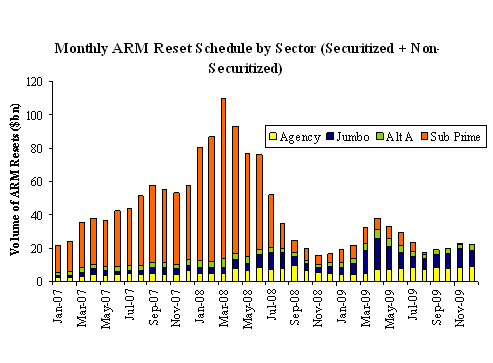
The Bail Out plan kicks in on the January 2008 resets
We should know better by now. We should know that They’re just not going to let the thing go off the rails and crash in a single, violent event. The purpose of the American Corporate State is to externalize the costs of unthinkable plunder onto the backs of people who are mostly too tired, dumb and angry to understand anything that’s happening to them. Americans, in general, are content to flush more of their children’s futures down the gurgler and thank Christ for their big screen TVs. Anyone who’s not behind the plan to save the criminal gangs on Wall Street must be with Bin Laden.
The tab, of course, is going to be paid by people who were stupid enough to manage their finances in a prudent manner. What handouts will the people who took fixed rate loan products during the bail out period get? Will they win the nanny state lotto as well?
Via: AP:
Congressional aides say the Bush administration has hammered out an agreement with industry to freeze interest rates for certain subprime mortgages for five years in an effort to combat a soaring tide of foreclosures.
These aides, who spoke on condition of anonymity because the details have not yet been released, said the five-year moratorium represented a compromise between desires by banking regulators for a longer time frame of as much as seven years and industry arguments that the freeze should only last one to two years.
Another person familiar with the matter said the rate-freeze plan would apply to borrowers with loans made at the start of 2005 through July 30 of this year with rates that are scheduled to rise between Jan. 1, 2008, and July 31, 2010.
The administration said that President Bush will speak on the agreement at the White House on Thursday and the Treasury Department announced that Treasury Secretrary Henry Paulson and Housing and Urban Development Secretary Alphonso Jackson would hold a joint news conference Thursday afternoon with officials of the mortgage industry.
Treasury also announced that there would be a technical briefing to explain more of the details of the proposal.
Paulson, who has been leading the effort to craft a plan, said on Monday that the program would only be available for owner-occupied homes — as a way to make sure that the break is not granted to real estate speculators.
The plan emerged from talks between Paulson and other banking regulators and banks, mortgage investors and consumer groups trying to address an avalanche of foreclosures that are feared as an estimated 2 million subprime mortgages reset from lower introductory rates to higher rates.
The higher rates in many cases will boost monthly payments by as much as 30 percent, making it extremely difficult for many people to keep current with their loans.
The plan is aimed at homeowners who are making payments on time at lower introductory mortgage rates but cannot afford a higher adjusted rate.
Through October, there were about 1.8 million foreclosure filings nationwide, compared with about 1.3 million in all of 2006, according to Irvine, Calif-based RealtyTrac Inc. With home loan defaults still rising, the trend is expected to worsen next year.
Goldman Sachs Shorted Toxic Waste Paper it Was Selling
December 5th, 2007This isn’t news, but it drives home the point: Hedging is key to juggling chainsaws and hand grenades.
Via: New York Times:
The point to bear in mind, as Mr. Sloan brilliantly makes clear, is that as Goldman was peddling C.M.O.’s, it was also shorting the junk on a titanic scale through index sales — showing, at least to me, how horrible a product it believed it was selling.
The Goldman Sachs spokesman said that the company routinely shorts the securities it underwrites and said that this is disclosed. He noted candidly that Goldman is much more short in this sector than usual.
Virus-Hit Island Seeks Urgent Aid
December 4th, 2007Via: BBC:
Britons living in what is described as the remotest community in the world are seeking help after the outbreak of an acute virus.
Many of the 271 British citizens living on the volcanic island of Tristan da Cunha, in the south Atlantic, have developed severe breathing problems.
They need urgent medical supplies which cannot be found on the island.
An international operation to provide urgent help is being led by the Foreign and Commonwealth Office.
BBC world affairs correspondent Mike Wooldridge said the islanders were being affected by what appears to be an outbreak of viral-inducted asthma, which causes severe breathing problems.
Tristan da Cunha’s one resident doctor, a South African, has issued an urgent appeal for medical supplies.
The South African Marine Rescue Co-ordination Centre was alerted first and informed British coastguards.
The volcanic island has no airstrip, making getting medicines there difficult.
However, merchant ships in the area are unlikely to have the necessary drugs on board and a coastguard spokesman said there were no British military vessels nearby at present.
Viruses have swept through the island before but Michael Swales, chairman of the Tristan da Cunha association, said he could not recall medicines becoming exhausted on previous occasions.
He said there was particular concern about the health of the elderly and the very young.
Isolated
Tristan da Cunha is situated 2,800 km west of Cape Town, South Africa, and is part of a small group of islands.
It was at one time on the main trading route between Europe and the Indian Ocean, but the small community living there is now extremely isolated.
The community of 275 people describe themselves as living in the world’s most isolated settlement.
The island is famous for a mass evacuation to Southampton in the 1960s after a volcano erupted.
The main island is about 38 sq miles (98 sq km) and the currency is the British pound.
Research Credit: PW
Bill Gates, Rockefeller and the GMO Giants Know Something We Don’t
December 4th, 2007I’m sure that the elite’s obsession with submarines has nothing to do with this…
* uncomfortable chuckle *
Via: Global Research:
So when Bill Gates decides through the Gates Foundation to invest some $30 million of their hard earned money in a project, it is worth looking at.
No project is more interesting at the moment than a curious project in one of the world’s most remote spots, Svalbard. Bill Gates is investing millions in a seed bank on the Barents Sea near the Arctic Ocean, some 1,100 kilometers from the North Pole. Svalbard is a barren piece of rock claimed by Norway and ceded in 1925 by international treaty (see map).
On this God-forsaken island Bill Gates is investing tens of his millions along with the Rockefeller Foundation, Monsanto Corporation, Syngenta Foundation and the Government of Norway, among others, in what is called the “doomsday seed bank.” Officially the project is named the Svalbard Global Seed Vault on the Norwegian island of Spitsbergen, part of the Svalbard island group.
Doomsday Seed Vault
The seed bank is being built inside a mountain on Spitsbergen Island near the small village of Longyearbyen. It’s almost ready for “business” according to their releases. The bank will have dual blast-proof doors with motion sensors, two airlocks, and walls of steel-reinforced concrete one meter thick. It will contain up to three million different varieties of seeds from the entire world, “so that crop diversity can be conserved for the future,” according to the Norwegian government. Seeds will be specially wrapped to exclude moisture. There will be no full-time staff, but the vault’s relative inaccessibility will facilitate monitoring any possible human activity.
Did we miss something here? Their press release stated, “so that crop diversity can be conserved for the future.” What future do the seed bank’s sponsors foresee, that would threaten the global availability of current seeds, almost all of which are already well protected in designated seed banks around the world?
Anytime Bill Gates, the Rockefeller Foundation, Monsanto and Syngenta get together on a common project, it’s worth digging a bit deeper behind the rocks on Spitsbergen. When we do we find some fascinating things.
The first notable point is who is sponsoring the doomsday seed vault. Here joining the Norwegians are, as noted, the Bill & Melinda Gates Foundation; the US agribusiness giant DuPont/Pioneer Hi-Bred, one of the world’s largest owners of patented genetically-modified (GMO) plant seeds and related agrichemicals; Syngenta, the Swiss-based major GMO seed and agrichemicals company through its Syngenta Foundation; the Rockefeller Foundation, the private group who created the “gene revolution with over $100 million of seed money since the 1970”; CGIAR, the global network created by the Rockefeller Foundation to promote its ideal of genetic purity through agriculture change.
Research Credit: PD
European Las Vegas Planned for Spanish Desert
December 4th, 2007What do people with $25 billion to invest in a development like this know about the future of the energy situation that the hardcrash blogosphere doesn’t know?
Hmm?
A lot is my guess.
Bonus points to you if you manage to read the part about the Spyland theme park without doing a double take. And never mind the themes of the casinos, all of which have profound significance in Illuminati lore. Where’s the company based that’s behind the whole show? London, of course. This is obviously just an attempt to build a family friendly venue. Good, clean fun for all.
Via: AFP:
Europe is set to get its own version of Las Vegas in a desert region of eastern Spain where developers plan to build 32 hotel-casinos, two theme parks, a racecourse and stadium over the next decade.
The project, approved last week by the regional government of Aragon, also calls for the construction of residential areas, an equestrian centre and a golf course on just over 2,000 hectares (5,000 acres) of land in the Los Monegros desert.
Tentatively called “Gran Escala,” which means large-scale, the development has a 17-billion-euro (25-billion-dollar) price tag that will be footed by International Leisure Development, a London-based consortium of investors.
The goal “is the construction of an integrated leisure city for people of all ages, the first European city with these characteristics,” a Spanish investor in the joint venture, Jaime Riera, told AFP.
Developers expect the complex will receive 25 million visitors per year when it is completed, below its maximum capacity of 35 million annual visitors.
The location — half-way between Madrid and Barcelona, Spain’s second city — was selected over two other possible sites in Europe because it has good transportation links, favourable tax laws and relatively low land prices.
Millions are being spent in the nearby city of Zaragoza to upgrade rail and air connections, and expand its small airport, in time for the 2008 World Fair which it will host.
Zaragoza is already connected to Madrid by a high-speed train that takes only 80 minutes to make the roughly 300-kilometre (185-mile) trip and by the time of the fair it will be linked by high-speed rail to Barcelona as well.
The high-speed rail links will make it easier for the millions of tourists who flock to Spain each year, making it the second most visited country in the world after France, to head to the casino city.
“The renewal of infrastructure, the fame which is coming to Aragon and the quick action of local officials all attracted this project here,” said Didier Rancher, a French entrepreneur whose company will install the two theme parks.
“It is an interesting project, we are dedicated to giving it all the necessary support and we have high hopes, we are forecasting the creation of 30,000 jobs,” said a spokesman for the government of Aragon.
The themes of the hotel-casinos will cover the sweep of history, from Pharaonic Egypt to Ancient Greece to the Roman Era and the Italian Renaissance.
The project, which will be formally presented in Zaragoza on December 12, also includes plans for a water park and a spy-themed park called Spyland based on the worldwide history of spies and secret services.
Construction of the water park and Spyland is scheduled to begin in the second half of 2008 with the whole project built in stages.
Despite the promise of more jobs for the region, not everyone is happy with the project.
“Once again we are seeing how the local government meets the needs of private developers instead of the needs of local people,” said Adolfo Barrena, a member of the opposition party Izquierda Unida or United Left.
Tourism is a major earner in Spain, with the sector accounting for some 12 percent of gross domestic product.
U.S. National Intelligence Estimate: Iran Halted Nuclear Weapons Program in 2003
December 4th, 2007“Brzezinski’s testimony indicates to me that the expansion of the conflict into Iran might not be allowed to happen. Don’t ask me how it will be stopped, but he is the mouthpiece of the people who run this show, not in appearance, but in fact.”
—Cryptogon: Zbigniew Brzezinski Before the Senate Foreign Relations Committee
That Brzezinski episode still takes the cake. The veil between worlds became thin on that one.
Via: Globe and Mail:
Despite months of sabre-rattling by U.S. President George W. Bush, America’s top spies have concluded that Tehran’s ruling mullahs may not want a finger on the nuclear trigger after all.
As recently as October, Mr. Bush was hinting at air strikes against Iran’s secretive and mostly underground nuclear sites, warning that averting World War III meant preventing Tehran from tipping its missiles with nuclear warheads.
So a key finding in yesterday’s National Intelligence Estimate, that Iran shut down its nuclear weapons program four years ago, was unexpected and may avert a showdown.
The Bush administration was quick to claim success, saying U.S.-led pressure on Tehran had pushed Iran to stop its pursuit of nuclear weapons.
…
It would be the middle of the next decade before any restarted weapons program could tip a missile with a warhead, the report adds.




