China’s Food Safety Woes Now a Global Concern
April 16th, 2007Via: MSNBC:
The list of Chinese food exports rejected at American ports reads like a chef’s nightmare: pesticide-laden pea pods, drug-laced catfish, filthy plums and crawfish contaminated with salmonella.
Yet, it took a much more obscure item, contaminated wheat gluten, to focus U.S. public attention on a very real and frightening fact: China’s chronic food safety woes are now an international concern.
In recent weeks, scores of cats and dogs in America have died of kidney failure blamed on eating pet food containing gluten from China that was tainted with melamine, a chemical used in plastics, fertilizers and flame retardants. While humans aren’t believed at risk, the incident has sharpened concerns over China’s food exports and the limited ability of U.S. inspectors to catch problem shipments.
U.S. DOLLAR BREAKDOWN CONTINUES
April 16th, 2007Guys, we’ve got a heavy equipment operator on our farm helping us with our major projects, so I’m outside today. Please review:
U.S. Dollar Index Breaches Significant Weekly Supports
and
Gold: Switch Off Your Targeting Computer
Those stories will put the breaking news into some context.
FDA Attempting to Regulate Supplements, Herbs and Juices as “Drugs”
April 14th, 2007Just have a clone burger instead.
Via: Organic Consumers:
When it comes to health freedom, this is the FDA’s end game. A new FDA “guidance” document, published on the FDA’s website, reveals plans to reclassify virtually all vitamins, supplements, herbs and even vegetable juices as FDA-regulated drugs. Massage oils and massage rocks will be classified as “medical devices” and require FDA approval. The document is called Docket No. 2006D-0480. Draft Guidance for Industry on Complementary and Alternative Medicine Products and Their Regulation by the Food and Drug Administration.
How Did a Strawberry Picker Earning $15,000 a Year Qualify for a Loan of $720,000?
April 14th, 2007There is no way to know how weird this is going to get.
Via: sfgate:
“We wanted to live in Watsonville,” says Rosa. “But [the real estate agent] said the houses there were older and more expensive.” One of the first homes they were shown was a “new” four-bedroom, two-bath house in Hollister for $720,000. When the Ramirez’s heard the price, they worried that they couldn’t afford it.
But the couple says they were assured them it was possible. “The monthly payment was supposed to be $4,800, but then after we bought it, it went up to $5,378,” says Rosa, speaking of their zero-down mortgage with a one-month “teaser rate.” “Our agent told us that once we refinanced, we could get the payments down to $3,000 or less.” For a number of months Avila, who arranged for the loan with New Century Mortgage, paid the difference between what the buyers had said they could afford — $3,000 — and the actual loan payment. According to the buyers, this arrangement was supposed to carry them over until the group refinanced.
The money-saving refinance failed to materialize, and eventually, Avila stopped subsidizing their current mortgage. (According to my analysis of interest rates during the period, hitting the $3,000 number would have been virtually impossible under any circumstances. An interest-only $720,000 loan at a 5 percent interest rate [15-year fixed] yields a $3,000 mortgage, but such mortgage rates weren’t available to anyone, much less a laborer with low income, no down payment and no other assets. Plus, that doesn’t count another $750 a month in taxes and insurance.) The two families continued to make the payments, sometimes sacrificing basic necessities, other times borrowing more. “It was very difficult,” Rosa says. “Sometimes we would eat less, and we took out personal loans from Bank of America.”
MI5 Trains Supermarket Checkout Staff
April 14th, 2007Via: The Independent:
Supermarket checkout staff are being trained by the security services in how to detect potential terrorists. MI5 has been secretly advising food retailers, including Asda and Tesco, on how to identify extremist shoppers.
Measures include increasing CCTV in underground carparks to prevent bomb attacks and being alert to mass purchases of mobile phones, which can be used as bomb detonators. The awareness training for staff also covers bulk sales of toiletries which could be used as the basic ingredient in explosives.
Research Credit: RB
U.S. Dollar Index Breaches Significant Weekly Supports
April 14th, 2007Yesterday, in Gold: Switch Off Your Targeting Computer, I wrote:
The U.S. dollar has been clobbered and may be technically oversold. While the U.S. dollar is in a descending triangle pattern now (bearish), it has also formed a creepy double bottom on weekly charts (bullish). So, what is it: a double bottom, or a descending triangle?
Let me consult my Magic 8 Ball…
My best guess is that this is not a bottoming formation on the dollar, and that the downtrend will continue. Why? The subprime mortgage paper apocalypse is spreading to “lower†risk paper in the Alt-A liar loan category. That might be bullish for the dollar is some weird Plunge Protection Team kind of way, but I doubt it otherwise. I wouldn’t be surprised if we see a fakeout bounce on the dollar before the long red candles start bleeding down computer screens everywhere.
Technically, it hadn’t formed a weekly double bottom when I wrote that. It just looked like it was going to.
Well, it didn’t. As the day finished out, rather than a bounce, we wound up breaching the weekly range and close supports.
I haven’t bothered you guys with charts before, but this one is worth examining. This is a weekly U.S. Dollar Index chart. The last red bar on the right is yesterday’s close.
I drew shaded circles to indicate the the critical support levels. The thick black line is the weekly close support level. The thin blue line is the weekly range support level. The dotted blue line is Friday’s close.
That’s a definite breach of the weekly range and close support levels.
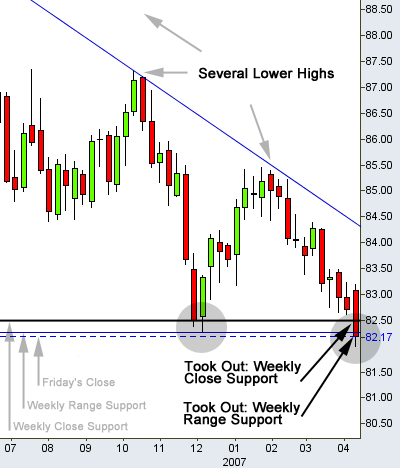
Weekly USD Index with Decending Triangle and Supports Taken Out
Ok, what does this mean?
I’m not trying to make traders out of you guys, or frighten anyone, but there is a good chance that we are about to lose cabin pressure on the U.S. Dollar.
Note the trendline following the lower highs downward? As that line approaches the support line underneath, think of the situation as building pressure. (Read more about descending triangles.)
I have seen several of these setups breach supports and then bounce, but I have more often seen this result in a strong and sustained move down.
I said previously that I wasn’t going to put exact numbers on this because of all the shakeouts that occur at times like this: but what the Hell, why not? If support/manipulation to the upside is going to occur, look for it as soon as Monday. If a situation like this isn’t followed up by strong buying, and soon, traders will interpret it as bearish and they will lean on it hard.
If it bounces, there will be no way to know if it is real. Only a lunatic, or someone who knows the future, would chase a rally on this thing long. If it rallies, it’s probably a fake out move to squeeze shorts out before the bottom falls out. I’d short any pop up to about 83, stop limit 83.17.
But, if there is downside follow through, the next two key support levels to watch for are 81.43 and the last chance holdout, 80.85, where several countries might try to circle the wagons. 80.85: That’s the (weekly) low, set back in December of 2004. Beijing and Tokyo (or someone, read on) MUST pour the support on here, or the sharks will smell blood in the water.
The perfect storm has been gathering strength for years; out of sight and out of mind for most people. We might be seeing the combined effects of real estate, oil and the intertwined federal deficit/national debt crisis.
If Beijing and Tokyo do not intervene here, the veil between worlds could become thin… Again.
In 2004, private banking clients in the Caribbean and London suddenly began buying billions of dollars worth of U.S. debt when the Asians threw in the towel and the bids dried up at the Fed’s bond auctions. Look at the U.S. Dollar Index for that period. Yes, that’s right. That 80.85 support level I mentioned above was established in 2004, after months of sustained selling. It’s nice to get a little help from your anonymous, private banking friends with billions of dollars to spend on U.S. funny money debt paper.
Well, here we are again. Is it going to be black ops banking and private accounts in the Caribbean that prop this pig up for another few weeks or months?
I certainly don’t know.
This is just a warning with a bit of context. Whatever happens, don’t get caught by surprise. Use this time to review your contingency plans and maintain a heightened state of vigilance over the next week or so.
London Police Radio Announcement Tells People to Report Anything or Anyone Suspicious to Counter Terror Hotline
April 13th, 2007I just learned of an almost unbelievable radio ad campaign that has been running in and around London. This sounds like a British version of the, Inoffizielle Mitarbeiter, or the Unofficial Collaborators, of the infamous East German Stasi.
Listen for yourself (mp3 hosted on Cryptogon). And don’t miss the insightful posters if you click through to the source material!
Via: London-Metropolitan Police:
Female Voice over:
How do you tell the difference between someone just video-ing crowded place and someone who’s checking it out for a terrorist attack?
How can you tell if someone’s buying unusual quantities of stuff for a good reason or if they’re planning to make a bomb?
What’s the difference between someone just hanging around and someone behaving suspiciously?
How can you tell if they’re a normal everyday person, or a terrorist?
Male voice over:
The answer is, you don’t have to.
If you call the confidential Anti-Terrorist Hotline on 0800 789 321, the specialist officers you speak to will analyze the information. They’ll decide if and how to follow it up.
You don’t have to be sure. If you suspect it, report it.
Call the Anti-Terrorist Hotline on 0800 789 321 in confidence.
More: Help Us Spot Terrorists – Police
More: We Can’t Go On Together
Research Credit: HT
Gold Breaks Above 680
April 13th, 2007WARNING: This is not a recommendation to buy sell or hold any financial instrument.
Key resistance.
HOME PRICES MAY FALL 20% AMID BAD LOANS
April 13th, 2007A quick passage from my Wall Street Chop Shop story is in order here:
The firm externalized the financial risks of being in this business by selling all of the paper they generated into the secondary mortgage market at the end of every month. This is an institutional marketplace that trades in commoditized mortgages, “debt paper.” In other words, at the end of each month, the firm had none of the impossible-to-payback-negative-amortization-no-money-down loans on their books!
Now, note the part below in bold and keep this in mind: It wasn’t just hedge funds and mutual funds who were buying this crap. How do I know? When I was working for that paper mill, I simply asked a person in Secondary Marketing, “Who buys this stuff?”
Think big, household name banks.
Via: Bloomberg:
Kenneth Heebner, manager of the top-performing real-estate fund over the past decade, said U.S. home prices may plunge as much as 20 percent because of rising defaults on riskier mortgages.
Subprime loans, made to borrowers with a history of missed payments or untested credit, and “Alt-A” loans, which require little or no documentation, account for about $2.5 trillion of the $10 trillion in outstanding mortgages, according to Moody’s Economy.com. As much as 40 percent of these loans may default, flooding the real estate market, Heebner said.
“It will be the biggest housing-price decline since the Great Depression,” Heebner, 66, said today in an interview in Boston. Prices may fall by a fifth in some markets, he said.
…
Fallout from subprime-loan defaults will also hit hedge funds, and to a lesser extent, mutual funds, that bought collateralized debt obligations and other securities backed by such mortgages, Heebner said. The investment banks and brokerage firms that package and sell these products won’t get hurt because they have passed on the biggest risks to the investors, Heebner said.
“They know the product is toxic; they’re not going to get caught,” Heebner said.
China’s Foreign Reserves Rise Past $1.2 Trillion
April 13th, 2007Any guesses on what that U.S. trade deficit number is going to show in a few hours…
Via: Forbes / AP:
China’s foreign reserves, already the world’s largest, have risen past $1.2 trillion, a state news agency said Thursday, amid surging trade and plans to create a multibillion-dollar company to invest some of the stockpile.
The figure, as of the end of March, represented a 37.4 percent rise over the same period last year, the Xinhua News Agency said, citing the central bank.
China’s reserves have risen rapidly as huge trade surpluses and foreign investment force Beijing to drain billions of dollars from the economy every month through bond sales to hold down pressure for prices to rise. The money is stockpiled in U.S. Treasury bonds and other foreign assets.
The government announced last month it will create a multibillion-dollar company to invest a portion of the reserves in hopes of making more profitable use of the money.