The Future Of School Safety Includes Round-The-Clock Surveillance Of Students
June 7th, 2019Via: TechDirt:
To go to school is to be surveilled, on campus and off. The average school hosts a number of cameras, and the average school administration is always looking for more ways to keep tabs on students, even after they’ve gone home.
The move towards pervasive surveillance of off-campus activities is generally justified with the meaningless assertion that if it stops one person from shooting up a school (or just shooting themselves), it’s all worth it. Two articles based on public records requests — both written by Benjamin Herold of Education Week — show there’s a surveillance state being built one school district at a time. (h/t Amelia Vance)
Documents obtained by Education Week via open-records requests show that over the past year, state agencies have discussed the possibility of sharing a breathtaking amount of data. That included more than 2.5 million records related to Floridians who received involuntary psychiatric examinations, records for over 9 million people placed in foster care, diagnosis and treatment records for substance abusers, unverified criminal reports of suspicious activity, reports on students who were bullied and harassed because of their race or sexual orientation, and more.
This database is currently on hold as education officials try to figure out how much of this incredibly sensitive info they can share with other agencies, much less collect in the first place. But once these details are ironed out, the rollout will continue, urged along by Governor Ron DeSantis, who has publicly expressed his frustration that schools aren’t placing students under round-the-clock surveillance quickly enough.
Citizen Cattle
June 7th, 2019Via: Ben Garrison:

Americans May Be Ingesting Thousands of Microplastics Every Year
June 7th, 2019Via: Smithsonian Magazine:
Microplastics are everywhere in our environment: oceans, soils, the air, the bodies of animals. It’s hardly surprising, then, that the tiny fragments have also been found in humans. But a new study is shining troubling light on the quantity of microplastics Americans are consuming each year—as many as 121,000 particles, per a conservative estimate.
Trails Made by Starlink Satellites
June 7th, 2019“Please note that the density of these satellites is significantly higher in the days after launch (as seen here) and also that the satellites will diminish in brightness as they reach their final orbital altitude.”
I would have added:
Please note that this is from 25 of the first batch of 60 satellites of a constellation that will eventually include approximately 12,000 satellites!
Also note that Starlink is only one of three (possibly five) low earth orbit satellite Interet provider constellations that are planned:
1) Starlink (Satellites already in orbit, target constellation size: 12,000)
2) OneWeb (Satellites already in orbit, target constellation size: 1972)
3) Amazon Project Kuiper (Planning, target constellation size: 3,236)
Others:
Via: International Astronomical Union:
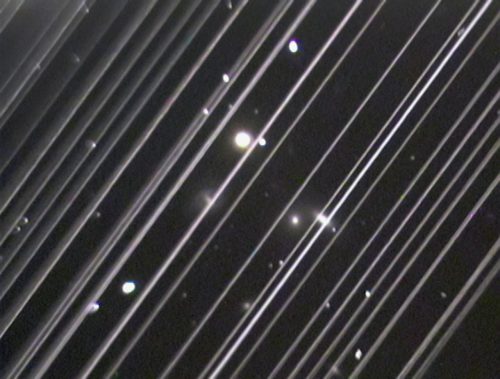
An image of the NGC 5353/4 galaxy group made with a telescope at Lowell Observatory in Arizona, USA on the night of Saturday 25 May 2019. The diagonal lines running across the image are trails of reflected light left by more than 25 of the 60 recently launched Starlink satellites as they passed through the telescope’s field of view.
Although this image serves as an illustration of the impact of reflections from satellite constellations, please note that the density of these satellites is significantly higher in the days after launch (as seen here) and also that the satellites will diminish in brightness as they reach their final orbital altitude.
Celera 500L Aircraft
June 7th, 2019Via: The Drive:
More than two years after The War Zone was first to report on a mysterious bullet-shaped aircraft appearing at the Southern California Logistics Airport near Victorville, a refined version of the plane has conducted taxi tests and looks to be getting close to its first flight. Even though much about its design and purpose remain unclear, we do know now that the aircraft, which is called the Otto Aviation Celera 500L, is definitely focused on potentially game-changing high-efficiency flight that has the potential to disrupt the aerospace marketplace.
NASA to Let Tourists, Film Crews Into International Space Station
June 7th, 2019Via: Independent:
Nasa will allow tourists to live inside the International Space Station.
The space agency plans to open the floating lab up to private astronauts as well as commercial companies, it said. That could include film crews, for instance, who could be allowed to make ads or whole films in space.
The first space tourists could head up to the ISS in 2020, Nasa said.
The plans allow private companies to lease out time on Nasa’s part of the International Space Station. They will also be able to borrow its own astronauts for their commercial work, and take their technologies to the floating lab – though they are expected to pay heavy prices for the opportunity.
Nasa has long been resistant to the idea of commercialising its operations, including the ISS. Previously, anything that was taken up to the ISS needed to have an educational or research component.
Toyota and Subaru Partner to Make All-Electric SUVs Together
June 6th, 2019Via: Electrek:
Toyota and Subaru, which is partly owned by the latter, have announced that they are partnering to develop a new electric platform in order to launch a couple of all-electric SUVs under each brand.
The two Japanese automakers have been increasingly collaborating over the past decade, including on some hybrid vehicle projects.
Both companies are also viewed as laggers in the all-electric space since neither have a fully-electronic option available to date.
Now they are announcing a partnership to help close that electric gap.
Related: Toyota Speeds Up Electrified Vehicle Schedule
GE Bet on Fossil Fuels, Lost Nearly $200B in Misjudging Renewable Energy Transition
June 6th, 2019
Via: Electrek:
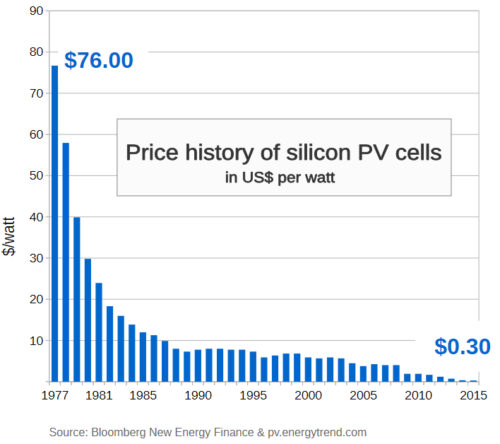
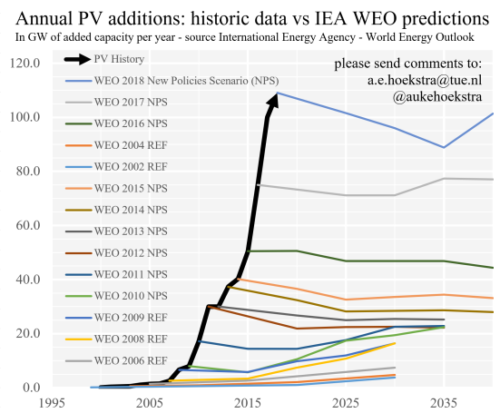
General Electric’s profitability collapse over the past few years can be largely attributed to the company’s inability to judge the accelerating pace of the global energy transition away from fossil fuels and toward renewables, a new study claims.
The analysis comes from the Institute for Energy Economics and Financial Analysis (IEEFA), which says that “GE made a massive bet on the future of natural gas and thermal coal, and lost,” concluding:
GE destroyed an almost unprecedented US$193 billion (bn)1 or 74% of its market capitalization over 2016-2018.
IEEFA acknowledges a number of “other management missteps,” but claims that “this value destruction was driven in large measure by the collapse of the new thermal power construction market globally—a collapse which caught GE entirely by surprise.”
Project Kuiper Initiative: Amazon Will Spend Billions to Build Satellite Internet Service
June 6th, 2019Via: Bloomberg:
Amazon.com Inc. plans to spend billions of dollars building a network of thousands of satellites to provide broadband internet service, Chief Executive Officer Jeff Bezos said.
The Project Kuiper initiative, disclosed earlier this year, is the type of big bet the company needs to keep making as its massive scale renders smaller endeavors less meaningful, Bezos said Thursday at Amazon’s re:MARS conference in Las Vegas.
The project, he said, is “a very good business for Amazon” because it requires a big capital expenditure, Bezos said. “It’s multiple billions of dollars of capex. Amazon is a large enough company now that we need to be doing things that, if they work, can actually move the needle.”
A Glass Battery That Keeps Getting Better?
June 6th, 2019As usual, never hold your breath waiting for disruptive battery technology to transition from the lab to a product that you can buy.
But this is a weird one…
Via: IEEE:
Is there such a thing as a battery whose capacity to store energy increases with age? One respected team of researchers say they have developed just such a technology. Controversy surrounds their claims, however, in part because thermodynamics might seem to demand that a battery only deteriorates over many charge-discharge cycles.
The researchers have a response for that critique and continue to publish peer-reviewed papers about this work. If such claims came from almost any other lab, they might be ignored and shunned by the broader community of battery researchers, the same way physicists turn their noses up at anything that smacks of a perpetual motion machine.
But this lab belongs to one of the most celebrated battery pioneers today—and one of the inventors of the lithium-ion battery itself. John Goodenough, who at 96 continues to research and publish like scientists one-third his age, last year joined with three co-authors in publishing a paper that grabbed headlines. (Spectrum had profiled him and his battery technology the year before, following an initial announcement about his group’s new glass battery.)
Goodenough and collaborators claimed they’d developed a non-flammable lithium battery (whose electrolyte was based on a glass powder) that had twice the energy density of traditional lithium-ion batteries. They also published a graph that showed an increase in capacity over more than 300 charge-discharge cycles. (This increase, however, pales in comparison to the cell’s at least 23,000-cycle lifespan.)




